Concepts stand in various relations to one another. Between any two concepts one of the following relations holds:
equivalence, intersection, subordination, exclusion.
- Two concepts are considered equivalent if their extensions completely coincide (for example, «Kyiv» and «the capital of Ukraine»).
- Two concepts are in a relation of intersection if their extensions partially coincide (for example, «scientist» and «businessman»).
- Concepts are in a relation of exclusion if their extensions completely exclude one another (for example, «profitable enterprise» and «loss-making enterprise»).
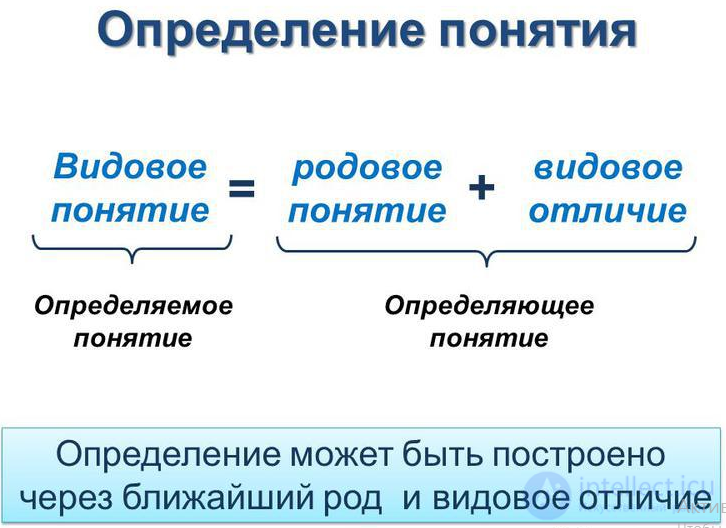
- Two concepts are in a relation of subordination if the extension of one of them is entirely contained within the extension of the other (for example, «investor» and «portfolio investor»). Here the concept that is broader in extension is called the subordinating concept, while the concept with the smaller extension is called the subordinate concept. If two concepts stand in a relation of subordination, the subordinating concept is called generic (a genus), and the subordinate concept is called specific (a species).
If A is the genus and B is the species, then B is a particular case of A. This is somewhat reminiscent of the classification of animals and plants (family –
genus – species); however, there is an important difference here: one and the same concept can be simultaneously both a genus and a species – a genus in relation to a concept with a narrower extension, and a species in relation to a concept with a broader extension. For example, the concept «transaction» is generic in
relation to the concept «barter transaction» and specific in relation to the concept «business operation».
- Generic concept – whichever of two concepts standing in a relation of subordination has the larger extension.
- Specific concept – whichever of two concepts standing in a relation of subordination has the smaller extension. The transition from a specific concept to a generic one, and vice versa, is carried out through the operations of generalisation and limitation.
- Generalisation – is a logical operation by which the extension of a concept is broadened through a reduction of its content. Through generalisation a specific concept loses a distinguishing feature and turns into a generic one. The limit of generalisation is a category.
- Limitation – is a logical operation by which the extension of a concept is narrowed through an increase in the complexity of its content. Whereas generalisation of concepts moves from species to genus, limitation, conversely, derives a specific concept from a generic one. Limitation is achieved by adding to the content of a generic concept a new, distinguishing feature, the presence of which narrows its extension and produces a specific concept. The limit of limitation is a concrete object.
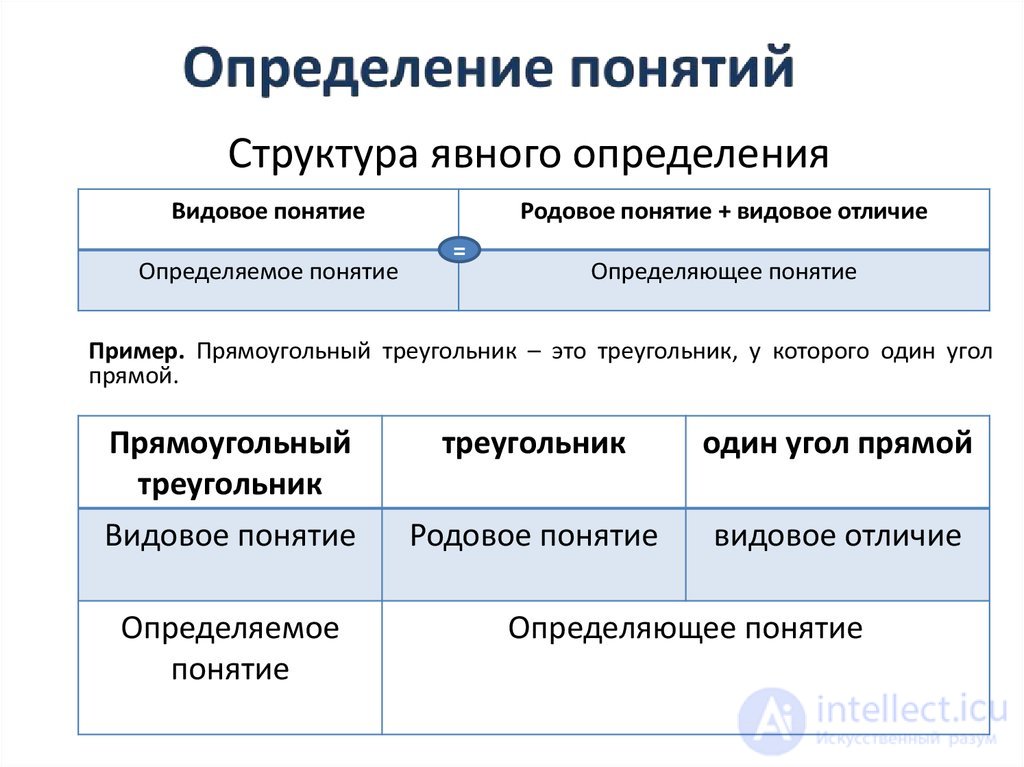
For example, if we exclude the specific features from the concept «joint-stock company» (including the feature «the company is formed through the issue and placement of shares»), we arrive at the generic concept «business association». If, conversely, we introduce such
an additional feature as «public subscription for shares», we arrive at the specific concept «open joint-stock company».
See also
See also


Comments