
Lecture
The success of a piece of scientific work depends to the greatest extent on the degree candidate's ability to choose the most effective research methods, since it is precisely these methods that make it possible to achieve the goal set for the work.
Scientific knowledge includes two interrelated levels — empirical and theoretical. The empirical level is concerned with the direct study of reality by means of observation, experiment, measurement, and description of the facts obtained. At this stage the researcher collects and systematizes specific data and identifies recurring phenomena and relationships. The theoretical level is aimed at a deeper explanation of the processes under study: here scientific concepts, laws, hypotheses, and theories are formulated, and general regularities are established. Thus, the empirical level answers mainly the question "what is happening?", while the theoretical level answers "why and how is it happening?"; at the same time, both levels complement each other and form a unified system of scientific knowledge.
The empirical level of scientific knowledge is the level of direct study of objects and phenomena of reality, at which the researcher obtains and systematizes specific facts. The main research operations here are observation of objects, which makes it possible to purposefully study their properties and changes; recording of facts by means of notes, measurements, descriptions, and other ways of preserving the information obtained; carrying out experiments, during which special conditions are created to test the properties and behaviour of the objects under study; and also establishing empirical relationships and connections between individual phenomena. Thus, the empirical level ensures the accumulation of reliable factual material, which is subsequently used to form hypotheses, identify regularities, and build scientific theories.
The specificity of empirical knowledge lies in the fact that it is formed on the basis of the researcher's direct interaction with the object and, above all, reflects its external connections, properties, and manifestations, accessible to observation and experimental verification. Empirical knowledge makes it possible to establish facts, describe recurring phenomena, and identify stable connections between them; however, it has a limited scope of application, since the results obtained relate mainly to the specific objects, conditions, and situations in which the research was conducted. Therefore, empirical data are important as a basis for scientific knowledge, but revealing underlying causes and general regularities requires further theoretical reflection.
Method (from the Greek methodas – research) is a way of investigating phenomena that determines the approach to the phenomena under study, a systematic path of scientific knowledge, and the establishment of truth.
Research employs general (general-scientific) and special (specific-scientific) methods (Fig. 2.2). In addition, there is a universal philosophical method of cognition that determines the main paths of any scientific research. The philosophical method itself is not part of the content of the technical sciences, since it is a component of another special form of social cognition – philosophy – but general (general-scientific) research methods are formed on its basis.
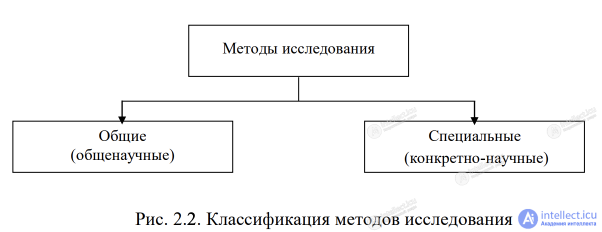
Fig. 2.2. Classification of research methods
The set of general-scientific research methods can be represented in the form of a tree-like classification, given in fragments in Figs. 2.3–2.5.
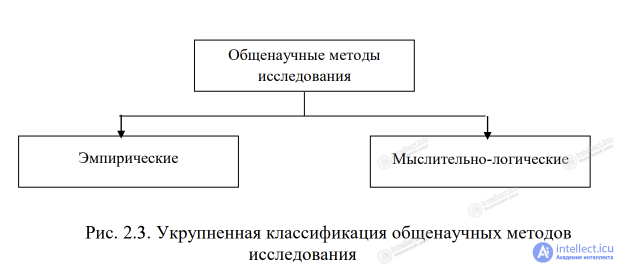
Fig. 2.3. Aggregated classification of general-scientific research methods
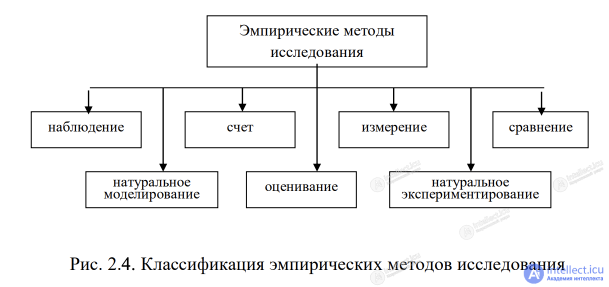
Fig. 2.4. Classification of empirical research methods
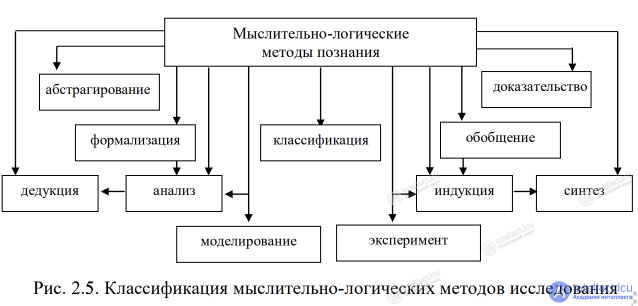
Fig. 2.5. Classification of mental-logical research methods
General-scientific methods of scientific knowledge are, unlike special methods, used throughout the entire research process and in sciences of the most varied subject matter, in both theoretical and empirical research.
General methods of scientific knowledge are usually divided into two or three large groups:
If the general methods of scientific knowledge are divided into three large groups, it is done as follows:
1) methods of empirical research (observation, comparison, measurement, experiment);
2) methods used both at the empirical and at the theoretical level of research (abstraction, analysis and synthesis, induction and deduction, modelling, etc.);
3) methods of theoretical research (ascent from the abstract to the concrete, etc.).
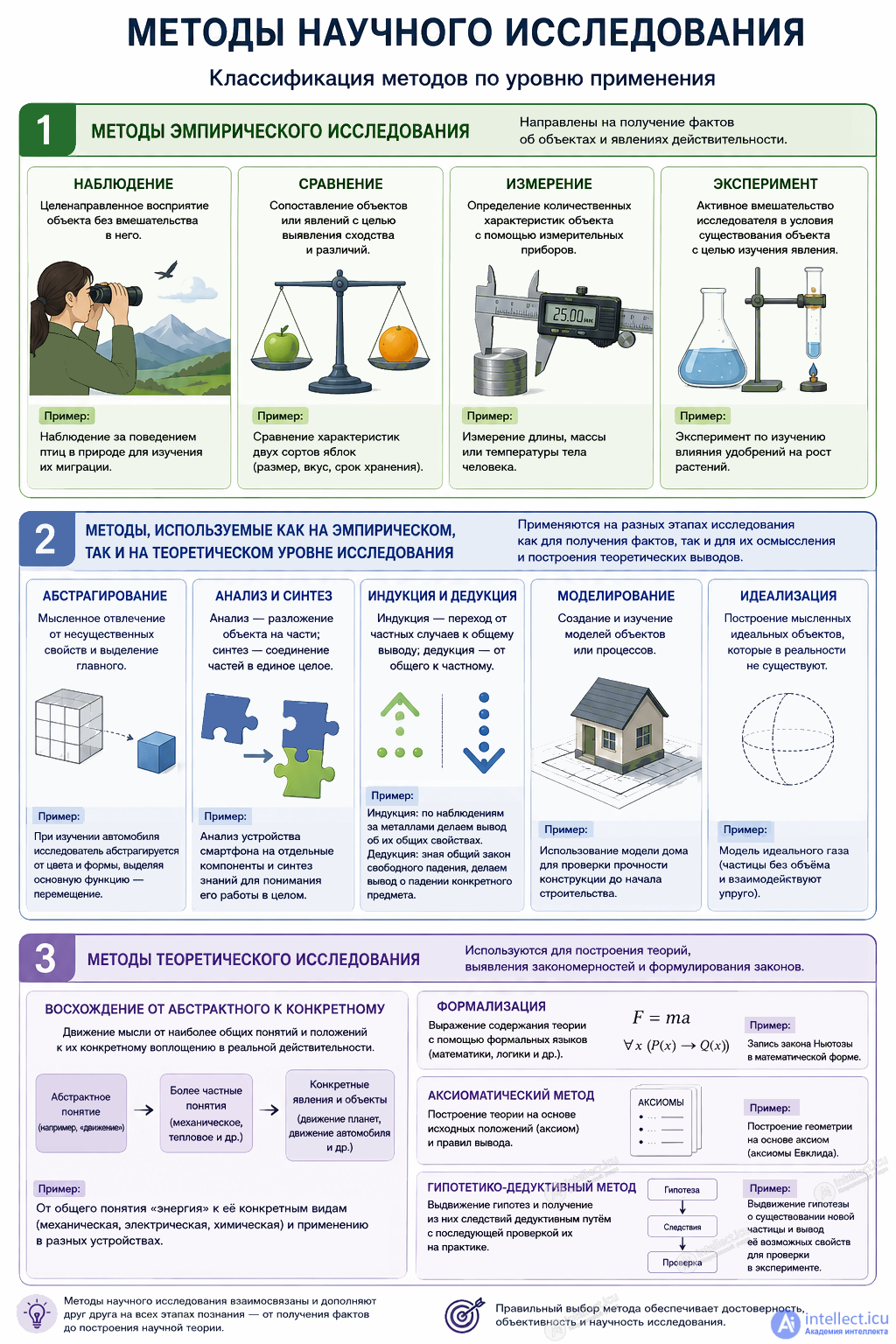
Observation - a method of studying a subject by means of its quantitative measurement and qualitative characterization. Observation is an active cognitive process based, above all, on the work of a person's sense organs and their practical material activity. This is the most elementary method, usually acting as one of the elements within other empirical methods. In everyday activity and in science, observations must lead to results that do not depend on the will, feelings, and desires of the subjects. To become the basis for subsequent theoretical and practical actions, these observations must provide information about the objective properties and relations of really existing objects and phenomena.
To be a fruitful method of cognition, observation must satisfy a number of requirements, the most important of which are:
Observation, as a means of cognition, provides primary information about the world in the form of a set of empirical statements.
Observation — is a purposeful and systematic study of an object without the researcher actively intervening in the processes taking place. Its advantages are the naturalness of the processes studied, the possibility of investigating phenomena directly under real conditions, and the absence of any need to alter the object of research. However, observation also has drawbacks: the researcher cannot always control the conditions of what is happening, some phenomena cannot be observed directly, and the results may depend on the observer's subjectivity. Moreover, observation makes it possible mainly to establish what is happening and how, but does not always make it possible to reliably determine the causes of the phenomenon observed.
Comparison - one of the most widespread methods of cognition. It is not for nothing that it is said "everything is known through comparison". Comparison makes it possible to establish the similarity and difference of objects and phenomena of reality. As a result of comparison, what is common to two or several objects is established, and identifying what is common and recurring in phenomena is, as is well known, a step on the way to the knowledge of regularities and laws.
For comparison to be fruitful, it must satisfy two basic requirements:
With the help of comparison, information about an object can be obtained in two different ways. First, it can appear as a direct result of comparison. Second, very often obtaining primary information is not the main purpose of comparison; that purpose is obtaining secondary or derived information, which is the result of processing primary data. The most widespread and most important way of carrying out such processing is inference by analogy.
Types of comparative methods.
Depending on the aims of the research, several types of comparison are distinguished: simple comparison, in which the common and distinguishing features of objects are established; structural comparison, which makes it possible to compare the composition and structure of the objects under study; functional comparison, aimed at identifying similarities and differences in functions and modes of action; historical comparison, in which phenomena are compared across different periods of their development; and also typological comparison, which makes it possible to group objects together according to essential common features. The comparative method helps to systematize scientific facts, establish stable connections, and identify the peculiarities of the objects under study.
A shortcoming of the comparative method is the inability, when using it, to control the truly "independent" variables of the object under study, given the possible influence, through unknown means, of these variables on significant indicators presumed to be in a direct causal or concomitant relationship.
Measurement unlike comparison, is a more precise cognitive tool, being a procedure for determining the numerical value of a certain quantity by means of a unit of measurement. The value of this procedure lies in the fact that it provides precise, quantitatively defined information about the surrounding reality.
The most important indicator of the quality of measurement and of its scientific value is accuracy, which depends on the diligence of the scientist and on the methods used, but chiefly on the measuring instruments available.
Measurement makes it possible not only to describe an object qualitatively, but also to obtain its quantitative characteristics, such as length, mass, temperature, time, or speed. The main elements of measurement are the object of measurement, the quantity being measured, the unit of measurement, the measuring instrument, and the researcher carrying out the procedure. An important concept is measurement error — the deviation of the value obtained from the true value of the quantity or from the value taken as the reference standard. Error can arise from the limited accuracy of the instrument, the conditions under which the measurement is carried out, or the peculiarities of the method itself; therefore, the results of measurements should always be assessed taking into account their accuracy and possible error.
A particular case of observation is experiment (from Latin experimentum – trial, test), i.e. a method that involves intervening in the natural conditions of existence of objects and phenomena, or reproducing certain aspects of objects and phenomena under specially created conditions, in order to test the results of theoretical research. It is carried out under precisely controlled conditions that make it possible to follow the course of the phenomenon and reproduce it repeatedly under given conditions.
Experimental study of objects has a number of advantages compared with observation:
1) in the course of an experiment it becomes possible to study a given phenomenon in "pure form";
2) experiment makes it possible to investigate the properties of real objects under extreme conditions;
3) the most important merit of experiment is its repeatability.
Unlike simple observation, experiment makes it possible not only to record the phenomena taking place, but also to test hypotheses, establish cause-and-effect relationships, and repeat the study under identical conditions. The main stages of an experiment are: formulating the problem and defining the aim of the research; putting forward a hypothesis; planning and preparing the experiment; determining the conditions, objects, and methods of research; carrying out the experiment and recording the results obtained; processing and analysing the data; testing the hypothesis and formulating conclusions. Thus, experiment is one of the most effective ways of obtaining reliable scientific knowledge.
Experimentum crucis (a decisive trial; literally "a trial by cross," as a metaphor for the medieval ritual of detecting evil spirits; sometimes also called a "critical experiment") — an experiment whose outcome unambiguously determines whether a particular theory or hypothesis is correct. This experiment must yield a predicted result that cannot be derived from other, generally accepted hypotheses and theories. The term "experimentum crucis" was introduced by Francis Bacon. Karl Popper considered the presence of an "experimentum crucis" to be a criterion of the reliability of scientific knowledge.
Conducting such an experiment is considered a necessary condition for a particular hypothesis or theory to be accepted into the generally recognized body of scientific knowledge. In the history of science there are not infrequent cases in which a theory is developed in full before a critical experiment is conducted. A theory that is consistent with already known experiments but has not yet undergone its critical experiment is usually considered worthy of further investigation — in search of an opportunity for experimental verification.
For the twentieth century, a famous example of experimentum crucis was the expedition to the island of Principe off the coast of Africa, undertaken in 1919 by Arthur Eddington to measure the positions of stars located close to the Sun during a solar eclipse. The observations of the stars' positions confirmed the existence of gravitational lensing predicted by Albert Einstein in the general theory of relativity published in 1915. Eddington's observations became the first solid confirmation of Einstein's theory.
In some cases, a proposed theory may rely on previously obtained experimental results, if no existing theory can explain them. An example is the ability of the quantum hypothesis, proposed in 1900 by Max Planck, to explain the observed spectrum of a blackbody — an experimental result that diverges from the predictions of the classical Rayleigh–Jeans law. However, such cases are not considered sufficiently strong evidence for the final acceptance of a new theory. In the example of quantum mechanics, its full acceptance required successful confirmation of the theory by new predictions that came true, such as the discovery of the positron or experiments on electron diffraction.
Popper's student Imre Lakatos argued that the concept of experimentum crucis is mistaken and that disagreements between theories cannot be resolved by means of experiments, which can only incline the scientific community toward choosing one scientific theory or another.
Any experiment can be carried out either directly with the object, or with a "substitute" for that object in cognition – a model.
Modelling is a method of studying objects by means of models, which makes it possible to obtain knowledge with the help of substitutes (models) for real objects. A model is a mental or materially realized system that replaces another system with which it stands in a relation of similarity. The model replaces the object of study and has certain properties in common with the object under study. Material models are made of physical materials. The modelling method makes it possible to obtain information about various properties of the phenomena under study on the basis of experiments with models.
There are several types of material models:
Modelling - a method of scientific knowledge based on replacing the object or phenomenon under study with its analogue, a model containing the essential features of the original. In economic research, economic-mathematical modelling is widely used, in which the model and its original are described by identical equations and are studied with the use of computers, for example, freight transport routes.
The use of models makes it possible to apply the experimental research method to objects that are difficult or even impossible to operate with directly. That is why modelling is a special method and is widely used in science.
These methods are usually taken to include
Let us now consider the mental-logical methods used at both the empirical and theoretical levels of research, which are usually taken to include abstraction, analysis and synthesis, induction and deduction, etc.
Abstraction (from Latin abstraherh – to draw away) is a method of mental detachment that makes it possible to move from the non-essential properties, connections, and relations of specific objects to general concepts and laws of development. Abstraction has a universal character in mental activity, since every step of thought is connected with this process or with the use of its result. It is applied, for example, in economic research for long-term planning, when the development of an industry or region for the coming period is forecast on the basis of a study of the operation of enterprises over the past period.
A distinction is drawn between the process of abstraction and the result of abstraction, called an abstraction. Usually, by the result of abstraction is meant knowledge of certain aspects of objects. The process of abstraction is the set of operations leading to the obtaining of such a result (an abstraction). Examples of abstractions include the countless concepts a person operates with, not only in science but also in everyday life: tree, house, road, liquid, and so on.
The process of abstraction, within the system of logical thinking, is closely connected with other research methods and, above all, with analysis and synthesis.
Analysis - a research method that involves studying a subject by mentally or practically breaking it down into its constituent parts (the parts of the object, its features, properties, relations). Each of the parts identified is analysed separately within the framework of the whole; for example, an analysis of a port's productivity is carried out for the enterprise as a whole and for each of its divisions. One type of analysis frequently used is systems analysis.
Systems analysis is the study of the object of research as a set of elements forming a system. In scientific research it involves assessing the behaviour of the object as a system, together with all the factors affecting its functioning. This method is widely used in research involving the comprehensive study of the activities of production associations and of an industry as a whole, the determination of proportions in the development of the national economy, and so on.
Synthesis (from Greek synthesis – connection, combination, composition) is a method of studying an object in its integrity, in the unity and mutual connection of its parts. In the process of scientific research, synthesis is connected with analysis, since it makes it possible to combine the parts of a subject broken down in the process of analysis, establish their connection, and understand the subject as a single whole (labour productivity for a production association as a whole).
The methods of analysis and synthesis are organically connected with one another in scientific creativity and can take various forms depending on the properties of the object under study and the aim of the research. Depending on the degree of knowledge of the object, and on the depth of penetration into its essence, various kinds of analysis and synthesis are applied.
- direct, or empirical, analysis and synthesis is applied at the stage of superficial familiarization with the object. This involves identifying the individual parts of the object, detecting its properties, taking the simplest measurements, and recording what is directly given, lying on the surface of the general. This type of analysis and synthesis makes it possible to know the phenomenon, but is insufficient for penetrating into its essence.
- return, or elementary-theoretical, analysis and synthesis is widely used as a powerful tool for reaching aspects of the essence of the phenomenon under study. Here the operations of analysis and synthesis are not carried out mechanically. They are based on certain theoretical considerations, which may take the form of an assumption about a cause-and-effect connection between various phenomena, or about the operation of some regularity.
- structural-genetic analysis and synthesis, which makes it possible to penetrate most deeply into the essence of the object. This type of analysis and synthesis requires isolating, within a complex phenomenon, those elements, those links, that represent the most central, most essential thing within them, their "cell," which exerts a decisive influence on all the other aspects of the object's essence.
Induction - (from Latin inductio – leading in, inducement) - a research method in which a general conclusion about the characteristics of a set of elements is drawn on the basis of studying these characteristics in part of the elements of that set. Thus, the factors negatively affecting labour productivity are studied for each individual enterprise, and are then generalized as a whole for the association comprising these enterprises as production units.
Deduction (from Latin deductio – derivation) is a method of logical inference from the general to the particular, i.e. the state of an object as a whole is examined first, and then its constituent elements. Applied to the previous example, labour productivity is first analysed for the association as a whole, and then for its individual production units. For studying complex, developing objects, the historical method is used. It is used only where, in one way or another, the object's history becomes the subject of the research.
Analogy - is a method of scientific inference by means of which knowledge of some objects and phenomena is achieved on the basis of their similarity to others. It is based on the similarity of certain aspects of various objects and phenomena; for example, labour productivity within an association may be investigated not for every enterprise, but only for those selected as an analogue, which produce output homogeneous with that of other enterprises and have identical conditions for production activity. The results obtained are then extended to all similar enterprises.
Concretization (Latin concretus – dense, solid) is a method of studying objects in the full range of their diversity, in the qualitative multiplicity of their real existence, as opposed to the abstract, detached study of objects. This involves examining the state of objects in connection with specific conditions of their existence and historical development, for example, forecasts of calculations for the application of new equipment and technology, and the like.
Formalization (from Latin formula – form, a definite rule) is a method of studying objects by representing their elements in the form of special symbols, for example, representing voyage time by a formula in which the elements of voyage time are depicted by means of symbols.
The hypothetical method (from Greek hipothetiros – based on assumption) is based on a scientific assumption put forward to explain some phenomenon, which requires empirical testing and theoretical justification in order to become a reliable scientific theory. It is applied in studying new phenomena that have no analogues (studying the efficiency of new machines and equipment, the cost of new types of products, and the like).
It was first applied by Euclid. The essence of the method is that, at the beginning of the argument, a set of initial propositions is given that require no proof, since they are entirely self-evident. These propositions are called axioms or postulates. From the axioms, a system of derived judgements is constructed according to certain rules. The set of initial axioms and the propositions (judgements) derived from them on their basis forms an axiomatically constructed theory. The axiomatic method involves the use of axioms, which are proven scientific knowledge, applied in scientific research as initial propositions for the justification of a new theory.
The creation of a theory - is the generalization of research results, the discovery of general regularities in the behaviour of the objects under study, and also the extension of research results to other objects and phenomena, which contributes to increasing the reliability of the experimental research carried out.
Of the methods of theoretical research, let us consider the method of ascent from the abstract to the concrete, which is a universal form of the movement of scientific knowledge, a law of the reflection of reality in thought. According to this method, the process of cognition is, as it were, divided into two relatively independent stages.
At the first stage, a transition takes place from the sensuously concrete, from the concrete in reality, to its abstract definitions. The unified object is broken down and described by means of a multitude of concepts and judgements. It is, as it were, "evaporated," turning into a set of abstractions and one-sided definitions fixed by thought.
The second stage of the process of cognition is precisely the ascent from the abstract to the concrete. Its essence lies in the movement of thought from the abstract definitions of the object, i.e. from the abstract in cognition, to the concrete in cognition. At this stage the original integrity of the object is, as it were, restored; it is reproduced in the whole of its many-sidedness – but now in thought.
Thus, it can be said that the method under consideration is a process of cognition according to which thought ascends from the concrete in reality to the abstract in thought and, from there, to the concrete in thought.
Most of the specific problems of the particular sciences, and even individual stages of their investigation, require the application of special methods of solution. Naturally, such methods have a highly specific character. It is therefore natural that they are studied, developed, and refined within the particular, special sciences. They are never arbitrary, since they are determined by the nature of the object under study.
Specific-scientific (special, particular) methods of scientific knowledge are the specific methods of the particular sciences. These methods are formed depending on the target function of the given science and are characterized by mutual penetration into homogeneous branches of science. For example, methods of economic analysis that emerged from accounting are applied in research in other economic sciences.
Thus, general-scientific research methods are applied in mutual connection and conditionality in both theoretical and empirical research.
It is customary to distinguish two main levels of scientific knowledge: the empirical and the theoretical. This division is connected with the fact that a subject can obtain knowledge empirically (through experience) and through complex logical operations, i.e. theoretically.
The empirical level of cognition includes
The empirical level is the stage of collecting data (facts) about social and natural objects. At the empirical level, the object under study is reflected mainly from the side of its external connections and manifestations. The main task at this level is fact-establishing activity. These tasks are solved with the help of appropriate methods.
The theoretical level of cognition is associated with the predominance of mental activity, with the comprehension and processing of empirical material. At the theoretical level, the following is revealed
Specific methods are used to obtain theoretical knowledge.
The metatheoretical level is that level of scientific knowledge at which, by means of methodological analysis, the main metatheoretical constructs (the metatheoretical foundations of science) are clarified:
Methodological research constitutes the basic metatheoretical foundations of science.
In recent decades, various versions and models of the metatheoretical foundations of science have been proposed.
T. Kuhn considers the most important of these to be the "paradigm", I. Lakatos regards the "scientific research programme" as performing this function, L. Laudan — the "research tradition", S. Toulmin — the "cognitive population", G. Holton — "deep thematic structures", J. Hintikka — the "conceptual stance".
The scientific picture of the world is an integral system of representation of the general properties of the subject area under study, based on the synthesis of scientific and philosophical knowledge.
Any scientific picture of the world studies what is being investigated in a given area of research.
The style of scientific thinking is a metatheoretical foundation of science that studies how research is conducted; it is a historically specific set of methodological standards, materials, and norms of scientific research.
The philosophical foundations of science are the ideas, concepts, and principles that create strategic orientations for the cognition of the world.
The metatheoretical level is presuppositional knowledge (disciplinary and philosophical reflection is carried out).
Levels:
Metatheoretical knowledge is divided into:
At the metatheoretical level, the following tasks have taken shape:
1. to make more accessible that knowledge which will be available to mass understanding (a description of reality in the language of metatheoretical foundations);
2. the task arose of linking science and culture — metatheoretical knowledge acts as a connecting bridge between science and culture;
3. regulative principles of cognition.
What is scientific research?
By what criteria are scientific studies classified?
Classification of scientific research by target purpose?
Give a definition of fundamental research?
Classification of applied research?
What is development?
What is meant by the object and subject of research?
Types of objects depending on their degree of complexity?
Methods of classifying research objects?
What is meant by a research method?
Classification of methods of scientific knowledge?
List the general-scientific methods of scientific knowledge?
Give the structure of specific-scientific methods?

Comments