
Lecture
The application of the principles of the systems approach in the sphere of supporting
decision-making has led to the emergence of a special methodology for solving problems, which came to be called systems analysis.
Systems analysis is a set of scientific methods and
techniques for solving problems in all spheres of purposeful human activity, based on the systems approach.
A problem in systems analysis is defined as a situation
that requires a decision to be made owing to the presence of a contradiction between two states of a system: the existing state and the desired one.
To resolve a problem means to eliminate the gap between these two
states, by making a choice of one of the alternative options for transitioning to the desired state.
At the foundation of systems analysis lie the systems approach, a number of mathematical disciplines, and various techniques for activating the mental
activity of a person. In essence, systems analysis is a framework that binds together diverse methods, coming from various disciplines, into
a single methodology for solving problems.
The technique of systems analysis presupposes three basic
stages of solving a problem:
1. analysis of the problem,
2. the formation of solution options (alternatives),
3. the selection of the best alternative.
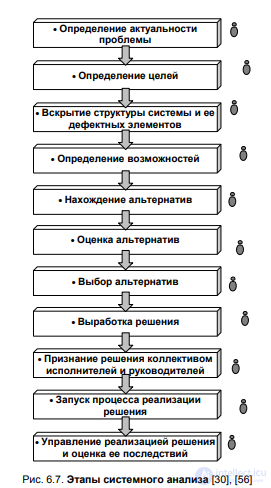
A more detailed list of the stages of systems analysis is presented in Fig. 6.7.
The core of systems analysis is the procedure of comparing alternatives. To carry out this procedure, various methods are applied, the set of which is determined by the class of problem being solved.
In systems analysis, three classes of problems are distinguished:
- well-structured (expressed quantitatively);
- poorly structured (problems characterized by
the presence of elements of uncertainty and not amenable to a strict quantitative description; solving such problems requires drawing on the intuition and experience of the decision-maker);
- unstructured (qualitative).
To solve well-structured problems,
the methods of mathematical programming, game theory, the Monte
Carlo method, queuing theory, and others are applied. These methods make it possible to obtain a quantitative assessment of alternative solutions to a problem. To solve unstructured problems, heuristic (intuitive-logical) methods are applied (these methods will be examined in Chapter 7 of this
textbook). The main sphere of application of systems analysis is the sphere
of poorly structured problems. To solve such problems, informal and graph-analytical methods are applied - the methods of scenarios, expert assessments ("Delphi", "brainstorming"), diagnostic, network, matrix, "goal tree" methods, and the like.
Most of the methods used within the framework of systems analysis were brought in from different disciplines. These methods were developed and
were used independently even before systems analysis took shape as a methodology for solving complex problems. However, there are also methods that were generated directly by the development of systems
methodology. These are, above all, methods intended for solving poorly structured problems - for example, the methods of scenarios and
expert assessments. Among the methods that are typical of the procedures of systems analysis are also the method of morphological
analysis and the method of the goal tree - let us examine them in more detail.
Morphological Analysis
Morphological analysis is a method of systematic
study of all possible variants of the object being analyzed,
arising from the regularities of its structure (i.e., its morphology).
The method of morphological analysis is intended for identifying
the multitude of alternative variants of the system being studied or
designed. As a designed system, for example, there can serve: a) the desired state of the object being improved (for example,
a new model of a car or a new system of personnel motivation at
the enterprise); b) a system of measures for eliminating the problem (for example, a system of anti-crisis measures).
The technology of morphological analysis includes three stages.
1. Formation of a list of the main parameters of the system (its elements, functions, properties, etc.).
2. Formation of a list of possible values for each parameter.
3. Drawing up all possible variants of the system by combining different values of its parameters.
Next, the effectiveness of the compiled variants of the system is evaluated, and the most preferable variant is selected.
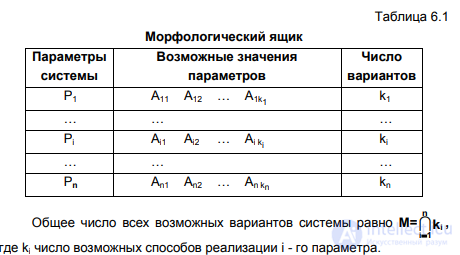
The results of stages 1 and 2 of the morphological analysis are formalized in
the form of a table, which has received the name of the morphological box (Table 6.1).
An example of the application of morphological analysis is given in the practical component of the chapter.
The Goal Tree Method
A goal tree is a hierarchical structure obtained
by decomposing the overall goal into subgoals. This structure is depicted in the form of an undirected graph, whose vertices are interpreted as elements, and whose edges are interpreted as connections between them.
The elements of a goal tree can be of two kinds:
120
120
a) goals and subgoals;
b) goals, activities and resources.
The construction of a goal tree is governed by the following rules:
- at each level of the tree there are goals that are comparable in
scale and significance;
- goals of a lower level ensure the achievement of goals of a higher level;
- the formulations of goals must ensure the possibility of assessing
the degree of their achievement in quantitative or qualitative form
("more - less", "better - worse");
- the depth of realization of different goals may be unequal,
therefore individual branches of the tree may have different lengths.
The analysis of a goal tree is aimed at solving two tasks:
1) qualitative analysis makes it possible to establish the composition of the elements
at each level and the interconnections between them;
2) quantitative analysis of the goal tree makes it possible to assess the degree of achievement of the overall goal, as well as of the goals at each level.
The procedure of quantitative analysis of a goal tree includes the following stages:
1. Experts assign coefficients of relative importance
for all elements of the goal tree. The value of each coefficient
must lie within the range [0;1]. The sum of the importance coefficients of all
subgoals of a single goal must equal one.
2. Experts set estimates of the degree of achievement of the goals of the lower
level. The value of each of the estimates must lie within the range [0;1]
(unless it is intended to take into account the possibility of "overfulfilling the plan").
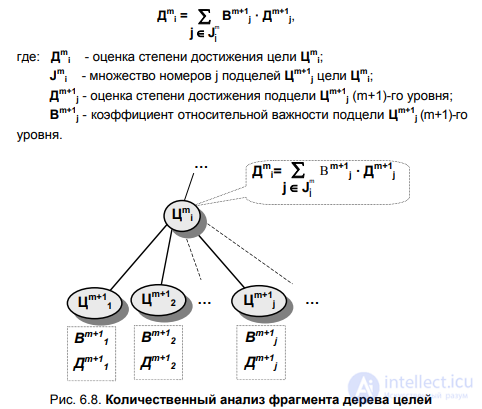
3. On the basis of the values of the importance coefficients and the estimates of achievement of the lower-level goals, the degree of achievement of each
element of the tree is determined, and, ultimately, the degree of achievement of the overall goal
of the upper level (Fig. 6.8).

An example of the construction and quantitative analysis of a goal tree is given in the practical component of the chapter.
PRACTICAL COMPONENT
METHODS OF SYSTEMS ANALYSIS IN SCIENTIFIC RESEARCH
Objectives of the assignment:
- to become acquainted with the role of the methods of systems analysis in scientific
research;
- to acquire skills in applying the method of morphological
analysis within the framework of research work;
- to learn to carry out qualitative and quantitative analysis of a goal tree.
122
122
Supplementary Material
Let us consider the technology for implementing the methods of morphological
analysis and of the goal tree using an example. As an example, let us take the problem of weak staff motivation at an enterprise that is in
a state of financial crisis. To solve this problem, the following actions must be carried out:
1. Design an effective system of personnel motivation
for the enterprise. At this step, it is advisable to apply the method of morphological analysis.
2. Form the set of tasks that need to be solved in order to
implement at the enterprise the designed motivation system. At
this step, it is advisable to construct a goal tree and carry out its quantitative analysis.
The results of the morphological analysis carried out are presented in Table 6.2.
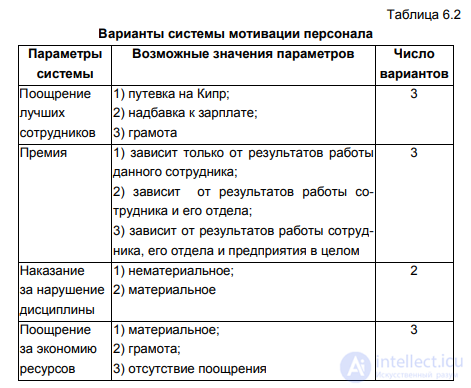
The total number of alternative variants of the motivation system
is equal to 3323=54. The final choice of the best alternative depends on the overall strategy of the enterprise. Since the enterprise, owing to the
financial crisis, is operating in a strict cost-saving regime, the most acceptable alternative will be the following:
- the size of the bonus depends on the results of the performance of the employee,
the department and the entire enterprise;
- the best employees are rewarded with certificates of merit;
- a certificate of merit is also issued as a reward for saving resources;
- at the same time, for violating work discipline, an employee bears a material penalty in the form of a fine.
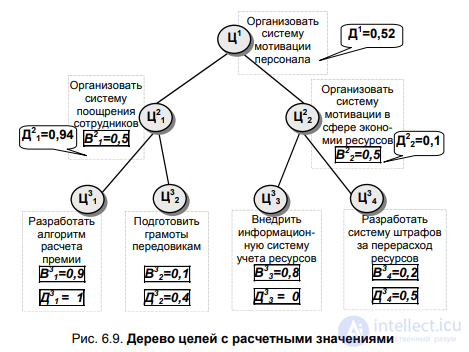
The goal tree, which combines the tasks that need to be solved in
the process of organizing the designed system of personnel motivation
at the enterprise, is presented in Fig. 6.9. The initial data are highlighted
in italics, and the calculated values are presented in callouts. As the
quantitative analysis showed, the measures for organizing the system of personnel motivation at the enterprise have already been carried out to the extent of 52%.
Assignment
1. Using the method of morphological analysis, form
alternative variants of some economic system on the topic
of your own research work. Choose one of the alternative variants of the system as the best one.
2. Construct a goal tree for the creation of the economic system,
designed as a result of completing Assignment No. 1. Carry out a quantitative analysis of the goal tree.
3. Carry out a decomposition of the goal of your own research work. Carry out a quantitative analysis of the resulting goal tree and determine the degree of achievement of the research goal at the current moment.
REVIEW QUESTIONS
8. Give a definition of the concept of a "system".
9. What types of systems do you know?
125
125
10. Give definitions of the concepts of "systems approach", "systems thinking" and "systems analysis".
11. List the basic principles of the systems approach.
12. List the basic properties of systems thinking.
13. List the basic stages of solving problems according to
the methodology of systems analysis.
14. What methods are applied in systems analysis for solving poorly structured problems?
15. What is the basic idea of the method of morphological
analysis?
16. What stages does the procedure of quantitative analysis of a goal tree involve?
CONCLUSIONS
Let us sum up what has been presented in Chapter 6:
One of the fundamental directions of the methodology of scientific cognition is the systems approach, which dictates the principles
of studying objects as systems and their parts.
According to the principles of the systems approach, to know a part without knowledge of the general whole is just as impossible as to know the whole without knowledge of its
parts.
Closely related to the concept of the systems approach is the concept of systems thinking. The difference between these concepts is determined by the fact that
the systems approach is a direction of the methodology of cognition and practice,
while systems thinking is a style of seeing the world, the ability to think in such a way
as to see the whole picture of the phenomena under consideration.
An applied science that uses the principles of the systems approach to solve complex problems in various spheres of human
activity is systems analysis.
According to the methodology of systems analysis, the procedure for solving
any problem includes three main stages: 1) analysis of the problem; 2)
formation of solution options (alternatives); 3) selection of the best
alternative.
To solve poorly structured problems in systems
analysis, informal and graph-analytical methods are applied, including
the methods of scenarios, expert assessments, diagnostic, network, matrix, "goal tree" methods, and the like.

Comments