
Lecture
A source of information is an object that identifies the origin of information. It is also an object that identifies the origin of information; a single element of a subset of one or another class of information resources, accessible to the user and, as a rule, possessing a certain problem-related definiteness.
All sources of scientific and technical information can be divided into two types: documentary and electronic. The bulk of scientific information is presented in the form of documents, which can be conditionally divided into primary and secondary, the latter being the result of transforming information on the basis of studying primary documents. A list of the main sources of information is given in Fig. 3.1.
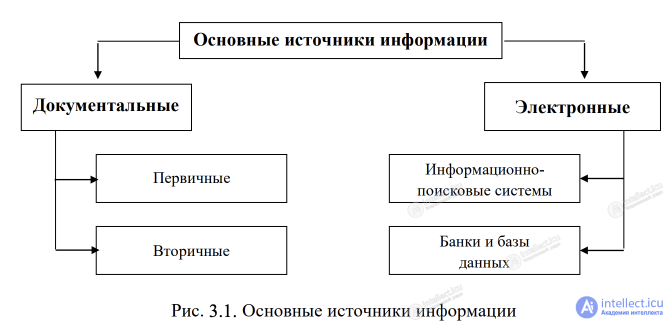
Fig. 3.1. The main sources of information
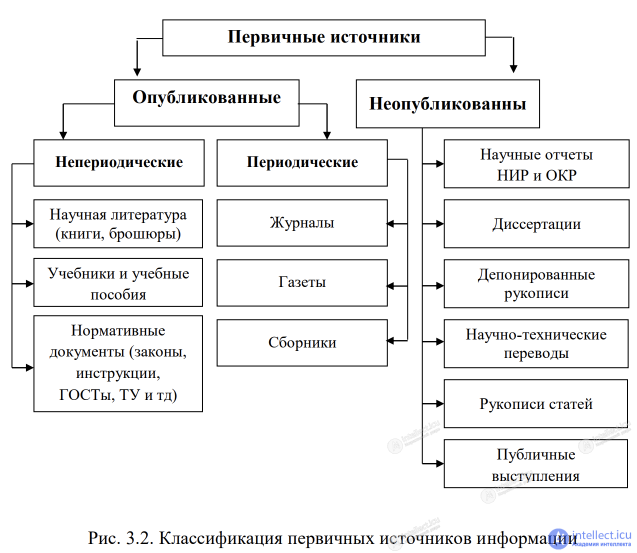
Fig. 3.2. Classification of primary sources of information
Book - a non-periodical publication in the form of several bound sheets of printed material, more than 48 pages in volume, as a rule in a cover or binding, having undergone editorial and publishing processing. Books are divided into several types:
Pamphlet - a printed work, from 5 to 48 pages in volume.
Periodical publication - printed works issued as separate issues, not repeating in content, under a single title, which are regularly released at fixed or indefinite intervals of time, each issue having a serial number or date.
Journal - a periodical publication appearing not less often than twice a year and not more often than once a week, serving the interests of a specific circle of readers, having a permanent title, uniform design, and continuous annual numbering.
The important role of the journal in scientific communications consists in the following:
Preprint - an offprint of a published article which the publisher distributes through its correspondent network. A preprint publishes what could, perhaps, not have been published in a journal and will never subsequently be published, as well as material considered raw, controversial, or untested, not requiring the kind of peer review that a journal article does.
Among unpublished sources, mention should be made of reports on NIR and OKR work, dissertations, and also deposited manuscripts held in repositories.
Dissertation - a qualifying scientific work in a specific field of science, containing a set of scientific results and propositions put forward by the author for public defence and testifying to the author's personal contribution to science and to their qualities as a scientist. A dissertation is based on completed and published scientific works, discoveries or inventions, technological processes introduced into production, and the like.
Deposited manuscripts - scientific works handed over for storage to a depositary body, carried out individually or in co-authorship and intended for a limited circle of users. Information about deposited manuscripts is reflected in abstract journals and bibliographic indexes. Deposited manuscripts are equated to publications, and their authors retain the right to publish articles in scientific journals. Restrictions on the volume of deposited manuscripts are considerably less strict than for publications, which allows the author to present the results of their work more fully.
Scientific report - a report by a scientific organization on research conducted, which is accessible to organizations and private individuals, and is kept in the holdings of the VNTITsentr.
Secondary sources serve as an intermediary between documents and recipients (readers, viewers, listeners) and are the result of the analytical-synthetic processing of information (ASPI). Information publications, the purpose of whose publication is to provide prompt information about the publications themselves and about the most essential aspects of their content. Information publications, unlike ordinary bibliographic publications, deal not only with data about printed works, but also with the ideas and facts contained in them. The publication of information publications is carried out by institutes, centres, and services of scientific and technical information (STI).
The bulk of sources are divided into three types: bibliographic, abstract, and review (Fig. 3.3).
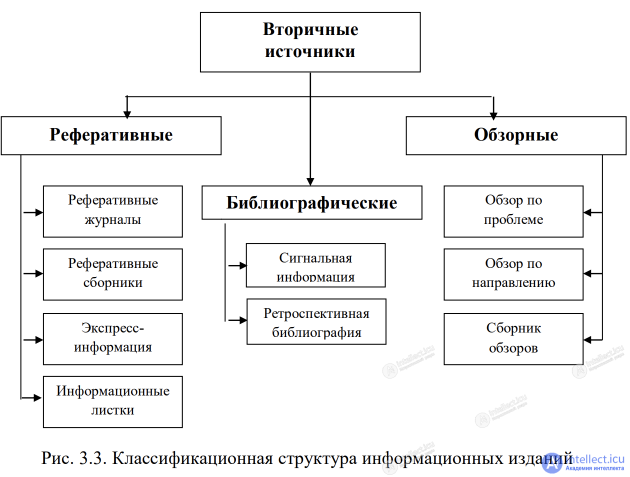
Fig. 3.3. Classification structure of information publications
Summary - answers the question "What?" about the source of information.
Annotation - answers the questions "What?" and "About what?" concerning the source of information.
Abstract - is a condensed account of the content of a primary document (or a part of it), with the main factual data and conclusions. Abstracting implies an analysis of the literature on a problem, i.e. a systematized account of other people's ideas with a reference to the primary source and, necessarily, with the author's own assessment of what is presented.
Catalogues (card indexes), are indexes that can be compiled on various bases. The most common are alphabetical, author, subject, geographical, numerical, chronological, and systematic catalogues (by branch of knowledge, regardless of who the author is), personalia card indexes (about a particular person), and address card indexes.
Bibliographic publications contain an ordered set of bibliographic descriptions that notify specialists of what has been published on a question of interest to them. A bibliographic description here performs two functions. On the one hand, it announces the appearance of a document (the signalling function); on the other, it provides the information needed to locate it (the addressing function). Bibliographic descriptions are compiled into bibliographic indexes and bibliographic lists.
Bibliographic indexes most often have a signalling character and consist of a list of bibliographic descriptions, often without annotations or abstracts. These publications reflect domestic and foreign literature with maximum completeness. They are distinguished by the speed of their preparation and by the comparatively short time between the appearance of a publication and the moment it is reflected in the index.
The most significant bibliographic index is "Signal Information" (SI). The purpose of such a publication is to inform specialists quickly about new publications in world science and technology. It is precisely these publications that are entrusted with the function of giving readers advance notice of scientific and technical literature that has just appeared. SI consists predominantly of systematic indexes, issued in the form of bulletins whose subject matter covers almost all branches of world science and technology.
In connection with the development of research work and the need for a detailed analysis of literature published in previous years, retrospective bibliography, whose purpose is the preparation and dissemination of bibliographic information about printed works for some period of the past, is becoming increasingly important for researchers.
This type of bibliography is represented by a wide range of aids. These include thematic indexes and reviews, in-book and appended reference lists, catalogues of branch scientific and technical publishing houses, personal bibliographies of outstanding natural scientists and engineers, and bibliographic indexes on the history of natural science and technology.
Abstract publications contain published abstracts, which include a condensed account of the content of primary documents (or parts of them) with the main factual data and conclusions. Abstract publications include abstract journals, abstract collections, express information, and information sheets.
Abstract journals on the technical sciences are published by VINITI, which most fully reflects all world literature on natural science and technology, publishing abstracts, annotations, and bibliographic descriptions compiled for articles, monographs, and collections.
Abstract collections are periodical, continuing, or non-periodical publications that contain abstracts of unpublished documents. They are issued by central branch institutes of scientific and technical information and of technical-economic research. Such publications usually have a narrowly specialized subject character.
Express information (EI) - is a periodical publication in journal or sheet form, which contains extended abstracts of the most topical published foreign materials and unpublished domestic documents requiring prompt coverage. Abstracts contain all the main data of the primary sources, accompanied by figures and tables, as well as theoretical calculations, as a result of which there is no need to consult the original.
Information sheets - prompt printed publications that contain abstracts reflecting information about advanced production experience or scientific and technical achievements.
The review publications include a review on a single problem or direction and a collection of reviews. Reviews summarize information contained in primary documents, being the highest stage of their analytical-synthetic processing. Such publications usually report on the state or development of some branch of science or practical activity, reflecting everything new that has been done in it over a given period.
The purpose of reviews is to ensure that scientific research and development are carried out at a contemporary level, to eliminate duplication of effort in the work of research organizations, and to help make the right choice of direction and methods of development in a given field.
A degree candidate conducting a search for literary sources cannot afford to overlook the publications of the book chamber, which issues bibliographic indexes; the publications of the state library; and of the state library of foreign literature, which publishes various bibliographic indexes and card indexes.
Alongside information publications, for information retrieval one should also use automated information retrieval systems, databases, and data banks. Search data can be used directly, but more often they serve as a step (a key) toward locating primary sources of information, which are scientific works (monographs, collections) and other publications needed for scientific work.
The reliability of information depends heavily on the type of source and the context, but a general hierarchy of reliability can be constructed.
Below is a ranking from the most reliable to the least:
1. Patents, inventions, etc.
2. Scientific publications and peer-reviewed journals
Undergo the peer-review procedure (review by experts).
High level of fact-checking and methodological verification.
Downside: can be difficult to comprehend and sometimes become outdated.
3. Official state and international organizations
Laws, statistics, reports (for example, WHO, UN, national statistical services).
Obliged to comply with strict standards.
Downside: political interpretation is possible.
4. Authoritative media and professional publications
Newspapers with a long-standing reputation ( Reuters, The New York Times).
Specialized journals (for example, in the field of engineering or medicine).
Downside: sometimes there is an editorial slant or rushed news reporting.
5. Textbooks and academic courses
Verified educational materials.
Downside: may lag behind the latest research.
6. Professional blogs and expert websites
Specialists share practical experience.
Downside: the level of fact-checking is lower than in journals.
7. Social networks and forums
Rapid transmission of information, first-hand experience.
Downside: high probability of misinformation, subjectivity.
8. Rumours, personal accounts, unverified sources
Minimal reliability.
Based on personal impressions, often distorted.
For scientific and technical tasks it is better to rely on journals, official reports, and textbooks.
For breaking news — on authoritative media, but checking several sources.
For opinions and experience — blogs and forums, but with a critical filter.

Comments