
Lecture 32 min.
Science is:
1. A system of knowledge of the objective laws of nature, society and thinking.
2. A subsystem of knowledge, a discipline (for example, management is the science of administration).
3. A sphere of human activity for acquiring knowledge.
4. A tool for acquiring knowledge.
5. A social institution.
The purpose of science consists in cognizing the objective world by revealing the essential aspects and interconnections of the phenomena of nature, society and
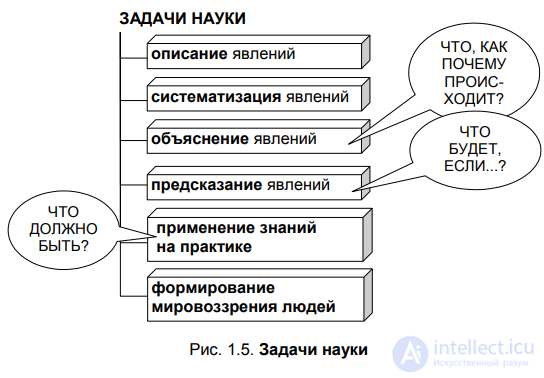
thinking. This purpose dictates the main tasks of science, presented in fig. 1.5.
As is evident from the list of tasks given above, the main functions of science are the explanatory, predictive and worldview functions. The explanatory function makes it possible to understand how
the world is structured, why this or that phenomenon occurs. The predictive function makes it possible to answer questions of the type "What will happen if …?".
Science cognizes and explains the surrounding world.
It obtains new knowledge about nature, society and man, and establishes regularities and laws.
Example: physics explains the motion of bodies, biology — the processes in living organisms.
Key question: "What do we learn?"
Heuristic means exploratory, creative.
Science not only uses already-known knowledge, but also discovers new things, puts forward hypotheses, creates new theories and ways of solving problems.
Example: a scientist puts forward a hypothesis about the existence of a new phenomenon, and then carries out research.
Key question: "What new can we discover?"
Scientific knowledge is applied to transform reality and create technologies.
For example:
discovery → scientific knowledge → technology → practical result.
The development of physics made it possible to create electrical systems, computers and modern means of communication.
Key question: "How to apply knowledge in practice?"
Science forms a person's integral conception of the world, its origin, structure and regularities.
For example, modern conceptions of the origin of the Universe and the evolution of life influence how a person understands the surrounding world.
Key question: "How is the world structured and what place does man occupy in it?"
Science influences the development of society and the solution of social problems.
It is used in medicine, economics, ecology, public administration, demography and other spheres.
Science also becomes part of the social organization of society: universities, scientific institutes, laboratories and research centers exist.
Key question: "How does science help society?"
Science is part of the culture of humanity and contributes to the development of a person's intellectual culture.
It forms:
Key question: "How does science develop the person and culture?"
Scientific knowledge is passed on to succeeding generations through education.
Schools, colleges and universities use the achievements of science to educate people and train specialists.
Key question: "How is scientific knowledge passed on to people?"
The human community possesses a great sum of knowledge. However, not all of it is scientific. There is speculative, practical, religious-mystical, artistic, esoteric and other knowledge. Unlike these, science constitutes the essence of reliable human knowledge, its most important part. Among the main features (signs) of science, the following can be distinguished.
Scientific knowledge is knowledge about a specific, clearly defined object. The object is that to which cognition is specifically oriented. But since the object is inexhaustible in the epistemological sense, the researcher or the community of scientists singles out within it a subject, which answers the question: "What exactly is being investigated in the object?". The methods of science answer the questions: "How is it investigated?"; concepts and categories – "By what means is it investigated?".
We should particularly note that science presupposes the existence of a specialized artificial language – concepts and categories.
Explaining nature and culture itself, researchers operate with an abstract conceptual-categorical apparatus. The ordinary language spoken by the "average" person is clearly insufficient for describing the deep essential phenomena and processes that take place in reality. Because of this, scientists create special terms to denote what is being cognized. Moreover, scientific vocabulary is not absolutely standardized or universal. Considerable effort on the part of researchers is needed to harmonize scientific terminology, to make it generally accepted, generally understood, and, most importantly, adequate to reality. Scientific concepts must not be created arbitrarily. The basic foundation of scientific vocabulary is formed by the classical languages – Ancient Greek and Latin. These are the universally recognized languages of science and culture as a whole. Terms from the classical languages are often mixed with terms from other languages, which sometimes provokes opposition within the scientific community. The languages of science also partly include national languages, especially English, German, French and Russian. Within the system of scientific terminology there are both universally significant and specialized concepts, applied in particular branches of knowledge. The vocabulary of science is not only an instrument of cognition, but also a means of conveying what has been learned to a wide circle of people interested in knowledge. Without a scientific language, thorough cognition of nature and culture is impossible; so too is the very existence of science itself. As C. Linnaeus asserted: "Not to know the names – is not to know the things."
Recognized objects are complex, diverse and contradictory. Knowledge about them needs to be brought under a certain class of concepts and general laws, generalized and systematized. Scientific information is not a chaotic or random set of data. Science represents an organic body of knowledge that has been put in order and is interpreted on the basis of definite theoretical principles. Science overcomes disparate findings by generalizing them and incorporating them into a conception, a theory. This is accomplished by means of hypotheses, axioms, postulates and theorems, logically and substantively interconnected with one another.
A theory, in essence, is regarded as a certain scientific unity of knowledge, in which facts and hypotheses are transformed into a certain wholeness, are linked to one another by definite relations, mutually condition one another, and are brought under a general law. Within it there is a rigid structure, a system of explanations based on postulates, principles and theoretical schemes. The systemic character of scientific material makes it possible to see, behind individual fragments and facts, a universal connection, the regularity of a phenomenon, and accordingly to explain why and how it proceeds, what can be expected of it in the future, and how it is connected with other phenomena. Systemic character presupposes obtaining a definite, relatively complete result, clear conclusions.
At the same time, it is important to bear in mind that the systemic character of knowledge is also relative. Not all knowledge, at all times, fits organically into the context of one science or another. Some knowledge may even stand apart or fall out of the system altogether, owing to the fact that significant groups of phenomena (natural, cultural) cannot be reduced to strict laws and precise numerical rules. Fragmentation is also characteristic of science, but rather as a temporary, surmountable phenomenon. By and large, systemic character is the result of the productive, deep, creative activity of scientists, which ultimately culminates in scientific works.
Unlike ordinary everyday knowledge, which a person acquires through everyday practical experience as a result of activity and communication with other people and which is sensory, empirical, scientific knowledge is, above all, the product of the deep mental activity of the researcher's mind. A scientist's understanding is constantly moving from ignorance to knowledge, from superficial knowledge to ever deeper knowledge, from the fragmentary to the comprehensive. Noticing this or that fact, the scientist does not merely state it, but thoroughly comprehends, describes, explains, interprets and compares it with others. He strives to answer the questions "what is this?", "Why is it exactly like this?", "How does this or that process proceed?", "Why this way and not otherwise?". The scientist takes nothing on faith, seeks no magical justification, does not fantasize, but relies on intellectual, logical procedures.
In Weber's view, a scientist must think rationally, must be the "voice" of facts and the relations between them.
The rationality of knowledge is impossible without clear criteria of cognition, namely: precision, reliability, concreteness, consistency, freedom from contradiction, verifiability, and problem character.
However, the rationality of science by no means implies a complete rejection of intuition, inspiration and poetic quality in the process of cognition. The mathematician G. Pólya asserted: "About every "yes" we speak conditionally. About every "no" – unconditionally." L. Einstein believed that there is always an element of poetry in scientific thinking.
Scientific knowledge is intersubjective knowledge of what is regular, general, and of universal significance. Investigating various aspects of reality, encountering disparate, chance facts and events, scientists strive to discern behind them a certain order – something universal, regular, stable, independent of their personal, racial or national ambitions, desires, prejudices, vanity, mood and value judgments, socially.
A genuine scientist strives for the most objective, realistic description of the object, phenomenon or process being cognized. Any manipulation of facts, any outright falsehood, is categorically inadmissible. The spirit of science is its honesty, its search for truth. Of course, the objectivity and reliability of the information obtained is not absolutely true. However, scientific knowledge is close to the truth, although truth, as a rule, is relative: it is the daughter of its time. The very reliability of knowledge is confirmed by experiment, by the course of social practice, or by the course of natural phenomena. Speaking of the objectivity of knowledge, one still cannot underestimate the role of the researcher – the bearer of understanding, since he provides his own interpretation of knowledge about the unknown. A scientist may introduce corrections into ideas earlier formulated by himself or by other researchers, or even radically revise them. Sometimes he is mistaken, makes errors, despairs, but invariably gets to the bottom of things. A decent scientist acknowledges his mistakes, his untenable point of view. Maximum objectivity of knowledge is achieved when the researcher serves science and truth, rather than personal predilections or someone's narrow self-interest.
Genuine science is characterized by a supra-personal, supra-class, supra-ethnic character. There should be no Jewish or German, proletarian or bourgeois mathematics, physics or cultural studies. Science is international, universal. Otherwise it is not science. Knowledge produced to a party or ideological order, but not confirmed by practice, sooner or later reveals its untenability. A self-respecting scientist never forgets the Aristotelian maxim: "Plato is my friend, but truth is dearer."
Of course, it is impossible to avoid subjectivity entirely, especially in social and humanitarian knowledge. Subjectivity may be partly excused by error, insufficient awareness, or the high degree of complexity of the object of cognition. But by and large, objectivity and subjectivity are interconnected components of the process of cognition, with the objective, the general, unquestionably dominating and being obligatory for everyone. Thus science, unlike most other elements of culture, bears a universal, objective, international character.
Although scientific knowledge bears a general, supra-individual character, science, without any doubt, is created mainly by individual researchers – solitary people, especially gifted, professionally trained, capable of seeing and foreseeing what is not given to the absolute majority of people. Immersing himself in a problem, a scientist, one might say, not only experiences it, but exists within it, himself becoming part of it. He detaches himself from the purely external world of everyday life. He has his own special rhythm of life. He may work day and night tirelessly, without weekends or holidays. A true celebration will come when the unknown is discovered. Many scientists never find the time to arrange their personal lives, to start a family or have children. The main thing is work, work and more work. A genuine scientist is ready for self-sacrifice, for the renunciation of many of life's needs and comforts. For the sake of scientific truth, many scientists have sacrificed their health, happiness and even their lives.
Of course, scientific inquiry can also bear a collective character and, in doing so, yield fruitful results. But a collective could not have created the heliocentric theory of the structure of the world, formulated the laws of dynamics, or discovered the law of universal gravitation or the theory of relativity. Collective scientific activity began to be practiced only from the middle of the 20th century.
So great science is made, above all, by individual researchers, outstanding personalities. The history of great ideas is at the same time the history of great people, the authors of scientific achievements. But on the whole, science is the product of universal effort, the result of the creativity of many generations of researchers and, by and large, does not depend on any single scientist.
We should particularly note that science is a conventional phenomenon, that is, it is the result of explicit or implicit agreements among its subjects. In becoming a researcher, an individual accepts as obligatory the general basic rules of scientific activity – he masters the language of science, its methods, the subtleties of interpretation, and its basic postulates. Whether a scientist wants to or not, he objectively enters into the general scientific convention, which he is obliged to observe.
Science, being an element of culture, mostly moves in parallel with the development of its other components. It accumulates the achievements of economics, technology, social relations, art, and even the state of religious views of one time or another. Scientific knowledge is, to a considerable extent, determined by the existing socio-cultural environment.
As a rule, science is a reflection of the state of culture contemporary to it. Moreover, this reflection is thorough, deep, and largely objective. Like no one else, the researcher tries to understand what is happening, to critically comprehend it, and to give it a correct assessment. He sees what many others do not see, operates with figures, facts and concepts inaccessible to the masses. Of course, owing to the complexity and contradictory nature of the objects being cognized, as well as prevailing views, not all the knowledge obtained at one time or another is reliable. But such is historical reality. One cannot demand of an ancient Greek scholar or a medieval thinker what we have the right to demand of a contemporary researcher, and it would hardly be fair to apply the standard of strict scientific rigor to their work.
But there are not infrequent cases when scientific knowledge clearly runs ahead of its time. A talented scientist is capable of correctly assessing not only the past and the present, but also of perceptively glimpsing the distant future. He may formulate a number of ideas that clearly do not fit into the views prevailing in his era.
Some scientific developments can be understood and called for only centuries or even millennia later. However, within the scientific realm, the past, present and future of scientific knowledge are inseparable.
The famous Archimedean "Eureka!" ("I have found it!") can rightly be considered an inherent feature of scientific cognition. Every scientist or community of researchers works at the "cutting edge," on the boundary of the epistemological horizon. Sometimes they passionately and aggressively storm the unknown adversary, but more often they methodically, patiently and thoroughly besiege it from all sides until they see what they are seeking and take possession of it. A scientist is capable of seeing something new not only in the unexplored, but also in what is already well established and known. In other words, scientific cognition moves not only outward in breadth (into the Universe), but also inward in depth (down to the smallest particles). Heuristic quality and innovativeness can manifest themselves both as the ultimate scientific result, and in the ways and means of proving or refuting previously obtained knowledge, in the parameters of its application, and in the means of systematization. The presence of novelty is a fundamental requirement for any research material.
Science does not tolerate dogmatism, overconfidence, or despair, and even less so, prolonged stagnation. Its basic motto is: "Forward, and only forward!". The spirit of the discoverer, Kh. Columbus, is an inherent feature of the seasoned worldview of the scientist, of his everyday way of life.
Science, despite its heuristic quality and innovativeness, has a hereditary character. In it, completely new knowledge, unconnected with what came before, never appears. Each new generation of scientists does not start from zero, but relies on what has already been achieved and on cooperation with contemporaries. In science, more than in any other element of culture, it is necessary to study the past in order to understand the present and forecast the future. The scientific work of Pythagoras, Euclid and Archimedes remains relevant today. Without it, modern algebra, geometry and physics would be impossible.
The ideas of past scientists are of more than mere epistemological interest. They can become a source for solving present-day problems, contribute to enriching conceptions of hard-to-grasp objects, and help rethink many fundamental aspects of science.
Moreover, thanks to the scientific knowledge of the past, it is possible to form a relatively accurate picture of the past, present and future of this or that cultural object or phenomenon, and indeed of culture as a whole.
In drawing on the scientific heritage of past times, a scientist must not only subject it to doubt and treat it critically, but also remain loyal to it, express respect for it, and give the predecessors their due.
Existing knowledge must be strictly taken into account, and efforts must be made to expand it, but it must never be absolutized or entirely rejected. The contemporary researcher is obliged to be guided by the wisdom: «We are dwarfs standing on the shoulders of giants.»
Scientific knowledge is partly knowledge, partly ignorance. Every achievement is not only a result, but also a new problem. Nature and culture are inexhaustible. They continually pose ever new questions before the researcher.
Science is never fully complete or finished. Even its most outstanding achievements are merely a certain stage on the way to new results. Science deals with the boundless. It, in Weber's words, occupies itself with something that never ends and can never end. It has no summit; it recedes into infinity. A scientist can practically never attain everything that he wants to know. Even the simplest object conceals within it the unexplored, not to mention complex systems. All the scientific results attained bear an incomplete, relative character. Today they may be of substantial significance; after some time they may pass into the category of trivial knowledge, and then become relevant again. Scientific cognition bears a contradictory, zigzag character. Errors, mistakes, incorrect conclusions, and even profound crises and impasses, are not excluded within it. But the strength of science lies in the fact that a genuine scientist is ready to acknowledge them, to take a critical look at what has been achieved, to revise it, correct what is erroneous, and move further, penetrating deeper into the object under study. He is never satiated with knowledge; on the contrary, he experiences an intellectual hunger for the unexplored. The more a scientist knows, the stronger grows his need for new knowledge.
The history of the development of scientific knowledge shows that the process of cognition is infinite, that there are no absolutely unknowable things, only things not yet known. The progress of science is the most important part of the infinite progress of human culture.
Science exists, above all, for the sake of genuine knowledge, for the sake of grasping the truth and clarity, purely as such, for its own sake. In its essence it serves the cause of self-knowledge and the cognition of physical phenomena. Every self-respecting scientist must, is obliged to, strive for truth. The highest reward for him is precisely discovery, a deeper understanding of things, and not the money, benefits or public recognition that it may bring him. True, the latter is also of considerable importance, since it stimulates active scientific inquiry.
Of course, science may also have a pronounced, concretely practical orientation, conditioned by political (military), geographical or geological upheavals, the needs of the economy, or the demographic situation. A scientist may carry out a social mandate, contribute to overcoming crisis phenomena. But even in this case, the cognition of what is true, of regularity, is not pushed into the background. For the one commissioning the work, the practical result is of paramount importance; for the scientist, the main thing is the grasping of what truly exists. Knowledge, truth – these are the highest values of the priest of science.
A genuine scientist, as a rule, is characterized by selflessness, self-criticism, cool calculation, the capacity for monotonous work, perseverance, persistence, diligence, readiness to take risks, intellectual honesty, freedom from ideological and political dogmas, and psychological readiness for what has been done and what may yet be done.
New knowledge brings the researcher pleasure, but at times also despondency. Not every truth is pleasant and joyful. Often a scientist is compelled to abandon his own preferences and values, for where a researcher approaches with his own selfish values, judgments and deaths, and defends them – there is no longer room for an objective understanding of realities and facts.
One of the most contradictory, ambiguous and problematic features of science is the ethicality of scientific knowledge. Even I. Kant, in his time, demanded that science be approached with regard to whether it brings benefit to people. In the 20th century, polar points of view formed on this question. Some scientists (for example, E. Teller, W. Vogt) tended to believe that science is impartial from the point of view of ethics, that, so to speak, it stands outside morality, since it grasps something wholly objective. Consequently, the task of the scientist is to grasp, understand, discover, explain, and increase the degree of mastery over nature. As for the further fate of discoveries and their possible negative consequences, that, supposedly, is not the researcher's problem. Another group of scientists (A. Einstein, N. Wiener, K. A. Timiryazev) held clearly pro-ethical positions, believing that the moral atmosphere of the development of science and the moral qualities of its practitioners play no small role, and that every scientist bears moral responsibility for the results of his activity and the consequences of their practical application.
The question, needless to say, is ambiguous. On the one hand, investigating the unknown, the scientist strives to obtain a final result. And, it would seem, scientific truth does not depend on moral choice, it is primary in relation to it. "What is, is, and there is no getting away from it!". But this is only the case at first, and moreover superficial, glance. For, on the other hand, science, especially modern science, has ceased to be the personal affair of the scientist or a search for objective truth alone. Scientific truth is not simply something precise, reliable and objective, but something far greater. It often imperceptibly passes into technology and production and radically transforms them. These changes can be catastrophic in character, altering what would seem to be even the unchangeable.
The achievements of science can simultaneously carry both great good and great evil. And in this case the scientist, as it were, throws up his hands, saying that he wanted the best, but politicians and entrepreneurs used his discovery to do evil to people. He has nothing to do with it! Such borderline situations are often possible. And not every scientist really reflects on this, although he should, he is obliged to do so. But it also happens that a scientist works purposefully on horrifying things. If, for example, he creates a bacteriological weapon capable of destroying billions of people within hours, then he is clearly a criminal, whatever expediency or motives may have guided him.
No researcher has the right to consider himself free of moral concerns and obligations toward humanity. The absolutization of the epistemological side and the underestimation of the humanistic side are categorically inadmissible. Moral indifferentism toward scientific work, a purely technocratic ideology, and professional cretinism are likewise unacceptable.
The strategic goal of science is not merely truth, but a truth that does no harm to people. Truth does not exist outside of value criteria, outside of goodness. A scientist has no right to contribute to the radical destruction of the natural course of things and of the fundamental foundations of life that have been built up over millennia. The progress of science must be ensured morally. Its intrusion into human life, in any form, must have moral limits. A scientist is obliged to carefully sort out the aims and circumstances of his work, to take all conditions into account, to judge and create with understanding, and to strategically calculate his actions and the possible consequences of his discoveries. Of course, all this is very complex and at times unpredictable, which is why science is not only a drama of ideas, but a drama of people (researchers).
As the great Aristotle said: "He who advances in the sciences but lags behind in morality goes more backward than forward."
Such are the main traits and features of science, although if one approaches this question more thoroughly, one can find far more of them.

Comments