
Lecture
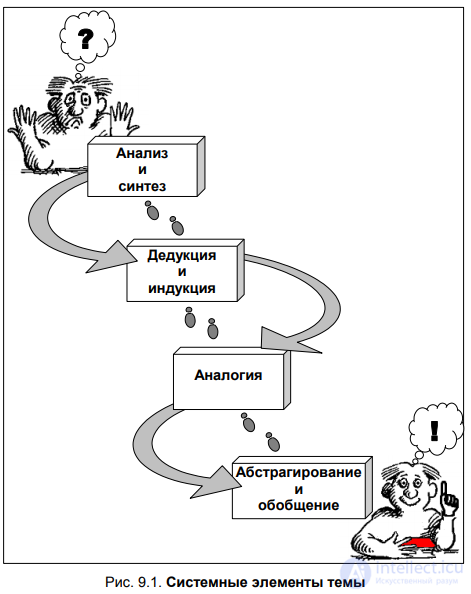
All general scientific methods of cognition are divided into three groups:
The purpose of this chapter – is to briefly describe the methods that belong to the group of general logical methods.
Key concepts of this chapter: analysis, synthesis, deduction, induction, complete induction, incomplete induction, simple (popular) induction, scientific induction, analogy, abstraction, generalisation.
Analysis is a procedure of mentally (and, in experimental research, often actually) breaking down objects, their properties and relations into constituent parts (features, properties, relations).
Synthesis is a procedure for studying a phenomenon
on the basis of combining interrelated elements into a single whole.
Any process of obtaining new knowledge is based on the unity of analysis and synthesis. The following types of analysis and synthesis are distinguished:
empirical, elementary-theoretical, structural-genetic.
The empirical (direct) type of analysis-synthesis involves a superficial study of the object, the identification of its individual parts,
the recording of its properties, and simple measurements. This type of analysis-synthesis is insufficient for penetrating the essence of the phenomenon.
The elementary-theoretical (recursive) type of analysis-synthesis involves carrying out the operations of analysis and synthesis on the
basis of certain theoretical considerations (assumptions about cause-and-effect relationships between phenomena, about the existence of laws and regularities in the behaviour of objects).
The structural-genetic type of analysis-synthesis involves singling out, within a complex object, those key elements that have a decisive influence on all the other aspects of the object. This type of analysis-synthesis makes it possible to penetrate most deeply into the essence
of the object (Example 9.1).
Example 9.1
Different types of analysis in scientific research
Studying the process by which income is generated at an enterprise involves the application of the following types of analysis:

Comments