
Lecture
Case-control study (CCS) is a type of observational study in which two study groups differing in the outcome obtained are compared on the basis of a suspected influencing factor. Case-control studies are often used to identify factors that may affect health status by comparing participants who have a disease ("cases") with participants who do not have it ("controls").
This type of study requires fewer resources to conduct, but it provides weaker evidence for causal inference than a randomized controlled trial. As a result of a case-control study, the researcher obtains only an odds ratio, which is a weaker indicator of a stable association compared with relative risk.
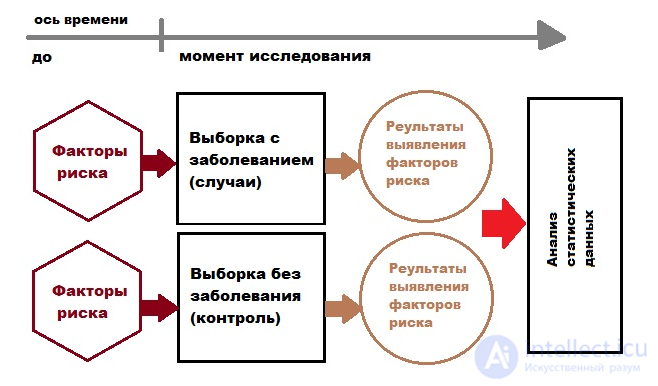
A case-control study is an analytical epidemiological study of persons with a given disease and persons in a corresponding control group who do not have the disease. The association between a characteristic and the disease is studied by comparing the diseased and the non-diseased in terms of the frequency of occurrence of the characteristic among them or, if the characteristics are quantitative, in terms of the level of the characteristic in each group.
Such a study is retrospective, since it begins after the onset of the disease and is aimed at studying possible etiological factors that operated in the past.
For example, in a study that attempted to show that people who smoke (the cause) are more likely to be diagnosed with lung cancer (the outcome), the case group consisted of people diagnosed with lung cancer, and the control group consisted of persons without lung cancer (not necessarily healthy), with smokers present in both groups. If a greater proportion of people in the case group smoke compared with the control group, this suggests, but does not provide definitive proof, that the hypothesis is correct.
Case-control studies are often contrasted with cohort studies, in which participants exposed and participants not exposed to a given factor are observed until they develop the outcome of interest to the researchers.
The correct selection of participants for both groups is the foundation of the study design. Both groups are selected from a predefined population.
The researcher must define cases as specifically as possible. Sometimes the definition of a disease may be based on several criteria; thus, all these points must be clearly stated in the case definition.
Participants in the control group should be in good health; the inclusion of people with the disease is sometimes justified, in cases where the control group is meant to show people without the disease who could potentially fall into the "risk group".
The control group may have the same diseases as the "cases", but of a different degree of severity, keeping it distinct from the expected outcomes of the study group.
As with any epidemiological study, a larger number of participants in the study will increase the reliability of the data obtained. The number of "cases" and "controls" need not be equal. In many situations it is much easier to recruit the control group than participants who directly have the disease. Increasing the number of participants from the control group relative to the "case" group, up to a ratio of 4 to 1, can be a cost-effective way to improve the study.
Incorrect results: A lack of control can lead to distortion of data and, as a consequence, to incorrect conclusions. This can be especially critical in fields where data reliability plays a decisive role, such as medical research.
Impossibility of replication: If a study is insufficiently controlled and documented, other scientists may find it difficult or even impossible to repeat the experiment in order to confirm its results. This threatens a fundamental principle of the scientific method.
Loss of resources: Studies can consume significant resources, and a lack of control can lead to their inefficient use. This can be especially important in the case of studies funded by society or the state.
Loss of trust: A lack of control can undermine trust in scientific research and scientists in general. This can lead to doubt in scientific conclusions and make it more difficult to implement new discoveries in practice.
In order to avoid these problems, it is important to pay due attention to control in scientific research, to follow strict methodological rules, to strive for transparency and reproducibility of results, and to share data and experience with colleagues to verify and confirm conclusions.
Excessive control in scientific research can also have its own negative consequences:
Resource costs: Too intensive control may require a large amount of time, financial and human resources, which may be disproportionate to the goals of the study.
Slowing down the study: An attempt to cover all possible variables and factors can slow down the course of the study and make it more difficult to obtain results.
Loss of practicality: Excessive control can make a study less practical and less applicable to real situations. Sometimes a small degree of unregulated variation and randomness can be useful.
Limiting innovation: Too strict control can suppress creativity and innovation in research, since researchers may be afraid to take risks or experiment.
Unreliability of results: In the case of excessive control, the results of the study may be too artificial and may not reflect real conditions, which makes them less applicable.
It is therefore important to find a balance between sufficient and excessive control in scientific research. This usually depends on the specific goals and nature of the study, as well as on the field of science in which the research is conducted.
One of the best-known case-control studies, published in the British Medical Journal in 1950, was devoted to studying the relationship between smoking and the development of lung cancer, conducted by Richard Doll and Bradford Hill, who managed to demonstrate a statistically significant association in a large-scale study. Their opponents argued for many years that studies of this kind could not confirm the cause of a given phenomenon, but the results of cohort studies proved the existence of a causal relationship between the disease and the outcomes obtained. At the current stage of science, it has been confirmed that smoking is responsible for 87% of lung cancer deaths in the United States.
Case-control studies were initially analyzed by testing for significant differences between the proportion of exposed subjects among the cases and the control group. Cornfield subsequently noted that when the disease outcome of interest is rare, the exposure odds ratio can be used to estimate the relative risk (see the rare-disease assumption). The validity of the odds ratio depends largely on the nature of the disease being studied, the sampling methodology, and the type of observation. Although in classical case-control studies it remains true that the odds ratio can only approximate the relative risk in the case of rare diseases, there are a number of other types of studies (case-cohort, nested case-control, cohort studies) in which it was later shown that the exposure odds ratio can be used to estimate the relative risk or incidence rate without the need for the rare-disease assumption.
When a logistic regression model is used to model case-control data and the odds ratio is of interest, both the prospective and retrospective likelihood methods will yield identical maximum-likelihood estimates for the covariate, with the exception of the intercept. Standard methods for estimating more readily interpretable parameters than odds ratios, such as risk ratios, rates and differences, are biased when applied to case-control data, but special statistical procedures provide simple-to-use consistent estimates.

Comments