
Lecture
INTRODUCTION TO THE CHAPTER
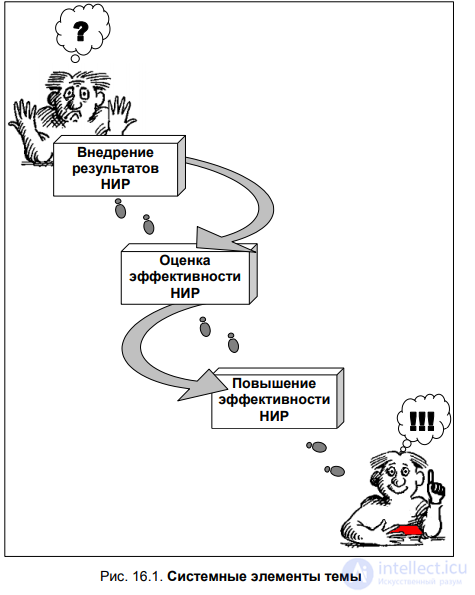
The purpose of this chapter is to clarify the essence of the processes of assessing the effectiveness and implementation of the results of research work.
288
288
In this chapter we will answer the following questions: What are the main
stages of introducing scientific output into production? What types of effectiveness are taken into account when assessing the significance of the results of research work? What types of effects characterise the results of scientific research from the point of view of their contribution to the development of
socio-economic systems? How does effectiveness differ from
an effect? What criteria are used to assess the effectiveness
of scientific research? What measures are applied to increase the effectiveness of R&D?
The key concepts of this chapter are: implementation of R&D results,
scientific output, pilot testing, contract for the performance of scientific and technical work, effect of R&D implementation, effectiveness of R&D,
economic effectiveness of R&D, social effectiveness of R&D,
scientific and technical effectiveness of R&D, effectiveness of a researcher's work, effectiveness of a research organisation's work.
THEORETICAL MATERIAL
§ 16.1. Implementation of the results of scientific research
The final stage of applied research work is the implementation of its results into practice. Whereas basic research serves, mainly, the purposes of the further
development of science, the very meaning of applied research lies in the implementation of its results.
R&D implementation is the transfer of scientific output created
within the framework of the given R&D into practical use (industrial
operation).
Scientific output is the results of R&D intended
for transfer into practical use and presented in the form of
reports, design and technological documentation, new
technologies, laboratory and industrial prototypes, and so on.
Examples of scientific output obtained as a result of economic research are theoretical and scientific-methodological
289
289
propositions, procedures and recommendations. Their implementation contributes to raising the level of production organisation, increasing labour productivity, improving product quality and saving
various kinds of resources.
The customers of scientific output are the state, enterprises and organisations, and the performers are universities, research institutes, design firms and
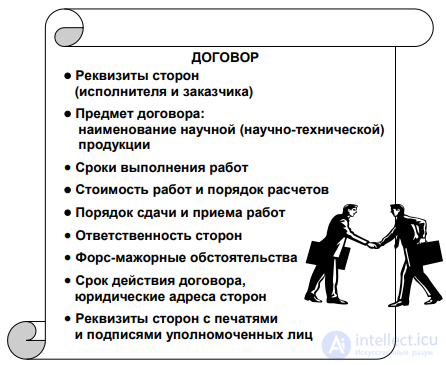
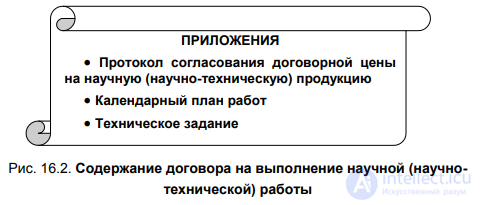
the like. The process of creating scientific output is governed by a contract concluded between the customer organisation and the performer organisation. The requirements for the scientific output are set out in the technical specification, which is attached to the contract (Fig. 16.2).
The process of introducing scientific output into production includes
the following stages:
Stage No. 1. Delivery of the completed R&D to the customer, accompanied
by the drawing up of an acceptance-delivery certificate for the scientific (scientific-technical) output.
An acceptance commission, consisting of representatives of the performer and the customer, takes part in drawing up the acceptance-delivery certificate.
The certificate states the deadlines for completing the work, the estimated and actual costs, information about the performers, a list of publications and patents based on the results of the
work performed, as well as information on the approbation of the results [40].
The introductory part of the certificate notes the fact of the completion of the research work and formalises the decision on the
implementation of the scientific output (indicating the place of implementation, the timeframe and
the expected economic effect).
Stage No. 2. Pilot testing, that is, verification of the R&D results under
production conditions.
The results of the pilot tests are recorded in a protocol. If any shortcomings are identified, the performer corrects them within the timeframe agreed with the customer.
Stage No. 3. Elimination by the performer organisation of the shortcomings
identified during the pilot testing.
Stage No. 4. The actual implementation of the scientific output, accompanied by the drawing up of a certificate on the implementation of the R&D results, which
is approved by the management of the customer organisation and the performer organisation.

Comments