
Lecture
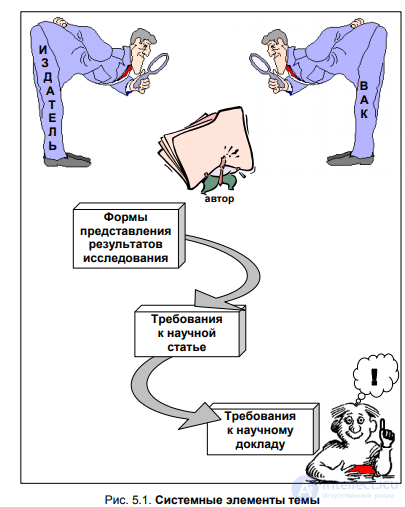
CHAPTER INTRODUCTION
The purpose of this chapter is to describe the main forms of presentation
of the results of scientific research and the requirements for them.
92
92
In this chapter we will answer the following questions: What are the purposes of publicizing scientific results? What are the main forms of presenting the results of scientific research? What requirements must
a scientific article satisfy? What requirements must a scientific report satisfy? Why should the content of a scientific report differ from the content of a scientific article on the same topic? What is
the standard structure of a scientific and technical report?
Key concepts of this chapter: scientific article, scientific report, abstract of a report (theses), monograph, dissertation, deposited manuscript, scientific and technical report, illustrative material (posters).
THEORETICAL MATERIAL
§ 5.1. Forms of presenting the results of scientific research
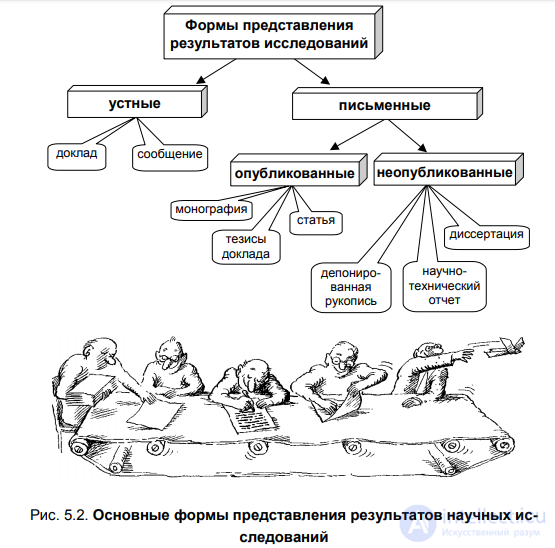
There are many forms of presenting the results of scientific
research (Fig. 5.2). Written forms include: monograph,
scientific article, abstract of a scientific report, dissertation, deposited
manuscript, and scientific and technical report.
A monograph is a scientific or popular-science book
publication that contains a complete and comprehensive study of a particular topic.
A monograph includes a description of results obtained not only by the authors of the monograph, but also by other researchers. A monograph
may contain not only new scientific results, but also technical solutions and known facts on the question under consideration.
A scientific article is a written composition of a scientific nature and small size (usually up to 10-12 pages of printed text), in which the authors present the results
of their own research.
Scientific articles are published in scientific journals and collections
of scientific papers. They contain up-to-date information from the «front line»
of scientific research.
The abstract of a report (theses) is written information of 0.5-2
pages of printed text, containing briefly formulated
main points of an oral presentation.
The abstract of a report has a strict structure, in which the following are distinguished:
- the introductory thesis, covering the relevance of the topic and the objective
of the research,
- the central thesis - the essence of the research,
- the concluding thesis - brief conclusions from the presentation.
Abstracts of scientific reports are published in collections of theses, which are issued based on the results of scientific conferences and seminars.
A dissertation is a qualifying scientific work that contains a new solution to a pressing scientific problem (issue),
demonstrates the author's personal contribution to science, and is submitted for
defense for the award of the academic degree of Candidate or Doctor of Sciences.
Defended doctoral and candidate dissertations are kept in
the V. I. Vernadsky National Library of Ukraine. A second copy of the dissertation is kept at the institution where the defense took place.
A deposited manuscript is an unpublished scientific
document that is produced in several copies on a
computer (typewriter) or recorded on a diskette and submitted for deposit to information agencies. The distribution
of such manuscripts among readers is carried out as follows: the information agency, through its publications, announces the arrival of new deposited manuscripts, and interested
persons can obtain copies of the manuscripts they need upon appropriate request.
A deposited manuscript is considered published only after
the information agency publishes its bibliographic description.
After that, its legal status is equated to that of a publication. In Ukraine, the deposit of manuscripts is carried out by the Ukrainian
Institute of Scientific, Technical and Economic Information - UkrINTEI
(this information agency will be discussed in Chapter 13).
Works usually sent for deposit are scientific papers (articles, abstracts of scientific reports, collections of articles and monographs) that are narrowly specialized in nature and of interest to a narrow circle of specialists.
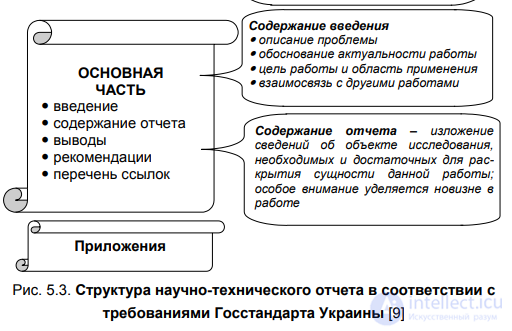
A scientific and technical report (a report on research and development work) is a handwritten or typewritten document containing
a detailed description of the course and results of the research work,
carried out in the field of science and technology (Fig. 5.3).
Scientific and technical reports are subject to mandatory registration with
the country's information agencies. In Ukraine, the function of registering
scientific and technical reports is performed by UkrINTEI (see Chapter 13).
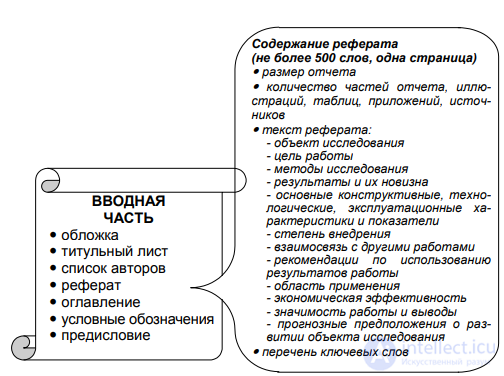
In addition, research work can be presented in the form of a computer presentation or a video with text commentary. Less often, it is demonstrated in the form of a working model or mock-up with text commentary.
 Report
A report is a document containing a presentation of the results of research activity or experimental design work, published in print or read out to an audience. The report must reflect the novelty and practical significance of the topic, disclose its main content, and substantiate the speaker's conclusions and proposals. All of this is also noted in the abstract of the report, which, as a rule, is published in a collection based on the results of the event (conference, seminar, etc.).
Poster presentationA report is a document containing a presentation of the results of research activity or experimental design work, published in print or read out to an audience. The report must reflect the novelty and practical significance of the topic, disclose its main content, and substantiate the speaker's conclusions and proposals. All of this is also noted in the abstract of the report, which, as a rule, is published in a collection based on the results of the event (conference, seminar, etc.).
This form of report is accepted in modern international practice as the most successful one, ensuring ease and concentration of perception of the content at conferences and other events. For each research work, a stand of about 1 m2 is provided. Materials intended for the poster presentation may be prepared in advance on a sheet of drawing paper and attached to the stand with pins (tacks, etc.) At the top of the stand a strip measuring 840x100 mm is attached, bearing the title of the work, set in a font no smaller than 48 pt (capital letter height 12 mm). Below the title, on the same strip, in a font no smaller than 36 pt (capital letter height 8 mm), the names of the authors and the academic supervisor, and the name of the institution and city where the work was carried out, are indicated. In the left corner of the strip, an individual stand number, communicated at registration, should be marked.
Requirements for a poster presentation
Structure of a poster presentation
It is advisable to present the methods and results of the research in graphical or illustrative form.
Review of a defenseFirst of all, teachers need to remember that a review is a critical analysis and assessment of a new work of art (a book, a play, a concert, a film) or a scientific work. A reference given on a scientific work or a work of art prior to its publication, defense, etc. may also be regarded as a review. A review may be published in the form of an article in a newspaper or a magazine
Literature review A literature review is a brief description of what is known about the phenomenon under study from various sources. It indicates the directions of research being pursued by various scientists. When preparing a literature review, one should begin work with a general familiarization — read the table of contents and briefly skim the content of the source. Then, upon a careful reading of the source by chapters and sections, the most important parts of the text should be highlighted.
It is then advisable to:
After this, it is necessary to compare and juxtapose this information with information obtained from other sources. In conclusion, it is important to give a critical assessment of what has been read and note remarks, paying attention to the objectivity of judgments. In a literature review, it is necessary to show that its author is familiar with the field of research from several sources and is capable of setting a research task for themselves. Preparing a literature review helps the researcher master the material and answer questions with justification during a scientific report.
Scientific article A scientific article is a distinctive literary genre. A scientific article must identify a problem and note known attempts to solve it. Based on this, it is advisable to distinguish the following in the structure of a scientific article:
Scientific reportA scientific report is a document containing a detailed description of the methodology and course of the research, its results, and the conclusions obtained in the course of research or experimental work. The purpose of a scientific report is to give an exhaustive account of the work performed, either upon its completion or over a specific period of time.
Structure of a scientific report
EssayAccording to the dictionary of foreign words, an essay (from the Latin referre — to report, to communicate) is:
• a brief oral report or written account of a scientific work, the content of a book read, etc.
• a report on some topic, based on a review of literary and other sources.
In practice, one encounters significant differences in teachers' requirements for students' work on essays and for their formatting and defense procedure. An essay is not a conspectus of literary sources. This genre of work requires the author to analyze the information used and to draw independent conclusions. Below are the key points that need to be taken into account when guiding students' work on essays.
The student's readiness to work on an essay
An essay makes it possible to check not only how well students understand the material, but also their ability to independently obtain and interpret knowledge. For this reason, it is advisable to involve in such activity students who are inclined toward research work and who possess analytical abilities and critical thinking. Naturally, a student's success in working on an essay will be ensured only if they independently decide to take up this kind of activity
The teacher's functions in guiding a student's essay work Guiding essay work involves the teacher helping the student choose a topic for the essay, advising them in the process of studying the chosen problem, and in formatting the text. It should be noted that this form of extracurricular student activity should not be mass in character — not every student, even with the teacher's support, is capable of deciding on a topic and formulating a problem, or of working independently with several sources of information. Undoubtedly, the teacher must fully guide the students' work on their essays, but should limit their own activity to advisory functions. They may give recommendations on the content of the introduction and conclusion, the selection of illustrative material and sources of information on the problem, the formatting of the text, and the defense procedure. It is the student who must identify the relevance of the problem, determine the structure of the work, and formulate the conclusions.
Deadlines for completing the essay
As a rule, work on an essay takes a student at least one month. It should be taken into account that, after the teacher reviews the draft version of the essay, the student may need time to refine the content and edit the text. One week before the defense, the essay is submitted for review to the subject teacher who supervised the work.
Structure of the essay
First, the student prepares a detailed outline of the essay, in which its structure and main content by section are defined:
The introduction envisages that its content formulates the problem, describes its relevance, and defines the goals and objectives of the essay. The length of the introduction should not exceed 1-2 pages. Each section of the main part of the essay ends with a logical conclusion arising from the content of the sources reviewed, along with the student's own assessment of the material. In addition, the entire text must contain correctly formatted quotations and references. The conclusion sums up the results of the work, formulates conclusions, and outlines prospects for solving the stated problem. The length of the conclusion should not exceed 1-3 pages.
The list of sources should be formatted in accordance with GOST. It may include not only literary sources such as books, journals, and newspapers, but also information drawn from the Internet, information from television and radio broadcasts, as well as private communications from various specialists expressed in personal conversations with the author of the essay.
Defense procedure for the essay
During the defense procedure, the teacher reads out the review of the essay before the members of the committee. The floor is then given to the student for the report. The student may keep a copy of the essay while presenting. The report should be designed to last 5-7 minutes. It is prepared as a separate text. The report should not be a retelling of the text of the essay, still less a reading of it. In the presentation, the student states the relevance of the chosen topic, the purpose of the essay, its objectives, and reports the conclusions reached. It is permissible to dwell on the most interesting points of the work. It is desirable for the student to state how significant the topic of the essay is to them personally. After the report, the members of the committee ask the student questions.
Next, a free discussion among the committee members may be opened, during which they express their views on the topic and content of the essay. After all the questions have been answered and the discussion has ended, the committee deliberates on the grading of the essay. During this time the student is not present in the room where the defense is being held. Once the committee reaches agreement on the grade for the work, the results of the defense are announced to the student. The members of the committee express their opinions on the content of the essay and give recommendations for continuing this kind of work.
Assessment of the essay
When assessing an essay, the teacher must take into account the following components of the work:
ProjectA project is a conception, a plan; a developed plan of a structure, a mechanism, a diagram of a technological process; a preliminary text of some document. Design, in essence, is the process of creating a project — a prototype, a preliminary image of an intended object or state. Types of projects
A single-subject project, carried out within the framework of one subject. Work on it fits well within the classroom-lesson system.
A cross-subject project, involving the use of knowledge, abilities, and skills in two or more subjects. Most often used as a supplement to classroom activity.
A supra-subject project, which is carried out at the intersections of fields of knowledge and goes beyond the content of school subjects. Used as a supplement to educational activity and has the character of research.

Comments