
Lecture 6 min.
Scientific knowledge — a system of knowledge about the laws of nature, society, and thought. Scientific knowledge is the foundation of the scientific picture of the world, since it describes the laws of its development.
Scientific knowledge is:
Being a specific kind of knowledge, scientific knowledge must meet a number of criteria, among which are predictive power, verifiability (testability in practice), systematicity, and consistency of results .
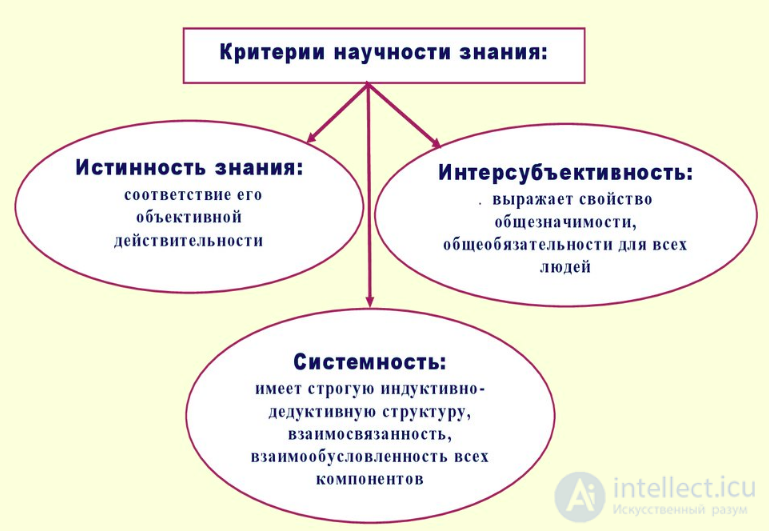
Criteria of scientific validity of knowledge
Scientific knowledge is usually considered on two levels — empirical and theoretical. Each of these levels employs its own special research methods and has a different significance for scientific knowledge as a whole.
Empirical knowledge accumulates as a result of direct contact with reality in observation or experiment. Science relies on firmly established facts obtained through the empirical, that is, experiential, route. At the empirical level, facts are accumulated, along with their initial systematisation and classification. Empirical knowledge makes it possible to formulate empirical rules, regularities and laws, which are statistically derived from observed phenomena.
The main methods of empirical knowledge are:
Information obtained through empirical methods is subjected to statistical processing. After that, scientists can make certain generalisations. The information obtained must be verified, so scientists are required to describe in detail the sources of information and the methods used.
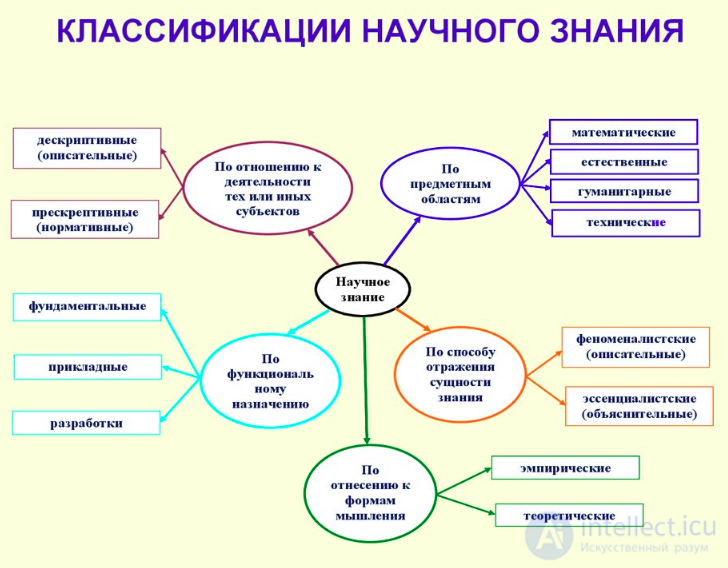
classification of scientific knowledge
Empirical knowledge by itself can rarely exhaustively explain a particular phenomenon. Such knowledge has little heuristic value, that is, it does not open up new possibilities for scientific inquiry. That is precisely why a theoretical level of knowledge is necessary, at which the empirical data obtained are fitted into a definite system. At the same time, without certain theoretical principles it is impossible to begin any empirical research.
Thus, the essence of theoretical knowledge is the description, explanation and systematisation of processes and regularities identified empirically, as well as an attempt at a holistic grasp of reality.
The main methods of theoretical knowledge are:
The main components of theoretical knowledge are:
The theoretical level of knowledge has two components — fundamental theories and theories that describe a specific area of reality, relying on the corresponding fundamental theories.
It is a more general level of scientific knowledge compared with the empirical and theoretical levels, is internally connected with them in the process of the development of scientific knowledge, and is made concrete for each scientific theory.
As its main components it includes general-scientific knowledge (the general-scientific picture of the world, general-scientific methodological, logical and axiological principles) and the philosophical foundations of science.
The metatheoretical level in mathematics is formed by metamathematics and metalogic. In the natural-science and socio-humanitarian disciplines, the metatheoretical level consists of the corresponding pictures of the world, as well as general-scientific and philosophical principles .
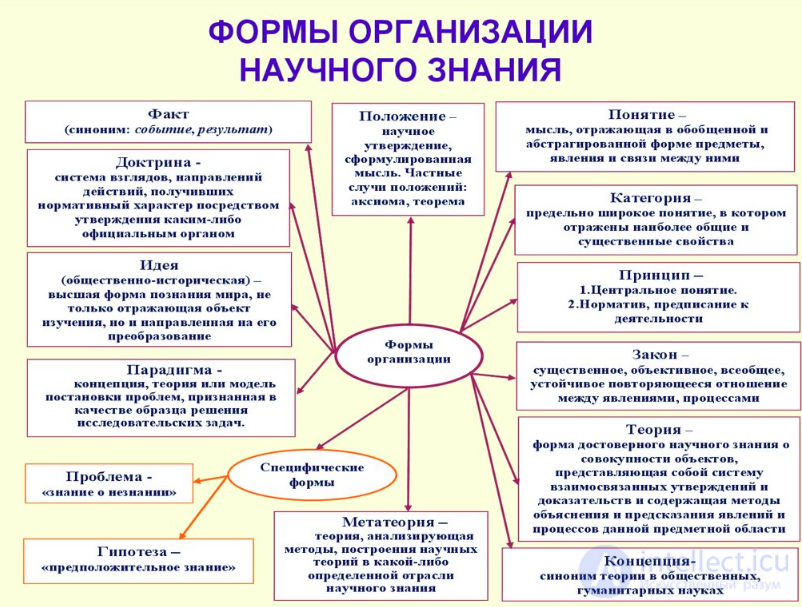
Forms of organisation of scientific knowledge
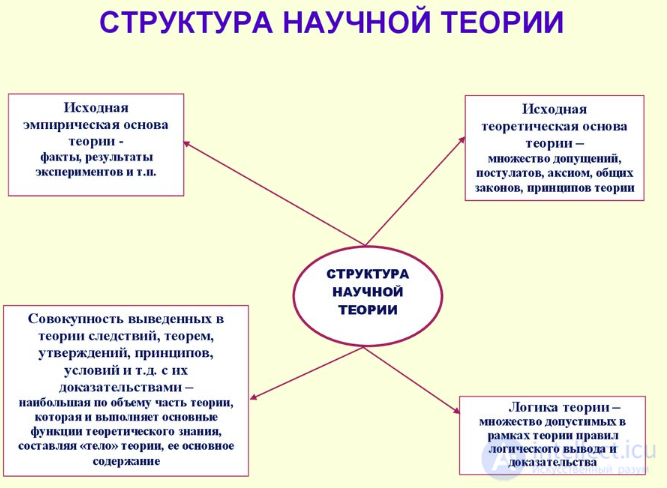
structure of a scientific theory

Comments