
Lecture
Let us give examples of heuristic rules from various spheres of human activity:
1. "First check the whole unit, and only then proceed to check
its components" (a heuristic used in the process of troubleshooting a technical system).
2. "First replace the cheaper parts, and only then take on
the more expensive ones" (another rule from the field of repair).
3. "Divisions that share the same customers (competitors) and common resources should conduct competitive intelligence in a centra-
131
131
lised manner. However, if the degree of similarity/overlap is low, a centralised competitive-intelligence structure should not be created" (a heuristic rule for determining the necessary degree of centralisation of competitive intelligence in a diversified company).
4. "If the patient has no high temperature, then the diagnosis
“flu” can be ruled out" (a rule from the field of medicine).
5. "If the patient has no runny nose, then the diagnosis “flu” can
be ruled out with a probability of 0.9" (another rule from the field of medicine).
6. "If it is necessary to eliminate the harmful effect of an object or process,
turn the harm into a benefit" (one of the rules for resolving contradictions in
systems).
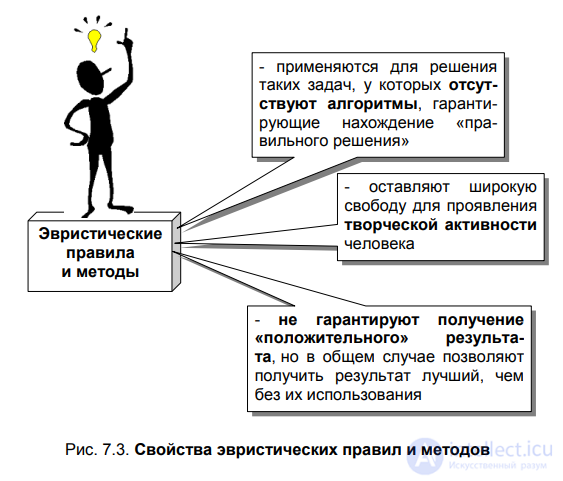
As we can see, heuristic rules largely guide human activity, but are by no means mandatory
prescriptions. They are rather recommendations formulated by a human expert on the basis of their practical experience. And it is the human user who decides on the application of a heuristic, based on their own
practical experience and intuition.
Heuristics are divided into limiting and directing,
absolute and relative (fig. 7.4).
In the list of examples of heuristic rules given above, heuristics No. 1, No. 2 and No. 6 belong to the directing type, heuristic No. 4 is
an absolutely limiting one, while heuristic No. 5 – a relatively limiting one.
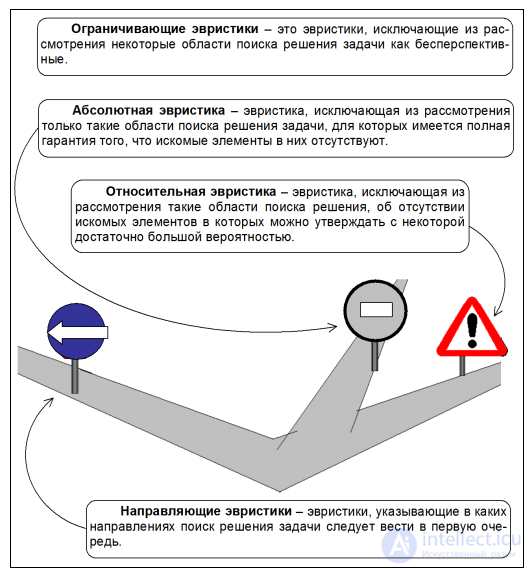
Fig. 7.4. Types of heuristic rules

Comments