
Lecture
Inference – is a logical operation whereby a new statement – a conclusion (inference, consequence) – is obtained from initial statements (premises). Deduction and induction are particular cases of inference.
Deduction – is an inference in which a logical transition is made from initial reliable statements to a new reliable statement. Typical deduction is an inference from general knowledge to particular knowledge.
Deduction makes it possible to derive new knowledge about an object on the basis of knowledge of the class to which the object under study belongs, and of the general properties characteristic of objects of that class.
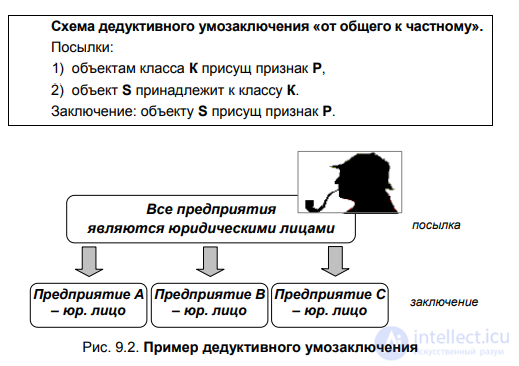
For example, bread belongs to the class of essential goods;
it is known that demand for essential goods is inelastic; therefore it can be concluded that demand for bread is inelastic
(Fig. 9.2).
Example 9.2
Sherlock Holmes on the deductive method
«From one drop of water…a person capable of logical thinking
can deduce the existence of the Atlantic Ocean or Niagara Falls, even if he has never seen either of them and has never
heard of them…
By a man's fingernails, by his hands, his footwear, the crease of his trousers…by the expression
of his face and the cuffs of his shirt – by such small details it is not hard to guess his
profession».
Arthur Conan Doyle, «A Study in Scarlet».
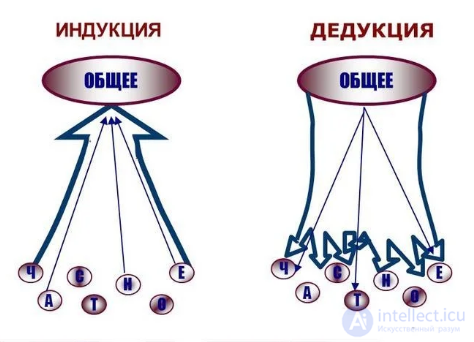
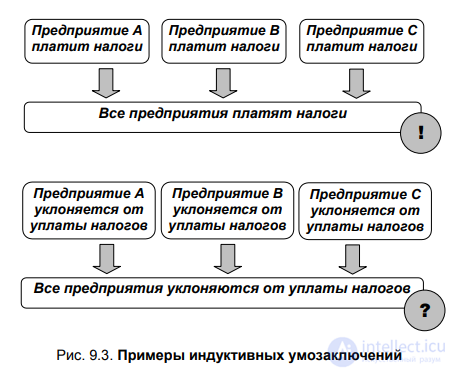
Induction – is a logical transition from reliable statements to probable ones. Typical induction is an inference from
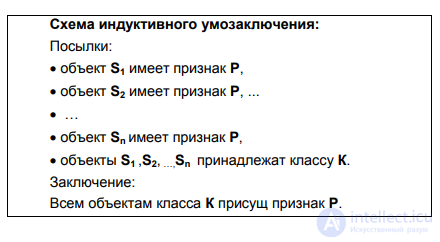
particular knowledge to general knowledge, when, on the basis of knowledge about part of the objects of a class, a conclusion is drawn about all objects of the class, about the class as a whole..
Induction – is a way of constructing hypotheses.
Many hypotheses in modern science are based on inductive
generalisations. For example, Dmitri Ivanovich Mendeleev, on the basis of generalising particular facts about chemical elements, formulated the well-
known periodic law.
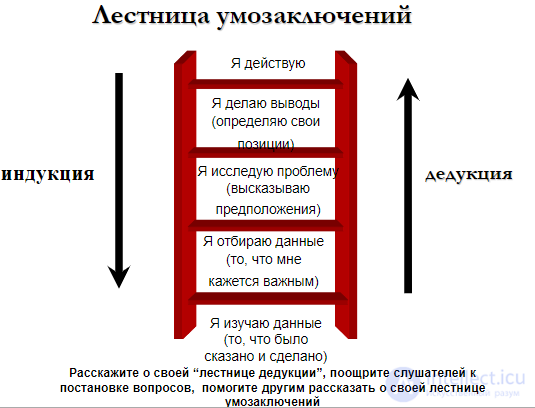
The ladder of inferences
Depending on the completeness of the empirical study of particular
facts, complete and incomplete induction are distinguished.
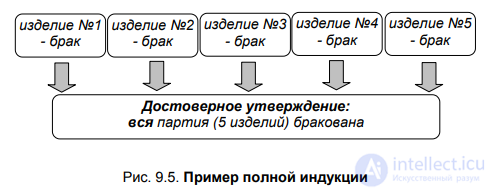
Complete induction is an inference in which a general conclusion about a class of objects is drawn on the basis of studying all objects of that class. Complete induction yields a reliable conclusion.
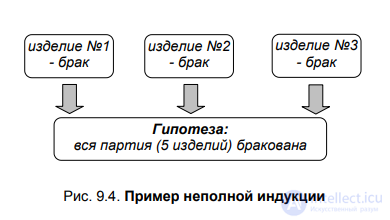
Incomplete induction – is a type of inductive inference in which a general conclusion about the features of an entire class of objects is drawn as a result of studying only part of the objects of that class.
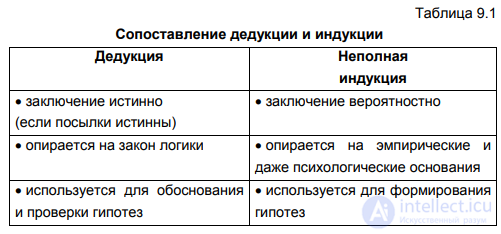
Incomplete induction considerably exceeds complete induction in the growth of knowledge it provides: its conclusion yields knowledge about new objects (not only about those that were considered in the premises). However, its conclusions possess a greater or lesser degree of probability (Table 9.1).
Depending on the degree to which the logical transition from
particular knowledge to general knowledge is justified, incomplete induction is subdivided into simple and scientific induction.
- Simple (popular) induction - is an inference in which a general conclusion about a class of objects is drawn on the basis of a random selection of particular facts.
- Scientific induction is an inference in which
generalisation is built by selecting necessary circumstances and excluding random ones. That is, there is a scientifically grounded
selection of facts, a study of methodically selected, most typical phenomena (see Example 9.3).
In simple induction, the observed objects are selected spontaneously,
unsystematically, and the general conclusion about the class of objects is drawn on the grounds that among the observed facts none was found that contradicted the generalisation. As a result, the discovered commonality of features may turn out to be accidental, and the inductive generalisation – false.
For this reason, simple induction is the least reliable kind
of inductive inference. It is used at the early stages of scientific research to form working hypotheses, which will later
be refined and revised.
Example 9.3 Scientific induction in production
Suppose an enterprise is set the task of investigating the qualitative homogeneity of steel from one and the same heat. Samples for analysis can be selected in various ways. One could take samples from a single ladle and judge the homogeneity of the entire heat from the commonality of properties of several portions. This approach amounts to popular induction. However, there is also another way, requiring the development of a certain methodical system for selecting samples for study, taking into account the time sequence in which the heat leaves the open-hearth furnace. With this approach, the possibility of accidental generalisation is usually eliminated. Here we see an example of scientific induction (the example is taken from the book by A.A. Yerishev, N.P. Lukashevich, and E.F. Slastenko).

Comments