
Lecture
Fig. 14.1. System elements of the topic
INTRODUCTION TO THE CHAPTER
The purpose of this chapter is to describe the purpose and features of dissertation research works. We shall answer the questions: Who writes dissertations? Why are dissertations written? How are dissertations written? Who con-
262
262
ducts the examination of dissertations? Who determines the rules for the defence of a dissertation?
Key concepts of this chapter: academic degree, dissertation
for the award of an academic degree, Higher Attestation Commission of Ukraine (VAK), specialized academic council.
THEORETICAL MATERIAL
§ 14.1. The System for the Certification of Scientific Personnel in Ukraine
Among the many research works a special place
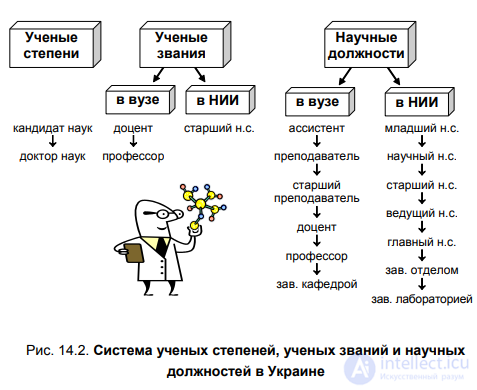
is occupied by so-called qualification works, based on the results of which their authors are awarded an academic degree. In Ukraine, at
the present time, the following classification of academic
degrees has taken shape: bachelor, master, Candidate of Sciences and Doctor of Sciences. In addition to academic
degrees, the system for the certification of scientific personnel of Ukraine also has
academic titles and scientific positions (Fig. 14.2) [27].
The degrees of bachelor and master in the corresponding speciality
are awarded to graduates of institutes, universities and institutions equivalent
to them.
The academic degrees of Candidate of Sciences and Doctor of Sciences are conferred on persons who have a complete higher education, deep professional knowledge and significant achievements in a particular field
of science. The degrees of Candidate and Doctor of Sciences are conferred on the basis of the results
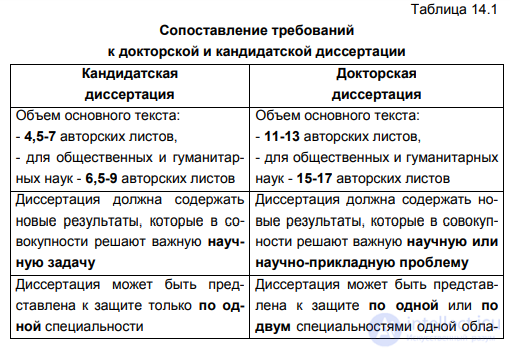
of the defence of dissertations (Table 14.1).
A dissertation for the award of an academic degree is a qualification research work, performed personally by the degree candidate in the form of
a specially prepared manuscript or a published monograph. It contains scientifically substantiated theoretical or experimental results, put forward by the author for public defence,
scientific propositions, and is also characterized by unity of content
and attests to the personal contribution of the degree candidate to science [37].

The main forms of training Candidates and Doctors of Sciences are postgraduate (PhD) studies and doctoral studies. The term of full-time postgraduate study is 3 years, and for part-time study while remaining in employment – 4 years. Another way of working on a candidate's dissertation is degree-seeking (soiskatelstvo), that is, the independent work of a specialist on a dissertation
while remaining in employment. The term for degree-seeking is 5 years.
The main governing body in the system for conferring the degrees of Candidate and Doctor of Sciences in Ukraine is the Higher Attestation Commission of Ukraine (VAK).
The Higher Attestation Commission of Ukraine (VAK of Ukraine) is the central body of executive power, which implements state policy in the field of the certification
of scientific and scientific-pedagogical personnel of the highest qualification, carries out the conferral of the academic degrees of Candidate
of Sciences and Doctor of Sciences, as well as the awarding of the academic title of senior research fellow [34].
VAK carries out the examination of dissertations and the issuing of diplomas
of Candidate and Doctor of Sciences. VAK also develops normative acts
regulating certification activity in the country. The documents
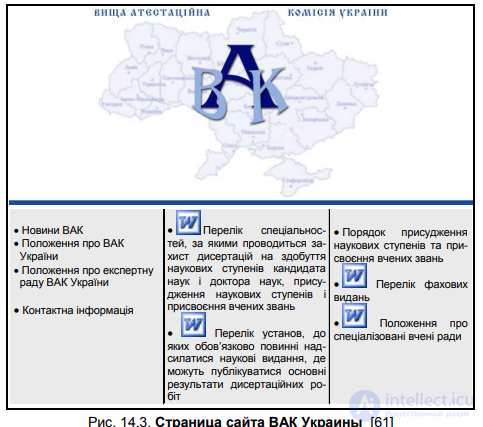
defining the requirements for conducting, formatting and defending dissertation works can be found on the website of VAK of Ukraine -
http://www.vak.org.ua/index.htm (Fig. 14.3), as well as in the bulletins published by VAK.
Under the guidance of VAK, specialized (dissertation) academic councils are created at higher education institutions and research institutes, which are the main link of the certification system at the local level. It is here that a degree candidate presents their dissertation work for the purpose of its defence and
obtaining the corresponding academic degree; it is here that initially
the most complete examination of the dissertation is conducted [17]. The procedure for the creation, functioning and activity of a specialized academic council is determined by the «Regulation on Specialized Academic
Councils», which is approved by VAK.

Comments