
Lecture
When studying scientific literature, the order
in which different sources are examined plays an important role. First, scientific works
are interconnected, they complement and build on one another. Second, the degree to which the material read is correctly understood depends on the reader's level of preparation, which is determined by the works read earlier.
The basic principle of studying scientific literature is moving from
simple material to complex, from the general to the specific.
Proceeding from this, specialists recommend organizing one's acquaintance with the scientific literature on a research topic in the following order
[3]:
- first become acquainted with the literature via abstract journals, compile a bibliography, and only then move on to the direct study of the required materials;
- begin the detailed study of literary sources with fundamental works, in which the topic under study is treated in the context of
the general paradigm of science;
- study newer works first, then older ones;
- study simpler material first, then more complex material;
- general works first, then specialized ones;
- theoretical works first, then applied ones;
- domestic works first, then foreign ones.
In the process of becoming acquainted with literary sources, one should
deliberately use two different types of reading – «fast»
and «slow» (Fig. 4.6).
«Fast» reading is reading «diagonally», which makes it possible to answer the question of whether it is worth spending time on a careful study of a given book or article.
«Slow» reading is intended for an in-depth acquaintance with a needed literary source.
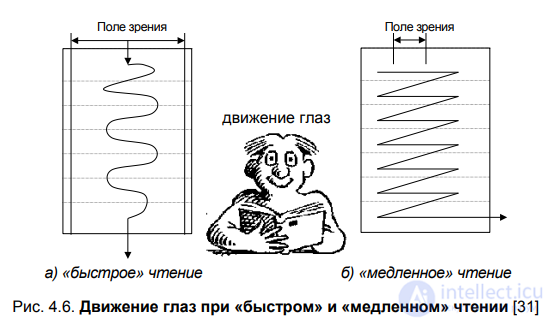

For an in-depth study of literary sources, one should use «slow» reading, accompanied by a detailed analysis of what has been read.
When reading a scientific article, it is important to understand that a scientific article
is a description of a certain piece of scientific research: its
concept and results, the hypotheses and axioms adopted, and the methods and models used.
In order for the reader to be able to «see» the main ideas of the research work carried out beyond the lines of the text, they
must be able to structure the article correctly.
To structure a scientific article means to find, in the text of the article, descriptions of the key elements of the corresponding scientific research in their logical interrelation.
78
78
In other words, this means «deciphering» the article. This fascinating process is akin to the process of decoding a cipher or reconstructing historical events. Structuring a scientific text allows the reader to reconstruct the picture of the main points of the research work, correctly assess the novelty and importance of the results obtained and, most importantly, subsequently make fruitful use of them in
their own professional activity.
In the process of structuring a scientific article, the reader must
identify the following key elements of the scientific research:
1. The problem of the subject area.
2. The scientific problem.
3. The object of the scientific research.
4. The subject of the scientific research.
5. The aim of the scientific research.
6. The hypothesis.
7. The facts on the basis of which the hypothesis was formulated.
8. The scientific research methods applied.
9. The conclusions obtained.
10. The scientific result.
Some of the listed elements may be described in
the text of the article explicitly, others – implicitly. In the latter case, the reader must
formulate the corresponding elements of the scientific research
independently.
Structuring a scientific article makes it possible to identify its main
ideas, to determine the work's place among current scientific research, and also to understand the theoretical and applied value of the results obtained

Comments