
Lecture 13 min.
The principal regulatory act governing activity in the field of education in the state is the Law of Ukraine of 23 March 1996 "On Education".
State policy in the field of education is determined by the Verkhovna Rada of Ukraine (in accordance with the Constitution of Ukraine) and is implemented by bodies of state executive power and local self-government bodies.
The structure of education includes the following:
In Ukraine the following levels are established:
educational levels:
educational-qualification levels:
qualification levels of basic higher education:
State standards of education are developed separately for each educational and educational-qualification level and are approved by the Cabinet of Ministers of Ukraine (CMU). They are subject to review and re-approval at least once every ten years.
Governance of education in Ukraine is carried out by a system of state bodies and local self-government bodies. The bodies governing education in Ukraine include:
The central sectoral body of state governance in the field of education is the Ministry of Education and Science, Youth and Sport of Ukraine (MESYS). MESYS develops the regulatory and legal framework for the functioning of the education system, examines draft national, departmental and other decisions and programmes as they relate to education and science, prepares draft legislative acts and government decisions; forecasts and streamlines the structure of the network of state educational institutions; develops proposals regarding the list of specialties, qualifications, academic titles and academic degrees; ensures that higher education institutions under its administration fulfil the state order and contracts for the training of specialists and academic-teaching personnel; develops regulations for educational institutions.
In the sphere of administration and work with managerial and academic-teaching personnel, MESYS submits proposals for the establishment, reorganisation and, in accordance with the established procedure, liquidation of institutions, organisations and enterprises of education of national significance; promotes the development of new educational institutions; carries out, in accordance with the established procedure, the attestation and accreditation of educational institutions regardless of their form of ownership and subordination, issues them licences and certificates, grants autonomy to higher education institutions; carries out state inspection of educational institutions; appoints the heads of educational institutions and institutions for advanced training and retraining of personnel that are under the functional administration of the Ministry of Education and Science of Ukraine, and gives consent to the appointment and dismissal of the heads of higher education institutions of national significance belonging to other ministries and agencies; develops regulations on bodies of public self-government in the field of education; organises advanced training and retraining of personnel of the education system; exercises general direction of scientific activity, and so on.
Other ministries and agencies of Ukraine, to which educational institutions are also subordinated (the Ministry of Culture and Arts, the Ministry of Health, the Ministry of Justice, the Ministry of Internal Affairs, the Security Service, the Prosecutor's Office and others), together with MESYS carry out state governance of the educational institutions subordinate to them.
The Higher Attestation Commission of Ukraine (VAK of Ukraine), in accordance with the Regulation on the Higher Attestation Commission of Ukraine, organises and conducts the attestation of scientific and academic-teaching personnel, and directs the work of conferring academic degrees and awarding the academic title of senior researcher.
The Ministry of Education of the ARC exercises authority over the governance of education in the territory under its jurisdiction, except for the powers assigned to the competence of MESYS and the ministries and agencies to which educational institutions are subordinated.
The foundations for organising science and training scientific personnel in Ukraine are set out in the Law of Ukraine "On Scientific and Scientific-Technical Activity".
A general outline of the organisation of science in Ukraine is presented in Fig. 1.1.
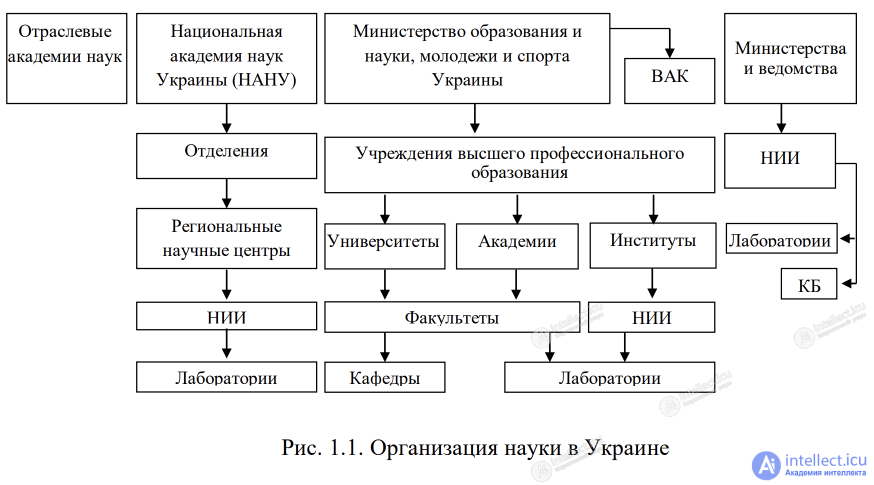
Fig. 1.1. Organisation of science in Ukraine
General direction of scientific research is carried out by the Cabinet of Ministers of Ukraine (CMU), which includes MESYS. The central body of executive power in the sphere of science governance is MESYS.
A specific place in the system of bodies operating in the sphere of science belongs to the Higher Attestation Commission of Ukraine (VAK) - the central body of executive power with the status of a state committee of Ukraine. VAK of Ukraine implements state policy in the field of attestation of highly qualified scientific and scientific-technical personnel, confers academic degrees and awards the academic title of senior researcher, and oversees the activity of specialised academic councils and the quality of attestation of highly qualified scientific and academic-teaching personnel.
VAK of Ukraine establishes specialised dissertation defence councils, approves their personal composition and the list of specialties for which these councils are granted the right to conduct dissertation defences, carries out their periodic attestation, develops and approves the requirements for dissertations and for persons seeking an academic degree and the academic title of senior researcher; approves the decisions of specialised academic councils on the conferral of the academic degree of Doctor of Sciences; makes decisions on issuing the certificate of senior researcher on the basis of an academic council's decision to award the academic title of senior researcher. On matters of attestation of highly qualified scientific and academic-teaching personnel, VAK of Ukraine issues an information bulletin.
To coordinate the work of ministries and other central bodies of executive power, the Commission of the Cabinet of Ministers of Ukraine on Scientific and Technical Development has been established, which operates in accordance with the Regulation approved by the CMU on 26 January 1998.
Another leading scientific centre of the country is the National Academy of Sciences of Ukraine (NASU). Since 22 March 1994, the Academy of Sciences has had national status and is now officially named the National Academy of Sciences of Ukraine. NASU is a self-governing state scientific organisation based on state property and operating in accordance with the legislation of Ukraine and the Statute of the Academy. It is the highest scientific institution of Ukraine, which organises and conducts fundamental and applied research into the most important problems of the natural, technical and humanities sciences. NASU coordinates the conduct of fundamental research in scientific institutions and organisations regardless of their form of ownership. Under NASU an interdepartmental council operates to coordinate fundamental research in Ukraine. The regulation on the council and its composition is approved by the CMU.
Besides NASU, sectoral academies of sciences also operate in Ukraine.
- The Ukrainian Academy of Agrarian Sciences.
- The Academy of Pedagogical Sciences of Ukraine was established by Decree of the President of Ukraine of 3 March 1992.
- The Academy of Medical Sciences of Ukraine was established by Decree of the President of Ukraine of 24 February 1993.
- The Academy of Legal Sciences of Ukraine was established by Decree of the President of Ukraine of 23 July 1993.
- The Academy of Arts of Ukraine, as the highest creative and academic institution in the field of art, established by Decree of the President of Ukraine of 14 December 1996.
Academies operate on the basis of a charter and may include research institutes, scientific-practical centres, educational institutions, laboratories and other institutions of various profiles for organising and conducting research.
Non-state academies also operate in Ukraine, uniting scientists on a voluntary basis according to the profile of their scientific activity. These include the Transport Academy of Ukraine, the Ukrainian Academy of Shipbuilding Sciences, the Academy of Economic Sciences, the Academy of Engineering Sciences, and others. Some of these academies have international status. As a rule, non-state academies do not have research institutes with a permanent staff of researchers within their structure, and the members of these academies conduct scientific research at their main place of work (higher education institutions, sectoral research institutes, design institutes, and so on).
Within the structure of many ministries and agencies, sectoral research institutes (NII), design and engineering bureaus (OKI) and other institutions operate, which participate in the development of sectoral and departmental science. They serve as a testing ground for trialling new models of design bureaus (KB). In the laboratories of research institutes, new materials are created, and calculations and forecasts of current and future theoretical models are carried out. Research institutes are also part of the structure of large higher education institutions. In addition, within faculties, research is conducted by departments and laboratories.
A research institute is organisationally divided into divisions (groups of departments), departments, laboratories, sectors and research groups, depending on the specifics of the institution's activity. The scientific career of a future researcher usually begins in laboratories and research groups, i.e. at the very lowest levels of the scientific institution. The institute's activity is headed by its director, under whom an academic council operates - an advisory body coordinating the main directions of research-and-development work.
Specialised academic councils of research-and-development institutes examine dissertations and submit materials to VAK under MESYS for the conferral of the academic degree of Doctor of Sciences, and, for verification, materials on the conferral by the council of the academic degree of Candidate of Sciences.
In Ukraine, in the sphere of maritime transport, the research institute of the merchant marine "UkrNIIMF" and the research and design-survey institute "ChornomorNIIproekt" operate, which are subordinate to the Department of Maritime and River Transport of the Ministry of Transport and Communications of Ukraine.
A significant amount of research is conducted in higher education institutions (HEIs) of accreditation levels III – IV (universities, academies), within which research institutes or departments operate.
One form of organising science is national scientific centres. The status of a national scientific centre may be granted to a scientific institution or a higher education institution of accreditation level IV (or an association of scientific institutions or higher education institutions of accreditation level IV) that conducts comprehensive scientific research of national significance and enjoys international recognition for its activity. The status is granted by Decree of the President of Ukraine on the recommendation of the CMU. National scientific centres carry out their activity in accordance with the Regulation on the National Scientific Centre, which is approved by the CMU.
The legal, organisational and financial foundations of expert activity in the scientific-technical sphere are defined by the Law of Ukraine of 10 February 1995 "On Scientific and Scientific-Technical Expertise". Mandatory scientific and scientific-technical expertise applies to: national, state and interstate scientific and scientific-technical programmes; sectoral and cross-sectoral programmes; innovation programmes and projects of national significance.

Comments