
Lecture 9 min.
Personnel for scientific activity are trained by higher education institutions of accreditation levels III-IV and the research organisations of the National Academy of Sciences of Ukraine, state sectoral academies, and sectoral research institutes.
The main forms of training scientific and academic-teaching personnel in Ukraine are postgraduate (PhD) studies and doctoral studies, the procedure for admission to and completion of which is established by the Cabinet of Ministers of Ukraine (Fig. 1.2).
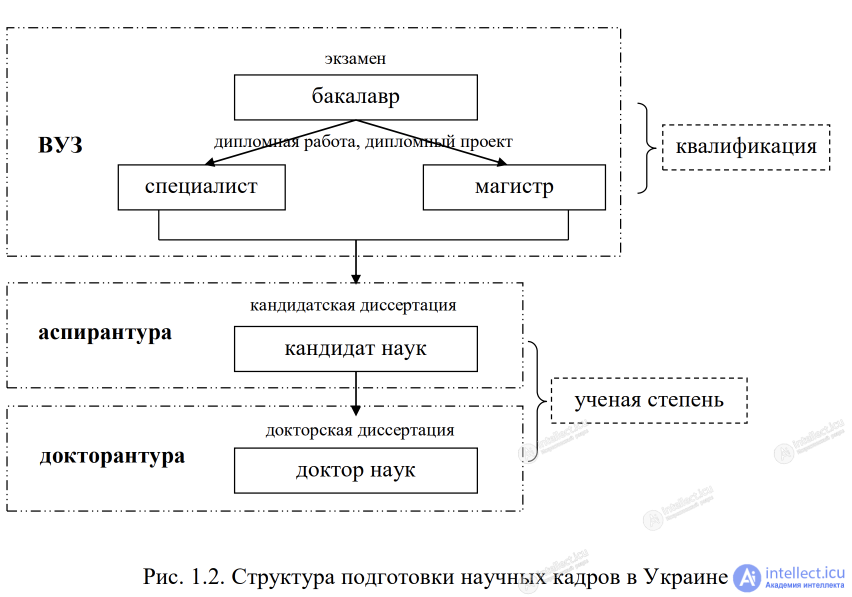
Fig. 1.2. Structure of the training of scientific personnel in Ukraine
Postgraduate studies - the most widespread form of training academic-teaching and scientific personnel. Admission to postgraduate studies is on a competitive basis for persons with a higher education degree. Each postgraduate student is assigned a research supervisor. The individual plans of postgraduate students and the topics of their dissertations are approved by the rector of the higher education institution. The duration of full-time training is not more than four years; part-time - four years.
The 4-year term of full-time postgraduate (PhD) studies has been in effect since 2016 - following the reform of the system of training scientific personnel and the introduction of the degree of Doctor of Philosophy (PhD) in place of the former three-year term.
During the period of study, a postgraduate student is required to:
A postgraduate student undergoes annual attestation by the department and is expelled from postgraduate studies for failure to fulfil the individual plan.
A candidate's dissertation is a scientific qualification work containing the solution of a problem of substantial significance for the relevant branch of knowledge, or providing the solution of important applied problems.
After the successful public defence of a candidate's dissertation, persons who have passed the candidate minimum examinations are awarded the degree of Candidate of Sciences.
Doctoral studies is one of the forms of training academic-teaching and scientific personnel in the system of postgraduate education. Persons admitted to doctoral studies are those who hold the degree of Candidate of Sciences, have scientific achievements in the relevant field of knowledge, and are capable of conducting scientific research at a high level in accordance with the current nomenclature of specialties. The duration of full-time training is not more than three years.
A doctoral candidate is assigned a scientific consultant from among Doctors of Sciences. During the period of training, the doctoral candidate is required to fulfil the dissertation preparation plan and submit the completed dissertation to the department to obtain the corresponding assessment.
A doctoral dissertation is a scientific qualification work in which, on the basis of research conducted, theoretical propositions are developed whose combination can be classified as a new major achievement in the development of the relevant scientific field, or in which a solution is provided to a problem of important significance for the relevant branch of knowledge, or in which solutions are set out whose implementation makes a significant contribution to accelerating scientific and technological progress.
After the successful public defence of a doctoral dissertation, persons holding the degree of Candidate of Sciences or the academic title of professor are awarded the degree of Doctor of Sciences. As an exception, the doctoral degree may also be awarded without the defence of a dissertation to persons known for their outstanding scientific works, discoveries and inventions.
The procedure for conferring academic degrees and awarding academic titles was approved by Resolution of the CMU of 28 June 1997.
The development of scientific knowledge is a movement from the undivided unity of science towards a complex system of specialised knowledge in all spheres of human activity. The classification of sciences takes place together with the formation of scientific knowledge.
The system of sciences is conventionally divided into natural, humanities and technical sciences (Fig. 1.3). These, in turn, are divided into scientific fields (specialties).
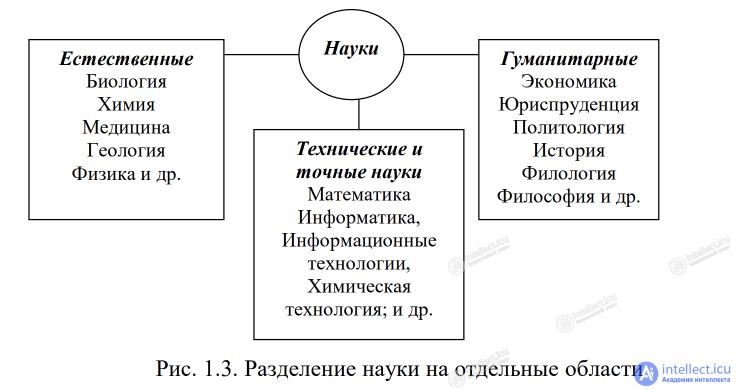
Fig. 1.3. Division of science into separate fields
All existing scientific specialties, with codes consisting of three pairs of Arabic digits, are given in the nomenclature of scientific specialties.
VAK of Ukraine approved the specialties of scientific workers, whereby the system of science is subdivided into branches, groups and individual sciences.
The main branches of science according to the classification given are as follows:
01.00.00 - Physics and Mathematics;
02.00.00 - Chemistry;
03.00.00 - Biology;
04.00.00 - Geology;
06.00.00 - Agriculture;
07.00.00 - History;
08.00.00 - Economics;
09.00.00 - Philosophy;
10.00.00 - Philology;
11.00.00 - Geography;
12.00.00 - Law;
13.00.00 - Pedagogy;
14.00.00 - Medicine;
15.00.00 - Pharmacy;
16.00.00 - Veterinary Science;
17.00.00 - Art History;
18.00.00 - Architecture;
19.00.00 - Psychology;
20.00.00 - Military Science;
21.00.00 - National Security;
22.00.00 - Sociology;
23.00.00 - Political Science;
24.00.00 - Physical Education and Sport;
25.00.00 - Public Administration.
The branches of science listed above are further differentiated in the classification into groups. The division of technical sciences into groups is given in Table 1.1.
Table 1.1
Differentiation of technical sciences into groups
|
05 |
TECHNICAL SCIENCES |
|
05.01.00 |
Applied geometry, engineering graphics and ergonomics |
|
05.02.00 |
Machine science |
|
05.03.00 |
Processing of materials in mechanical engineering |
|
05.05.00 |
Sectoral mechanical engineering |
|
05.07.00 |
Aviation and rocket-space technology |
|
05.08.00 |
Shipbuilding |
|
05.09.00 |
Electrical engineering |
|
05.11.00 |
Instruments |
|
05.12.00 |
Radio engineering and telecommunications |
|
05.13.00 |
Informatics, computer engineering and automation |
|
05.14.00 |
Power engineering |
|
05.15.00 |
Mineral resource development |
|
05.16.00 |
Metallurgy |
|
05.17.00 |
Chemical technologies |
|
05.18.00 |
Technology of food and light industry |
|
05.22.00 |
Transport |
|
05.23.00 |
Construction |
|
05.24.00 |
Geodesy |
|
05.26.00 |
Life safety |
|
05.27.00 |
Electronics |
|
05.28.00 |
History of technology |
The groups listed above are subdivided into individual sciences (specialties). Table 1.2 gives an example of the differentiation of the transport group into specialties.
Table 1.2
Differentiation of the transport group into specialties
|
05.22.00 |
Transport |
|
05.22.01 |
Transport systems |
|
05.22.02 |
Automobiles and tractors |
|
05.22.06 |
Railway track |
|
05.22.07 |
Railway rolling stock and train traction |
|
05.22.09 |
Electric transport |
|
05.22.11 |
Roads and airfields |
|
05.22.12 |
Industrial transport |
|
05.22.13 |
Navigation and traffic control |
|
05.22.20 |
Operation and repair of transport vehicles |
Scientific workers who combine research activity with teaching work are awarded academic titles: associate professor, professor. The structure of the awarding process is shown schematically in Fig. 1.3. Attestation of scientific personnel in Ukraine is carried out by the Higher Attestation Committee - VAK of Ukraine.
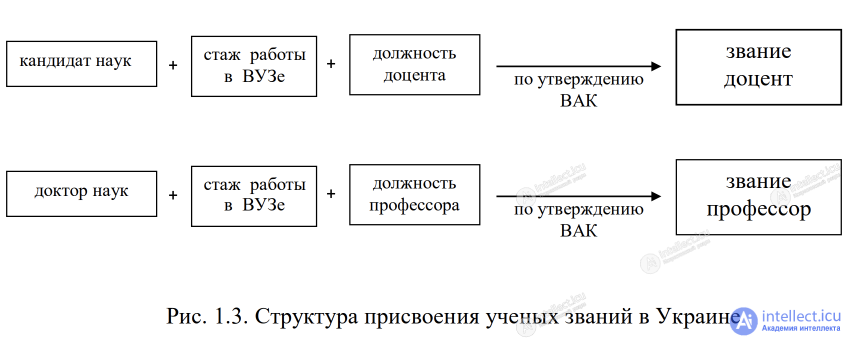
Fig. 1.3. Structure of the awarding of academic titles in Ukraine
Employees of research organisations are awarded, by their academic councils, the academic titles of junior and senior researcher. The decision to award the academic title of senior researcher must be approved by VAK of Ukraine, as must the decisions of specialised academic councils on the conferral of the academic degrees of Candidate and Doctor of Sciences.

Comments