
Lecture
A report is one of the types of monologic speech, a public, detailed, official communication on a particular question, based on the use of documentary data; a communication or document whose content presents information and reflects the essence of the question or research as applied to the given situation.
In order to understand how to correctly present the results of research work, it is important to understand why this is done. The main purposes of publicizing the results of research
are:
These goals shape the main requirements for presenting scientific results to the general public: the information made public must be reliable and well-founded, clearly and understandably presented.
The requirements for the structure of scientific articles are established by the Higher Attestation Commission (VAK) .
According to a resolution of the presidium of VAK , the editorial boards of scientific publications are required to accept for publication only those scientific
articles that contain a number of mandatory elements (these elements are shown in Fig. 5.4).
When writing a scientific article, in addition to observing the mandatory
requirements of VAK, it is also advisable to follow the specialists' recommendations below:
A reader's understanding of the text of an article depends both on their ability to analyze scientific text (see § 4.2) and on the author's ability to present this text clearly.
- publish on time (both premature articles and delays in publication should be avoided: a premature article may
contain unreliable information, while a delayed article may lead to a loss of priority in authorship).
Faraday's motto: «to work, to finish, to publish» (work, finish, publish)
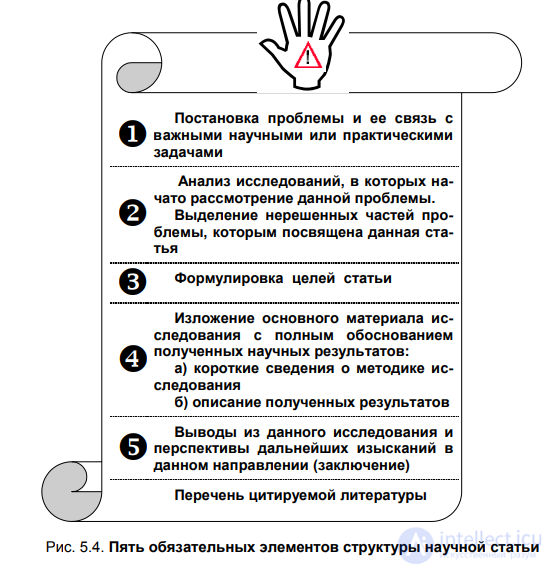
The outline of a scientific report is similar to the outline of a scientific article (Fig. 5.4),
however the content of the report should differ somewhat from the text of the article. The reasons for this are such features of a report as oral
speech, the time limit on the presentation, the availability of posters, and the possibility of feedback.
The following requirements are usually put forward for the presentation of a report:
Illustrations allow the speaker to turn listeners into viewers and to form in them an image of the problem under consideration.
The use of illustrative material makes it possible to shorten the report by 20-30%.
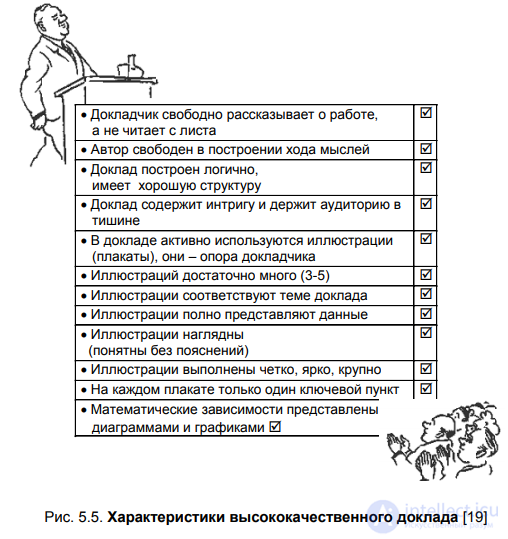
The characteristics of a well-prepared report are shown in Fig. 5.5. These characteristics can be used both for assessing the quality of reports one has listened to and for self-assessment. Meeting each requirement is scored 1 point, and not meeting it is scored 0 points. To obtain an integral assessment of the report, one needs to sum the points across all criteria and divide the resulting sum by the number of criteria.
The final score will fall within the range [0;1]. Obviously, the higher this score, the higher the quality of the report.
Objective of the assignment:
Supplementary material
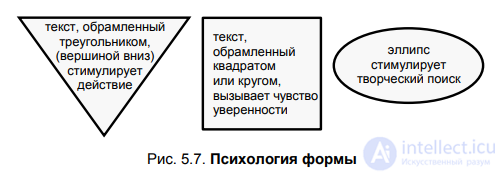
Psychologists have established the following regularities in the perception
of text on posters and slides [39]:

Prepare the text of the report and layouts of the posters illustrating the relevance, purpose, object, subject, and hypotheses of your research work. When preparing the posters, the regularities of human perception of visual information must be taken into account.
8. What forms exist for presenting the results of scientific research?
9. What types of documents (monograph, scientific article, etc.) contain descriptions of research results obtained not only by the authors of the document, but also by other researchers?
10. What types of documents have only one author and contain descriptions of research results obtained personally by them?
11. Why, in your opinion, did such a type of document as deposited manuscripts arise?
12. What requirements for the structure of scientific articles have been established by the Higher Attestation Commission (VAK)?
13. Why do the requirements for a scientific report differ somewhat from the requirements for a scientific article?
14. How should the illustrative material (posters and slides) accompanying a speaker's presentation be formatted?
Having studied Chapter 5, you have learned that:
1) a statement of the problem;
2) an analysis of research devoted to the problem under consideration;
3) a formulation of the goals of the article;
4) a description of the course and results of the research;
5) conclusions.
[[b8982]]

Comments