
Lecture
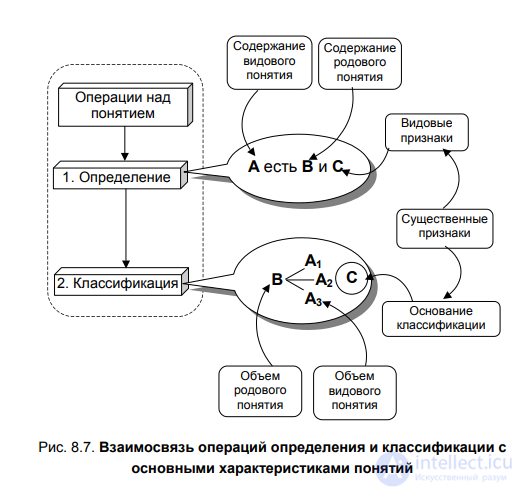
Classification – is a multi-stage, branching division. Classification, also classifying (from the Latin classis «rank» and facere «to make») — a concept in science (in philosophy, formal logic and elsewhere) denoting a form of dividing the extension of a concept according to a definite basis (feature, criterion), in which the extension of a generic concept (class, set) is divided into species (subclasses, subsets), and the species, in turn, are divided into subspecies, and so on.
Division – is a logical operation for distributing into groups those objects that are conceived within the initial (divided)
concept. The groups obtained as a result of the division are called the members of the division. The feature by which the division is carried out is called the basis of the division.
The Argentine writer Jorge Luis Borges cites in one of his books
a passage from «a certain Chinese encyclopedia». According to this encyclopedia, «animals are divided into:
Classification is widely used both in science (especially in the natural sciences) and in practical activity, and scientific classifications are distinguished by a more stable character, so they persist for a long time . For example, the classification of chemical elements created by D. I. Mendeleev continues to be supplemented to this day.
In classification, the choice of basis (criterion, feature) for dividing the subject is of great importance. The basis may be essential or non-essential. Classification carried out on an essential feature is called natural, while classification carried out on a non-essential feature is called — artificial (or, auxiliary) classification .
One of the difficulties that arises in classification is the transitional form . For example, when classifying human and civil rights and freedoms, freedom of speech may be assigned either to natural (innate) rights or to political rights.
Depending on their breadth, classifications may be encyclopedic (universal) and specialised (branch-specific), the latter covering classifications of a narrow range of homogeneous phenomena .
It is intuitively clear that this classification is not drawn up correctly. So how should it be done correctly?
A correctly drawn-up classification must satisfy a number of standard requirements, shown in Fig. 8.5.
As we can see, the classification «from the Chinese encyclopedia» violates
the standard rules. Let us give further examples of erroneous classifications (see also Fig. 8.6):
1. Example of a violation of rule No. 1: by level of education, people
are divided into those with primary education, secondary education and higher education. Such a classification leaves no place, for example, for a small illiterate boy.
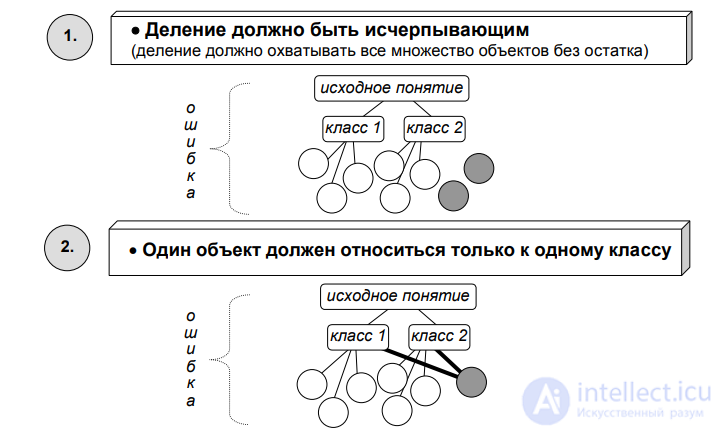
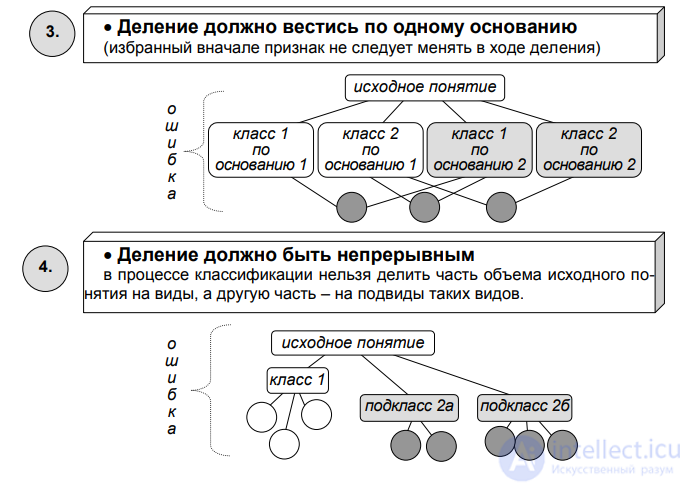
Fig. 8.5. Rules for forming classifications
2. Example of a violation of rule No. 2: numbers are divided into
multiples of two, multiples of 3, multiples of 5 and primes. In such a classification, the number 30, for example, belongs to several classes at once.
3. Example of a violation of rule No. 3: footwear is divided into men's,
women's and rubber. Here the basis of division was at first the sex of the footwear's wearer, and then – the material of the footwear.
Which group should men's rubber boots be placed in?
4. Example of a violation of rule No. 4: people are divided into women, tall men and short men. It would be correct to first single out the classification groups of men and women, and then within these groups to single out subgroups by the feature of height

Classifications are divided into natural and artificial.
Of course, the «essentiality» of a feature depends on the tasks for whose solution the classification is being performed.
Since classification is a form of the division of a concept, it is subject to all the rules used in the operation of dividing the extension of concepts .
The problem of classification - a formalised problem that contains a set of objects (situations) divided in a certain way into classes . Given is a finite set of objects for which it is known to which classes they belong. This set is called the sample . It is unknown to which class the other objects belong. It is necessary to construct an algorithm that will be capable of classifying an arbitrary object from the original set.
To classify an object means to indicate the number (or name) of the class to which this object belongs.
The classification of an object - the number or name of the class, output by the classification algorithm as a result of its application to this object.
In mathematical statistics, classification problems are also called problems of discrete analysis. In machine learning, the classification problem is, as a rule, solved using artificial neural network methods when the experiment is set up as supervised learning.
There are also other ways of setting up the experiment - unsupervised learning, but these are used to solve a different problem - clustering or taxonomy. In these problems the division of the objects of the training sample into classes is not given, and objects must be classified solely on the basis of their similarity. In some applied fields, as well as in mathematical statistics itself, because of how close the problems are, the clustering problem is often not distinguished from the classification problem.
Some algorithms for solving classification problems combine supervised and unsupervised learning, for example, one of the versions of Kohonen neural networks - learning vector quantization networks trained by a supervised learning method.
PRACTICAL COMPONENT. WORKING WITH CONCEPTS IN THE COURSE OF SCIENTIFIC RESEARCH
Purpose of the assignment:
- to learn to identify the content of the key concepts of the subject area under study on the basis of an analysis of the literature.
Supporting material
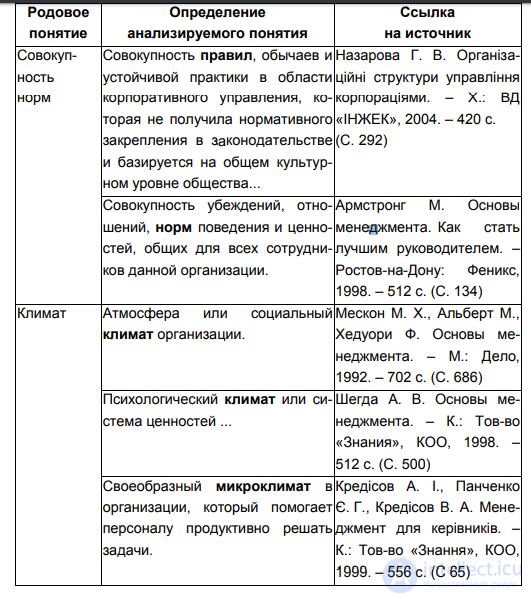
An important component of working with concepts in the course of scientific research is identifying and clarifying the content of the key concepts of the subject area under study. The essence of concepts is identified on the basis of an analysis of the works of domestic and foreign scholars.
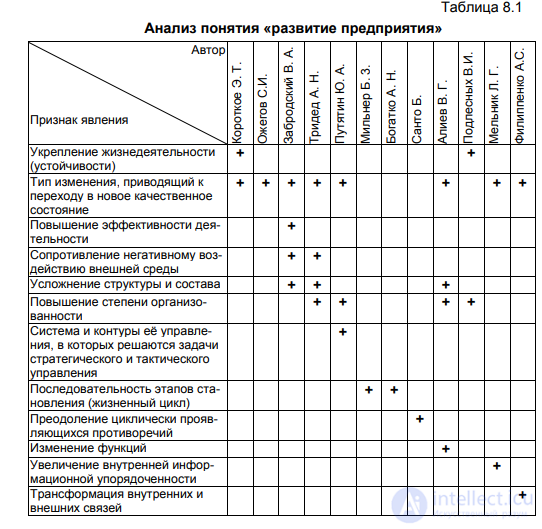
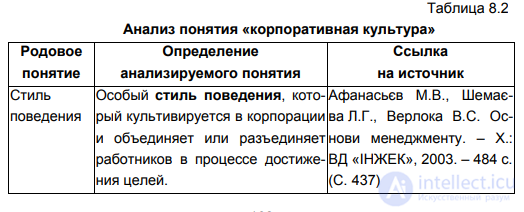
As experience shows, different authors interpret the content of many concepts describing economic and social phenomena differently. In this connection, an analysis of scholarly works aimed at identifying the essence of the concept under consideration should provide answers to the following questions: In the opinion of various researchers, what are the essential features of the phenomenon conceived in the concept? Which concepts are considered generic in relation to the concept being analysed? By which features, and into which groups, is the concept under consideration classified in various scholarly works? The results of such an analysis must be scrupulously recorded, with obligatory references to the literary sources. Examples of how the results of a concept analysis are presented are given in Tables 8.1 and 8.2 (materials prepared by postgraduate students
of KhNEU Ostroverkhova G. and Revenko E. in classes on the course «Fundamentals of Scientific Research»).
let  - be the set of descriptions of objects,
  -the set of class numbers (or names). There exists an unknown target dependency - a mapping
  , the values of which are known only on the elements of a finite training sample
  . It is necessary to construct an algorithm
  , capable of classifying an arbitrary object
  .
.
More general is the probabilistic formulation of the problem. It is assumed that the set of pairs «object, class"  is a probability space with an unknown probability measure
  . There is a finite training sample of observations , generated according to the probability measure . It is necessary to construct an algorithm , capable of classifying an arbitrary object .
A feature is a mapping  , where
  - is the set of admissible values of the feature. If the given features are
  , then the vector
  is called the feature description of the object . Features can be identified with the objects themselves. In this case the set
  is called the feature space .
Depending on the set  features are divided into the following types:
 ; - a finite set; - a finite ordered set; - the set of real numbers.
Applied problems with heterogeneous features are common, and far from all methods are suitable for solving them.
The classification of signals and images is also called pattern recognition .
1. Identify 5 key concepts of the subject area on the topic of your own research work. On the basis of a study of the literature, carry out an analysis of the content of the identified concepts. For each concept, formulate a definition, and also indicate the generic
and specific concepts.
2. Develop two classifications of objects (phenomena) belonging to the subject area you are studying.
15. What is a concept?
16. Which features of objects are considered essential?
17. What types of concepts are distinguished?
18. Name the two main characteristics of concepts.
19. How are generic and specific concepts interrelated?
20. What is a definition?
21. How do explicit definitions differ from implicit ones?
22. Formulate the rules for constructing definitions.
23. What is classification?
24. Formulate the requirements for classifications.
SUMMARY
Having studied Chapter 8, you have learned that:

Comments