
Lecture 36 min.
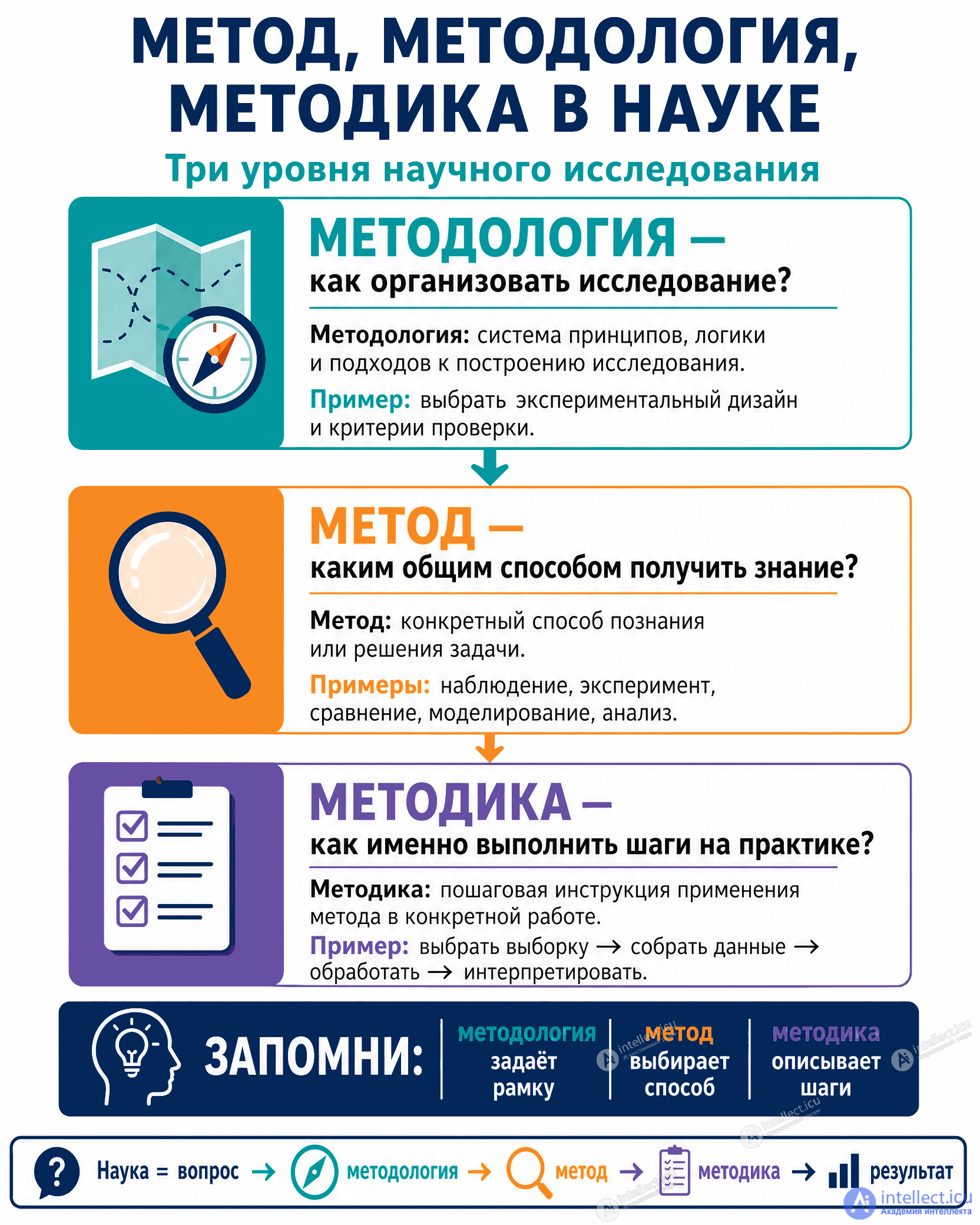
Methodology (from Greek μεθοδολογία — the study of methods; from Ancient Greek μέθοδος from μετά- + ὁδός, literally «a path following something», and Ancient Greek λόγος — thought, reason) — the study of methods, ways, and strategies for researching the subject.
Modern encyclopaedic definitions of methodology:
«Methodology (from «method» and «logia») – the study of the structure, logical organisation, methods, and means of activity» (Soviet Encyclopaedic Dictionary).
«Methodology – a system of principles and methods for organising and structuring theoretical and practical activity, as well as the study of that system» (Philosophical Encyclopaedic Dictionary).
If we generalise these definitions and give them greater rigour, we can arrive at the following:
Methodology – is the study of the organisation of activity.
In science, three components are distinguished, corresponding to
different levels of cognition of phenomena:
The theoretical foundations of science consist of theories, concepts, hypotheses, and the conceptual and scientific-methodological apparatus. The empirical foundations are formed by facts and empirical hypotheses. So what are the methodological foundations of science? The methodological foundations (usually called more briefly – methodology) form that
part of science which constitutes the study of its theories and methods,
of their creation and application in practice.
The methodology of science (from method and ...logy) is:
Briefly, the methodology of science is the science of science.
The methodology of science addresses such tasks as identifying the object and
subject of research, formulating the scientific problem, developing a method for solving the problem at hand, and verifying the reliability and assessing the significance of the results of scientific research. As follows from
the term «methodology» itself, questions of constructing and applying scientific methods
play no small role in the methodology of science.
The structure of the concept of «methodology» is also represented in the form of four basic elements: theoretical, substantive, practical, and formal. The theoretical component of methodology strives toward a model of ideal knowledge — this is gnoseology (the science of cognition). Substantive methodology includes the study of laws, theories, the structure of scientific knowledge, criteria of scientificity, and the system of research methods used — this is epistemology (the science of the ways and method of cognition). The practical component of methodology — is a programme (algorithm), a set of techniques and ways of achieving a practical goal without sinning against the truth. Finally, formal methodology is concerned with analysing research methods from the standpoint of logical structure and formalised approaches to constructing theoretical knowledge, its truthfulness, and its cogency.
Methodology, drawing on accepted theories and conceptual approaches, defines (and includes) the ways, means, methods, and technologies of research. A combination of several methods is customarily called a methodological approach.
In the scientific literature, the term «methodology» is defined within at least four planes. Some authors interpret methodology as a system of principles and methods for organising and structuring research1. A. Ya. Antsupov, M. I. Dyachenko, and other researchers assign this category a guiding status and define it as a path of research using methods for the objective manifestations of the psyche and the disclosure of regularities. The Encyclopaedic Dictionary notes that the methodology of research is a kind of study of the methods, procedures, ways, and means of cognition. According to A. Reber, it is a system of methods, specific procedures, and means used in research.
Methodology can be considered on two levels: as theoretical, formed by the branch of philosophical knowledge known as gnoseology, and as practical, oriented toward solving practical problems and the purposeful transformation of the world. The theoretical dimension strives toward a model of ideal knowledge (under the conditions specified by the description, for example, the speed of light in a vacuum), while the practical dimension is a programme (algorithm), a set of techniques and ways of achieving the desired practical goal without sinning against the truth, or against what we consider true knowledge. The quality (success, effectiveness) of a method is tested by practice, by solving scientific-practical problems — that is, by seeking the principles for achieving a goal, realised in the whole complex of real actions and circumstances.
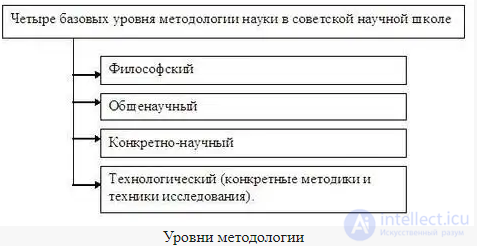
The following structure can be identified within methodology:
Thus, we can propose the following «scheme of the structure of methodology»:
1. The foundations of methodology: philosophy, psychology, systems analysis, science of science, ethics, aesthetics;
2. The characteristics of activity: features, principles, conditions, norms of activity;
3. The logical structure of activity: subject, object, subject matter, forms, means, methods, result of activity;
4. The temporal structure of activity: phases, stages, steps.
Such an understanding and construction of methodology makes it possible to:
Methodology is also divided into substantive and formal. Substantive methodology includes the study of laws, theories, the structure of scientific knowledge, criteria of scientificity, and the system of research methods used. Formal methodology is concerned with analysing research methods from the standpoint of logical structure and formalised approaches to constructing theoretical knowledge, its truthfulness, and its cogency.
The emergence of methodology in Ancient Egypt, 14th century BCE. The rudiments of methodological knowledge can already be found at the early stages of the development of culture. Thus, in Ancient Egypt geometry took the form of normative prescriptions that determined the sequence of measurement procedures when dividing land plots. An important role in this was played by such a form of social activity as training in labour operations, their sequence, and the choice of the most effective way of acting.
The development of dialectical methodology, 18th-19th centuries. The limitations of both the rationalist and empiricist trends in methodology were revealed by German classical philosophy, which subjected the conditions of cognition, its forms, and organising principles to critical analysis. In contrast to the mechanistic methodology that treated the paths and ways of cognition metaphysically, a dialectical methodology was developed, which appeared in classical German philosophy in idealist form (Kant, Fichte, Schelling, Hegel).
The emergence of dialectical-materialist methodology, 19th century. The rational principles of the methodology of previous eras were generalised and reworked on a consistently materialist basis in Marxist philosophy, enriched by new achievements of science and social practice. The dialectical method underwent radical transformations in Marxism: from a method of analysing forms of knowledge in themselves - irrespective of reality and the objective laws governing its development - it became a method of the most complete and substantive investigation of that development, an instrument not only of theoretical cognition but also of the revolutionary transformation of reality on the principles of scientific communism.
The development of methodology in the 20th century In the 20th century there is a rapid growth of methodological research, driven by revolutionary changes in social practice, science, technology, and other spheres of life. The development of methodology is particularly influenced by the processes of differentiation and integration of scientific knowledge, the radical transformation of classical disciplines and the emergence of many new ones, and the transformation of science into a direct productive force of society.
The crisis of methodology at the end of the 20th century. The independent development of methodology continued approximately until the early 1980s. Starting from this period, a crisis of methodological thought becomes apparent, caused, in part, by its separation from philosophy. The transformation of certain trends in methodology (for example, the school of systems-thought-activity methodology led by G. P. Shchedrovitsky) into a pure technology of thinking (based on theories of activity and thought-activity) is a fairly natural phenomenon. This occurs, firstly, as a result of the independent development of methodology, and secondly, of its naturalisation, that is, its being understood as a normative metatheory. The task of methodology in these trends came to be seen as the standardisation of any thinking, in a general methodological expansion into various spheres of activity. Representatives of this normative trend claimed that the schemes of methodology are universal and do not depend on the content and nature of particular subjects. This position naturally led to a decline in interest in methodology and to the quite justified accusation of formalism levelled at it.
Method (from Ancient Greek μέθοδος — path of research or cognition, from μετά- + ὁδός «path») — a way of achieving some goal.
Unlike a field of knowledge or research, a method is authored, that is, created by a specific person or group of people, a scientific or practical school. Owing to their limitation to a scope of action and a result, methods tend to become outdated, transforming into other methods and developing in line with the times, with advances in technical and scientific thought, and with the needs of society. A set of homogeneous methods is customarily called an approach. The development of methods is a natural consequence of the development of scientific thought.
A method is a set of mental and practical operations aimed at solving a specific type of problem.
Methods of scientific cognition are classified on various grounds. From the point of view of their scope of use, methods are divided into
general-scientific and specialised.
In addition, methods are divided into:
This division is connected with the separation of scientific research into theoretical and empirical (that is, based on experience). The main methods of empirical research are observation and experiment.
The main methods of theoretical research are the hypothetical, hypothetico-deductive, axiomatic, logical, and historical methods, as well as formalisation, idealisation, and the method of ascent from the abstract to the concrete. Theoretical research also makes use
of experiment, but here it is a thought experiment, carried out without any equipment.
Method in mathematics — is a synonym for a way, an algorithm for solving a problem, for achieving a goal.
A method in object-oriented programming — is a procedure or function belonging to some class or object.
In software engineering, a method — is a technical way of building software. Compare with methodology.
A method in computer science — is a single generalised way of solving problems of a particular class.
A method of solution is erroneous if it gives incorrect results for certain problems.
A method of solution is correct if it gives correct results for all problems of a given class.
Method— is a way of constructing a system of knowledge, a set of techniques and operations for the theoretical and practical mastery of reality.
The modern system of methods is as diverse as science itself. Experimental, theoretical, heuristic, and algorithmic methods are distinguished. Quantitative and qualitative methods of studying reality can be identified. Depending on the degree of justification, statistical, probabilistic, hypothetico-inductive, and deductive methods can be identified. Based on the mechanism of generalisation, synthetic and analytical, inductive and deductive methods are considered, as well as methods of idealisation, generalisation, typologisation, and classification.
Each of these methods is given concrete form within some particular science and filled with its own specific content. Some methods are universal, others — more limited. For example, the empirical method. It consists in the accumulation, description, explanation, classification, and systematisation of facts and experimental data on phenomena. Being specific, it is far from universal.
Let us turn to consider some of the methods used in logic.
First of all, there is the heuristic method. It consists in finding some algorithm for solving a problem. Here, methods of cognition connected with mathematics begin to play a substantial role. At the same time, although this method is theoretical, it is closely connected with the empirical methods of constructing theories.
More effective in logic is the use of the axiomatic method. This is a way of constructing a theory in which certain propositions of the theory are chosen as the initial ones, while all the other propositions of the theory are derived from them by a purely logical route, by means of proofs. The initial propositions are called axioms, and the propositions proved on their basis — theorems. A system of rules is then formulated, allowing the initial propositions to be transformed and, from a limited number of axioms, a multitude of provable propositions — theorems — to be obtained.
One of the important methods of logic is the method of formalisation. This method is based on the distinction between natural and artificial languages. Natural languages take shape in the process of communication and serve as a means of communication, of transmitting information, of expressing emotions, and so on. Unlike them, artificial languages are oriented toward strictly defined and limited research tasks. They lay claim not only to a more compact notation, but also to more effective work. Operations can be performed on the formulas of artificial languages, yielding new formulas and relations from them. Symbolic calculus becomes an analogue of reasoning, allowing one, in a deductive (strictly demonstrative) manner, to obtain from certain structures of signs and symbols others expressing new knowledge about the given object.
In symbolic languages, certain symbols, by denoting relations between concepts, correspond to a word or expression of a natural language. Thus, there exists a definite correspondence between the structures of thought and the structures of their linguistic expression. This means that, within formal logic, operations with thoughts about objects can be replaced by actions with signs and symbols. Consequently, formalisation in this case represents a logical method of clarifying the content of a thought by clarifying its logical form.
Method (Greek methodos — path of research or cognition) — is a constantly developing and changing way, or a set of ways, techniques, operations, steps, actions. On this point the views of many researchers coincide. However, in the substantive part («a way of what?») disagreements among authors emerge. Some define method as a way of constructing and substantiating a system of knowledge (of reality), others — as a way of solving a particular problem, of achieving some goal, and still others — as a way of performing something, of working with facts and concepts in a systematic mode1. S. L. Rubinstein writes of method as the way by which the subject matter of a science is cognised. The Psychological Dictionary notes that method is a way of studying the psychological manifestations of a person's personality. In the Philosophical Dictionary, method is interpreted as a way of the theoretical and practical mastery (cognition) of activity.
Weakly formalised methods include conversation, observation, analysis of the products of activity, the biographical method, introspection, and empathic listening. These methods make it possible to record certain external behavioural reactions of subjects under various conditions, as well as such features of the inner world that are difficult to identify by other means, for example, experiences, feelings, and certain personality traits. The use of weakly formalised methods requires a high level of qualification on the part of the diagnostician, since there are often no standards for conducting the assessment and interpreting the results.
The positive aspects of these methods are:
The following should be noted as drawbacks:
Procedure — is, as a rule, a kind of ready-made «recipe», algorithm, or process for carrying out certain targeted actions. Procedure differs from method in the greater specificity of its techniques and tasks. For example, the mathematical processing of experimental data can be described as a method (mathematical processing), while the specific choice of criteria and mathematical characteristics — as a procedure.
The concept of procedure is close to the concept of method. However, these two terms should not be confused.
Procedure – is the specification of a method, bringing it to an instruction, an algorithm, a clear description of the way of carrying it out
(for example, a procedure for calculating an indicator, a procedure for valuing an asset).
Research procedure – is the set of methods and techniques necessary for conducting research, as well as the rules
application of the methods and techniques from this set.
Procedure in education — a description of specific techniques, ways, and skills of pedagogical activity in particular educational processes ; «a collection of rules of educational activity»
The procedure for teaching a subject includes:
The psychodiagnostic method is aimed at solving a broad range of problems, while a psychodiagnostic procedure is aimed at solving specific problems. A procedure, unlike a method, represents specific instructions for conducting the diagnostic, processing the data, and interpreting the results. Within a single method there can exist a practically unlimited number of procedures.
The necessary requirements for a procedure, as a specific «recipe» or process, are the following:
Unlike a method, a procedure has authorship. In the Dictionary of Business Terms, a procedure is defined as a set of methods and techniques, tested and studied for performing a particular piece of work. S. L. Rubinstein points to a procedure as a specific, auxiliary, or intermediate research method. A. Reber asserts that a procedure is a derivative of a method, specified for a real situation, a particular learned process or set of processes for achieving some specific goal.
Within the theoretical framework of the terms of psychological gnoseology, research tool is presented as synonymous with the concept of «method» and is interpreted as a technique, a way of acting to achieve something, an instrument (an object, a set of devices) for carrying out some activity.
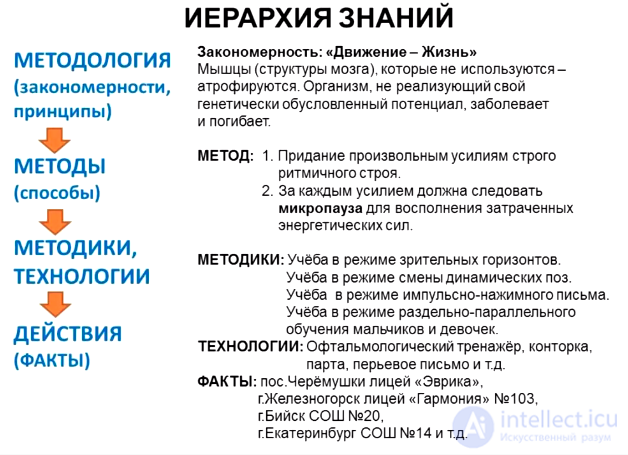
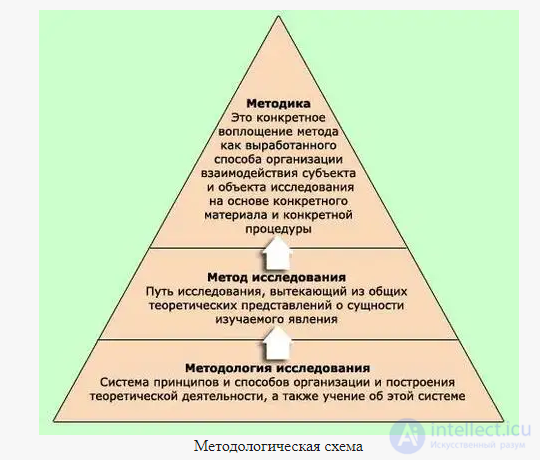
Fig. hierarchy of knowledge
In the theory of experimental psychology, a researcher must understand the distinction between the following epistemological psychological categories: methodology, method, procedure, research tool, technology and technique, testing, modelling, and others (Fig. 1.3), on which we shall dwell briefly.
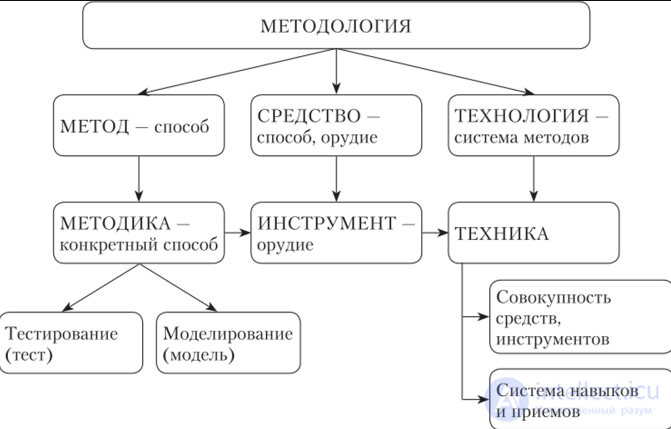
Fig. 1.3. The terminological system of the methodology of psychological research
The main points of the chapter are the following:
Science is a system of knowledge in which three subsystems are distinguished, corresponding to different levels of cognition of phenomena: the empirical foundations, the theoretical foundations, and the methodological foundations of science.
The methodological foundations of science (methodology) constitute the study of the forms and methods of scientific cognition, of the organisation of research activity, and of scientific methods and theories.
Briefly, the methodology of science is the science of science.
1. What are the methodological foundations of science?
2. Give a classification of scientific methods.
1. What most accurately characterises the concept of «methodology» in scientific research?
Hint: Compare the level of general research principles with the researcher's specific actions.
2. What is the main defining feature of a method of scientific research?
Hint: Determine what is directly used by the researcher to obtain and substantiate scientific knowledge.
3. What most accurately characterises the procedure of scientific research?
Hint: A procedure answers, first and foremost, the question «how exactly is the research to be carried out in practice?».
4. A researcher decided to study students' attitudes toward distance learning using a survey. What is the method in this case?
Hint: Find the option that denotes a specific way of obtaining research data.
5. A researcher determined that the survey would be conducted among 200 students, the questionnaire would contain 15 questions, and the collection of responses would last two weeks. What in this example belongs to the procedure?
Hint: Pay attention to the specification of the way the research is conducted.
6. A researcher chooses a systems approach and considers the phenomenon under study as a set of interrelated elements. To which concept does such a choice belong?
Hint: A systems approach belongs to the general level of organising and substantiating the research.
7. How are method and procedure related?
Hint: One term denotes the way of researching as a whole, the other — its practical implementation.
8. A researcher uses the method of observation. In advance, he determines what will be observed, how long the observation will last, which indicators will be recorded, and how the results will be recorded. What does the described plan represent?
Hint: Look for the specification of the process for using the chosen way of researching.
9. Which option correctly shows the relationship between the concepts «methodology — method — procedure»?
Hint: Arrange the concepts from the most general level to the most specific.
10. A researcher studies the effect of a new teaching method on student performance and deliberately creates two groups: an experimental one and a control one. Which method is being used?
Hint: Determine whether the described situation involves an active change of the research conditions.
11. A researcher decided to use an experiment as the method. He worked out the order for forming the groups, determined the duration of the experiment, the indicators for assessing performance, and the sequence for carrying out the procedures. What does the order he worked out represent in this case?
Hint: The method has already been chosen. Determine what needs to be done for its specific practical application.
12. Which of the statements is correct?
Hint: Think about whether one way of researching can be used in different research situations.
13. A scientist adheres to the principles of objectivity, systematicity, and evidentiality when organising the research. To which level does this set of principles belong?
Hint: The principles of organising scientific cognition belong to the most general level.
14. Which of the following is an example of a procedure, and not a method?
Hint: A procedure should describe not the name of the way, but the specific order of its implementation.
15. Which situation best demonstrates the difference between methodology, method, and procedure?
Hint: Find the option in which a general approach, a specific way of researching, and the order of its practical application are all presented together.

Comments