
Lecture 7 min.
The purpose of this chapter – is to reveal the essence of science as a system of knowledge; to explain the meaning and show the interrelations of such categories of science,
as fact, theory and hypothesis, law, regularity and principle, methodology, method and procedure.
In this chapter we will answer the following questions: What elements make up science as a system of knowledge? What is the role of facts, hypotheses and theories in this system? What is the difference between a theory and a concept? How do regularities differ from laws, and laws – from principles? What are the methodological foundations of science?
Key concepts of this chapter: fact, hypothesis, theory, concept, law, regularity, principle, methodology, method, procedure.
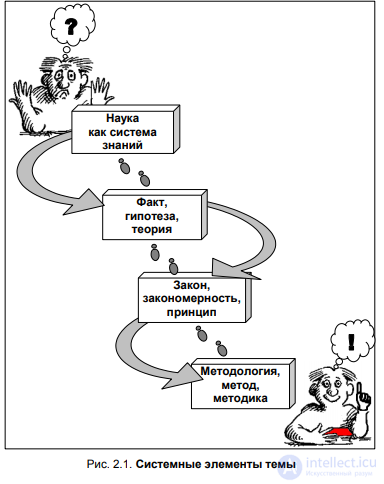
In the structure of every science one can identify elements whose totality constitutes science as a system of knowledge. These elements include facts, theories, hypotheses, problems, methods, laws, principles, etc. [46]. In order to use scientific knowledge correctly, one needs to
know the functions of each of the named elements, understand the differences between fact and theory, theory and concept, concept and hypothesis, regularity and law, law and principle, methodology and procedure...
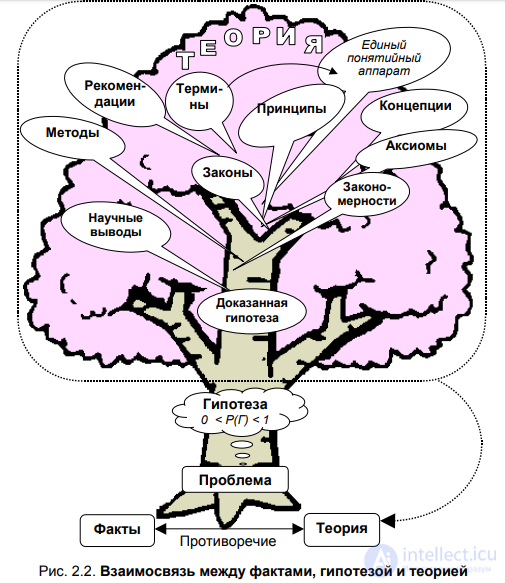
The elements of science as a system of knowledge stand in various relations to one another. For example, facts – are the basis for forming
a scientific hypothesis, a hypothesis – is the basis for forming a theory (Fig. 2.2). A theory gives a holistic picture of the laws and regularities of a subject area. Scientific methods are used to identify laws and regularities. The principles for constructing and using methods form a methodology. And so on... Let us begin unraveling this tangle of interconnected categories of science with the concept of «facts».
Facts – are empirical (that is, experiential) data. A fact – is a «fragment of reality».
Facts constitute the foundation of science. One could say that the development of science – is the refinement and replacement of existing theories as a result of the emergence of new facts that could not be predicted and explained within the old theories. It is important to understand that for
science not just any empirical data matters: of interest
are only scientific facts. To move from the results of observations and experiments to scientific facts, two conditions are necessary:
1) repetition of observations and experiments;
2) conducting a theoretical analysis, as a result of which, after systematization, classification and generalisation, empirical data become scientific facts.
Scientific facts – are facts that have received a description and explanation based on the generalisation of a class of phenomena and that reflect the laws and
regularities of a subject area.
In order to make at least a step in the boundless sea of empirical material (facts), a hypothesis is needed, that is, a preliminary
theoretical assumption about possible laws and regularities of a subject area, This assumption may, in the end, be confirmed or not confirmed.
- Hypothesis – is a scientific assumption about a regular connection between phenomena, containing elements of novelty and originality.
Proven hypotheses form the basis for the formation of scientific theories.
- Theory – is the highest, most developed form of organization of scientific knowledge, giving a holistic picture of the regularities and essential connections of a certain area of reality.
The following components make up theory as a system of knowledge:
systematized scientific facts, a conceptual apparatus, proposed hypotheses, concepts, elements of the scientific-methodological apparatus,
conclusions, recommendations, etc. In the course of its development, science turns
into a system of theories.
The concept of theory is closely connected with the concept of a concept. If a theory
gives a holistic picture of a certain area of reality, then a concept may concern only some objects of a subject area. In general, a concept lacks the wholeness, detail and breadth that are characteristic of a theory.
Concept - a particular way of understanding, interpreting some subject (phenomenon), the basic point of view on the subject.
The key elements of theories and concepts are laws and regularities.
Regularity – is an objectively existing, recurring, essential connection between phenomena, expressed, as a rule, qualitatively, descriptively (example of a regularity: «raising staff qualifications entails an increase in the enterprise's profit»).
Law of nature – is a necessary, essential, stable connection between phenomena (for example, the law of universal gravitation).
It is important to understand the difference between laws of nature and economic laws.
Economic laws, unlike laws of nature, do not possess universality: individual people may in their behavior deviate
from the norms dictated by economic laws. The reason for this is that human behavior is determined not only by objective factors,
but also by their subjective will. Therefore, economic laws should be classified rather as regularities.
Economic laws – are stable, essential interrelations between economic phenomena, processes, relations. For example, the law of demand («other things being equal, a rise in the price of a good leads to a corresponding decrease in the quantity demanded of that good»), the law of supply, the law of value, the law of diminishing returns, the law of increasing marginal costs.
Principles are closely connected with laws, but, unlike laws, principles do not objectively exist in nature. They are specially created by man in the process of systematizing knowledge.
[[b8966]]

Comments