
Lecture
The meaning of scientific research, its social value, is determined by the scientific result obtained. A scientific result is both the goal and the reward of the researcher. Everything connected with scientific research can be defined through the concept of a scientific result:
Note: not every product of research work can be considered a "scientific result".
A scientific result – is a product of scientific activity, obtained through the application of some scientific-methodological apparatus and satisfying the requirements of novelty, reliability and usefulness.
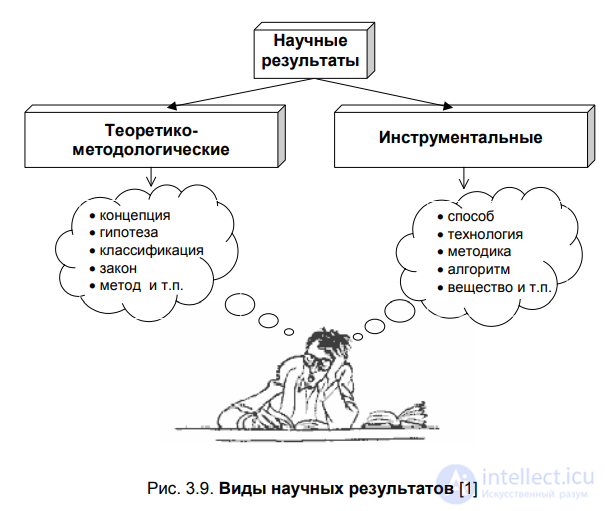
The forms of a scientific result are: concept, theory, law, regularity, classification, method, etc. (Fig. 3.9).
Examples of scientific results:
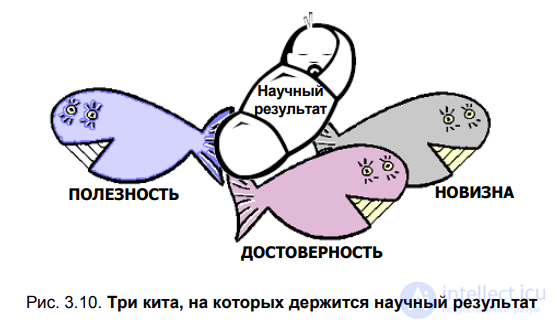
As has already been mentioned more than once, the main requirements imposed on a scientific result are reliability, novelty and usefulness (Fig. 3.10). It is time to work out what these requirements mean.
Reliability of a scientific result – is its regularly expressed conditionality by objectively existing cause-and-effect relationships in the corresponding subject area.
Confirmation of the reliability of a scientific result is its substantiation.
Novelty of a scientific result – is a concept characterising the fact that the scientific result has been obtained for the first time in the world (Fig. 3.11).
The novelty of a scientific result also implies its non-triviality, that is, the impossibility of obtaining such a result by means of a previously known scientific-methodological apparatus.
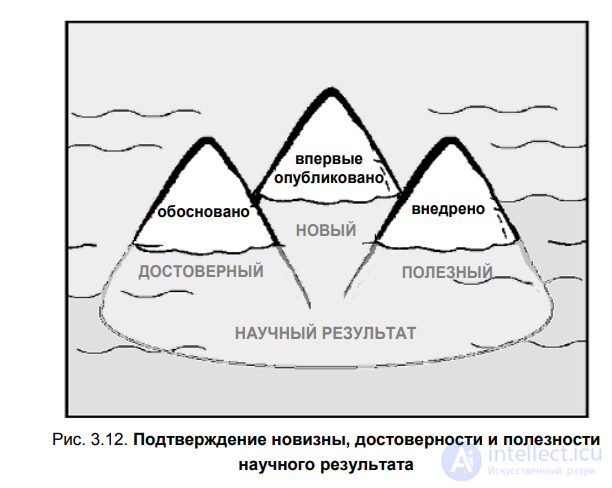
Generally speaking, novelty can be absolute (world-wide) or relative (if the scientific result is new only for some particular group). However, just as there is no such thing as sturgeon of the second freshness, so the novelty of a scientific result must be absolute only. Confirming the novelty of a result requires two conditions:
1) publication of the given result by the author;
2) the absence of a similar scientific result in earlier publications by other authors (Fig. 3.12)

Usefulness of a scientific result – is the demand for this result by science and/or practice. Scientific and practical usefulness are distinguished.
If the obtained scientific result satisfies the requirement of scientific usefulness, then it is a contribution by the author to science (provided that it is new and reliable).
Note: not every useful scientific result is a contribution to science (that is, to theory, to methodology). Some results constitute a contribution to the practice of the subject area. In this connection, scientific results are classified into theoretical and practical ones (Fig. 3.13).
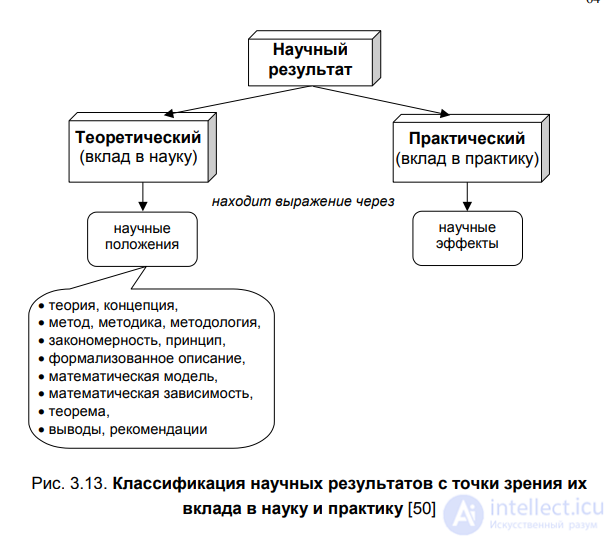
Theoretical results are formulated in the form of scientific propositions. Example of a scientific proposition: "For a homogeneous electrical circuit, the current equals the voltage divided by the resistance" – Ohm's law. Practical results manifest themselves in the form of scientific effects.
Scientific results that constitute a contribution to science are characterised by a high degree of generalisation and abstractness. The more specific the formulation of a scientific problem, the greater the contribution of the result obtained not to science but to practice. Suppose, for example, that researcher A has developed an organisational structure for a specific enterprise, OJSC "XXX", while researcher B has developed a concept for forming an enterprise's organisational structure depending on the strategy of activity chosen. Feel the difference. Where is the contribution to science, and where is the contribution to practice?
Example 3.5
On results that do not meet the requirement of usefulness: every year Cambridge University holds the presentation of the so-called Ig Nobel Prizes, which are awarded for useless and silly, or amusing, research results. Here are just a few of the achievements recognised with an Ig Nobel Prize:
Scientific novelty is a result of research that has not previously been obtained or has not been considered in the form proposed by the author. It shows what new contribution the work makes to the study of the chosen scientific problem.
Scientific novelty can be expressed in:
At the same time, scientific novelty does not necessarily have to represent a fundamentally revolutionary discovery. For a student research project, it is enough to convincingly demonstrate how the results obtained differ from already existing approaches and what new elements were introduced by the author.
The novelty of a study can take various forms. When describing it, it is necessary to specify precisely what result:
For example, theoretical novelty can be formulated as follows: "For the first time it has been substantiated…", "The classification has been improved…", "The understanding of… has been refined", "The approach to… has received further development".
Practical novelty can be expressed in the creation of a specific result: "Methodological recommendations have been developed…", "An algorithm has been proposed…", "A model has been developed…", "A software module has been created…".
Thus, when formulating scientific novelty, it is important not to limit oneself to general statements, but to clearly show exactly what new result was obtained within the project and how it differs from already existing research and solutions.
Relevance and scientific novelty — are interrelated but different characteristics of a study. Relevance explains why the chosen problem is important to study right now, while scientific novelty shows what new contribution the author offers in studying it.
In other words, relevance answers the question "Why is this topic important?", while novelty answers "What new has been done in this study?".
| Criterion | Relevance | Scientific novelty |
|---|---|---|
| Main question | Why does the problem need to be studied? | What new has been obtained as a result of the study? |
| Main task | To substantiate the significance of the chosen topic | To show the author's contribution to studying the problem |
| Relation to the problem | Shows why the problem is important, current or insufficiently studied | Shows how the study supplements or changes existing knowledge |
| What it is directed at | At the need to carry out the study | At the results and achievements of the study |
| When it is determined | Substantiated at the beginning of the work | Formulated on the basis of the results obtained |
| Typical wordings | "The topic is relevant because…", "The problem is acquiring particular significance…" | "For the first time developed…", "Improved…", "A new approach proposed…" |
| Example | Changing technologies require the search for new ways of solving a particular problem | The work proposes a new way of solving this problem, not previously presented in this form |
In brief:
Relevance is the substantiation of the need for the study, while scientific novelty is the characteristic of the new result obtained in the course of the study.
Scientific novelty must show the author's specific contribution to studying the chosen problem. For the novelty to be well-founded, it must meet several basic requirements:
Thus, the main requirement for scientific novelty is to prove that the study contains a result that supplements already existing knowledge and differs from previously proposed solutions.
Scientific novelty can manifest itself in various forms depending on exactly what new result was obtained in the study. The main types can be divided as follows:
Thus, scientific novelty can be expressed not only in the creation of fundamentally new knowledge, but also in the improvement, refinement, systematisation or new application of already existing scientific propositions.
The scientific novelty of a study can be expressed in various forms:
When formulating scientific novelty, it is convenient to use ready-made speech constructions. They help to clearly show exactly what new thing has been done in the study.
If the result has been obtained for the first time:
If an existing approach has been improved:
If the result refines or makes known propositions more specific:
If an already existing scientific direction is being developed:
For practical and organisational novelty:
Universal formula:
"The scientific novelty of the study consists in the fact that, for the first time / it has been improved / refined / developed…"
The main thing — after the cliché, be sure to state the specific result, rather than simply writing "the study is new".
To prove scientific novelty, it is not enough simply to state that the study is new. It is necessary to compare the results obtained with already existing scientific approaches and show the author's specific contribution.
The following algorithm can be used to substantiate novelty:
Example:
If existing procedures allow an indicator to be assessed using only three parameters, and the study proposes a procedure that takes five parameters into account and proves its effectiveness, the scientific novelty may consist in improving the procedure by expanding the system of parameters taken into account.
Scientific novelty is assessed by how much the results obtained differ from those already known and what contribution they make to the development of scientific knowledge.
The following criteria are usually taken into account in the assessment:
| Criterion | What is assessed |
|---|---|
| Originality | How much the result differs from already known solutions |
| Substantiation | Whether the claimed novelty is confirmed by the results of the study |
| Scientific significance | Whether the result expands existing scientific understanding |
| Independence | What contribution was made directly by the author |
| Reliability | How convincingly the results obtained are confirmed |
| Practical value | Whether the result can be used to solve practical problems |
| Correspondence to the aim of the study | Whether the result is connected with the stated aim and objectives |
Thus, good scientific novelty must be specific, proven, and different from already existing results.
Aims of the assignment:
Supplementary material
As an example of the formulation of the topic, aim, objectives and results of scientific research, let us give a fragment of an extended abstract (avtoreferat) for the degree of Candidate of Economic Sciences [59].
Topic: "Strategic management of enterprise development"
Aim and objectives of the study. The aim of the dissertation work consists in generalising and refining theoretical propositions concerning the transition of industrial enterprises to strategic management, and in developing methodological support for forming strategic potential.
To achieve the stated aim, the following objectives were addressed:
Object and subject of the study. The process of managerial activity in developing and implementing the strategy of industrial enterprises was chosen as the object of the study. The subject of the study is the scientific-methodological support for managing the strategic development of an enterprise and forming its potential under conditions of the reform of Ukraine's economy.
The scientific novelty of the results obtained consists in the following:
Complete the following assignments on the topic of your own research work:
1. Based on a study of the literature, identify the applied and scientific problems that exist within the research topic under study. Substantiate the relevance of the topic.
2. Determine the object and subject of the study.
3. Formulate the aim of the study.
4. Make the title of the research topic more specific.
5. Carry out a structuring and analysis of the subject area.
6. List the anticipated scientific results.
7. Substantiate the practical significance of the work, and indicate the organisations and persons that might be interested.
1. What is scientific research?
2. Which studies are classified as fundamental and which as applied?
3. List the stages of scientific research.
4. What is the difference between an applied problem and a scientific problem?
5. How are the object and subject of a study related to one another?
6. What information is recorded in the working plan of scientific research?
7. Name the main requirements imposed on the results of scientific research.
8. Give examples of scientific results from the field of economics.

Comments