
Lecture
When beginning to prepare a scientific work, one should first of all master the language in which scientists communicate with one another. The language of science is highly specific. It contains many concepts and terms used in scientific activity. The degree to which the researcher has mastered the conceptual apparatus of science determines how precisely, competently, and clearly he can express his thought, explain this or that fact, or prove this or that proposition.
The basis of the language of science is made up of words and phrases of a terminological character, some of which are given below:
Relevance of the topic - the degree of its importance at a given moment and in a given situation for solving a given problem (task, question).
Aspect - the angle from which the object (subject) of research is viewed.
Hypothesis - a scientific supposition put forward to explain some phenomena.
Dissertation - a scientific work executed in the form of a manuscript, a scientific report, a published monograph, or a textbook. It serves as a qualification work intended to show the research-and-scholarly level of the researcher presented for the award of an academic degree.
Idea - a defining proposition in a system of views, theories, and so on.
Information:
survey - secondary information contained in surveys of scientific documents;
relevant - information contained in the description of a prototype of a scientific problem;
abstracting (referative) - secondary information contained in primary scientific documents;
signal - secondary information of varying degree of condensation, performing the function of preliminary notification;
reference - secondary information representing systematized brief data in some field of knowledge.
Scientific research - the process of generating new scientific knowledge, one of the types of cognitive activity. It is characterized by objectivity, reproducibility, evidential validity, and precision.
Research specialty (often referred to as a research direction) - a stably formed sphere of research that includes a certain number of research problems from a single scientific discipline, including its field of application.
Research task - an elementarily organized complex of research actions, the deadlines for whose execution are set with a sufficient degree of precision. A research task has significance only within the bounds of a specific research topic.
Category - a form of logical thought in which the internal, essential forms and relations of the objects under study are revealed.
Concept - a system of views on something, the main idea, in which the aims and tasks of the research are defined and the ways of conducting it are indicated.
Keyword - a word or phrase that most fully and specifically characterizes the content of a scientific document or part thereof.
Research method - a way of applying old knowledge to obtain new knowledge. It is an instrument for obtaining scientific factors.
Methodology of scientific cognition - the doctrine of the principles, forms, and methods of research activity.
Science - a sphere of human activity whose function is the generation and theoretical systematization of objective knowledge about activity. It is one of the forms of social consciousness.
Scientific discipline - a branch of science which, at the given level of its development, has at the present time been mastered and introduced into the educational process of higher education.
Scientific topic - a task of a scientific nature requiring the conduct of scientific research. It is the main planning-and-reporting indicator of research work.
Scientific theory - a system of abstract concepts and statements which represents not a direct but an idealized reflection of reality.
Scientific research - purposeful cognition, the results of which appear in the form of a system of concepts, laws, and theories.
Scientific cognition - research that is characterized by its own special aims and, most importantly, by the methods of obtaining and verifying new knowledge.
Scientific report (doklad) - a scientific document containing an account of research or development work, published in print or read before an audience.
Scientific report (otchet) - a scientific document containing a detailed description of the procedure, the course of the research (development), the results, as well as the conclusions obtained as a result of the research or development work. The purpose of this document is to give an exhaustive account of the work performed upon its completion or over a specific period of time.
Scientific fact - an event or phenomenon that serves as the basis for a conclusion or confirmation. It is an element forming the basis of scientific knowledge.
Survey (review) - a scientific document containing systematized scientific data on some topic, obtained as a result of analyzing primary sources. It acquaints the reader with the current state of a scientific problem and the prospects for its development.
Definition - one of the most reliable ways of guarding against misunderstandings in communication, debate, and research. The purpose of a definition is to clarify the content of the concepts used.
Subject of research - everything that lies within the bounds of the research in a specific aspect of consideration.
Concept - a thought in which the distinctive properties of objects and the relations between them are reflected.
Principle - the fundamental, initial proposition of some theory, doctrine, or science.
Problem - a large generalized set of formulated scientific questions that encompasses an area of future research. The following types are distinguished:
research problem - a complex of related research topics within the bounds of a single scientific discipline and a single field of application;
complex scientific problem - the interrelation of research topics from various fields of science, directed at solving the most important tasks of the national economy;
scientific problem - a set of topics covering the whole of a research work or part of it, offering a solution to a specific theoretical or experimental task aimed at ensuring the further scientific and technical progress of the given branch.
Judgment - a thought by means of which something is affirmed or denied. Such a thought, expressed in a sentence, contains three elements: the subject, the predicate, and the copula "is" or "is not" (the words expressing the copula are usually not used in Russian).
Theory - a doctrine, a system of ideas or principles. A set of generalized propositions forming a science or a branch of it. It functions as a form of synthetic knowledge, within the bounds of which individual concepts, hypotheses, and laws lose their former autonomy and become elements of an integral system.
Inference - a mental operation by means of which, from a certain number of given judgments, another judgment is derived, connected in a definite way with the original ones.
Factual document - a scientific document containing textual, numerical, and other information reflecting the state of the subject of research or collected as a result of research work.
Claim of an invention - a description of a discovery, drawn up in an approved form and containing a brief statement of its essence.
Claim of a discovery - a description of a discovery, drawn up in an approved form and containing an exhaustive statement of its essence.
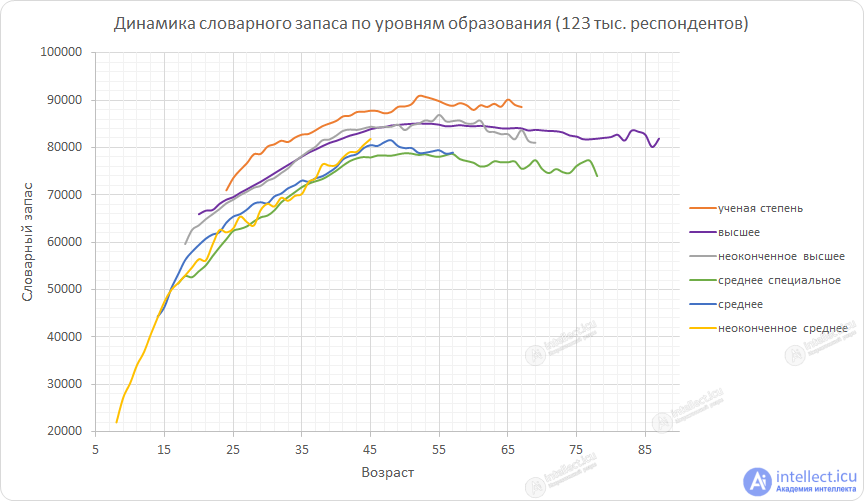
These two graphs show well why memorizing and mastering new terms and concepts is of great importance not only for learning, but also for preserving intellectual potential in adulthood and old age.
At the same time, it is important to make a reservation: the graphs measure vocabulary size, not directly the memory's ability to memorize new words. Therefore, it is more correct to interpret them as an indicator of accumulated linguistic knowledge, education, and a person's ability to maintain and use the conceptual apparatus.
Vocabulary is not simply the number of words a person knows.
Behind each term there usually stands a concept, category, connection with other concepts, and a specific context.
For example, if a person encounters the term "neuroplasticity" for the first time, it is not enough simply to memorize the sequence of letters.
For a term to truly become part of one's knowledge, it is necessary to form approximately the following structure:
neuroplasticity → the nervous system's ability to change → learning → formation of new connections → recovery of functions → memory.
That is, learning a new term expands not only the vocabulary, but also the system of conceptual connections.
This is precisely why the regular acquisition of new terms is especially important.
These two graphs show well why memorizing and mastering new terms and concepts is of great importance not only for learning, but also for preserving intellectual potential in adulthood and old age.
At the same time, it is important to make a reservation: the graphs measure vocabulary size, not directly the memory's ability to memorize new words. Therefore, it is more correct to interpret them as an indicator of accumulated linguistic knowledge, education, and a person's ability to maintain and use the conceptual apparatus.
The first graph compares the vocabulary of people over 30 years of age depending on education.
A very steady increase in vocabulary with rising education can be seen
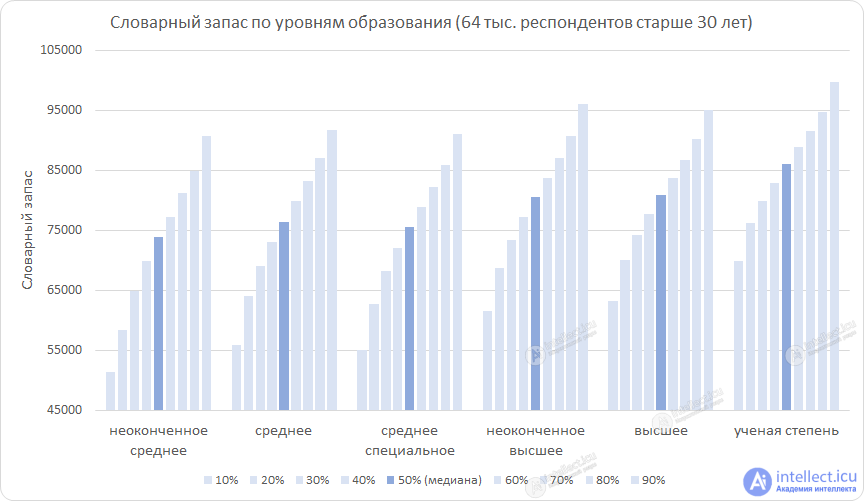
The second graph already shows the change in vocabulary with age. And here an even more interesting regularity appears: vocabulary actively increases up to approximately 40–50 years of age, after which most groups reach a stabilization, while in some — a gradual decline sets in.
Here it is important to distinguish between memorizing a word and understanding a concept.
Simple mechanical memorization:
"Mitochondrion — mitochondrion — mitochondrion"
is far less effective than creating a network:
mitochondrion → cell → energy → ATP → metabolism → aging → physical exertion.
In the second case, the new term becomes part of an already existing system of knowledge.
This can be represented as follows:
new term
↓
understanding of its meaning
↓
connection with already known concepts
↓
use in several contexts
↓
repeated retrieval from memory
↓
consolidation
↓
emergence of a new element in the overall system of knowledge
Therefore, what is most valuable is not the increase in the number of memorized words as such, but the expansion of the network of interrelated concepts.
At the same time, one should not strive to memorize as many terms as possible. It is far more important to gradually build a dense network of interrelated concepts. It is precisely such a network that turns individual memorized words into a full-fledged system of knowledge.

Comments