
Lecture 27 min.
Scientific research is a process that requires significant expenditure of the researcher's time, intellectual effort, and material resources. In order for the expenditure incurred to pay off, the result obtained from the research must be in demand in society (by production enterprises, scientific circles, the general public, etc.).
The social value of a research result is determined by its novelty, reliability, and usefulness. These requirements become especially important when conducting scientific research under market conditions based on the principles of self-financing.
The novelty, reliability, and usefulness of a result are formed and reinforced at every stage of scientific research, but their cornerstone is laid at the first stage, when the researcher faces the task of rationally formulating the topic and goal of the research work. Let us examine the process of forming the topic and goal of the research
in more detail – step by step. It should be noted that this process is iterative, so each of the subsequent steps may lead to
a revision and refinement of the results of the previous step.
At this stage, it is determined exactly what will be studied and for what purpose. The researcher formulates the problem, topic, goal, and objectives of the work, determines the object and subject of the research, and puts forward a hypothesis.
Then a research programme is developed: methods and means of obtaining information are selected, the procedure for conducting the experiment or observation is determined, and the necessary theoretical and empirical basis is formed. A study of the scientific literature and existing research on the topic is carried out.
After preparation, the actual conduct of the research takes place: data is collected, observations, experiments, surveys, or other procedures stipulated by the method are carried out. The information obtained is systematised, processed, and analysed. Based on the analysis, the hypothesis put forward is tested and preliminary conclusions are formulated
Three types of topics are distinguished:
The requirements for formulating the title of the research topic are presented in Fig. 3.4 .
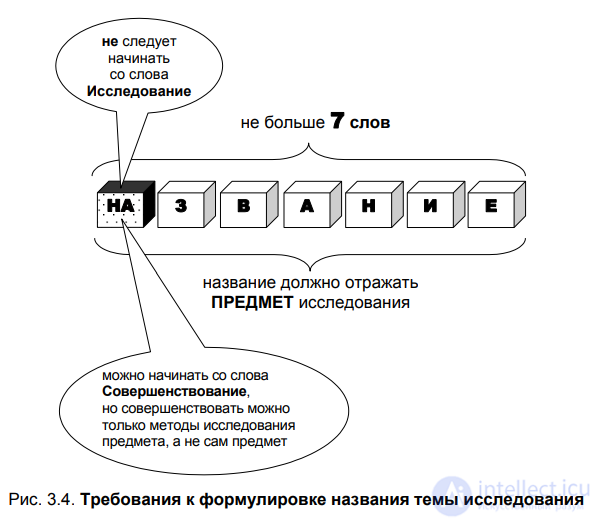
In order to correctly formulate an initiative research topic, it is necessary to find the intersection of the circle of the researcher's scientific interests, the circle of topics supported by information, and the circle of topics that are relevant.
The relevance of a topic is a concept characterising the social need for research on a given subject.
Relevance exists wherever there is a need to resolve a problem that has arisen in the theoretical or practical activity of humans. In order to assess the relevance of a topic, it is necessary to
answer the question: «Who needs this?», that is, «Which branch of production or knowledge needs the anticipated scientific results?».
The relevance of a topic is a necessary (though not sufficient) condition for the usefulness of a research result.
Choosing a topic for a master's thesis is of exceptionally great importance. Practice shows that choosing the right topic means halfway ensuring its successful completion.
Master's theses, as is well known, are written in different ways. Some proceed from purely practical considerations, because they need to obtain a diploma, and work on the thesis only for that reason. They take any topic at all, just to "defend" it. Others view the master's thesis as an opportunity to realise an idea they have long been contemplating, until it has "matured". It is precisely such people who have the best chances of choosing a good topic on which they will work purposefully and with satisfaction at the results obtained. When choosing a topic for a master's thesis, it is advisable to take on a relatively narrow task so that it can be worked through in depth.
The following techniques can help a degree candidate choose a topic for the master's thesis:
Reviewing catalogues of defended master's theses and becoming familiar with work already completed at the department.
Familiarisation with the latest research results in adjacent, borderline fields of science and technology, bearing in mind that at the junction of sciences it is possible to find new and sometimes unexpected solutions. As academician A.E. Fersman put it, "science is held together by the close ties that it is able to establish with neighbouring disciplines, by the skilful borrowing of others' methods, and by the thoughtful introduction of its own achievements and methods into other sciences".
Assessment of the state of development of research methods, principles of designing technical means, and technological techniques as applied to a specific sector of the national economy. Here attention should be paid to the possibility of applying "other people's" methods used in adjacent fields to the study of "one's own" field of knowledge.
Reconsideration of known scientific solutions by means of new methods, from new theoretical positions, and with the involvement of new, significant facts identified by the researcher. Choosing the topic of a master's thesis on the principle of a thorough reconsideration of theoretical propositions already known in science, from new positions, from a new angle, at a higher technical level, is widely used in the practice of scientific work.
Substantial help in choosing a topic is provided by becoming familiar with analytical reviews and articles in specialised periodicals, as well as conversations and consultations with practitioners, in the course of which important questions that have been little studied in theoretical terms can be identified.
Speaking of the novelty of an idea (and, consequently, of the topic), one must not forget the well-known proposition that not everything new is necessarily progressive, just as not everything old is conservative. But it has been correctly noted: the new is strong because it usually carries within it everything progressive from the old, and therefore the future belongs to it.
Scientific novelty as applied to the master's thesis itself is a feature the presence of which gives the author the right to use the concept "for the first time" when characterising the results obtained and the research conducted as a whole. The concept "for the first time" means, in science, the fact that no similar results existed prior to their publication. Research on original topics that have not previously been studied in one branch of scientific knowledge or another may be conducted for the first time.
For a large number of sciences, scientific novelty is manifested in the presence of theoretical propositions that are formulated and substantively substantiated for the first time, and of methodological recommendations that have been introduced into practice and exert a significant influence on the achievement of new socio-economic results. Only those propositions of a master's research that contribute to the further development of science as a whole, or of its individual areas, can be new.
When assessing the relevance of the chosen topic one should know that relevance, as applied to a master's thesis, consists in the conviction that no similar work has previously been carried out. When assessing the relevance of the chosen topic, one must not proceed from the political situation in the country or the world. Genuine science does not tolerate opportunistic approaches. Politicisation in assessing relevance leads to a narrowing of the spectrum of directions of scientific research, to the exclusion from it of those directions that, for one reason or another, did not enjoy the support of the ruling party, which led to a lack of objectivity in scientific development.
When assessing the practical significance of the chosen topic, one should know that this significance depends on the nature of the specific scientific research.
If a master's thesis is of a methodological nature, its practical significance may manifest itself in the publication of the main results of the research in monographs, textbooks, and scientific articles; in the approbation of the research results at scientific-practical conferences and symposiums; and in the use of the research results in the preparation of new regulatory and methodological documents.
If a master's thesis is of a methodical nature, its practical significance may manifest itself in the existence of a scientifically substantiated system of methods and means, tested through experimental work, for improving the economic, technical, or social development of the country. This also includes research on the scientific substantiation of new systems, methods, and means, and on the development of existing ones, for one or another type of activity.
The forms of implementation of scientific results of a methodical nature can vary. The main ones are as follows:
If a future study is to be of a purely applied nature, its practical significance may manifest itself in the following forms:
The structural units of a scientific direction are complex problems, topics, and scientific questions.
A complex problem is a set of problems united by a common goal; a problem is a set of complex theoretical and practical tasks whose solutions have become ripe within society.
From a socio-psychological standpoint, a problem is a reflection of the contradiction between the social need for knowledge and the known ways of obtaining it, a contradiction between knowledge and ignorance.
A problem arises when human practice encounters difficulties or even runs into "impossibility" in achieving a goal. A problem can be global, national, regional, sectoral, or cross-sectoral, depending on the scale of the tasks arising. Thus, for example, the problem of environmental protection is global, since its solution is aimed at satisfying universal human needs. In addition to those listed, problems are also distinguished as general and specific.
General problems include general scientific, social problems, and the like.
The topic of a scientific study is a constituent part of a problem. As a result of research on a topic, answers are obtained to a specific range of scientific questions that cover part of the problem. Generalisation of the results of answers on a set of topics can yield the solution to a scientific problem.
Scientific questions are usually understood as small scientific tasks relating to a specific topic of scientific research.
Choosing the direction, problem, and topic of scientific research, and posing scientific questions, is an extremely responsible task.
Relevant directions and complex research problems are formulated in the directive documents of our country's government. The direction of research is often predetermined by the specifics of the scientific institution and the branch of science in which the researcher works. Therefore, choosing a scientific direction for each individual researcher often comes down to choosing the branch of science in which they wish to work. The specification of the direction of research is the result of studying the state of production reserves, social needs, and the state of research in one direction or another at a given point in time. In the process of studying the state and results of research already conducted, ideas may be formulated for the combined use of several scientific directions to solve production problems.
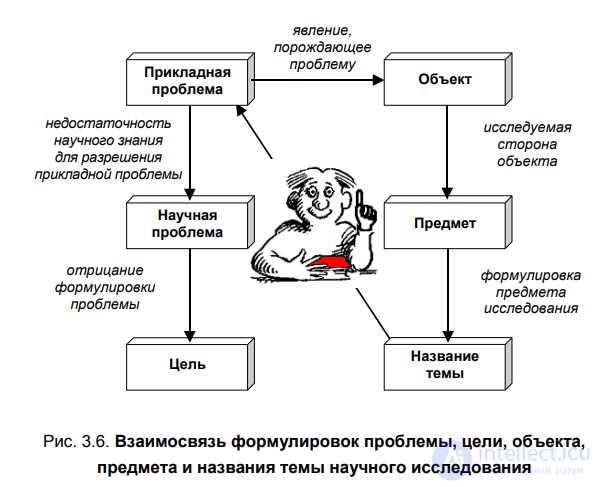
As already mentioned, scientific research is divided into fundamental and applied research. A significant part of economic research is applied in nature. The goal of applied research is to solve applied (practical) problems. Therefore, in order to correctly formulate the goal of applied research, it is necessary, within the chosen subject area, to identify the applied problem that will become, as it were, the «centre» of the research (Example 3.1).
Example 3.1 Identifying an applied problem
Let us consider, as an example, applied scientific research devoted to issues of improving the tax system. Within this subject area, a whole range of problems is revealed that economic actors face in their everyday practice. The main problem is related to the insufficient justification of the tax burden on production enterprises. This problem can initiate scientific research both in the field of macroeconomics and in the field of enterprise management. As a working hypothesis, one may assume that in forming the
tax burden of an enterprise, one should take into account not only the task of replenishing the state budget, but also the interests of personnel, as well as the interests of the development of the given enterprise as one of the links in the country's production and economic system.
In the event that the applied problem posed is characterised by a sufficiency of scientific knowledge for its resolution, it is a scientific task.
If, however, the means for its resolution are insufficient, it becomes a scientific problem (Example 3.2).
A scientific task is a contradiction characterised by a sufficiency of scientific knowledge for its resolution.
A scientific problem is a contradiction for whose resolution it is necessary to go beyond the bounds of old, already achieved knowledge.
Let us return to Example 3.1. If, in the case under consideration,
science has already proposed effective methods and models for determining the optimal tax burden on economic entities, taking into account the interests of the state, owners, personnel, and development prospects
of enterprises, then it only remains to apply these methods – both at the state level and at enterprises in the process of determining business tax strategy. Otherwise, the applied problem provokes the emergence of a scientific problem, the essence of which is the absence, in the domestic economy, of such methods and models for determining the optimal tax burden on production enterprises that would take into account the interests of the state, owners, and personnel, as well as the development prospects of these enterprises.
As a result of formulating the topic and the problem, the object and subject of the research are determined.
The object of research is a phenomenon (an object or process) that gives rise to the problem situation and has, as a consequence, been chosen for study.
The subject of research is that aspect of the object of research which is examined in a given piece of research work. The object and subject of research relate to one another as the general and the particular (for example, the object – an enterprise, the subject – accounting for the results of the enterprise's investment activity).
The goal of research is what the researcher strives for and is described as a list of the required scientific results.
The formulation of the goal can be obtained as a negation of the formulation of the problem (Example 3.3). At the same time, to make the goal more specific, it is important to clarify which aspects of the problem have already been developed by other researchers, and which of its sides no one has yet touched upon. The logical relationship between the goal, the problem, and the topic of scientific research is shown in
Fig. 3.5 and 3.6.
For a ship that does not know where it is sailing, there is no favourable wind. Proverb
Setting the goal is one of the fundamental stages of scientific research. Knowledgeable people say: «If you
poorly solve the task set, then you will obtain an ineffective solution, but if you formulate the goal incorrectly, then you will be solving entirely different tasks, and the results obtained may turn out not to be in demand in society»
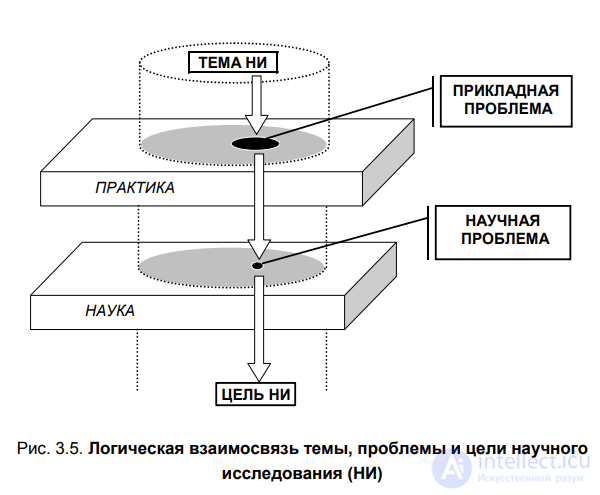
The goal of the research examined by us in Examples 3.1 and 3.2 can be formulated as a negation of the identified scientific problem. In this case, the formulation of the goal will read as
follows: to develop a set of methods and models for determining the optimal tax burden on a production enterprise in the domestic economy, based on taking into account the interests of the state, owners, personnel, and the enterprise's development prospects in their interrelation.
The object of our research is the tax system in general, and the process of determining the optimal tax burden on production enterprises in particular.
Subject of research: methods and models for determining the optimal tax burden on production enterprises.
Since it is advisable to reflect the subject of research in the topic of the work as well, the title of the topic will read as follows: «Methods and Models for Determining the Optimal Tax Burden on Production Enterprises»
The goal of the research that has been set is then subjected to refinement and decomposition, as a result of which a list of the specific objectives of the scientific work is formed.
For a correct understanding of the essence of the problem being solved and a clear formulation of the list of objectives, it is necessary to precisely outline the subject area of the research and identify its structure (Example 3.4).
The subject area of research is the totality of all objects and phenomena that must be taken into account in the process of scientific research in order to correctly understand the problem and achieve the goal set.
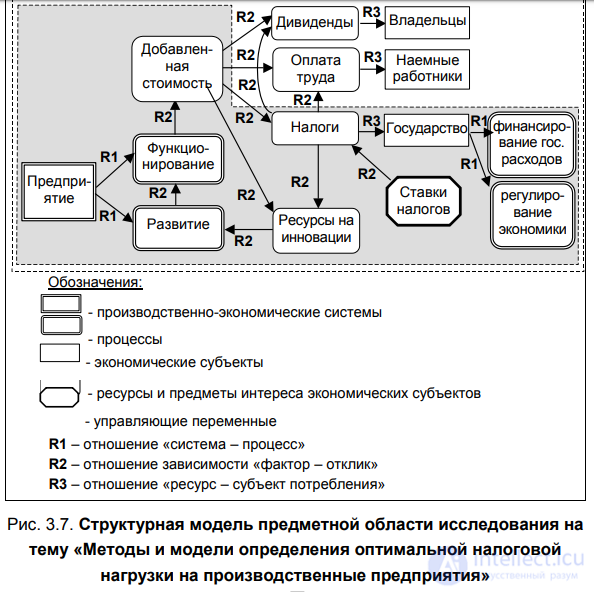
To structure the subject area means to identify the boundaries, the elements of the subject area, and the connections between the elements. The main form of carrying out structuring is the construction of a structural model of the subject area.
A structural model of the subject area is a figurative-symbolic model, depicted in the form of a graph, whose vertices are the objects and phenomena of the subject area, and whose edges are the interrelations between them.
The structural model of the subject area of the research devoted to the topic of improving the tax system is shown in Fig. 3.7. The dotted line in the figure indicates possible variants of the boundaries of the subject area. As can be seen, the researcher has the opportunity to vary the breadth of the field of research depending on the resources at his disposal and the tasks facing him.
The results obtained must become accessible to the scientific community. For this purpose, they are presented in the form of a scientific article, report, monograph, paper, dissertation, conference abstracts, or other scholarly work.
Publication does not merely involve making the data obtained public, but also their scientific substantiation: the researcher describes the methods, the conditions under which the work was carried out, the results obtained, and the conclusions. This allows other scholars to assess the reliability of the research and, if necessary, reproduce it.
Thus, publication performs the function of disseminating scientific knowledge and incorporating the results of a specific study into the general scientific circulation.
After the results are published or presented, they become the subject of scientific discussion. The researcher may present the work at a conference, seminar, or dissertation defence, or discuss it with colleagues. Other specialists assess the validity of the conclusions and the research methods, the reliability of the data obtained, and identify the strengths and weaknesses of the work.
In the course of such discussion, comments, questions, alternative explanations, and new scientific hypotheses may arise. The researcher analyses the criticism received and, if necessary, refines the results, adjusts the conclusions, supplements the research, or conducts additional experiments.
Therefore, scientific research does not always end with the first result obtained. Refinement and verification of results ensure their reliability and contribute to the further development of scientific knowledge.
These stages form a single process:
preparation → conducting the research → processing and analysing the data → publication of results → scientific discussion → refinement and verification of results.
Their sequential completion makes it possible to transform the original scientific problem into substantiated, verified, and accessible scientific knowledge.

Comments