
Lecture 9 min.
In addition to the fact that scientific disciplines undergo linear development from the pre-scientific period to the methodological one, cyclical development is also inherent in any mature science. According to the concept of the American philosopher and historian of science Thomas Kuhn, any given science develops cyclically through a constant alternation of two qualitatively different periods:
- the period of "normal science",
- crisis and a revolutionary period (Fig. 1.9).
The period of "normal science" – is an equilibrium state of science, when a certain "paradigm" reigns unchallenged.
Paradigm (Greek paradeigma -- example, pattern, model) – is a recognised scientific theory that, for a certain time, sets the model of scientific activity. In addition, a paradigm is also the dominant model of scientific activity itself, consisting of a set of theoretical principles, methodological norms, worldview attitudes and value criteria.
In other words, it is the dominant conceptual system, the style of thinking in science.
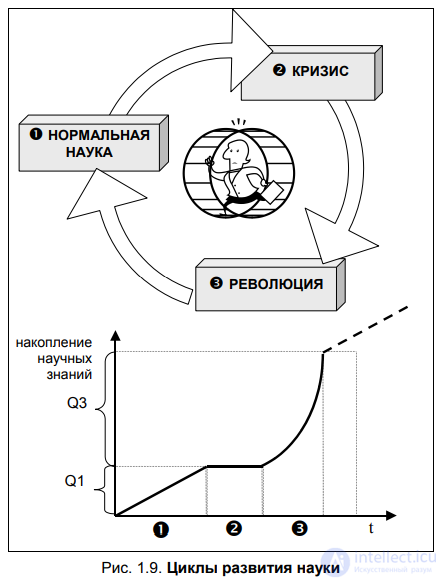
During the period of "normal science", the provisions of the accepted paradigm are not called into question. Scientists carry out research that is not aimed at major discoveries but is intended to extend the scope and increase the precision of the application of the paradigm. However, the peaceful "expansion" of the dominant paradigm does not go on forever. Gradually more and more facts accumulate that contradict the prevailing theory. At first these facts are ignored or fitted to the provisions of the theory, but at a certain point it becomes impossible to ignore them any longer, which gives rise to a situation of crisis.
Crisis in science marks the beginning of the "revolutionary" period of its development. During this period, an awareness arises of problems that in principle cannot be solved within the framework of the old paradigm. A search begins for alternative ideas and the paradigms based on them. A struggle and competition arises between the proposed concepts, as a result of which
one of the new paradigms wins out, which means the beginning of a new period of "normal" science. This cycle then repeats itself (see Example 1.1).
Example 1.1
The Paradigm of Employment Theory
One of the paradigms that formerly prevailed in economic theory is the classical theory of employment, which dominated
in science in the nineteenth and early twentieth centuries. The main idea of this theory is that capitalism is a self-regulating system and that a market economy is capable of ensuring practically constant full employment of the population. This conclusion is based on Say's Law ("supply creates its own corresponding demand") and on the assumption of the elasticity of prices and wages. It was believed that, since supply creates demand, general overproduction is impossible: any decrease in consumption spending would be offset by a decrease in prices and wages, as a result of which real output and employment would not fall. During the period of "normal science" these provisions were considered axioms, and scientists set themselves particular, narrower tasks. For example, one of the tasks that scientists solved during the period when the classical theory of employment dominated was the study of the influence of savings on the process of market self-regulation. The classical economists showed that savings do not at all lead to a deficiency of demand (as might seem at first glance), since household savings are offset by entrepreneurs' investments. The second question was how the equality of savings and investment is ensured. The classical economists found a solution to this problem as well. It was shown that the equality of savings and investment is ensured by changes in the interest rate on the money market.
At the beginning of the twentieth century, the provisions of the classical theory of employment were called into question owing to recurring periods of unemployment.
At first, scientists explained short-term declines in output by wars and unfavourable external circumstances, but in the 1930s the "Great Depression" struck America. This fact completely
contradicted the tenets of the prevailing theory. In connection with this, many scientists began to criticise the fundamental principles of the classical theory of employment. The "revolutionary" period in economic
science ended with the classical theory of employment being replaced by Keynesian theory, which asserts that capitalism is not a self-regulating system and that under it there exists no
mechanism guaranteeing full employment of the population.
Objectives of the assignment:
- to consolidate the knowledge gained about the tasks and functions of science;
- to gain experience in identifying the general tasks of scientific research.
Supplementary material
Any scientific research is aimed at solving one or several tasks. Let us recall that the main tasks of science include:
- describing phenomena of reality;
- systematising phenomena of reality;
- explaining phenomena of reality;
- predicting phenomena of reality.
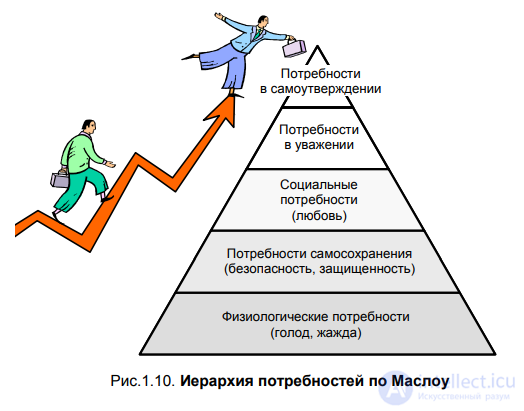
Let us take, as an example, the well-known hierarchy of needs proposed by Abraham Maslow (Fig. 1.10). It is obvious that this hierarchy
solves the task of systematising human needs: the needs
are grouped and ranked in terms of their importance. At the same
time, Maslow's hierarchy is an attempt to explain why, in different
situations, people are driven by different interests. In other words, this
scientific result solves the task of explaining phenomena of reality. Moreover, with the help of Maslow's theory it is possible to predict a person's behaviour on the basis of information about which of their needs
are satisfied and which are not. Thus, the hierarchy of needs
proposed by Abraham Maslow solves the tasks of describing, systematising, explaining and predicting phenomena. It is useful to subject the results of all research work to a similar analysis. A correct
determination of which tasks a given piece of scientific research solves makes it possible to correctly determine the scope of application of its results
Assignment
Find, in literary sources, descriptions of the results of scientific studies. Determine which tasks (description, systematisation, explanation or prediction of phenomena of reality) each of the results is aimed at solving.
1. What is the specific nature of scientific thinking?
2. Give a definition of the concept of "science".
3. What are the main functions and tasks of science?
4. What fundamental differences exist between the natural and the social sciences?
5. What is the classification of the sciences and what is it for?
6. Give a brief characterisation of the stages in the formation of science.
7. What phases does the development cycle of any mature science include?
CONCLUSIONS
Let us summarize what was presented in Chapter 1:

Comments