
Lecture 7 min.
In organizing information retrieval, the systematization of documents is of great importance. It allows books, articles, patents and other documents to be rationally arranged in repositories and enables searching in catalogues. The basis of systematization is the indexing of documents in information and bibliographic publications and the formation of reference and information holdings.
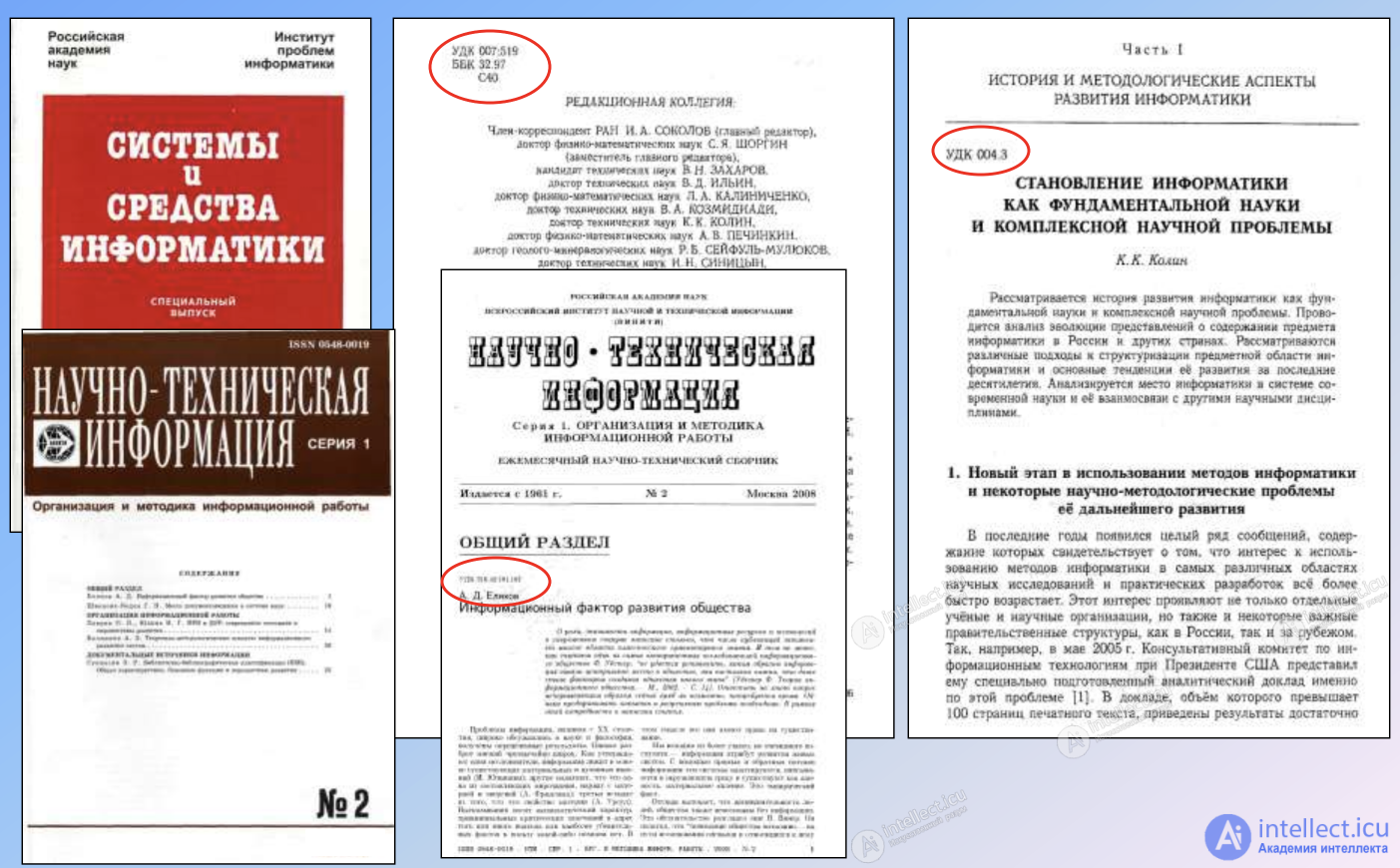
The essence of indexing is that concepts (topics) reflecting the content are established, and for these concepts (topics) indexes (subject headings) are found that have been fixed in pre-compiled tables, dictionaries, etc. Information-retrieval languages (IRLs) are used to express the main content. IRLs can be classified according to various criteria. At present, all bodies of scientific and technical information and technical libraries use an IRL called the Universal Decimal Classification (UDC), which belongs to the library-bibliographic type of IRL.
The UDC consists of the main table, auxiliary tables and an alphabetical subject index (Fig. 3.4).
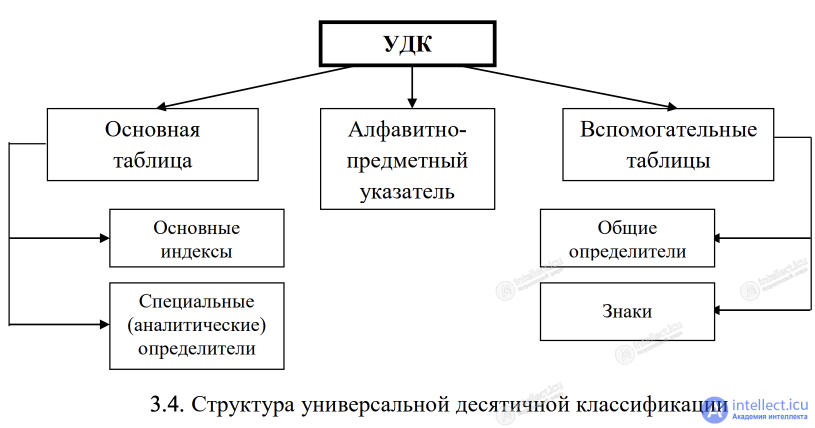
3.4. Structure of the Universal Decimal Classification
The main table contains the indexes by means of which materials are systematized according to content. Each concept reflected in the main table corresponds to a specific UDC index. The entire sum of human knowledge is divided into 10 main classes:
0 – general division;
1 – philosophy, psychology;
2 – religion; theology;
3 – social sciences; statistics, politics, economics;
4 – vacant;
5 – mathematics, natural sciences;
6 – applied sciences, medicine; technology;
7 – art, applied art, etc.;
8 – language, linguistics, fiction, literary studies;
9 – geography, biography, history.
Each subsequent digit added to the designation of the main division refines it. This construction of indexes makes it possible to divide the most general concept into narrowly specialized ones. The greater the degree of subdivision, the more characters the index contains. For better readability, a period is placed after every three digits of the index. Within a given section, indexes are arranged on the principle of general to specific. The sequence of a UDC index is determined by the order of the digits of that index.
Alongside the main indexes, the main table also gives special (analytical) qualifiers, reflecting features characteristic of a narrow range of concepts and applied only within the section at the beginning of which they are placed. In UDC publications, analytical qualifiers are marked with a bold vertical line in the margin and are attached to the main indexes by means of a hyphen (-), a period (.) and a zero (0).
The auxiliary tables of the UDC list common qualifiers, reflecting features by which materials can be subdivided across all divisions, as well as various signs used for combining several main indexes (Table 3.1). Letters of the Latin or Russian alphabet, individual words or names may be added to the indexes if necessary.
Table 3.1
Common qualifiers of the UDC
|
Name |
Sign |
Example |
Note |
|
Common point-of-view qualifier |
.00 |
.001 – theoretical point of view; research work |
- |
|
Form and character qualifier |
(0) |
(031) – encyclopedias (031)6 – technical encyclopedias |
Characterizes the form of the publication; the number after the bracket denotes the branch of knowledge |
|
Place qualifier |
( ) |
(47+57) – Soviet Union; (470.311) – Moscow Region |
Reflects the geographical or territorial aspect |
|
Time qualifier |
«…» |
«1964.01.24» - 1964, January 24 «19» - 20th century
|
Indicates the time (the digits in quotation marks denote the year, day and month of the event) |
|
Language qualifier |
= |
=30 – in German; =20 – in English; =82 – in Russian |
Indicates the language in which the material was published, the number denotes the name of the language |
|
Race and peoples qualifier |
(=) |
(=927) – Arabs (=82) – Russians (=40) – French
|
Names of nations are designated by placing the qualifier in round brackets |
Alongside common qualifiers, the UDC also uses various signs for combining a number of indexes (Table 3.2).
Table 3.2
Signs used in the UDC
|
Purpose |
Sign |
Example |
Note |
|
Addition |
+ |
669+622 – metallurgy and mining |
Reflects the number of topics covered by a single piece of material. |
|
Extension |
/ |
546.32/34 – from potassium to lithium 017/019 – catalogues |
Combines concepts that are adjacent in the decimal sequence: instead of 546.32+546.33+546.34, 546.32/34 is written |
|
Relation |
: |
016:631.3 – bibliography on electronics |
Used to denote the interrelation of two or more concepts |
|
Relation |
:: |
575::576.3 - cytogenetics |
Fixes a particular order of two or more components |
|
Union (synthesis) |
‘ |
546.32‘175 – sodium potassium |
Joins indexes that have the same initial digits and close meanings: 546.32 – potassium and 546.175 - sodium |
|
Square brackets |
[…] |
[622+669](477) – mining and metallurgy in Ukraine |
A sign used in all sections of the UDC in compound and composite indexes |
The addition sign is used when several independent questions of equal significance are being considered.
The extension sign is used to replace indexes reflecting questions that are close in meaning.
The relation sign makes it possible to classify materials dealing with questions between which there is an internal connection.
The union (or synthesis) sign is used when classifying materials on chemical compounds and alloys.
Having established the main content of the material, one must consult the alphabetical subject index and use it to determine the section corresponding to the content, then select the heading and record its index. Several keywords are selected from the title or abstract of the work, and for each keyword, UDC indexes are found using the alphabetical subject index; these are then combined into one overall index by means of the corresponding signs.

Comments