
Lecture
In normative and scientific literature the concept of plagiarism is defined as follows:
"The disclosure (publication), in whole or in part, of someone else's work under the name of a person who is not the author of that work" [11];
"The appropriation of authorship of someone else's work of science, literature, or art, or of someone else's discovery, invention or rationalisation proposal, as well as the use in one's own works of someone else's work without reference to the author" [15, 796-797]
"A type of violation of the rights of an author or inventor, consisting in the unlawful use, under one's own name, of someone else's work (scientific, literary, musical) or invention, rationalisation proposal (in whole or in part) without indicating the source of the borrowing ..." [4, 601];
Unlawful actions to coerce co-authorship may also be recognised as plagiarism, and in the electronic environment this phenomenon may be regarded as one of the types of electronic crime, similar to hacking, the spreading of viruses, spam and phishing.
Self-plagiarism (English: self-plagiarism) is the repeated publication by an author of their own scientific texts that are substantial in volume and identical in form and content, without indicating the fact of their previous or simultaneous publication.
Self-plagiarism may take the form either of the repeated publication of one and the same article with minor changes to the title and content ("double" or "multiple publication"), or of an article containing substantial fragments of previously
published scientific works without indicating references to the latter ("slicing")
Recently, more and more material has been appearing about a deep crisis of academic integrity, evidence of which is the increase in the number of recorded cases of plagiarism, falsification and fabrication of results in the scientific works of Ukrainian scholars and educators. The factors that have caused it include:
1. The general crisis of society, which over the past few decades has become more tolerant of legal nihilism, corruption, and numerous violations of legislation and ethical norms. The intensification of discussions on academic integrity coincides with the beginning of the overcoming of this crisis in recent years and is in itself already a positive shift. But there still remain more problems than achievements.
2. The detachment of our higher education and science from the world scientific and educational community, from the needs of society, the economy and the labour market. The orientation of higher education towards quantitative indicators ("gross output"), papers, diplomas and the like, rather than towards quality, competitiveness, usefulness to society, etc. The education reform is to a large extent aimed at solving these problems. But its results will only be seen in a few years' time.
3. Problems of legislation. For example, the current Law of Ukraine "On Scientific and Scientific-Technical Activity" (Art. 1.22) notes that "a scientific result may take the form of a report, a published scientific article, a scientific paper, a scientific communication on research work, a monographic study, a scientific discovery, a normative legal act, a normative document or scientific-methodological documents, the preparation of which requires the conduct of corresponding scientific research or contains a scientific component, etc.". This provision has existed since at least 1991, and it is the basis for creating systems for assessing the scientific activity of scholars, higher education institutions and research institutions according to formal quantitative indicators (number of publications, number of sheets ...), rather than according to the level, quality and influence of the research results.
4. The inconsistency of the requirements placed on higher education institutions, scientific-pedagogical staff and degree candidates with the funding and other resource provision of higher education and science. In particular, the excessive requirements of legislation and internal normative documents regarding staffing, the number of publications, the volume of qualification and other academic works, and the like. For example, in many higher education institutions the requirements for the volume of coursework and diploma papers, practice reports, and other written documents that students must prepare assume that one hour of a student's academic workload must correspond to 1-3-5 pages of the corresponding document. This takes into account neither the considerably lighter norms for lecturers, nor the need to use a substantial part of the allotted time for searching for literature, carrying out research, calculations, analysing their results, and other practical tasks. The volume of written works must be agreed with the time that, under the individual study plan and/or the programmes of academic disciplines, is allotted for their completion. The norms on the number of scientific works of scientific-pedagogical staff (irrespective of the quality of these works), which are established by the Licensing Conditions for carrying out educational activity and other normative documents, require revision.
5. The absence of legally established or generally accepted procedures for assessing scientific and academic works for the presence of plagiarism, fabrication, falsification and other violations of academic integrity.
6. The internal demotivation of lecturers and scholars to observe the principles of academic integrity under conditions of low salaries, the absence of the material base necessary for quality research, quality external evaluation, and external demand for research results.
7. The emergence of new technologies that significantly facilitate the copying of other people's works, the replacement of the results of experimental and empirical research with computer modelling and plausible estimates, the need to edit graphic, video and audio materials, and the like.
8. The practice of imitating and falsifying scientific research in certain politicised sciences during the times of the USSR, which became widespread in recent decades due to the disregard of research quality standards generally recognised in European countries, and a significant increase in the relative share of research in the corresponding fields.
Certain instruments for preventing violations of academic integrity are contained in the current Laws of Ukraine "On Higher Education" and "On Copyright and Related Rights", the Procedure for the Award of Academic Degrees, and the internal normative documents of some higher education institutions. A substantial contribution to the creation of the legislative foundations for ensuring academic integrity was Article 42 "Academic Integrity" of the new Law of Ukraine "On Education". At the same time, the adoption of this law caused an intensification of discussions on the corresponding issues. Some participants deny the existence of any problems at all. Others believe that the law on copyright and related rights is quite sufficient for resolving them. Still others insist on restricting the understanding of plagiarism solely to the presence of direct textual coincidences without proper references. Sometimes requirements are also added regarding the permissible percentage of text that coincides with other sources. Without agreeing with these extreme interpretations, it must be acknowledged that many problems remain that require normative regulation. This is also evidenced by cases of court decisions which, citing the absence of such regulation or its vagueness, in effect substitute for the authorised bodies on matters of awarding academic degrees or admitting students to the defence of their final qualification papers.
According to part 4 of Article 42 of the Law of Ukraine "On Education", academic plagiarism is "the disclosure (partially or fully) of scientific (creative) results obtained by other persons as the results of one's own research (creativity), and/or the reproduction of published texts (disclosed works of art) of other authors without indicating authorship". A similar wording is contained in part 6 of Article 69 of the current Law of Ukraine "On Higher Education". The Law of Ukraine "On Copyright and Related Rights" gives a fundamentally different definition. According to point c) of Article 50, plagiarism is "the disclosure (publication), in whole or in part, of someone else's work under the name of a person who is not the author of that work". In addition, under part 2 of Article 52 of this law, subjects of copyright and/or related rights may apply to a court or other competent bodies for the protection of their rights. But the law does not provide for any variants of holding violators liable without an application from the subjects of the said rights. It is not hard to see that the understanding of plagiarism in this law is significantly narrower than the understanding of academic plagiarism in the education laws. Moreover, part 3 of Article 433 of the Civil Code of Ukraine directly excludes ideas, processes, methods of activity or mathematical concepts as such from the objects of copyright, which should not prevent their identification as academic plagiarism in cases where there are no proper references to the actual authors in academic works.
There are many different definitions of plagiarism, which is due to the aims of regulation and the traditions that exist in various fields of knowledge, spheres of professional activity, and other countries.
According to T. Fishman [6, 7], plagiarism is academic behaviour "that is characterised by the following five cumulative features: when a certain person
(1) uses words, ideas or the results of the work,
(2) belonging to another specific source or person
(3) without reference to the source from which they were taken
(4) in a situation in which it is legitimately expected that the authorship of the original be indicated
(5) for the purpose of obtaining a certain benefit, respect, or advantage, which need not necessarily be of a monetary nature".
At Stanford University, plagiarism is called "the use without providing reasonable and appropriate credit or acknowledgement of the author or source of another person's original work, regardless of whether that work is code, a formula, an idea, language, research, a strategy, a text, etc.".
Yale University regards plagiarism as "the use of another person's work, words or ideas without attribution".
Cambridge University calls plagiarism "the submission as one's own work, regardless of whether there was an intent to deceive, of work that is partially or fully borrowed from another person's work without proper attribution" [10].
The US National Science Foundation calls plagiarism "the appropriation of another person's ideas, methods, results or words without giving appropriate credit" [11]. Credit here is understood to mean references to the authors or the source of the information, provided in the form accepted for the corresponding cases (a reference to a publication, mention of a surname in the text, an acknowledgement, etc.).
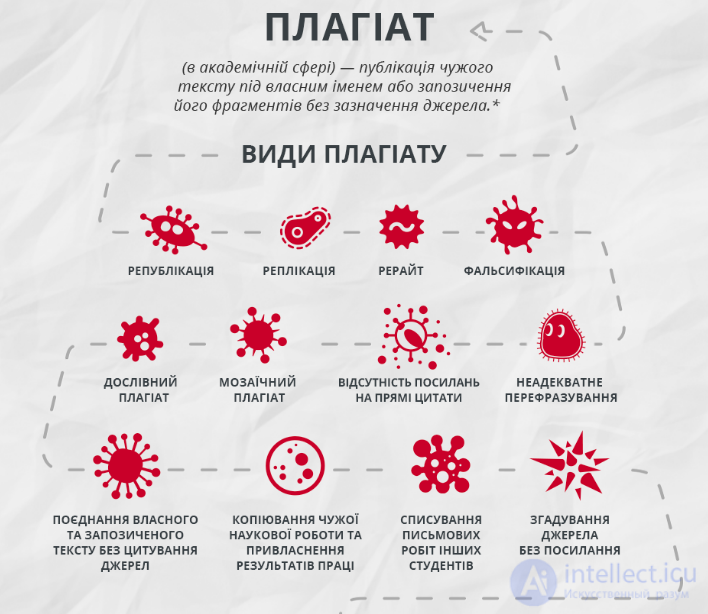
The following main types of plagiarism are distinguished:
> Verbatim borrowing of text fragments without presenting them as quotations with a reference to the source (in certain cases even the use of a single word without a reference to the source is considered incorrect, if that word is used in a unique meaning provided by that source)
> The use of information (facts, ideas, formulas, numerical values, etc.) from a source without a reference to that source;
> Paraphrasing the text of a source in a form close to the original text, or the flooding of a summary of ideas, interpretations or conclusions from a specific source without a reference to that source;
> Presenting as one's own works (dissertations, monographs, textbooks, articles, theses, reports, tests, calculation assignments, coursework, diploma and master's theses, essays, papers, etc.) works carried out to order by other persons, or works in respect of which the actual authors have given consent to such use (this may also be regarded as a type of academic dishonesty - deception).
Sometimes several further types of plagiarism are distinguished, which can be reduced to those indicated above.
The Law of Ukraine "On Copyright and Related Rights" (Article 50, point c) has as its purpose the protection of the personal property and non-property rights of subjects of copyright (part 2, Article 3), and not the prosecution of those who appropriate authorship in cases where intellectual property is not at issue. In particular, its scope does not cover the incorrect use, as the results of one's own scientific or creative activity, of other people's ideas, texts, etc., which are not objects of copyright within the meaning of the said law. This concerns, above all, folklore, official documents of state authorities, official symbols, certain types of media reports, etc. (Article 10). Nevertheless, their use without proper references should be regarded as academic plagiarism. Problematic from the point of view of applying the norms of this law is the protection of copyright in objects of scientific or creative activity that have not been published and do not exist in objective form (part 1, Article 3). For example, ideas expressed in the course of discussions. Yet the norms of academic ethics presuppose references to the authors of such ideas.
Proceeding from an analysis of the problem of plagiarism, as well as of the existing normative base and materials of European and North American higher education institutions and research institutions, in particular [12 - 15], the following recommendations can be given along with normative documents and comments on establishing and identifying facts of plagiarism.
Academic plagiarism must not be equated with a violation of copyright as a type of intellectual property.
The protection of copyright and related rights concerns, above all, personal non-property rights, as well as the property rights of subjects of copyright and related rights. Yet the norms on academic plagiarism are directed not at these, but at persons who violate academic integrity by failing to provide reliable information about the authors of certain ideas, texts, scientific results, and the like.
Academic plagiarism is regarded as a violation of the ethical norms of the academic community, whereas a violation of copyright is regarded as an offence, liability for which is established by legislation (in Ukraine - by the Civil Code).
The requirements of academic integrity provide for giving correct references to the actual authors of the works used, rather than to the persons to whom copyright in them might have been transferred (for example, the successors of the authors).
Copyright, on the other hand, protects those to whom, at a given point in time, the property or personal non-property rights to a work belong. In the case of property rights, these will not necessarily be the actual authors of the work.
The publication under one's own name of results obtained by other persons, with the permission of those persons, is not a violation of property copyright, but is academic plagiarism. In this case, it is clear that the actual author will not, in such cases, make use of non-property rights, in particular the right to have their authorship acknowledged by having their name properly indicated on the work and its copies.
Copyright has a limited term of validity. After its expiry, the use of a work is permitted without the consent of the authors or their successors and without payment of the corresponding remuneration. But this does not remove the need to reference the authors. The absence of proper references is the main indicator of academic plagiarism.
Academic plagiarism may concern texts, drawings, fragments of musical works, mathematical models, expressions and transformations, program code, and the like. Its sources may be books, articles, pamphlets, patents, theses, manuscripts, websites and other Internet resources, presentations made during discussions, handout materials for students, the works of other students, etc.
Academic plagiarism must be distinguished from citation errors. The most typical citation errors are:
- the absence of quotation marks when using text fragments borrowed from other sources, while a correct reference to that source is present;
- referencing a different source than the one from which the quotation is taken;
- incorrect formatting of a reference, which makes it difficult to find the source.
Citation errors are usually considered a less serious violation of academic integrity, but sometimes they are, not entirely justifiably, regarded as a type of plagiarism. However, this is most often done in instructions for students, rather than in documents that establish academic liability. Typical of Ukrainian educators and scholars from various fields of knowledge is the presentation of an entire publication, or its review section, as a set of fragments borrowed from various sources, which are not always correctly formatted, even where they constitute direct quotation. Such texts frequently have mixed-up references. There are also errors in authors' surnames, the titles and publication details of works, which makes it difficult or impossible to find the sources and process them with scientometric systems. Sometimes there are grounds to suspect,
Regardless of whether they are considered plagiarism or not, citation errors are a violation of academic ethics, since under present-day conditions they create inconvenience for other scholars and may infringe their rights.
In certain cases it is unclear whether there is a need, or no need, for references to the sources of "common knowledge". This concept is ambiguous and depends on the circumstances. Common knowledge is usually understood to mean knowledge that is found in encyclopaedias, textbooks and other similar sources. Knowledge given in many (five or more) sources is also classed as common knowledge. But what is common knowledge for representatives of one science or profession may not be so for representatives of other sciences and professions. When making decisions on this matter, the following should be taken into account:
> Ideas, methods, formulas, models, etc. can usually be regarded as common knowledge, but not fragments of texts, photographs, etc.;
> Who the publication is intended for - what is "common knowledge" for the author may not be so for an ordinary reader;
> Whether information about the primary source is fundamentally accessible - sometimes one can find dozens of identical texts in sources that are clearly not original and authoritative;
> Whether there is a possibility of alternative attribution of the author, for example through mention of his or her surname (for example, "Ohm's law") without indicating a specific source (bearing in mind that such attribution based on secondary sources may turn out to be erroneous)
The question of the correct citation of translations is a matter of debate. There is a view that a literal translation should be formatted as a quotation, and that the absence of quotation marks is a violation. But no less well-founded is the other view, that translation always introduces certain changes into the understanding of a text. Therefore, formatting even a literal translation as a quotation may convey to readers a distorted picture of the position of the author of the original text. A solution to the problem may be to provide a free translation with a reference to the source. In this case, gross translation errors that distort the thoughts of the original authors may still be regarded as independent violations of academic ethics. Other common ways of resolving this problem are to give the original text alongside the translation, or to provide, in brackets, in the original language, individual words whose translation is ambiguous.
Another debatable question consists in assessing as plagiarism works that consist of fragments of the works of other authors where correct references are present. Such works cannot be considered plagiarism, since they do not contain the key feature - the appropriation of other people's results. But in most cases (with the exception of certain types of student work) they do not meet the established requirements or objectives, in particular regarding scientific novelty, the presence of one's own results, critical analysis of sources, and the like. Sometimes such works contain indicators of other violations of academic integrity - deception, falsification and/or fabrication.
There are various requirements regarding citation and the formatting of references for different types of academic works. In particular, some of the requirements that make a text harder for readers to follow may not apply to scientific-methodological works – textbooks, study guides, methodological recommendations, etc. But even in this case, the use of direct textual borrowings without properly formatted quotations and in-text references is considered impermissible. It is also recommended that such publications provide, at a minimum, a general list of the sources used. Specific requirements for different types of publications and academic texts should be established at the level of higher education institutions or their subdivisions, the editorial boards of scientific publications, and professional communities. In doing so, account should be taken of the practices of the world's leading universities, the type and intended purpose of the publications, and the use of the given references by scientometric databases and other sources of scientific information.
Even greater debate is caused by the introduction, in the new law on education, of the concept of self-plagiarism. According to part 4 of Article 42, self-plagiarism is "the disclosure (partially or fully) of one's own previously published scientific results as new scientific results".
The problem of self-plagiarism is relevant because certain authors of scientific publications repeatedly reproduce the same scientific results. In doing so, they present them as independent results that were not previously known and had not been published. But it should be understood that in cases of self-plagiarism, what is at issue is not the appropriation of other people's results, but the use, incorrect from the point of view of academic ethics, of one's own previously published scientific results. This determines the specific nature of identifying cases of self-plagiarism and of academic liability for such a violation.
The main reasons for the need to single out self-plagiarism as a type of violation of academic integrity in the countries of Europe and North America are considered to be that it:
Typical examples of self-plagiarism are:
> Duplication of publications - the publication of one and the same scientific work (in full or with insignificant changes) in several publications, as well as the repeated publication (in full or with insignificant changes) of previously disclosed articles, monographs, and other scientific works, as new scientific works;
> Duplication of scientific results - the publication of the same scientific results in various articles, monographs, reports, and other scientific works, as new results being published for the first time;
> The presentation, in reports on the performance of scientific projects, of results contained in previous works, as having been obtained in the course of carrying out the corresponding project;
> Aggregation or supplementation of data - the combining of old and new data without their clear identification with the corresponding references to previous publications;
> Disaggregation of data - the publication of part of previously published data without a reference to the previous publication;
> Repeated analysis of previously published data without a reference to the previous publication of that data and to the analysis of it previously carried out.
The aggregation or augmentation of data may make it difficult or impossible to interpret it correctly, since the data may not be comparable, may have different statistical characteristics, may concern non-identical objects, may fail to take dynamics into account, and the like. The disaggregation of data without a reference to the previous publication, an explanation of the reasons for excluding part of the data, the recalculation of statistical characteristics, the making of changes to graphs, etc. may give the reader a distorted impression of the reliability and validity of the data and conclusions. Therefore, aggregation and disaggregation without a proper distinction between old and new data and results are regarded as a violation of academic integrity and/or evidence that the researcher lacks the necessary qualification.
Repeated analysis of previously published data may be due to the emergence of new data-processing technologies, new theories applied to their processing, analysis, explanation, and the like. It is considered self-plagiarism, above all, if the publication partly contains the results of a prior analysis, but references to the corresponding publications are absent. In this case, the reader forms a distorted impression of the research methodology and, accordingly, of the reliability and validity of the results.
Article 42 of the Law of Ukraine "On Education" defines the concept of self-plagiarism only for scientific results. World practice extends it to other types of activity as well, in particular creative activity, which is relevant, for example, for institutions of the arts, as well as journalism and some other specialities. Higher education institutions should take this into account when creating internal normative documents on ensuring academic integrity, and should establish safeguards against self-plagiarism for a broad range of results used in assessing the educational, scientific or creative activity of participants in the educational process. The basis for this is the norm of the same Article of the Law on deception, as a type of violation of academic integrity, of which self-plagiarism is a particular case.
Proceeding from an analysis of the problem of self-plagiarism, as well as materials of European and North American higher education institutions and research institutions, in particular [15 - 17], the following recommendations can be given along with normative documents and comments on establishing cases of self-plagiarism.
The concept of self-plagiarism should not be applied to cases of reproduction of an author's scientific results in publications that are not scientific in nature. In particular, in his or her publications on social networks, in the media, in educational and popular-science publications, and the like. But even in these cases, the absence of references to the primary source may be a sign of other types of academic dishonesty and/or of a violation of the copyright of other persons.
The concept of self-plagiarism should also not be applied in cases of a failure to provide references to information about the author's scientific results that had previously already been disclosed in non-scientific sources, in particular on social networks, in the media, in educational and popular-science publications. References to such sources are often considered unacceptable in scientific literature. In particular, such publications often contain preliminary results that require proper substantiation. At the same time, authors should be encouraged to reference such sources as much as possible, in cases where this is considered acceptable for the corresponding type of publication and the corresponding field of knowledge (branch of science) and/or follows from legislation on the protection of copyright and related rights.
When identifying self-plagiarism, attention must be paid to the fact that some publications permit copying or duplication, provided this does not infringe the rights of other publishers and references are given to the first publication, or information is given about the simultaneous submission of materials for publication in other publications. In such cases, the published material must contain the corresponding data. It should also be noted that certain publications, above all electronic ones, carry out reprinting without agreement with the authors or informing them of the reprint. In this case, objections regarding a violation of integrity and/or legislation can be raised against that publication, but not against the authors.
Self-plagiarism does not include the republication (unchanged, or reworked and/or supplemented) of monographs, textbooks, study guides, or other works containing the results of scientific, educational or creative activity, which contain information about the republication and/or references to the first edition. Nor is it self-plagiarism to partially use, in new monographs, textbooks or study guides, fragments of an author's previously published works, provided the new work gives the corresponding information and the extent of the duplication has been agreed with the publisher and the commissioning parties for the edition.
A significant problem for identifying self-plagiarism is the incorrect definition of the concept of "scientific result" in the current Law of Ukraine "On Scientific and Scientific-Technical Activity". When analysing scientific works for the presence of self-plagiarism, one should proceed from the norm of the Law (point 22, Article 1), that a scientific result is "new scientific knowledge obtained in the course of basic or applied scientific research", rather than from the following wordings regarding the forms in which a scientific result exists. At the same time, the internal documents of a higher education institution, a research institution, or their structural subdivisions should provide for a detailed list of what is considered a scientific result, taking into account the specifics of the corresponding fields of knowledge or sciences.
To sum up, it may be noted that overcoming the crisis of academic integrity and, in particular, the problems of plagiarism and self-plagiarism requires, among other measures, the establishment, by special laws and by the normative documents of higher education institutions and research institutions, of clear procedures and criteria for identifying these violations. It is precisely these that must become safeguards against the possibility of releasing violators from liability on the basis of decisions based on legislation that has no relation to the problems of academic integrity. When developing internal documents, similar procedures and recommendations of leading European and North American universities should be taken into account.
1. Law of Ukraine "On Scientific and Scientific-Technical Activity".
2. Law of Ukraine "On Education".
3. Law of Ukraine "On Higher Education".
4 . Law of Ukraine "On Copyright and Related Rights".
5. Civil Code of Ukraine.

Comments