
Lecture
Norm (from Latin norma — literally «a set square», in a figurative sense – a guiding principle, rule, model) — a rule or prescription operative in a given sphere and requiring compliance.
Norms are not based on experience, but are a priori subjectively determined requirements.
At the same time, a norm represents an exact prescription or an obligatory rule of conduct in a given situation. A norm, established as a legalized decree, acquires a recognized obligatory status.
Sentences containing verbs in the imperative mood («don't do that!», «go to the market») are the most obvious way of expressing standards. They tend to create obligations (duties) and permissions. Such norms are deontological. The treatment of duties and permissions as norms is important for ethics and the philosophy of law.
In political philosophy it is debated whether norms of competence, that is, norms that give someone the right to create other norms, are deontic norms or not. For some, such norms are non-deontic institutional facts.
Rules are a variety of norms. Games depend entirely on standards. They determine winners, losers and the score. Laws are rules established by the government of a region, district or country, which are necessary to prevent conflicts, harm, and so on.
Norms are basically rules that serve to keep a place, a game, and so on, organized.
Norms are concepts (propositions) of practical significance, oriented toward the performance of an action, rather than conceptual abstractions that describe, explain and express. Normative propositions imply types of statements and assertions of the "ought" kind, as opposed to propositions that provide types of statements and assertions of the "is" kind. General normative propositions include commands, permissions and prohibitions; general normative abstract concepts include sincerity, validity and honesty. A popular account of norms describes them as reasons to act, to believe, and to feel.

Commands and permissions express norms. Such propositions-as-norms do not describe what the world is, but rather prescribe what the world should be. Imperative sentences are the most obvious way of expressing norms, but declarative sentences can also be norms, as in the case of laws or «principles». As a rule, whether an expression is a norm depends on what is intended to be asserted in the sentence. For example, a sentence in the form «All ravens are black» can, on the one hand, be regarded as descriptive, in which case the example of a white raven would contradict it, or, alternatively, «All ravens are black» can be interpreted as a norm, in which case it functions as a principle and a definition, so that a «white raven» would not be a raven.
Those norms directed at creating obligations (or duties) and permissions are called deontic norms (see also deontic logic). The concept of a deontic norm is already an extension of the earlier concept of a norm, which would include only imperatives, that is, norms directed at creating duties. The understanding that permissions are norms became an important step in ethics and the philosophy of law.
Besides deontic norms, many other varieties have been identified. For example, some constitutions establish a national anthem. These norms do not directly create any duties or permissions. They create a « national symbol ». Other norms create the nations themselves, or the political and administrative regions within a country. The action-orientation of such norms is less obvious than in the case of a command or permission, but it is important for understanding the relevance of adopting such norms: when a folk song becomes a «national anthem», the meaning of singing the same song changes; similarly, when a plot of land becomes an administrative district, this has legal consequences for many kinds of activity carried out on that territory; and without these consequences relating to action, norms would be irrelevant. A more explicitly action-oriented variety of such constitutive norms (as opposed to deontic, or regulative norms).) establishes social institutions that give rise to new types of action or acts that did not previously exist (the standard example is the institution of marriage, without which «getting married» would not be a possible action; another is the rules that constitute a game: without the norms of football there is no such action as taking a free kick).
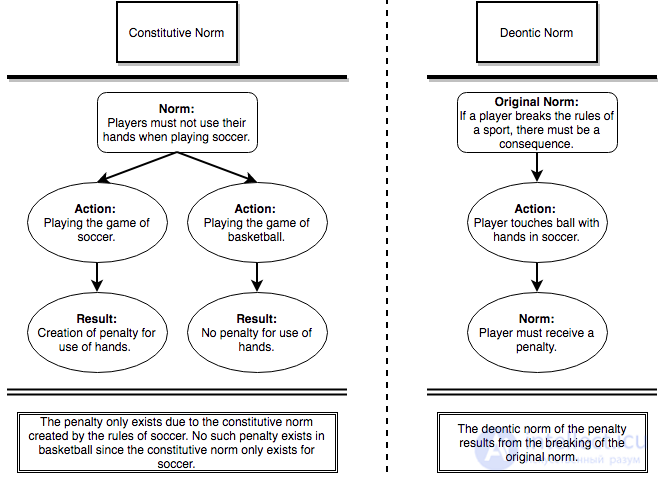
Flowchart with examples of constitutive and deontic norms.
Any agreement can create a norm, although the relationship between them has not been established.
There is significant debate about the (legal) norms that give someone the right to create other norms. They are called power-conferring norms or norms of competence. Some authors argue that they are still deontic norms, while others argue that there is a close connection between them and institutional facts (see Raz 1975, Ruiter 1993).
Linguistic conventions, for example, the convention in English that «cat» means cat, or the convention in Portuguese that «gato» means cat, are among the most important norms.
Games depend entirely on norms. The fundamental norm of many games is the norm establishing who wins and who loses. In other games it is the norm determining how points are scored.
One of the main characteristics of norms is that, unlike propositions, they are not descriptively true or false, since norms are not intended to describe anything, but rather to prescribe, create or change something. Some people say [ euphemistically ], that they are «prescriptively true» or false. Whereas the truth of a descriptive statement is supposedly based on its correspondence to reality, some philosophers, beginning with Aristotle, argue that the (prescriptive) truth of a prescriptive statement is based on its correspondence to right desire. Other philosophers argue that norms are ultimately neither true nor false, but only successful or unsuccessful (valid or invalid), depending on whether their propositional content is realized or not (see also John Searle and speech act).
There is an important distinction between norms and normative propositions, although they are often expressed by identical sentences. «You may leave» usually expresses a norm if it is said by the teacher to one of the pupils, but usually expresses a normative proposition if it is uttered to one of the pupils by one of their classmates. Some ethical theories reject the possibility of the existence of normative propositions, but they are accepted by cognitivism. One can also think of propositional norms; statements and questions may perhaps express propositional norms (they establish a judgment as asserted or as being called into question).
It is often claimed that another supposed feature of norms is that they never concern only natural properties or objects. Norms always bring in something artificial, conventional, institutional or «otherworldly». This may be connected with Hume's claim that it is impossible to derive «ought» from «is», and with G. E. Moore's claim that there is a naturalistic fallacy when one attempts to analyze «good» and «bad» in terms of natural concepts. In aesthetics too it has been argued that it is impossible to derive an aesthetic predicate from a non-aesthetic one. However, the acceptability of non-natural properties is much debated in contemporary philosophy. Some authors deny their existence, others attempt to reduce them to natural properties, on which the former supervene.
Other thinkers (Adler, 1986) argue that norms can be natural in a sense other than «correspondence to something proceeding from the object of the prescription as a strictly internal source of action». Rather, those who assert the existence of natural prescriptions say that norms can satisfy the natural needs on the part of the subject being prescribed to. However, more important is the advancement of the idea that, just as descriptive statements considered true are conditioned by certain self-evident descriptive truths corresponding to the nature of reality (such as: it is impossible for the same thing to be and not be at the same time and in the same respect), prescriptive truth may correspond to the nature of the will, insofar as it is grounded in self-evident prescriptive truths (such as: one must desire what is truly good for oneself, and nothing else).
Recent works argue that normativity plays an important role in several different philosophical subjects, and not only in ethics and the philosophy of law (see Dancy, 2000).

Comments