
Lecture
Laws of philosophy in a number of philosophical systems — a necessary interconnection between events, phenomena, and objects, expressed in its most general form . Philosophical laws often serve as the concentrated content of these philosophical systems. However, the very question of the existence of objective regularities as such depends on the philosophical position one holds and does not always presuppose the existence of any philosophical laws.
The first philosophical constructions elevated to the rank of laws by various philosophical schools arose at the dawn of the development of philosophy and science in general. For example, in ancient China, the Confucians, concerned with the problem of the state and with ethics, held that a person's fate is predetermined by heaven according to the law of "ren." The Daoists, for their part, reflected on the Dao — the fundamental law of nature and the natural way of things — concluding that development occurs through opposition and in a circle, largely independent of any subjects. On the basis of numerous strands of natural philosophy, beginning in the 3rd century BC, in addition to the teaching of the 5 elements or primary substances — water, fire, metal, wood, and earth — and the polar forces of yin and yang, and the notion of qi as primal matter, there arose the notion of li as law, principle, normative foundation, a rational creative force standing in contradiction with qi.
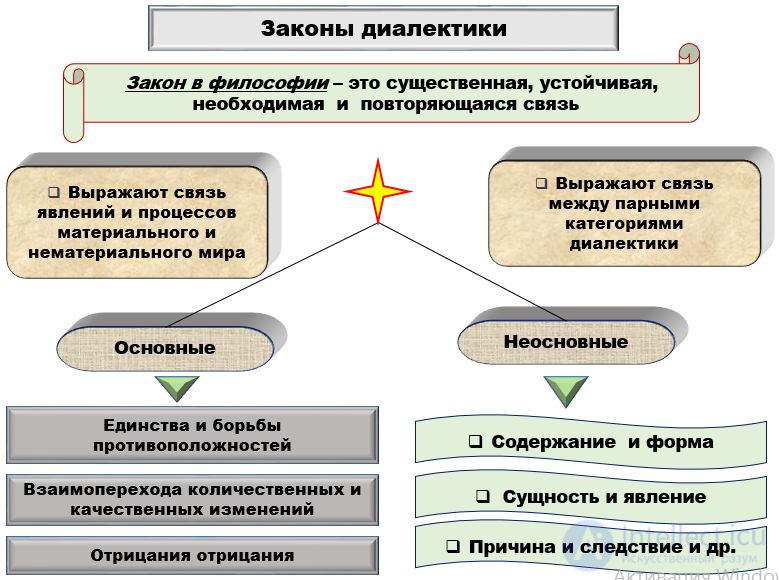
Law – a constant, necessary, essential, universal connection between phenomena and objects.
Science distinguishes 3 levels of laws:
- Laws of individual sciences (particular-scientific);
- General-scientific laws;
- Philosophical laws (laws of dialectics, laws of philosophy) – apply to all phenomena of the spiritual and material world, i.e., have a universal character.
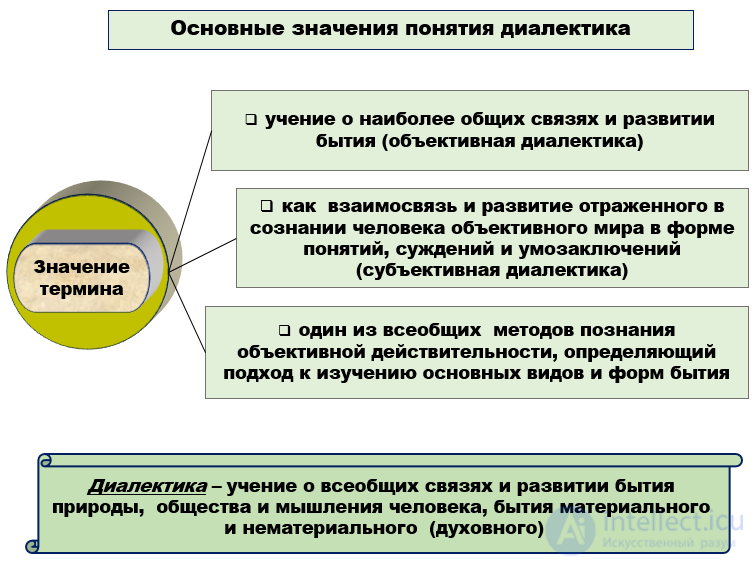
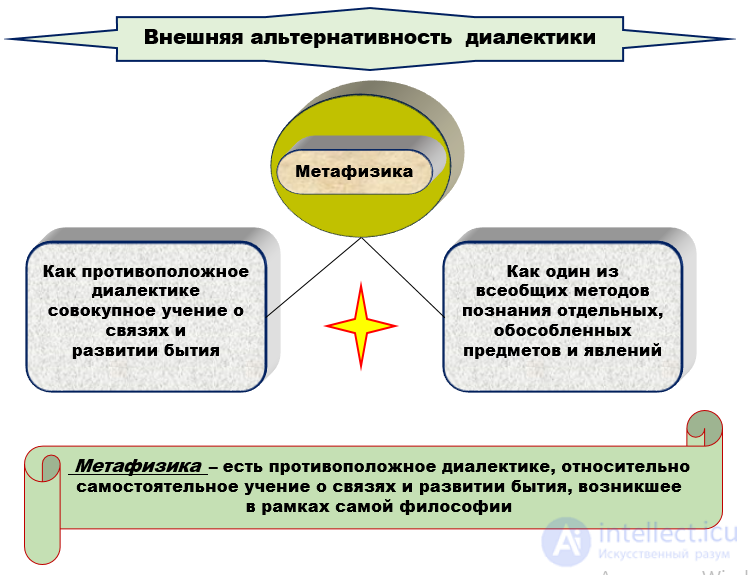
Within dialectics one distinguishes:
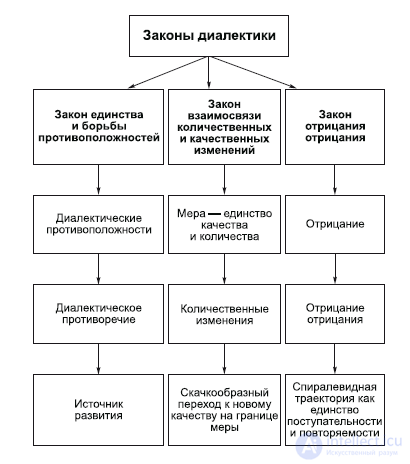
• Laws of dialectics (3 laws of philosophy)
• Categories of dialectics (essence and phenomenon, form and content, cause and effect, etc.);
The division into laws and categories in dialectics is conventional (all paired categories of dialectics are in fact its laws).
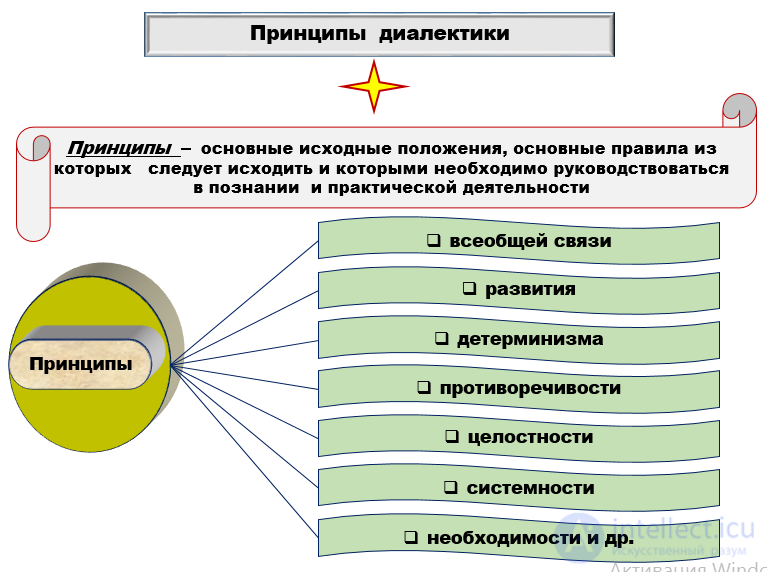
Engels formulated the "three laws of dialectics" (laws of philosophy), which he obtained by interpreting Hegel's dialectics and the philosophical works of Marx:
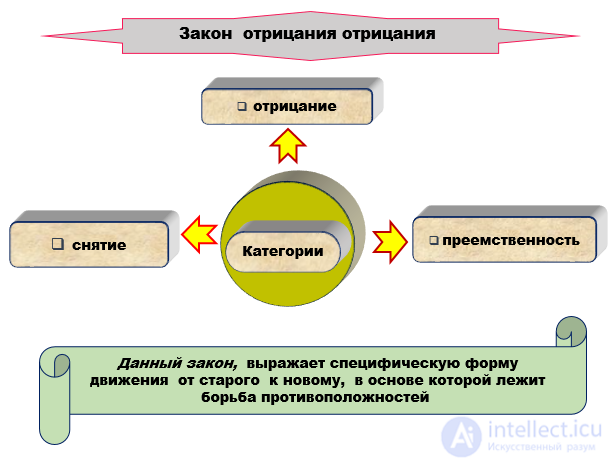
It is held that the fundamental one among them is the law of the unity and struggle of opposites. Regarding the last law, it can also be said that continuity of development is carried out in such a way that after the second successive negation of the old by the new, the new incorporates the old in a sublated, transformed form, on a different basis.
Examples of the laws of philosophy
The law of the unity and struggle of opposites
* Our world exists only thanks to the presence of opposites!:
In the material world –
In thought –
In society – the struggle of various social groups, classes;
In human life –
The law of the transition of quantitative changes into qualitative ones
The boundaries of a measure can be sharp (noticeable) or blurred, short or extended.
Examples: disruption of a biocenosis, baldness, historical and geological processes, disease.
The law of the negation of the negation
The process of development usually passes through a number of negations before the contradiction is finally resolved:
Health – illness – health, and so on.
Already within the mythological worldview, and later in the philosophy of the ancient world, the idea was put forward that changes in the world are connected with the struggle of opposing forces. As philosophy developed, the acceptance or denial of objective contradictions became one of the most important features distinguishing dialectics from metaphysics. Metaphysics does not see objective contradictions, and if they appear in thought, this is taken as a sign of error, of a mistake.
Of course, if objects are considered outside their interconnection, in statics, we will see no contradictions. But as soon as we begin to consider objects in their interconnections, in motion, in development, we discover objective contradictoriness. Hegel, to whom belongs the credit for the theoretical grounding of the laws of dialectics, wrote that contradiction "is the root of all movement and vitality; it is only insofar as something contains a contradiction within itself that it moves, has impulse and activity."
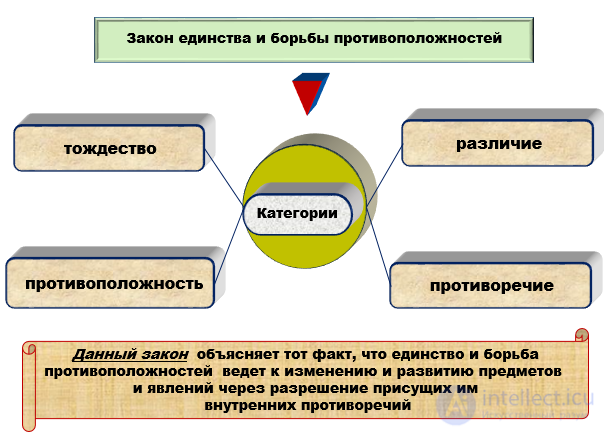
We use the concepts of "opposite" and "contradiction." But what do they mean? Marx wrote that dialectical opposites are "correlative, mutually conditioning, inseparable moments, but at the same time mutually excluding one another… extremes, that is, poles of one and the same thing." To clarify, let us consider the following example. From point 0, objects move in opposite directions (+x and – x). When we speak of opposite directions, we mean that:
1) these two directions mutually presuppose one another (if there is motion in the direction +x, motion in the direction – x necessarily also exists);
2) these directions mutually exclude one another (motion of an object in the direction +x excludes its simultaneous motion in the direction – x, and vice versa);
3) +x and -x are identical as directions (it is clear that, for example, +5 km and -5 km are opposites, whereas +5 kg and -5 km are not opposites, since they differ in their nature).
Dialectical contradiction presupposes opposites. Opposites within a dialectical contradiction do not merely coexist at the same time, and are not merely somehow interconnected, but act upon one another. Dialectical contradiction is the interaction of opposites.
The interaction of opposites creates within objects an internal "tension," a "struggle," an internal "unrest." The interaction of opposites determines the specific nature of the object and predetermines its tendency toward development.
Dialectical contradiction sooner or later is resolved either by the "victory" of one of the opposites in the conflicting situation, or by a smoothing over of the acuteness of the contradiction, by the disappearance of the given contradiction. As a result, the object passes into a new qualitative state with new opposites and contradictions.
The law of the unity and struggle of opposites: all objects contain opposing sides within themselves; the interaction of opposites (dialectical contradiction) determines the specific character of the content and is the cause of the development of objects.
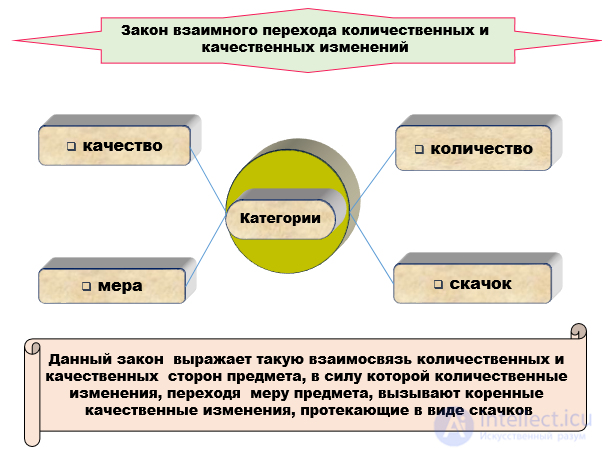
Quantitative and qualitative changes occur in material objects. The category of measure reflects the unity of quality and quantity, consisting in the existence of a certain limited interval of quantitative changes within which a given quality is preserved. Thus, for example, the measure of liquid water is the unity of a certain qualitative state of it (in the form of di- and trihydrols) with a temperature interval from 0 to 100 °C (at normal pressure). A measure is not simply some quantitative interval, but the interrelation of a certain interval of quantitative changes with a certain quality.
Measure underlies the law of the interconnection of quantitative and qualitative changes. This law answers the question of how development occurs: quantitative changes, at a certain stage, at the boundary of the measure, lead to qualitative changes in the object; the transition to a new quality has an abrupt character. The new quality will be linked to a new interval of quantitative changes; in other words, there will be a measure as the unity of the new quality with new quantitative characteristics.
A leap represents a break in the continuity of an object's change. Leaps, as qualitative changes, can occur both in the form of one-time "explosive" processes and in the form of multi-stage processes.
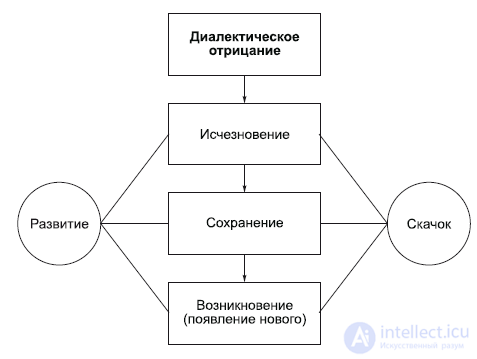
Development occurs as the negation of the old by the new. The concept of negation has two meanings. The first is logical negation, an operation in which one statement negates another (if the statement P is true, then its negation not-P will be false, and vice versa, if P is false, then not-P will be true). The other meaning is dialectical negation as the transition of an object into something else (another state, another object, the disappearance of the given object).
Dialectical negation should not be understood merely as destruction, as the annihilation of an object. Dialectical negation includes three aspects: disappearance, preservation, and emergence (the appearance of the new).
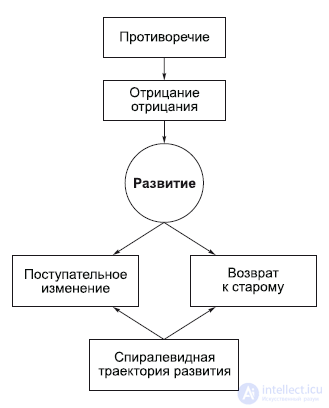
Every material object, by virtue of its inner contradictoriness, is sooner or later negated, passing into something else, something new. But this new thing, in turn, is also negated, passing into something else. The process of development can be characterized as "the negation of the negation." The meaning of "the negation of the negation" is not reducible to a simple succession of negations. Let us take Hegel's example: grain – stalk – ear. Here the negations proceed as a natural process (unlike, say, the case of: grain – stalk – mechanical damage to the stalk).
What, then, is revealed in the negation of the negation when a natural process takes place? First, the preservation of elements of the old together with the appearance of the new determines the forward-moving character of the process of negation of the negation. But it would be a simplification to view the development of an object as a straightforward linear change. Alongside forward movement, the process of development also contains repetition, cyclicity, a tendency to return to the old state. This situation is reflected in the law of the negation of the negation. Let us give a formulation of this law: in the process of development (negation of the negation) two tendencies objectively exist – forward change and a return to the old; the unity of these tendencies determines the "spiral-like" trajectory of development. (If forward movement is depicted as a vector, and the return to the old as a circle, then their unity takes the form of a spiral.)
The result of the negation of the negation, while completing a certain "turn of the spiral," is at the same time the starting position for further development, for a new "turn of the spiral." The process of development is unlimited; there cannot be some final negation after which development ceases.
In answering the question of where development is headed, the law of the negation of the negation at the same time expresses a complex, integral process that may not be detectable over small time intervals. This circumstance is a basis for doubts about the universality of this law. But such doubts are removed if one traces sufficiently large intervals in the development of material systems.
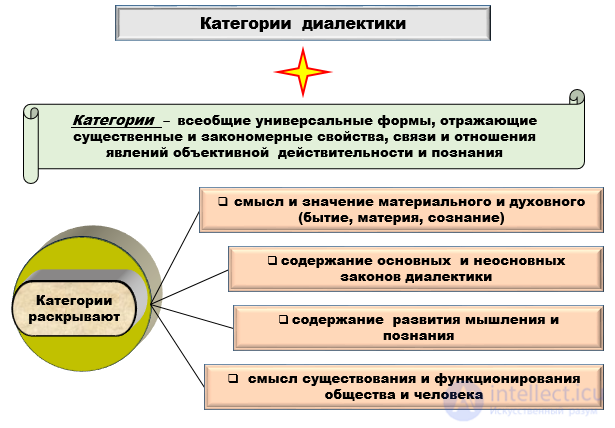
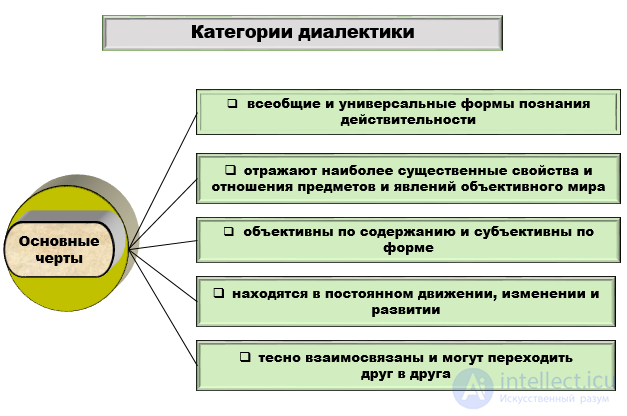
The categories of dialectics – the most general concepts with which philosophy operates in order to disclose the essence of dialectical problems.
Cause – that which is necessary and sufficient for the appearance of an effect (to be distinguished from a mere occasion, accompanying conditions, etc.).
Those conditions which are not sufficient are called accompanying causes.
Effect – that which appears owing to the action of a cause. The cause produces quantitative changes in an object – a new quality appears, which is
called the effect.
Cause and effect are both simultaneous and non-simultaneous.
A determinative (or causal) connection – is the conditioning of some objects, phenomena – by others.
Essence – those properties (regularities) of an object without which it does not exist.
A change in one such property is a change in the object as a whole.
Phenomenon – those properties of an object without which the object can exist while remaining itself (but without all phenomena – it cannot!). Phenomenon always reflects essence.
Between phenomenon and essence there is a dialectical interrelation: from the phenomenon we judge the essence of an object, while a change in essence
leads to a change in the whole range of phenomena.
Necessity – the process without which something cannot occur;
Chance – a form of expression and complement of necessity. Without chance, no process exists!
Actuality – the concrete being of an individual object in concrete space and time. One actuality flows into another, and
so on.
Possibility – the future of an object within its present, its tendencies of development.
Every given actuality contains within itself a multitude of possibilities, of which some will be realized and some will not.
Logic is an abstract science and began to develop as one of the earliest, being called for as language developed. The axioms of logic are taken as laws and form the basis of so-called formal logic. These include the law of sufficient reason, and the law of identity, formulated as early as Parmenides. In Aristotle one finds the law of the excluded middle, and the law of non-contradiction.
In formal logic, operations are performed on statements, proof is carried out, and conclusions and generalizations are drawn. The laws of logic pertain to the domain of thought, to operations on objects of reflected reality.
Philosophy does not operate with laws in the same sense as the natural sciences or the legal system. Philosophy is oriented rather toward the search for and reflection on fundamental ideas, concepts, and principles, rather than toward the formulation of laws or rules to which one must submit.
However, philosophy and its concepts have important significance for practical life and purpose in the following respects:
Orientation and direction of thought: Philosophy helps us develop critical thinking, logic, and analytical skills. These skills can be applied in many spheres of life, including scientific research, decision-making, the analysis of ethical and moral problems, and so on.
Value orientation: Philosophy helps us reflect on values, ideals, and morality. It contributes to the development of our consciousness and ethical self-awareness, helping us determine the personal values and principles that guide us in life.
Understanding the world and society: Philosophical concepts and ideas help us understand complex questions about the nature of reality, society, the human being, and their place in the world. They help us analyze social, political, and cultural processes, become aware of our role within them, and make informed decisions.
Development of creative thinking: Philosophy inspires creative inquiry and thought. It allows us to think freely and creatively, to seek new ways of solving problems, and to propose new ideas.
A material object represents a unity of phenomenon and essence. Phenomenon includes the attributes: quality and quantity, space and time, motion; essence – the attributes: law, actuality and possibility, necessity and chance, causality and interaction. The attributive understanding of matter is continued in the dialectical conception of development.
On the whole, although philosophy does not pursue specific practical goals or have precisely defined "laws," its concepts and ideas play an important role in shaping our thinking, values, and understanding of the world, which can ultimately influence practical life and decision-making.

Comments