
Lecture
Science – is a sphere of the cognitive activity of people, a system of objectively true knowledge about natural and social reality, and about man himself. The immediate aim of science is the attainment of truth and the discovery of objective laws. Science – is a creative activity for obtaining new knowledge, and the results of this activity: a body of knowledge brought into a coherent system on the basis of definite principles. Disparate, chaotic information does not constitute scientific knowledge.
Science — is a sphere of human activity directed at the elaboration and systematization of objective knowledge about reality. This activity is carried out by means of the collection of facts, their regular updating, systematization and critical analysis. On this basis, a synthesis of new knowledge or generalizations is carried out, which describe observed natural or social phenomena and point to causal connections, thereby making prediction possible. Those hypotheses that describe a body of observed facts and are not refuted by experiments are recognized as laws of nature or society (see scientific method).
According to the historian of science I. N. Veselovsky, «Modern science, in essence, rests on the following three foundations: 1) the use of experiment, observation and experience in the study of nature; 2) the logical proof of conclusions obtained from basic premises; 3) the possibility of a mathematical representation of natural processes.»
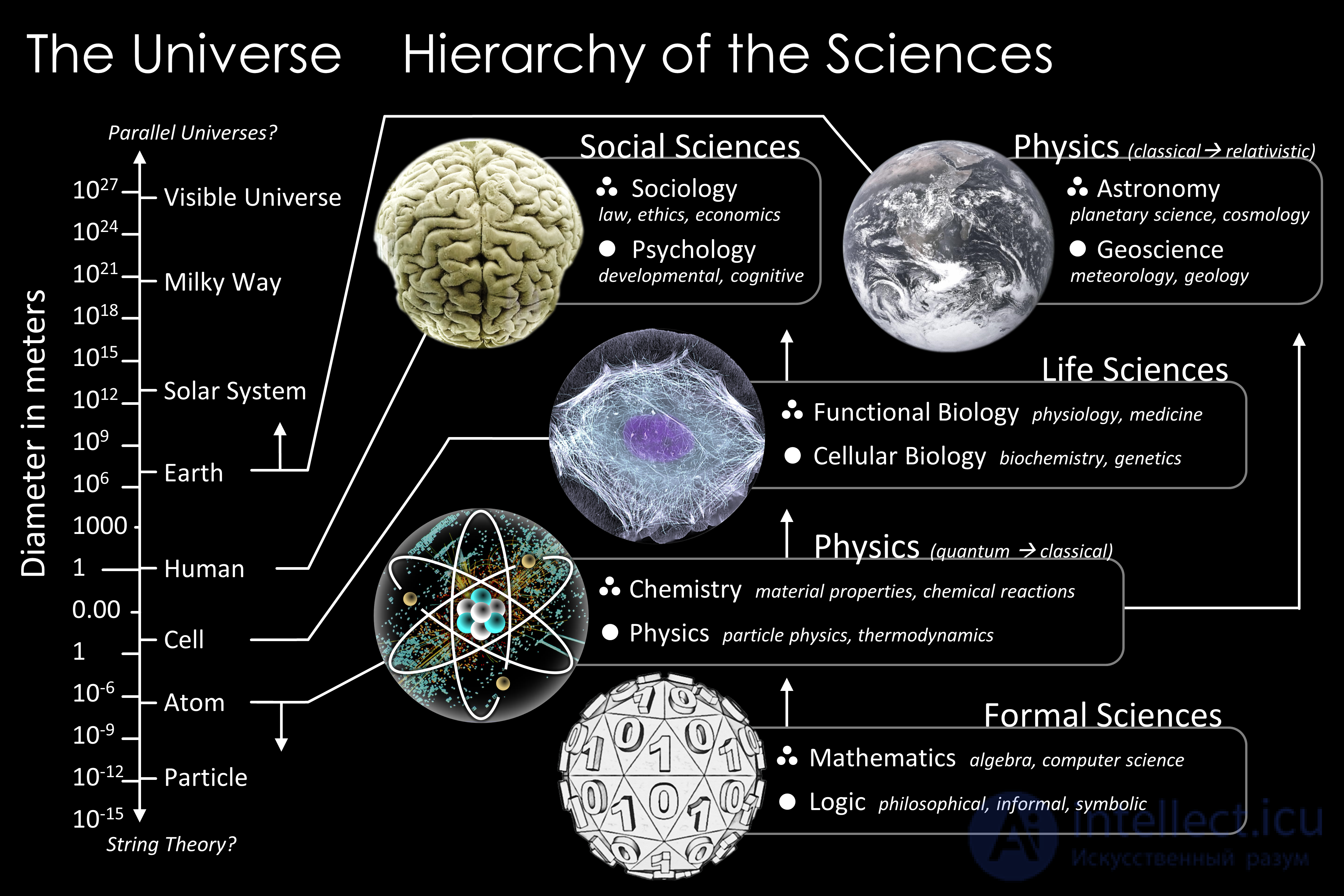
The scales of the objects of the Universe, correlated with branches of science; the formal sciences stand out as the foundation of scientific knowledge
Science, in the broad sense, includes all the conditions and components of the corresponding activity:
Science studies — a research field engaged in the study of science.
As the highest form of cognition and a specific type of spiritual production, science arose in the Modern age, in the 17th – 18th centuries.
Modern science – is a multifaceted phenomenon in its basic features, characteristics and functions. It appears as:
a special form of social consciousness, reflecting the world in the form of scientific representations, concepts, theories;
a branch of spiritual production, in which millions of people are employed, and whose principal output consists of concepts, laws, theories;
a social institution with its own structure and functions.
Science as an activity for producing new knowledge and as a social institution. It provides for the production and accumulation of knowledge, as well as its use in practice. Science as a social institution includes scientific institutes, scientific schools, experimental laboratories, a system for training scientific personnel, and so on.
Science is divided into a multitude of branches of knowledge, which differ from one another in which aspect of reality, which slice of reality, they study. Natural and human sciences are distinguished, sciences of thought and technical sciences, fundamental and applied sciences, and so on.
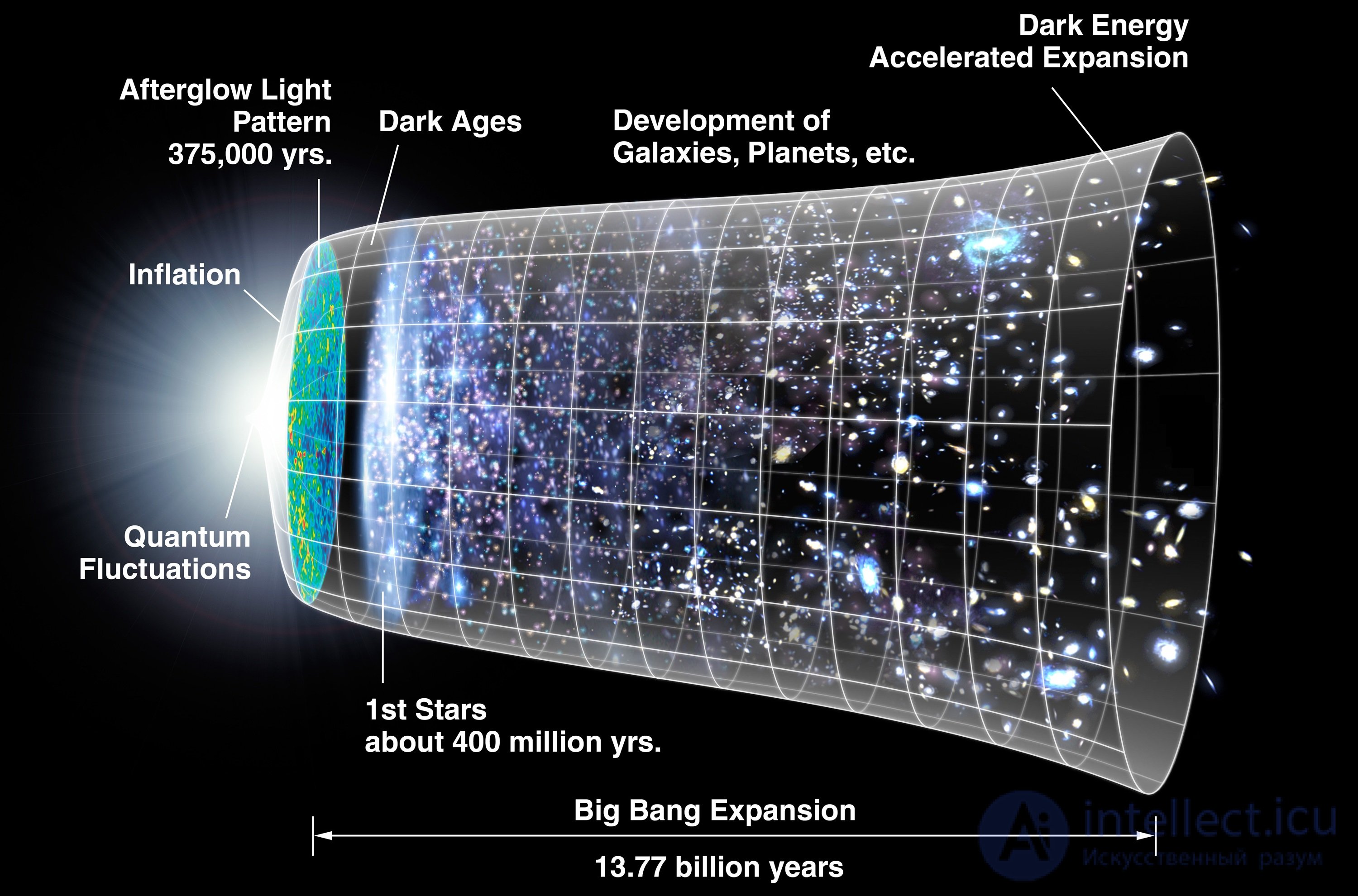
The Universe is represented in the form of several disc-shaped slices through time, which runs from left to right
Science arose when humanity was confronted with the necessity of moving from the cognition of the external side of phenomena to the cognition of their essence, to the discovery of regularities. The genesis of science. Sociocultural preconditions and the basic stages of the historical development of science. In the development of scientific knowledge, one can distinguish the stage of pre-science and of science proper. At the first stage, nascent science does not yet go beyond the bounds of existing practice. It models the change of objects included in practical activity, predicting their possible states. Real objects, in cognition, are replaced by ideal objects and appear as abstractions with which thought operates. Their connections and relations, and the operations performed with them, are also drawn from practice, appearing as schemes of practical actions. Such was, for example, the character of the geometrical knowledge of the ancient Egyptians. The first geometrical figures were models of plots of land, and the operations of surveying a plot with a measuring rope, fixed at the end with stakes allowing arcs to be drawn, were schematized and became a method of constructing geometrical figures with a compass and straightedge.
The transition to science proper is connected with a new way of forming ideal objects and their connections, modeling practice. Now they are drawn not directly from practice, but are created as abstractions, on the basis of previously created ideal objects. The models constructed from their connections appear as hypotheses, which then, having received justification, are transformed into theoretical schemes of the subject domain being studied. Thus arises a special movement within the sphere of developing theoretical knowledge, which begins to build models of the reality under study from above, in relation to practice, with their subsequent direct or indirect practical verification.
Historically, mathematics was the first to accomplish the transition to properly scientific cognition of the world. Then the method of theoretical cognition, based on the movement of thought within the field of theoretical ideal objects with the subsequent experimental verification of hypotheses, became established in natural science. The third milestone in the development of science was the formation of the technical sciences as a peculiar mediating layer of knowledge between natural science and production, and then came the formation of the social sciences. Each of these stages had its own sociocultural preconditions.
The first model of a mathematical theory (Euclidean geometry) arose in the context of ancient culture, with its inherent values of public discussion, the demonstration of proof, and justification as conditions for obtaining truth.
Natural science, based on the combination of the mathematical description of nature with its experimental investigation, was formed as a result of the cultural shifts that took place in the era of the Renaissance, the Reformation and the early Enlightenment.
The formation of the technical and social sciences was connected with the intensive industrial development of society, the increasing introduction of scientific knowledge into production, and the emergence of needs for the scientific management of social processes.
At each stage of development, scientific cognition made its organization more complex. In all developed sciences, levels of theoretical and empirical research take shape, with their own specific methods and forms of knowledge.
The basic form of the theoretical level is scientific theory; of the empirical level – scientific fact.
By the middle of the 19th century, the disciplinary organization of the sciences is formed, and a system of disciplines with complex connections between them arises. Each of the sciences (mathematics, physics, chemistry, biology, technical and social sciences) has its own internal differentiation and its own foundations: a picture of the reality under study peculiar to it, specific ideals and norms of research, and philosophical-worldview foundations characteristic of it.
As a social institution, science began to take shape in the 17th – 18th centuries, when the first scientific societies, academies and scientific journals arose in Europe. In the 20th century, science was transformed into a special type of production of scientific knowledge, including diverse types of association of scientists, including large research collectives, purposive financing and special expertise for research programs, their social support, a special industrial-technical base servicing scientific inquiry, a complex division of labor, and purposive training of personnel. In the course of the historical development of science, its functions in social life changed. In the era of the formation of natural science, science defended, in its struggle with religion, its right to participate in the formation of a worldview. In the 19th century, the function of being a productive force was added to the worldview function.
In the first half of the 20th century, science began to acquire yet another function; it began to turn into a social force, penetrating various spheres of social life and regulating various kinds of human activity.
In the contemporary era, in connection with global crises, the problem arises of the search for new worldview orientations for humanity. In this connection, the functions of science are also being rethought. Its dominant position in the system of cultural values was, to a great extent, connected with its technological projection. Today it is important to have an organic union of the values of scientific-technological thinking with those social values represented by morality, art, and the religious and philosophical comprehension of the world.
Scientific cognition and its specificity. Scientific cognition, compared with ordinary, artistic, philosophical and other types, has its own specific features and represents a special activity for obtaining new knowledge. What, then, are the features of scientific-cognitive activity? Let us begin our examination by clarifying the specificity of the result (product) of scientific cognition. The specificity of scientific cognition consists in the fact that it is such a form of cognitive activity whose most important goal and result (product) is the elaboration and improvement of objectively true knowledge.
Compared with the ordinary, scientific knowledge, as the result and goal of scientific-cognitive activity, is distinguished by such specific characteristics as truth, groundedness, systematicity, an orientation toward reflecting the essential properties of the objects studied, an anticipation of existing practice, and a special professional-specialized language.
The truth of scientific knowledge, its groundedness, its aspiration toward the cognition of essence, create the preconditions for an anticipatory reflection of reality and the prediction of practical activity. In this respect, a true scientist always is ahead of his time.
Scientific cognition is distinguished not only by its result, but also by the special character of the objects of reality it investigates, which cannot be reduced to the objects of ordinary experience. Scientific cognition, science, is not limited to the cognition only of those objects that can be mastered within the bounds of existing practice, historically formed at the given stage, but also of such objects whose regularities, once investigated, may find application only in the future.
The specific objects of science also condition the use of special means of scientific-cognitive activity. Scientific research requires the use of scientific apparatus for conducting experiments in the study of new types of objects, special measuring instruments, and tools. A specially created scientific language, with precise concepts, terms and definitions, serves as such a specific means in science. Colloquial language, with its ambiguous expressions, metaphors and descriptions, cannot ensure the rigor and reliability of the scientific grounding of the propositions being advanced. In modern science, an artificial, specially created formalized language is also widely used. Among the means of scientific cognition should also be included the ideal regulatives of research – methods of cognition, models, norms, ideals of scientific activity, and so on.
For the organization of scientific cognition, a professionally trained subject of cognition, possessing special scientific knowledge, is also necessary, one who has mastered the historically formed means, methods and techniques of scientific-cognitive activity. Moreover, the subject of scientific cognition, the scientist, must also assimilate a definite system of moral guidelines characteristic of science, prohibiting the falsification of facts, plagiarism, and so on. Science is supported by morality, which guides the behavior of scientists and helps to give correct social assessments of scientists' activity.
Scientific cognition has specific features: a) from the standpoint of its result; b) from the standpoint of the objects studied; c) from the standpoint of the means employed; d) from the standpoint of the goals of cognition.
Before proceeding to an analysis of the structure of scientific cognition, let us note its basic purpose and general aims. They come down to the solution of three tasks – the description of objects and processes, their explanation, and, finally, prediction, the forecasting of the behavior of objects in the future.
As for the architecture of the edifice of science, the structure of scientific cognition, two levels are distinguished within it – the empirical and the theoretical. These levels should not be confused with the aspects of cognition in general – sensory reflection and rational cognition. The point is that, in the first case, what is meant are different types of the cognitive activity of scientists, while in the second, what is at issue are types of the psychic activity of the individual in the process of cognition in general, and both of these types find application at both the empirical and the theoretical levels of scientific cognition.
The levels of scientific cognition themselves differ according to a number of parameters:
according to the subject of research. Empirical research is oriented toward phenomena, theoretical – toward essence;
according to the means and instruments of cognition;
according to the methods of research. At the empirical level, this is observation, experiment; at the theoretical – the systems approach, idealization, etc.;
according to the character of the knowledge obtained. In one case these are empirical facts, classifications, empirical laws; in the other – laws, the disclosure of essential connections, theories.
In the 17th – 18th centuries, and partly in the 19th, science was still at the empirical stage, limiting its tasks to the generalization and classification of empirical facts, and the formulation of empirical laws.
Subsequently, above the empirical level, a theoretical one is built up, connected with a comprehensive investigation of reality in its essential connections and regularities. In this, both types of research are organically interconnected and presuppose one another within the integral structure of scientific cognition.
The structure of scientific cognition. Scientific theory and its structure. The initial stage of the scientific-cognitive cycle – is the posing of a problem, which can be defined as knowledge about non-knowledge, knowledge with a question mark. In the posing of a problem, it is necessary, first, to recognize a certain situation as a task; second, to have a clear understanding of the meaning of the problem, formulating it with a demarcation of the known and the unknown.
The second link in the cycle – is the elaboration of a hypothesis (or a series of hypotheses) with the aim of solving the problem. A hypothesis – is a scientifically grounded supposition, proceeding from facts, an inference whose purpose is to solve a scientific problem and which bears a probabilistic character. Without going into detail, let us point out the signs of the fruitfulness of a hypothesis. Above all, the quality of a hypothesis is determined by the measure of its ability to encompass both the range of phenomena under investigation and other phenomena, including newly discovered ones. The strength of a hypothesis is also measured by how capable it is of predicting new facts. Finally, a hypothesis must satisfy the requirement of being verifiable in principle.
For a hypothesis to acquire the status of reliable knowledge, the status of a theory, presupposes its confirmation, its proof, carried out by various means, above all by practice, by experiment.
A theory, unlike a hypothesis, represents no longer probable but reliable knowledge.
A scientific theory – is a system of knowledge that describes and explains a certain body of phenomena, provides a grounding for all the propositions advanced, and reduces the laws discovered in the given field to a single foundation. For example, the theory of relativity, quantum theory, the theory of state and law, and so on.
Let us outline the basic features of a scientific theory:
A scientific theory – is knowledge about a definite subject or a strictly defined, organically connected group of phenomena. The unification of knowledge into a theory is determined by its subject.
A theory is characterized, as its most important feature, by the explanation of a known body of facts, and not simply their description, by the disclosure of the regularities of their functioning and development.
A theory must possess predictive power, must be able to predict the course of processes.
In a developed theory, all its main propositions must be united by a common starting point, a foundation.
Finally, all the propositions comprising the content of a theory must be grounded.
Substantive features of the empirical and theoretical levels of scientific cognition. Basic methods and forms of scientific cognition. One of the important features of scientific cognition, in comparison with ordinary cognition, consists in its organization and its use of a whole range of methods of investigation. By method is understood a set of techniques, ways, and rules of the cognitive, theoretical, and practical, transformative activity of people. These techniques and rules, in the final analysis, are established not arbitrarily but are worked out on the basis of the regularities of the objects studied themselves.
Therefore methods of cognition are just as diverse as reality itself. The investigation of the methods of cognition and of practical activity is the task of a special discipline – methodology.
Despite all the difference and diversity of methods, they can be divided into several basic groups:
Universal, philosophical methods, whose sphere of application is the broadest. The dialectical-materialist method belongs to this number.
General scientific methods, finding application in all or almost all sciences. Their distinctiveness and their difference from universal methods lies in the fact that they find application not at all, but only at certain stages of the process of cognition. For example, induction plays the leading role at the empirical level, while deduction does so at the theoretical level of cognition; analysis predominates at the initial stage of investigation, while synthesis does so at the concluding stage, and so on. In doing so, the general scientific methods themselves, as a rule, find in themselves the manifestation and refraction of the requirements of the universal methods.
Particular or special methods, characteristic of individual sciences or areas of practical activity. These are the methods of chemistry or physics, of biology or mathematics, the methods of metalworking or of construction.
Finally, a special group of methods is formed by procedures, representing techniques and ways worked out for solving some particular, specific problem. The choice of the correct procedure is an important condition for the success of an investigation.
Let us dwell briefly on the characterization of some general scientific methods of investigation. Let us turn, first of all, to the methods that find application at the empirical level of scientific cognition – to observation and experiment.
Observation is the deliberate and purposeful perception of phenomena and processes without direct interference in their course, subordinated to the tasks of scientific investigation.
Observation is used, as a rule, where interference in the process under investigation is undesirable or impossible.
Observation in contemporary science is connected with the wide use of instruments, which, firstly, strengthen the sense organs, and, secondly, remove the taint of subjectivism from the evaluation of the observed phenomena.
Observation in the social sciences is distinguished by particular complexity, where its results depend to a great extent on the personality of the observer and their attitude toward the phenomena studied. In sociology and psychology a distinction is drawn between simple and participant (involved) observation. Psychologists, alongside this, also use the method of introspection (self-observation).
Experiment, unlike observation, is a method of cognition in which phenomena are studied under controlled and managed conditions.
Experiment, as a rule, is carried out on the basis of a theory or hypothesis, which determine the formulation of the problem and the interpretation of the results.
The advantages of experiment in comparison with observation consist, firstly, in the fact that it becomes possible to study a phenomenon, so to speak, in a «pure form»; secondly, the conditions under which the process occurs can be varied; and thirdly, the experiment itself can be repeated many times.
Observation and experiment are the source of scientific facts, by which science understands propositions of a special kind that fix empirical knowledge. Facts are the foundation of the edifice of science; they form the empirical basis of science, the base for advancing hypotheses and creating theories.
Let us now turn to the methods of cognition used at the theoretical level of scientific cognition. This includes, in particular, abstraction – a method that consists in disregarding, in the process of cognition, certain properties of an object with the aim of an in-depth study of one particular side of it. The result of abstraction is the working-out of abstract concepts that characterize objects from different sides.
In the process of cognition, a technique such as analogy is also used – an inference about the similarity of objects in a certain respect on the basis of their similarity in a number of other respects.
Connected with this technique is the method of modeling, which has become especially widespread in contemporary conditions. This method is based on the principle of similarity. Its essence consists in the fact that it is not the object itself that is directly studied, but its analogue, its substitute, its model, and then the results obtained in studying the model are transferred to the object itself according to special rules.
Modeling is used in those cases where the object itself is either difficult of access or its direct study is economically unprofitable, and so on.
Organically connected with modeling is idealization – the mental construction of concepts and theories about objects that do not exist and are not realizable in reality, but for which there exists a close prototype or analogue in the real world. Examples of ideal objects constructed by this method are the geometric concepts of point, line, plane, and so on. All the sciences operate with idealized objects of this kind – an ideal gas, an absolutely black body, a socio-economic formation, the state, and so on.
An essential place in contemporary science is occupied by the systems method of investigation, or, as is often said, the systems approach.
The special elaboration of the systems approach began in the mid-20th century with the transition to the study and practical use of complex, multicomponent systems.
The systems approach is a way of theoretically representing and reproducing objects as systems.
At the center of attention in the systems approach is the study not of elements as such, but, above all, of the structure of the object and the place of the elements within it. On the whole, the basic points of the systems approach are the following:
The study of the phenomenon of wholeness and the establishment of the composition of the whole and its elements.
The investigation of the regularities governing the combination of elements into a system, that is, of the structure of the object, which forms the core of the systems approach.
In close connection with the study of structure, it is necessary to study the functions of the system and its constituents, that is, the structural-functional analysis of the system.
The investigation of the genesis of the system, its boundaries, and its connections with other systems.
A special place in the methodology of science is occupied by the methods of constructing and grounding a theory. Among them an important place is occupied by explanation – the use of more concrete, in particular empirical, knowledge to clarify more general knowledge. Explanation can be:
a) structural, for example, how a motor is built;
b) functional: how a motor operates;
c) causal: why and how it works.
In constructing a theory of complex objects, an important role is played by the method of ascent from the abstract to the concrete.
At the initial stage, cognition proceeds from the real, the objectual, the concrete, toward the working-out of abstractions reflecting individual sides of the object under study. In dissecting the object, thought, as it were, kills it, presenting the object as dismembered, cut apart by the scalpel of thought.
Now the next task arises – to reproduce the object, its integral picture, in a system of concepts, relying on the abstract determinations worked out at the first stage, that is, to move from the abstract to the concrete, but now reproduced in thought, or to the spiritually concrete. In doing so, the construction of the theory itself may be carried out either by the logical or by the historical method, which are closely connected with one another.
In the historical method the theory reproduces the real process of the emergence and development of the object up to the present time, while in the logical method it is limited to reproducing the sides of the object as they exist in the object in its developed state. The choice of method, naturally, is not arbitrary but is dictated by the goals of the investigation.
The logical method is the same historical method, but purged of its historical form. Thus a student begins to study mathematics with what its history began with – with arithmetic, while Marx, by the logical method, paints a picture of capitalism beginning with what capitalism historically takes its origin from – with the commodity.
In its turn, the historical method, in the final analysis, gives the same real picture of the object as the logical method, but the logical method is thereby burdened with the historical form.
The axiological status of science in the system of culture. Systematic engagement in science presupposes the assimilation of a special system of values. The foundation is formed by value orientations toward the search for truth and toward the continual increase of true knowledge. On the basis of these orientations, a system of ideals and norms of scientific investigation develops historically. These value orientations constitute the basis of the ethics of science, which forbids the deliberate distortion of truth to suit this or that social goal and demands constant innovative activity, imposing prohibitions on plagiarism. The fundamental value orientations correspond to two fundamental and defining features of science: the objectuality and objectivity of scientific cognition, and its intention toward the study of ever new objects, irrespective of the currently available possibilities of their mass practical application. The turn of the 20th and 21st centuries coincided with an all-encompassing transformation of civilization, of the entire established world order. One of its vectors is the unprecedented growth of humanity's technological power. Another is the political, economic, informational, and cultural globalization of social life. Finally, yet another vector of change points to an unprecedented growth of risk factors, global threats, and challenges to the future of the whole inhabited world of our planet. In other words, the more powerful humanity becomes, the more dangerous and uncertain its future turns out to be.
The strengthening of the role of religion in contemporary society has intensified researchers' attention to the question of the relation between science and religion, knowledge and faith, although this problem already has its origin in medieval philosophy. Faith has several meanings:
The acceptance, as true, of a thesis that is not proven with certainty or is in principle unprovable (epistemological faith);
The recognition and acceptance of some thesis as a value, the resolve to adhere to it despite life's circumstances, as a personal life strategy (psychological faith);
Faith in the supernatural (religious faith).
The relations between knowledge and faith can result in one of three basic positions: the absolutization of knowledge and the complete exclusion of faith; the hypertrophy of faith at the expense of knowledge; an attempt to combine both poles.
In contemporary science, ideas are increasingly voiced that scientific thought needs faith, as the right hand needs the left. This is justified on the grounds that in scientific and in religious cognition, in principle, different structures of the human being are engaged. In science, the human being acts as «pure intellect»; conscience, faith, love, and decency – all of this is «assistance» to the work of the scholar's intellect. But in religious life, by contrast, the intellect is merely a workforce in the service of the heart. In recent years, attempts have even been made to connect the «exact sciences» (mathematics, physics) with philosophy, psychology, religious studies, and mysticism.
Scientific and extra-scientific knowledge. Alongside scientific knowledge, there always coexists in culture a rather noticeable layer of knowledge organized differently from scientific knowledge. One cannot demand of scientific knowledge that it describe, by its means, all the components of human existence and of people's life-world.
In the context of culture, alongside scientific knowledge, various alternative approaches and programs are formed, going beyond the bounds of scientific rationality, which, on the one hand, contribute to the formation of scientific knowledge, and, on the other hand, are sometimes a rather dangerous social phenomenon. Knowledge of this kind is called by various names: non-scientific, extra-scientific, alternative, para-scientific, quasi-scientific, and so on. Non-scientific knowledge is those forms of cognitive activity that arise as: 1) primary forms of comprehending reality, preceding scientific knowledge; 2) knowledge not conforming to the generally accepted criteria for constructing and grounding proposed conceptions; 3) knowledge supplementing existing kinds of scientific knowledge; 4) knowledge that contradicts science, built on the ignoring of empirical facts, characterized by extreme authoritarianism and diminished criticism. Let us examine some kinds of non-scientific knowledge.
Ethnoscience (ethno – people) – a traditional kind of system of specialized knowledge, called «folk science.» Ethnoscience is the result of the accumulation and preservation of observations, information, and positive experience relating to this or that sphere of life activity important to people. Folk science acts as a product of collective consciousness and accumulated experience. Over time, the centralization and specification of this experience occurs. The preservation and application of folk science becomes the business of special groups or castes of society – shamans, healers, priests, tribal elders, possessing certain knowledge. Ethnoscience exists, as a rule, in oral form and is organized as prescriptive-practical knowledge transmitted directly from person to person. It was expressed in the laconic form of signs, instructions, precepts, sacred customs, and rituals. The knowledge accumulated in the folk sciences is, in its own way, quite profound, expedient, and highly effective in practical terms. In contemporary culture the folk sciences exist as relict formations, constantly deprived of their main nourishing medium – traditional folk life, a distinctive worldview. This is what determines the incommensurability of ethnoscience with contemporary scientific knowledge. At the same time, in light of increasingly threatening ecological problems, it seems possible to take a different view of «folk technologies,» which were more organically fitted into natural cycles and did not destroy the environment. From the point of view of the «ecology of culture,» the centuries-old experience of successful survival under sometimes harsh living conditions, compressed within the folk sciences (as is characteristic, for example, of the northern regions of «risky agriculture»), can be quite successful, and post-industrial technologies, in the distant future, will perhaps come to resemble folk technologies more, harmoniously fitted into the natural environment.
Proto-scientific knowledge (pre-scientific knowledge, preceding scientific knowledge) – knowledge representing the primary forms of comprehending reality, forming in the process of the becoming of scientific knowledge, when the necessary empirical material is still absent and methods of investigation and norms for constructing theory have not yet been worked out. Protoscience relies both on existing reliable knowledge and on the subjective assumptions of the researcher, their creative imagination. Proto-scientific knowledge creates the prerequisites for constructing reliable theoretical conceptions, acting as a kind of «scaffolding» for scientific theories, with whose emergence proto-scientific knowledge exhausts its possibilities. Thus, the formation of classical natural science in the 17th–18th centuries was preceded by the doctrine of phlogiston as the basis of chemical energy, and of caloric, to which the causes of thermal processes were attributed, and so on. On the basis of these ideas, explanations were given for chemical and thermal phenomena, and the formation of truly scientific knowledge was also carried out, for example, the formation of the foundations of thermodynamics, chemical theory, and so on.
The historical fate of astrology (Greek astron – star and logos – teaching) also, to a certain degree, coincides with the historical fates of other sciences and travels the path from pre-scientific (proto-scientific knowledge) to theoretical knowledge. Astrology originates in the East, then reaches Greece, where it takes shape as a fairly well-grounded doctrine of a certain dependence between «earthly» events, that is, events occurring in our earthly life, and «heavenly» events, that is, those occurring with heavenly bodies in the world of the stars.
Astrology was revived with new force in the Renaissance, then in the nineteenth century, in the light of «genuine» science with its clear and unambiguous criteria of scientificity, astrology was regarded as an unworthy pseudoscience, charlatanism, and was firmly forgotten, but already in the twentieth century astrology could not complain of a lack of attention from the enlightened scientific community.
Despite the fairly widespread opinion that astrological ideas either simply have nothing to do with science or are pseudo-scientific (quasi-scientific) notions, it should nevertheless be kept in mind that the real basis of astrological predictions is formed by the many-thousand-year experience of humanity, deposited in the most diverse forms. Astrological predictions differ quite substantially from traditional forms of divination «by the stars», for at their foundation lies not star-worship but theoretical, sometimes highly mathematical, constructions. The theory of astrology includes a fairly significant volume of objective information about celestial bodies, the nature of their motion, their trajectories, and their mutual arrangement. These ideas, of course, are not exclusively astrology's property, but astrology took part in their development. It was astrologers who, almost until the end of the nineteenth century, regularly published tables and calendars (ephemerides) indicating the movement of celestial bodies for each year, which enriched the store of astronomical knowledge.
In the course of historical vicissitudes astrology was perfected as a science, developed mathematical calculation techniques (it is no accident that astrologers in Rome were called mathematicians), refined tables of the positions of the luminaries at various periods of time, and substantiated methods of prediction. The need for predicting one's fate never disappeared; astrology merely clothed this need in fairly rational, or at least not useless-for-science, forms. Nowadays the research component in astrology is growing stronger; it appeals to research in the fields of bioastronomy and biophysics, thereby revealing a fairly strong tendency to inscribe astrology into the infrastructure of scientific knowledge.
In the real process of the development of science, alongside scientific knowledge, various kinds of non-scientific knowledge are formed, which either lay the foundation for the emergence of individual sciences and complement them, or act as pseudo-scientific constructions that do enormous harm to scientific knowledge.
The ethics of science and the problem of the social responsibility of scientists. In science, as in other areas of human activity, scientists are subject to a certain system of moral norms. These are taboos, universal human moral requirements and prohibitions, such as «do not steal», «do not lie».
In science, plagiarism is assessed as theft, when a person passes off other people's scientific results and ideas as their own. A lie is considered to be the deliberate distortion of the data of an experiment or study. The goal of a scientist should be the search for truth, for new reliable knowledge, and not considerations of personal gain, fame, and so on. A scientist must courageously defend their convictions, and also possess the courage to abandon them if their fallacy becomes evident.
In contemporary science, questions concerning the relationship between science and society, and the scientist and society, questions of the social responsibility of the scientist, have acquired particular urgency. This concerns how the achievements of science will be used, and whether knowledge will turn against humanity. The development of genetic engineering, biotechnology, and medicine has opened up possibilities for directed influence on the heredity of organisms, up to and including the creation of organisms with predetermined properties. A person can construct a new form of life sharply different from everything known to us, but they will not be able to bring it back into non-existence. The danger of the appearance of mutant organisms has arisen. The problem of human cloning is widely discussed, for it affects not only the interests and ambitions of scientists but all of humanity.
A scientist must foresee the possible unfavorable consequences of their research. Only those scientific-technical decisions that are made on the basis of sufficiently complete information can be considered socially and morally justified.
The problem of the social responsibility of scientists lies in the fact that the power over nature, over socio-economic and political processes possessed by human communities, is combined with helplessness in understanding the inner world of the individual person and with powerlessness to influence it. Effective technologies for manipulating people's consciousness and subordinating their behavior to another's will have already been created. But it has still not been possible to create social institutions and mechanisms that promote the elevation of a person's moral dignity and that oppose evil. Humanity has had alternatives, but it forfeited them not only owing to various material causes and motives. A considerable – and perhaps decisive – role was played by the crisis of European, and subsequently of the whole of Western, culture, which first appeared as early as the nineteenth century and in the following century became the dominant feature of the spiritual life of the West and of civilization as a whole.
It is beyond dispute that in the moral history of humanity philosophy has always occupied the most worthy, indeed a central, place. It is equally beyond dispute that exemplary morality is impossible without philosophy (morality without philosophy is a nonsense, an absurdity). But it is no less beyond dispute that both philosophy as a whole, and especially its moral part, ethics, remain to a considerable extent unclaimed. The unclaimed status of philosophy is a genuine renunciation of exemplary morality. Why does this happen, and can it be overcome?
The fact that philosophy and ethics go unclaimed is not surprising: people are strange creatures, who, like crows, often rush toward glittering trinkets without noticing genuine treasures under their feet. What is surprising is something else: why, even after more than two thousand years of the history of philosophy and philosophical ethics, humanity remains poorly receptive to it. This fact can be explained, above all, by the following reasons. First, skillful and clever philosophy is difficult to understand; for many it is simply inaccessible. Second, the division of the sciences led to the separation of philosophy into an independent field of knowledge, and beyond its boundaries people began to think one could quite well do without philosophy. Third, philosophers did not trouble themselves to present their beloved brainchild in a form adapted for non-philosophers. Fourth, the successes of moral philosophy are not as far-reaching as one would like. Quite often, even in the views of outstanding philosophers, founders of philosophical movements, it is very difficult to single out the moral aspect and extract it from the general philosophical shell. Even at the beginning of the twenty-first century, people in the realm of morality very often make do with superficial notions, far removed from high scientific standards.
Thus, the unclaimed status of moral philosophy is not the result of any malicious intent on anyone's part. It is the result of what is happening in the moral sphere, where there is an acute need for the intensification both of ethical research and of interdisciplinary ties between philosophers and non-philosophers.
Prospects for the development of science in the twenty-first century and its priorities. Among the trends existing today in the humanities, the following can be singled out:
Mathematical methods of data analysis and modeling of social and economic processes are increasingly penetrating the humanities. The process of the mathematization of natural science, which began in the Middle Ages with mechanics and physics and has continued uninterruptedly to the present, is now capturing the humanities as well. Mathematical models are becoming the common language of science, underscoring and sustaining the unity of scientific knowledge.
The second half of the twentieth century became a period of transition for the most developed countries from industrial to so-called post-industrial or information societies, for which the information industry becomes one of the main branches of the economy.
Labor productivity in this branch depends substantially on the degree of automation of mental, or intellectual, labor, and this task is being solved by new information technologies based on the widespread use of electronic computing machinery, modern communication systems, and their software.
In certain areas, computer systems can autonomously generate new knowledge and thereby exert a reverse influence on the human intellect that gave rise to them. Thus, the maintenance of the unity of scientific knowledge becomes possible not only thanks to traditional scientific communications and the development of a common language of science, but also thanks to the creation of new means and methods of processing and disseminating information. The principle of unity is not only turning into the most important principle of humanities education. It is also closely bound up with the modern information environment in which the humanities function.
Next among the most important principles is the principle of dialogism. Its methodological foundations, like the theory of dialogue itself, received comprehensive development and grounding in the works of M.M. Bakhtin, which constituted an entire epoch in twentieth-century humanistic thought. Assessing Bakhtin's contribution to the development of the spiritual sphere of the civilizational process, the interpreter and popularizer of his legacy, V.S. Bibler, characterized Bakhtin's idea of dialogue as «one of the tense focal points of the real polyphony of twentieth-century humanistic thought».
Another of the most important principles is rationalism. It may seem strange that at the end of the twentieth century one still has to draw special attention to things that would seem to be self-evident. The cult of rationality, which arose at the end of the eighteenth century as a reflection of faith in the boundless possibilities of the human mind, fairly quickly began to be transformed into its opposite, with the external trappings of the rational coming to overshadow its essence.
All these departing realities do not simply disappear without a trace from the pages of European and world history – an environment is being created for the affirmation of a new humanistic worldview. In the twenty-first century, the following features are becoming significant:
With the development of writing in the countries of the ancient civilizations, empirical knowledge of nature, humanity, and society was accumulated and reflected upon, and the beginnings of mathematics, logic, geometry, astronomy, and medicine arose. The predecessors of present-day scholars were the philosophers of Ancient Greece and Rome, for whom reflection and the search for truth became their principal occupation. In Ancient Greece, variants of the classification of knowledge appeared.
Science in the modern sense began to take shape from the sixteenth—seventeenth centuries. In the course of historical development, its influence extended beyond the development of engineering and technology. Science became the most important social and humanistic institution, exerting a significant influence on all spheres of society and on culture. The volume of scientific activity has doubled roughly every 10—15 years since the seventeenth century (growth in discoveries, scientific information, and the number of scientific workers) .
In the development of science, extensive and revolutionary periods alternate — scientific revolutions, leading to changes in its structure, principles of cognition, categories and methods, as well as the forms of its organization. Science is characterized by a dialectical combination of the processes of its differentiation and integration, and of the development of fundamental and applied research.

The universe as understood by Aristotle and Ptolemy, from Peter Apian's work «Cosmographia» of 1524. The earth consists of four elements: earth, water, fire, and air. The earth does not move and does not rotate. It is surrounded by concentric spheres containing the planets, the sun, the stars, and the heavens
The totality of people engaged in science makes up the scientific community. The scientific community is a complex self-organizing system in which state institutions, public organizations, and informal groups all operate. A distinctive feature of this community is the heightened degree of recognition accorded to authority achieved through scientific success, and the reduced degree of recognition accorded to authority based on power, which sometimes leads to conflict between the state and the scientific community. It should also be noted that informal groups, and especially individual persons, are more effective here than in other social spheres. The most important tasks of the scientific community are the recognition or rejection of new ideas and theories, ensuring the development of scientific knowledge, as well as support for the system of education and the training of new scientific workers.
The way of life and the worldview of people in the scientific community can differ substantially from those prevalent in society. It is believed that atheistic and skeptical views now predominate in the scientific community. Studies conducted in the 1990s showed that only 7% of members of the American National Academy of Sciences and 3.3% of members of the Royal Society of the United Kingdom turned out to be believers. At the same time, according to a nationwide poll, 68.5% of the population of the United Kingdom consider themselves believers [unreliable source?]. V.L. Ginzburg, in an article on Ateizm.ru, having noted that «an article by Ising („Poisk“ No. 25, 1998) cites a table, previously published in Nature (vol. 386, p. 435, 1997), showing that among American scientists in 1916 there were 42% believers, and in 1996, 39% believers, that is, the decline is small. This seems strange in light of the enormous achievements of science over the 80 years between the surveys», expressed the opinion that a possible reason for this was «a reaction to the militant atheism of the communists» . Sociologist Elaine Howard Ecklund (English)Russian conducted a survey of 1,646 professors working at elite American universities, asking them to answer 36 questions on the subject of faith and spiritual practices, in the course of which she established that among scientists in the natural-science direction (biology, physics, and chemistry), 38% are atheists, with the greatest number of non-believers — 41% — found among biologists, while among sociologists the figure was 31%, and the smallest number — 27% — among political scientists . According to data published in June 2005 by researchers from the University of Chicago, 76% of American doctors consider themselves believers, and 59% are convinced of the existence of an afterlife . The history of science testifies to the changeability of the prevailing views and doctrines in science, as well as to their dependence on the political conjuncture of the corresponding state or historical period.
A scientist is a representative of science who carries out meaningful activity for forming the scientific picture of the world, whose scientific activity and qualifications have received recognition in one form or another from the scientific community. The main formal sign of the recognition of qualifications is the publication of research materials in authoritative scientific journals and presentations at authoritative scientific conferences. A presentation at all-Russian and international scientific conferences is equated to a scientific publication, though for candidates for an academic degree a number of restrictions exist . In Russia a formal attempt has been made to separate authoritative scientific publications from others in the form of a list of publications whose contents are recognized by the Higher Attestation Commission. However, even among authoritative publications and conferences there exists a system of priorities that is not entirely unambiguously understood. As a rule, international publications and conferences enjoy the greatest priority, and recognition at the international level is valued more highly than at the national level. The authority and recognition of a scientist's qualifications is connected with their fame within narrow circles of specialists. There are attempts to construct rankings by the number of citations of a given scientist's work in the works of other scientists. For example, among professors in the same field of knowledge, the best expert on a particular scientific direction is considered to be the one who is the author of publications precisely in that direction. And if both authors (holding the same academic title) work in the same scientific direction, the better expert will be the one whose work is cited more, and whose qualifications are therefore recognized more by other authors. This is how the prestige of a specialist within the scientific community is formed.
Among scholars it is customary to conclude any sufficiently lengthy piece of research on a given topic with the publication of a corresponding monograph, which usually contains a detailed description of the research methodology, a presentation of the results obtained, and their interpretation.
In the scholarly community, teaching work is highly valued. The right to lecture at a prestigious educational institution is recognition of a scholar's level and qualifications. Also highly valued is the creation of a scientific school, that is, the training of several scholars who go on to develop their teacher's ideas.
Membership in the professional scientific community and a scholar's level of qualification may be formally determined by local and national qualification commissions (a dissertation defense council, a certification commission, the Higher Attestation Commission). In the USSR and Russia, a scholar's qualification is formally confirmed by an academic degree (candidate or doctor of sciences) and an academic title (associate professor or professor). The awarding of both degrees and titles is overseen by the Higher Attestation Commission. Academic degrees are awarded by field of science, for example, candidate of physical and mathematical sciences, candidate of legal sciences, and so on — the Higher Attestation Commission currently recognizes 22 such fields. To obtain the corresponding academic degree, one must write and defend a dissertation before a specialized council; as an exception, and for outstanding scientific merit, the dissertation may be replaced by a report on the work performed. Such an exception is made very rarely, for example, for Chief Designers. A mandatory condition for a successful defense is the publication and validation of the results of the scientific work. Validation is usually understood as presentations at conferences, since this format allows the results to be discussed and, accordingly, to receive open criticism if the scholarly community disagrees. To obtain an academic title (associate professor or professor), in addition to an academic degree one must conduct teaching work, in particular have instructional and methodological publications. There are also more minor formal markers of recognized qualification; for example, permission to supervise the research work of postgraduate students is a necessary step in the transition from candidate to doctor.
The highest level is membership in the Academy of Sciences. In Russia, as previously in the USSR, there are two levels of membership: the first — corresponding member of the Academy, and the highest — academician. Academies are self-organizing scholarly communities, and they elect academicians and corresponding members at their own meetings. Candidates are nominated by a university or research institute. Elections have always been held on a multi-candidate basis. At present in Russia, in addition to the Academy of Sciences (without further qualification), there are branch academies; some of them, for example, the Academy of Medical Sciences, have a long history, while others arose relatively recently. Their organization is similar to that of the Academy of Sciences, but their status is, naturally, lower.
The scholarly community contains quite a large number of scientific organizations. Voluntary scientific societies, whose main task is the exchange of scientific information — including through conferences and publications in periodicals issued by the society — play an active role in the development of science. Membership in scientific societies is voluntary, often free, and may require membership dues. The state may provide these societies with various forms of support, and a society may express a coordinated position to the authorities. In some cases, the activity of voluntary societies also covers broader issues, such as standardization. One of the most authoritative and largest societies is the IEEE. International scientific unions allow both collective and individual membership. National academies of sciences in some European countries historically grew out of national scientific societies. In the United Kingdom, for example, the role of the Academy is played by the Royal Society.
The first scientific societies appeared in Italy in the 1560s — these were the "Academy of the Secrets of Nature" (Academia secretorum naturae) in Naples (1560), the "Academy of the Lynxes" (Accademia dei Lincei — literally, "academy of the lynx-eyed," that is, possessing especially sharp sight) in Rome (1603), and the "Academy of Experiment" ("Accademia del Cimento," 1657) in Florence. All of these Italian academies, which included quite a few significant thinkers and public figures headed by the invited honorary member Galileo Galilei, were created for the purpose of promoting and expanding scientific knowledge in the field of physics through regular meetings, exchange of ideas, and the conducting of experiments. Undoubtedly, they influenced the development of European science as a whole.
The need for accelerated development of science and technology required more active participation by the state in the development of science. Accordingly, in a number of countries, for example in Russia, the Academy was created by decree from above. However, most academies of sciences have adopted democratic charters that ensure them relative independence from the state.
Scientific organizations:
Scientific institutes — academies and research institutes — cooperate at the international level. Modern large-scale scientific projects, such as decoding the human genome or the International Space Station, require enormous material resources and the coordination of the activity of many scientific and industrial teams. In most cases, this is done more effectively through international cooperation.
International scientific institutes:
Scientists are awarded scientific prizes and medals for scientific achievements.
Scientific humor is a type of professional humor based on the unusual or paradoxical aspects of scientific theories and scientific activity. Often, scientific humor cannot be adequately perceived and appreciated by people who lack sufficient knowledge in the relevant field of science.
Scientific humor can also refer to the mocking of scientists and certain aspects of science (for example, the Ig Nobel Prize — a parody of the Nobel Prize).
Some attempts to collect scientific humor have been met with strong misunderstanding. For example, there was a phone conversation between the compilers of the collection "Physicists Joke" and other scientists, in which the compilers' interlocutors said: "our staff are engaged in serious matters and have no time for jokes"[10].
The objective and impartial way of examining the world distinguishes science from other ways of knowing, such as everyday, artistic, religious, mythological, esoteric, or philosophical understanding of the world. For example, in art the reflection of reality occurs as a sum of the subjective and the objective, where the reproduction of reality usually involves an emotional assessment or reaction. Following the scientific method shapes a scientific way of thinking.
The structure of the modern scientific method, that is, the way of constructing new knowledge, includes:
At every stage, a critical attitude toward both the data and the results obtained at any level is of fundamental importance. The necessity of proving and substantiating everything with verifiable data, and confirming theoretical conclusions with the results of experiments, distinguishes science from other forms of knowledge, including religion, which is based on faith in certain basic dogmas.
Ideas about science and the scientific method — the methodology of science — have changed over time.
Three main directions can be distinguished in scientific research[11]:
Many scientists have conducted scientific experiments on themselves.
The philosophy of science is represented by a multitude of original conceptions offering various models of cognitive activity and the development of science. It is focused on identifying the role and significance of science, and the characteristics of science that distinguish it from other forms of cognitive activity.
The philosophy of science has the status of historical socio-cultural knowledge regardless of whether it is oriented toward the study of the natural sciences or the social sciences and humanities. The philosopher of science is interested in scientific inquiry, the "algorithm of discovery," the dynamics of the development of scientific knowledge, and the methods of research activity. (The philosophy of science, although interested in the rational development of the sciences, is nevertheless not itself called upon to directly ensure their rational development, as multidisciplinary meta-science is called upon to do).
If the main goal of science is the attainment of truth, then the philosophy of science is one of the most important areas for humanity in the application of its intellect, within which the question "how is the attainment of truth possible?" is discussed.
Conviction in the omnipotence of science and confidence that, owing to the continuity of the process of accumulating scientific knowledge, the unknown remains so only temporarily, is a constant stimulus for the productive activity of an ever-renewing scientific community. Meanwhile, this postulate cannot, within the scientific method, be either experimentally refuted or proven, and therefore, by Popper's criterion, it is not considered scientific.
However, it is possible to separate the area in which science is competent regarding the knowledge of objectively existing reality from knowledge of that part of this reality which cannot in principle be investigated using the scientific method. This division runs along the line separating questions posed to nature into those that imply the fundamental possibility of obtaining reliable answers to them empirically, and those that only seem to[13].
Gödel's incompleteness theorem is widely known, according to which, within any formal system that includes the arithmetic of natural numbers, if that system is consistent, its consistency cannot be proved.
Thus Lobachevsky, as early as 1829 in the work "On the Foundations of Geometry," presented a non-Euclidean geometry of space, just as free of contradictions as Euclidean geometry. He thereby showed that space can be described by two different, mutually incompatible, but internally logically consistent geometries
Alan Turing proved in 1936 that the halting problem is undecidable on a universal computing machine; there is no general algorithm for solving this problem[14], even given an exact logical description.
Science operates with models of real objects, which differ to one degree or another from the real world. The problem that arises here is called the "map–territory relation."
One of the problems of the philosophy of science and epistemology is the problem of the reliability of scientific knowledge. In general, this problem comes down to the question: "Is scientific knowledge objective?" The most common answer is the "moderately relativist" one: knowledge attained by science is reliable (objective) if, at a given moment, it is confirmed by multiple independent sources and observations.
Anti-scientists believe that science is unable to prove its basic assertions, and therefore its worldview conclusions are logically incorrect, and that scientism is consequently considered insufficiently substantiated for the main theses of this position to be recognized as valid.
Paradoxically, it was precisely in the Age of Enlightenment that a stream of warnings against science intensified. For example, Jean-Jacques Rousseau wrote that scientific inquiry involves many dangers and false paths[16]. Before one can attain the benefit that truth will bring, one must pass through many errors before it is achieved. He believed that if the sciences are unable to solve the problems they set for themselves, then they harbor even greater dangers, to which they often lead. "The sciences are born of idleness and then nourish idleness, all the while entailing an uncompensated loss of time" — in this Rousseau saw an inevitable harm to society. The founder of the Berlin Academy of Sciences, Leibniz, in a memorandum that formed the basis of the document establishing the Academy in 1700, wrote that its activity should not be directed solely toward satisfying the thirst for knowledge and toward useless experiments: work and science must be jointly directed toward achieving benefit.
N. P. Ogaryov wrote that science does not yet possess such universality that society could move on the basis of it alone. Science lacks the certainty and completeness of content for every person to believe in it.
The judgments of Russian religious thinkers, in particular N. Berdyaev (1874—1948), L. Shestov (1866—1938), and S. Frank (1877—1950), occupy a special place in the critique of science. «Faith in the god of science has now been shaken,» N. Berdyaev is convinced, — «trust in absolute science, in the possibility of constructing a scientific worldview that satisfies human nature, has been undermined.» He sees the reasons for this in the fact that «new phenomena are intruding into the domain of scientific knowledge, phenomena that the official dogmatism of scholars only recently rejected as supernatural… And on the other hand, philosophy and epistemology have shown that science cannot ground itself, cannot secure itself within the bounds of exact knowledge. In its roots science reaches down into a depth that cannot be investigated simply scientifically, while at its summits science rises toward heaven. <…> Even for people of scientific consciousness it is becoming ever clearer that science is simply incompetent to resolve the question of faith, revelation, miracle, and the like. And indeed which science would take upon itself the boldness to decide these questions? Surely not physics, not chemistry, not physiology, not political economy or jurisprudence? There is no science, there are only sciences [in the sense of disciplines]. The idea of a single, all-resolving science is undergoing a serious crisis, faith in this myth has fallen. <…> Science is only a particular form of adaptation to particular forms of being»[19].
Berdyaev resolves the problem of scientism and anti-scientism in his own way, remarking that «no one seriously doubts the value of science. Science is an indisputable fact, needed by man. But one may doubt the value and necessity of scientism. Science and scientism are quite different things. Scientism is the transfer of the criteria of science onto other spheres alien to spiritual life, alien to science. Scientism rests on the belief that science is the supreme criterion of the whole life of the spirit, that everything must submit to the order it establishes, that its prohibitions and permissions carry decisive significance everywhere. Scientism presupposes the existence of a single method… But here too one can point to a pluralism of scientific methods corresponding to the pluralism of science. One cannot, for example, transfer the method of the natural sciences into psychology and the social sciences.» And if the sciences, in N. Berdyaev's view, represent an awareness of dependency, then scientism is the enslavement of the spirit to the lower spheres of being, a ceaseless and universal awareness of the power of necessity, of dependence on «the weight of the world.» Berdyaev concludes that scientific universal obligation is the formalism of a humanity internally torn apart and spiritually divided.
L. Shestov writes that science conquered and seduced humanity not through its omniscience, nor through proof of the impossibility of a satisfactory resolution of all the doubts that trouble people, but through the worldly benefits that turned the head of a humanity that had suffered misfortune for so long. He refers to Tolstoy, Dostoevsky, and other authors who tried to set morality against science, but whose efforts were unable to achieve this. «Law or norm is the father of two sisters – science and morality. They may be at enmity at times, and even at moments hate one another, but sooner or later their common kinship will make itself felt, and they will inevitably be reconciled.»
Shestov also points to the multitude of individual facts that science throws overboard like unnecessary and superfluous ballast. Science, in his view, turns its gaze only to those phenomena that occur constantly and with a certain regularity. The most precious material for science consists of cases in which a phenomenon can be induced artificially, that is, when the possibility of experiment exists. He asks what, then, is to be done with singular, non-repeating, non-inducible cases. Science, in his view, demands silence about them. Shestov calls on his contemporaries to abandon scientific quixotism and try to trust themselves. However, many singular phenomena (which at a certain stage of history merely appear unique, this being one of the important properties of the historical development of science) can be studied through the accumulation of facts about them, which can subsequently be generalized and systematized into some theory – for example, the radical change in ideas about comets came about thanks to E. Halley: before him, each comet was thought to visit the solar system only once (unique), whereas the scientist, having calculated the orbits of 24 comets, identified several of them as one and the same, later named after him, and, most importantly, predicted its reappearance.
Representatives of integral traditionalism characterize modern science as reductionist, naturalist, evolutionist, secularist, and rationalist, and consider it unobjective and biased. In their view, science is a dogmatic system of beliefs based on an unverified epistemology, which is either not knowledge at all or, at the very least, represents a substantially limited view of reality, missing a great deal precisely because of its methodology.
Stanislaw Lem wrote (for example, in «Summa Technologiae») about a certain artificiality in the human scientific approach to studying the universe and its resulting limitations[28]:
…our inability to put the right question to Nature. Man asks Nature a multitude of questions that are meaningless from its «point of view,» and wishes to receive unambiguous answers that fit into schemes agreeable to him. In a word, we strive to discover not Order in general, but only a certain particular order – the most economical («Occam's razor»!), unambiguous (not allowing itself to be interpreted in various ways), universal (dominant throughout the whole Cosmos), independent of us (independent of how and by whom it is studied), and unchanging (that is, such that the laws of Nature for it do not change over time). But all this consists of postulates introduced by the researcher, not truths revealed to us. Neither was the Cosmos created for us, nor we for it. We are a by-product of stellar evolution, and the universe has produced, and continues to produce, such by-products in enormous quantity.
Accordingly, some of the aforementioned fundamental principles pertain to classical science (based on a mechanistic picture of the world), which have changed or been supplemented in the non-classical and post-non-classical pictures of the world (for example, the principle of the influence of observation and the observer on quantum processes, or the principle of the change of the laws of nature over time in certain cosmogonic theories).
In the view of A. Einstein[29]:
One of the strongest motives that leads people to <…> science is the desire to escape from everyday life with its painful harshness and comfortless emptiness <…> This motive drives people of finer sensibility away from their personal experience into the world of objective perception and understanding. …
To this negative motive is added a positive one. Man strives to create within himself, in some adequate manner, a simple and clear picture of the world, in order to break away from the world of sensation, to a certain extent replacing this world with the picture thus created.
There is also a viewpoint according to which the main reason for engaging in science (as with any other activity aimed at producing cultural output) is the unconscious manifestation of sexual selection in the form of courtship, which explains the disproportionately large number of men among scientists and the correspondence between periods of high intellectual and sexual activity in a person's life[30][31].
The scientific picture (model) of the world is a system of ideas about the properties and regularities of actual reality, constructed as a result of the generalization and synthesis of scientific concepts and principles[32].
In the process of the development of science, knowledge, ideas, and concepts are constantly updated; earlier conceptions become particular cases of new theories. The scientific picture of the world is neither a dogma nor an absolute truth. Scientific conceptions of the surrounding world are based on the whole body of proven facts and established cause-and-effect relations, which makes it possible, with a certain degree of confidence, to draw conclusions and forecasts about the properties of our world that contribute to the development of human civilization. A discrepancy between the results of testing a theory, hypothesis, or concept, and the discovery of new facts — all this compels a revision of existing conceptions and the creation of new ones that correspond more closely to reality. In such development lies the essence of the scientific method.
Attempts to classify the fields of human knowledge on various grounds have been made since antiquity.
Thus, Aristotle divided[33] the sciences into three kinds, which he arranged in a kind of hierarchy:
Aristotle did not identify the formal logic he created with philosophy, considering it an «organon» (instrument) of all cognition[34].
The classification of the Roman encyclopedist Marcus Varro included the following sciences: grammar, dialectic, rhetoric, geometry, arithmetic, astrology, music, medicine, and architecture[35].
Muslim Arab scholars divided the sciences into Arab sciences (poetics, oratory) and foreign sciences (astronomy, medicine, mathematics)[35].
Attempts at classification continued in the Middle Ages. Hugh of Saint-Victor, in the Didascalicon, divides the sciences into four groups[36]:
F. Bacon divided the sciences into 3 groups (depending on cognitive faculties such as memory, reason, and imagination):
Roger Bacon likewise distinguished four classes of sciences: grammar and logic, mathematics, natural philosophy, and metaphysics and ethics. In this he considered mathematics to be the foundation of the sciences of nature.
He worked out new principles that organically combined two main elements: an objective approach and the principle of subordination (or the principle of development). With the single concept of «form of motion,» common to all realms of nature, Engels embraced the various kinds of energy operating in inanimate nature, as well as life (the biological form of motion). From this it followed that the sciences arrange themselves naturally in a single series: mechanics... physics... chemistry... biology. A series of sciences was constructed: mathematics, mechanics, chemistry, physics, biology.
There are 2 approaches:
The Modern Classification of the Sciences (Early 20th Century)
Troshin divided the material world into 6 classes:
1 – microobjects;
2 – stable structures;
3 – macroobjects;
4 – life in all its manifestations;
5 – artificial nature;
6 – human society.
It is difficult to classify the sciences by this criterion. Sciences belong simultaneously to different classes.
Kedrov developed the most complete classification of the sciences. Kedrov divided the whole of reality into nature and the human being. Within the human being he distinguished society and thought. The sciences of nature are the natural sciences, of society the social sciences, and of thought the philosophical sciences.
The Soviet philosopher, historian, and methodologist of science B. M. Kedrov developed a more detailed classification of the sciences. Kedrov divided the whole of reality into nature and the human being. Within the human being he distinguished society and thought. The sciences of nature — the natural sciences, of society — the social sciences, and of thought — the philosophical sciences
| Social and Humanities Sciences | Natural Sciences | Technical Sciences |
|---|---|---|
| Cultural Anthropology | Astronomy | Agronomy |
| Archaeology | Biology | Architecture |
| Geography (economic) | Geography (physical) | Aeronautics |
| Linguistics | Geology | Ballistics |
| Art history | Medicine | Bionics |
| History | Soil science | Biotechnology |
| Cliometrics | Physics | Geodesy |
| Local history | Chemistry | Geomechanics |
| Culturology | Psychology | Informatics |
| Literary studies | Mathematics | Shipbuilding |
| Pedagogy | Hydrology | Food technology and culinary science |
| Political science | Geophysics | Cryptography |
| Psychology | Geochemistry | Materials science |
| Religious studies | Natural science | Engineering science |
| Sociology | Nature studies | Metrology |
| Philology | Zoology | Mechanics |
| Philosophy and history of philosophy | Botany | Nanotechnology |
| Economics | Astrophysics | Robotics |
| Ethnography | Systems engineering | |
| Jurisprudence | Tribology | |
| Library science | Electrical engineering | |
| Bibliology | ||
| Archival science | ||
| Urban studies |
Sciences such as mathematics, logic, informatics, and cybernetics are sometimes distinguished as a separate class — the formal sciences, otherwise called the abstract sciences. The formal sciences are contrasted with the natural and social sciences, which together receive the general designation of empirical sciences. Other scholars, however, consider mathematics to be an exact science and the rest to be cognitive sciences.
The creation of a new science (an independent scientific field) is accompanied by the following stages:
A science is considered an independent discipline if, in the course of its development, its subject matter becomes clearly recognized, if it possesses substantial, systematized foundations of its scientific content, and if specific methods have been created for it[47].
An example of the creation of new sciences in natural science can be found in the sciences of the geological cycle.
Scientific literature consists of scholarly works, monographs, and journals.
What distinguishes it from ordinary literature and philosophical works is the demonstrability of its ideas, based on reliable experiments and grounded in scientific sources.
The popularization of science — the process of disseminating scientific knowledge in a modern and accessible form for a broad circle of people.
The popularization of science, the «translation» of specialized information into the language of the poorly prepared listener or reader, is one of the most important tasks facing popularizers of science.
The task of the popularizer of science is to turn so-called «boring, dry» scientific information into interesting, understandable, and accessible information for everyone. This information can be directed both at society as a whole and at a part of it, the rising generation – talented schoolchildren.
An important role in the popularization of science is played by science fiction. It is precisely science fiction that predicted a great many scientific discoveries. A substantial contribution to this was made by the science fiction writer Jules Verne.
The influx of young people into science and high-technology fields of production, and the attention of the uninitiated part of society to scientific problems, depend on the level of popularization[49].
Scientists, as bearers of scientific information, are interested in its preservation and increase, which is aided by the influx of young people into it. Indeed, the popularization of science increases the number of people interested in science and stimulates their entry into it.
It often happens that, in the popularization of scientific information, it is simplified and gradually turns into a scientific myth.
It also happens that, in the popularization of science, such popular-science clichés arise as: the mysteries of the universe, «scientists have discovered,» and so on.
Tycho Brahe held that scientific knowledge should be accessible only to rulers capable of using it. Academician of the Russian Academy of Sciences Ludwig Faddeev spoke as follows about the popularization of science[51]:
We are aware that we must nonetheless explain to people, to taxpayers, what we are doing. But one should popularize those areas of science that are already fully understood. Contemporary science is harder to popularize. Talking about all sorts of quarks, strings, Yang-Mills fields… it doesn't come out well — it comes with distortions.
According to Ivan Yefremov, in the USSR, at meetings of commissions and editorial boards, some scientists said that popular-science literature was trivial.
According to a VTsIOM poll, 81% of Russians could not name a single contemporary Russian scientist.
Pseudoscience is activity that imitates scientific activity but in essence is not such. Characteristic features of a pseudoscientific theory are the ignoring or distortion of facts, non-falsifiability (non-conformity to Popper's criterion), the refusal to check theoretical claims against the results of observation in favor of appeals to «common sense,» «obviousness,» or «authoritative opinion,» the use, as a basis for the theory, of data not confirmed by independent experiments, the impossibility of independent verification or repetition of the results of the investigations, and the use of political and religious attitudes and dogmas in scientific work.
Developers of theories not recognized by the scientific community often declare themselves «fighters against ossified official science.» At the same time, they hold that representatives of «official science,» for example, members of the commission for combating pseudoscience, defend group interests (mutual cover-up), are politically biased, are unwilling to acknowledge their own mistakes, and, as a consequence, defend «outdated» conceptions to the detriment of the new truth carried precisely by their theory.
Some non-scientific conceptions have received the name parascience.
Astrophysics
Medicine
Mathematics
Biology
1. The goal of science is:
2. Scientific knowledge is formed, first and foremost, on the basis of:
3. Philosophy of science as an independent discipline is formed in:
4. Not a subject of contemporary philosophy of science is:
1) scientific rationality
2) the ethics of science
3) the synthesis of humanities and natural-science knowledge
4) the sociology of science
5. The criterion of the scientific character of knowledge, connected with the presence of ways of verifying
information obtained, is:
1) systematicity;
2) groundedness;
3) verifiability;
4) falsifiability.
6. Science is:
1) a component of spiritual culture;
2) an element of the material-objectual mastery of the world;
3) an element of the practical transformation of the world;
4) the result of ordinary, everyday knowledge.
7. The main feature of science is its:
1) dependence on the personality of the researcher;
2) objectivity;
3) regulation by ideological leadership;
4) subordinate position with respect to religious dogmas.
8. Parascientific knowledge is knowledge:
1) speculation around popular theories
2) incompatible with the existing epistemological standard
3) new branches of knowledge that have not yet received general-theoretical status
4) knowledge connected with religion
9. Anti-scientific knowledge is knowledge:
1) relying on methods of violence and coercion
2) consciously distorting conceptions of reality
3) everyday knowledge
4) mythological knowledge
10. Features of scientific knowledge:
1) verifiability
2) refutability
3) universality
4) consistency.
11. Everyday knowledge differs from scientific knowledge in that:
1) it does not presuppose demonstrability
2) it does not appeal to scientific texts
3) it cannot derive regularities
4) it does not have a systematized character
12. The objectivity of scientific knowledge means:
1) the independence of knowledge from the human being – the subject in general
2) independence from the personality of the researcher – the subject
3) absoluteness – the inviolability of knowledge
4) the independence of knowledge from the method of obtaining it.
13. Scientific knowledge is not possible:
1) in the conditions of a preliterate culture
2) under the dominance of religion in culture
3) at the level of the gathering of empirical material
4) in the presence of mythological thinking
14. Mythological consciousness has a similarity to scientific consciousness:
1) in the scale of comprehension of reality
2) in terminological terms
3) in the ways of constructing a picture of the world
4) in the ways of demonstration
15. Propositions (statements) of a special kind, fixing
empirical knowledge about an object, are –
1) a hypothesis
2) a theory
3) a problem
4) a fact.
16. Not among the criteria of the scientific character of knowledge is:
1) reflexivity
2) systematicity
3) figurativeness
4) objectivity
17. For an individual researcher in science it is necessary to have:
1) a mastered stock of the knowledge of other authors
2) imagination
3) a scientific degree
4) inclusion in a collective of researchers
18. The worldview position at the basis of which lies the conception of scientific knowledge
as the highest cultural value and a sufficient condition for the human being's orientation in
the world is called:
1) empiricism;
2) scientism;
3) sociocentrism;
4) hermeneutics.
19. A logically organized system of scientific knowledge that gives an integral and
comprehensive description of an object is –
1) a scientific program
2) a theory
3) a method
4) a paradigm.
20. A model, an exemplar for the posing and solving of problems, accepted by
the scientific community, is –
1) a theory;
2) a paradigm;
3) a method;
4) natural philosophy.
Scientific cognition
Task 1
«In introducing this term, I had in mind that certain generally accepted examples of the actual
practice of scientific research – examples that include a law, a theory, their
practical application, and the necessary equipment – all together give us
models from which specific traditions of scientific research arise. Such are the
traditions that historians of science describe under the headings «Ptolemaic
(or Copernican) astronomy,» «Aristotelian (or Newtonian) dynamics,» «corpuscular
(or wave) optics,» and so on». (T. Kuhn)
The author of the excerpt above is speaking of …
1) a paradigm 2) logic 3) consensus 4) philosophy
Task 2
«In introducing this term, I had in mind that certain generally accepted examples of the actual
practice of scientific research – examples that include a law, a theory, their
practical application, and the necessary equipment – all together give us
models from which specific traditions of scientific research arise. Such are the
traditions that historians of science describe under the headings «Ptolemaic
(or Copernican) astronomy,» «Aristotelian (or Newtonian) dynamics,» «corpuscular
(or wave) optics,» and so on».
(T. Kuhn)
In considering the historical dynamics of scientific knowledge, alongside the term
«paradigm,» T. Kuhn uses the concepts …
1) «normal science» 2) scientific revolution 3) bifurcation 4) falsification
Task 3
«In introducing this term, I had in mind that certain generally accepted examples of the actual
practice of scientific research – examples that include a law, a theory, their
practical application, and the necessary equipment – all together give us
models from which specific traditions of scientific research arise. Such are the
traditions that historians of science describe under the headings «Ptolemaic
(or Copernican) astronomy,» «Aristotelian (or Newtonian) dynamics,» «corpuscular
(or wave) optics,» and so on».
(T. Kuhn)
T. Kuhn is a representative of____________________________________
_____________________________________________________________________
Philosophy of technology
Task 1
«It would not be an exaggeration to say that the question of technology has become a question of the fate of the human being
and the fate of culture. Technology is the human being's last love, and they are ready to change their image
under the influence of the object of their love. And everything that happens with the world nourishes this new
faith of the human being. The human being thirsted for a miracle for faith, and it seemed to them that miracles had ceased. And
now technology produces real miracles…
Technology everywhere teaches how to achieve the greatest result with the least expenditure of effort. And
such, especially, is the technology of our technical, economic age… But, indisputably,
technology is always a means, an instrument, and not an end. There can be no technical ends of life,
there can only be technical means; the ends of life always lie in another sphere, in
the sphere of the spirit. The means of life very often substitute for the ends of life; they can occupy so much
place in human life that the ends of life finally and even completely
disappear from human consciousness».
The author of the excerpt above is …
1) N. A. Berdyaev 2) J. Ortega y Gasset 3) I. Kant 4) V. I. Vernadsky
_____________________________________________________________________
Task 2
«It would not be an exaggeration to say that the question of technology has become a question of the fate of the human being
and the fate of culture. Technology is the human being's last love, and they are ready to change their image
under the influence of the object of their love. And everything that happens with the world nourishes this new
faith of the human being. The human being thirsted for a miracle for faith, and it seemed to them that miracles had ceased. And
now technology produces real miracles…
Technology everywhere teaches how to achieve the greatest result with the least expenditure of effort. And
such, especially, is the technology of our technical, economic age… But, indisputably,
technology is always a means, an instrument, and not an end. There can be no technical ends of life,
there can only be technical means; the ends of life always lie in another sphere, in
the sphere of the spirit. The means of life very often substitute for the ends of life; they can occupy so much
place in human life that the ends of life finally and even completely
disappear from human consciousness».
The characteristics inherent to technology, in the author's opinion, are …
1) a source of faith
2) an instrument and means
3) the human being's last love
4) the meaning of life
5) an end
6) a thirst for knowledge
____________________________________________________________________
Task 3
«It would not be an exaggeration to say that the question of technology has become a question of the fate of the human being
and the fate of culture. Technology is the human being's last love, and they are ready to change their image
under the influence of the object of their love. And everything that happens with the world nourishes this new
faith of the human being. The human being thirsted for a miracle for faith, and it seemed to them that miracles had ceased. And
now technology produces real miracles…
Technology everywhere teaches how to achieve the greatest result with the least expenditure of effort. And
such, especially, is the technology of our technical, economic age… But, indisputably,
technology is always a means, an instrument, and not an end. There can be no technical ends of life,
there can only be technical means; the ends of life always lie in another sphere, in
the sphere of the spirit. The means of life very often substitute for the ends of life; they can occupy so much
place in human life that the ends of life finally and even completely
disappear from human consciousness».
The ends of human life, according to the author of the text, lie in ______________________

Comments