
Lecture
Philosophy (Ancient Greek φιλοσοφία, literally — «love of wisdom») — a special form of cognition and a system of knowledge about the general characteristics, concepts and principles of reality (being), as well as the being of the human person, and the relation between the human being and the surrounding world. Philosophy is a field of knowledge that investigates the fundamental questions of the meaning of life, the nature of reality, cognition, morality, ethics, society and much else. Philosophy strives to understand the basic principles and concepts on which our understanding of the world is based.
At the initial stage of its formation, philosophy accumulated and compiled knowledge from all fields and disciplines, most of which it created within itself through scholarly inquiry. But then philosophy faced the problem of the sheer breadth of the knowledge and fields being collected and examined, together with their origins and applications.
Part of this knowledge, much later, formed new independent sciences; another part was classified and divided into disciplines of philosophy, while a third part remained within classical, ancient, original philosophy. This general philosophy was supplemented over time and represents the most extensive (general) compilation of known and presumed data of the scientific world. One might say that general philosophy is the maxim of synthesis and induction, in which all detailed knowledge from various fields of scientific knowledge is gathered, examined, assimilated and presented within a single system.
The term «philosophy» (from Ancient Greek phileo – I love, sophia – wisdom) is translated as love of wisdom. The term «philosopher» was first proposed by the Greek mathematician and thinker Pythagoras (6th century BC), who used it to characterize people striving for knowledge and leading a highly moral way of life.
Philosophy originated initially in the 6th–7th centuries BC in Ancient India, Ancient China and Ancient Greece, where the most developed civilizations of that time existed, and was regarded as a synonym for the totality of scientific knowledge.
There are three main concepts explaining the sources of the origin of philosophy.
1. According to the mythogenic concept (G. W. F. Hegel, A. F. Losev), the sole source of the origin of philosophy was pre-philosophical myth. In particular, Hegel drew no distinction between myth and religion, considering it the worldview component of any religion. Myth was regarded as the sole spiritual source of philosophy; it determined the very possibility of philosophizing. Philosophy arose as a result of the development of the human capacity to express the objectively-rational content of the world in a conceptual form corresponding to it.
2. In the scientistic concept (from Latin scientia – knowledge, science), the sole source of the origin of philosophy is regarded as pre-philosophical concrete scientific knowledge. The growth in the volume of such knowledge, its organization into a system and its generalization lead to the emergence of philosophy.
3. The gnoseo-mythogenic concept (from Greek gnosis – knowledge) of the origin of philosophy rests on the idea of three sources of philosophical knowledge: developed religious-mythological conceptions; empirical (from Greek empeiria – experience) scientific knowledge; and everyday wisdom, reflecting ordinary moral experience.
Some philosophers hold that philosophical knowledge is, first and foremost, ethically understood knowledge, a cognition of Truth and the Good, uniting within itself the aims of cognition and moral aims.
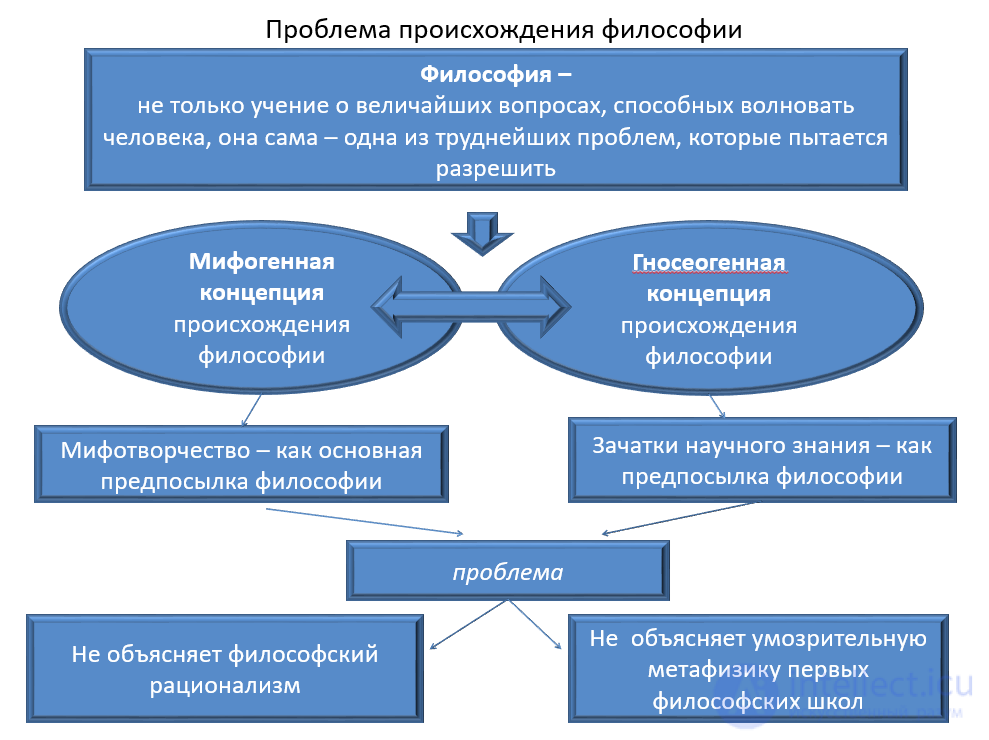
The problem of the origin of philosophy
Thus, the general characterization of philosophy appears as a set of mutually complementary concepts, each performing its own specific functions. The above is further supplemented by the integration of philosophy into other sciences, for example, the philosophy of natural science, and by the disciplines I have discussed in other articles
.
At present there exists an academic form of general philosophy, which is popularly presented and taught in institutions of higher education, to a greater or lesser extent, to all categories of listeners. This possibility is explained by two main reasons.
The first reason is the well-established general characterization of philosophy set out in the works of thinkers of the past. The works that have found confirmation formed the basis for further research; those that have not are regarded as the history of science, all the more so since many misconceptions are so close to actual knowledge that, with the application of corrections or allegories, they become true.
The second reason for teaching general philosophy to a broad range of listeners is the avoidance of a detailed examination of knowledge. In courses, theories, hypotheses and inferences are presented only descriptively, or with minimal supporting evidence, which is left to specialist listeners.

Fig. what philosophy is according to various philosophers of different eras
Here are some of the main topics and directions in philosophy:
Epistemology: this is the branch of philosophy that studies cognition and cognitive processes. It asks questions about the nature of knowledge, the sources of cognition, truth, justification and belief.
Metaphysics: this is the field that investigates fundamental questions about reality, existence and the nature of the world. It touches on such questions as free will, the definition of reality, the relation between mind and matter, causality and the transcendental aspects of being.
Ethics and morality: this is the field of philosophy that studies questions of right and wrong conduct, values, moral principles and virtues. It seeks to understand how we ought to act and what our moral norms should be.
Political philosophy: this is a direction that studies questions of power, the state, political systems, justice and rights. It touches on topics such as democracy, tyranny, social justice, the duties of citizens, and others.
Philosophy of religion: this is the field that investigates the phenomenon of religion, faith, doctrines of belief and religious practices. It asks questions about the nature of God, the relation between faith and reason, religious ethics, and others.
Logic: this is the branch of philosophy that studies the rules of reasoning and inference. Logic is concerned with the analysis and evaluation of arguments, the structuring of thought and the methods of rational thinking.
These are only some aspects of philosophy. If you have more specific questions or topics of interest in philosophy, I will be glad to answer in the comments!
Among the first stages of becoming acquainted with general philosophy is the examination of the basic concepts of this science throughout its entire history. Among the key general concepts of philosophy are worldview, world-perception and world-feeling.
Worldview – a system of an individual's general views and opinions about themselves, the surrounding world and their own place within this world, one that excludes abstraction from the bearer of the worldview. That is, it is easy to understand that what is usually called by the layman the "philosophy" of some group, individual or part of a culture is in fact a worldview.
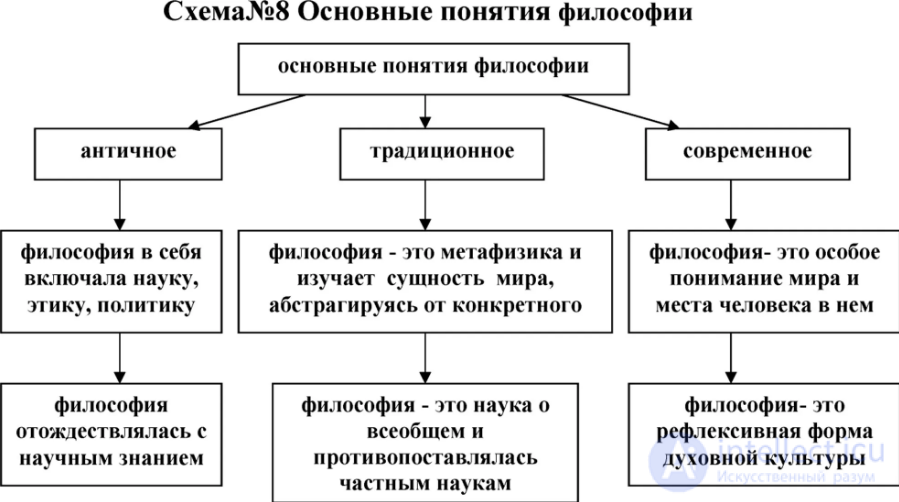
World-perception – a complex of perception and identification, an association of an individual's views and opinions with images serving as visual or abstract examples, standards for explaining their worldview. Put more simply, this is how an individual perceives themselves, the surrounding world and the connections between these two phenomena.
World-feeling – a system of sensory associations for and during the cognition, representation and explanation of one's worldview, that is, the experience of bodily sensations. It should be noted that world-feeling actively interacts with world-perception, and the character of this mutual influence largely determines the type of an individual's worldview – either perception plays the dominant role, or feeling prevails.
The relation to the human being in philosophy, sociology and other disciplines is examined in separate articles. Let us define three other key concepts of general philosophy that occur in connection with one another: personality and environment.
Personality – a set of particular and specific traits and properties illustrating, for the environment, including the social environment, the hidden essence of a person's unique individuality, known only to its bearer. Although for most people, this essence is in fact unknown to them, either owing to its absence, or owing to insufficient self-knowledge. Because of the latter, a person adopts widespread patterns of behavior, judgment and worldview in general, through which they come to belong to the category of "people".
Environment – the space and place of habitation, residence or creative activity of an individual. Place does not necessarily pertain to the material world (locus corporalis et spiritualis – Lat. material and spiritual place). In psychology, the term locus does not relate so categorically to place, which is often understood as part of some space (matter), and therefore, without further explanation, is perceived as a non-material localization. From this definition it is clear that the environment can be created by an individual, an individual may reside within it, and may likewise exist within it (natural environment). At the same time, environment includes not only purely material space, but also informational spaces. The latter is a subject for a separate discussion, which I will not go into here.
The object of philosophical cognition is the relation «human being –world», while its subject matter consists of the most general characteristics (properties) of this relation and its components. Despite the fact that in various historical types of philosophy and philosophical doctrines the subject matter of philosophy has had and continues to have its own particularities, conditioned by the character of the culture of the era, the development of science and philosophy, and the structure of social life, it includes four fundamental philosophical problems within the framework of the relation noted above.
1. The problem of the world around us, the universe, the Cosmos, being, the search for the first principle of all that exists. In connection with this problem, questions are discussed such as: what is the world, how did it arise, what are its prospects, what unites all the phenomena of the world, in what state is it (does it change or remain unchanged)? In different philosophical doctrines, from the very origin of philosophy onward, various answers have been given to these questions, but the interest in them has remained and continues to remain constant, since the answers were linked to determining the prospects of human being. This and other problems of philosophy will be examined in more detail in subsequent topics.
2. The problem of the human being, of their origin, the meaning of their existence and the prospects of their being in the world. This problem, as one of the central problems in philosophy, has been examined in many schools and doctrines of the philosophy of Ancient India and China, in ancient Greek philosophy (Socrates, the sophists), in German classical philosophy (L. Feuerbach), in the philosophy of Marxism, in twentieth-century philosophical anthropology, in the philosophy of existentialism, and others. In this connection the human being has been characterized as part of the Cosmos (a microcosm), as a social being, as the highest of all earthly living beings, endowed with reason, as a set of social relations, and so on. In studying the problem of the human being, as with other problems, philosophy relies on the results of the corresponding scientific research.
3. The problem of the interaction between the human being and the world, the subjective and the objective, the ideal and the material. Materialist philosophy, at all historical periods, has solved this problem by relying on the corresponding scientific research, in the spirit of affirming the eternity and primacy of matter and nature, the objective existence of and derivative, secondary character (in the sense of origin and content) and dependence of consciousness, thinking, the human psyche, the subjective, and one's inner world. However, whereas materialism regarded consciousness, the ideal and the subjective as derivative properties of matter, idealist philosophy was based on the opposite position. The problem of the unity and connection between matter and consciousness was organically bound up with the answer to the question of the possibilities and paths of representing, in ideal forms and in human knowledge, the objective world, nature and society, that is, with the question of the knowability of the world and the reliability (truth) of knowledge. Therefore, questions of the knowability of the world also belong to the subject matter of philosophy.
4. The problem of human being within the «world of people». The solution to this problem is bound up with the search for the most harmonious system of relations in society, including interpersonal ties, the interaction of the individual and society, and the building of a more perfect society and state. Such motifs can be traced in philosophy from Plato and Confucius down to the present day, when a planetary society is taking shape under conditions of globalization in all the most important spheres of social life.
The problem of the subject matter of philosophy
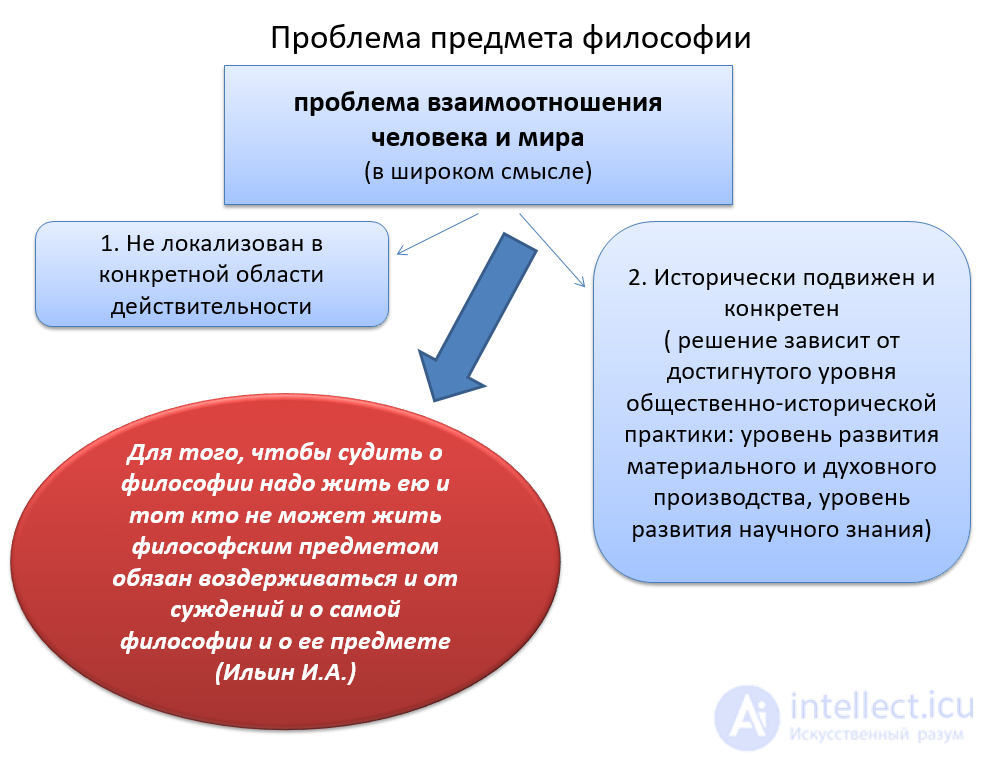
The content of the subject matter of philosophy is historically renewed, which is conditioned by the development of society itself, of science, by the growing role of intellectual labor, and by the emergence of new problems on which the future of humanity depends. On the whole, the subject matter of philosophy includes the search for the most general laws of being (development) of natural, social and spiritual reality, and the corresponding theoretical reproduction of the world as an integral system, using scientific knowledge, aesthetic vision, forms of its artistic reflection, practical mastery, and so on.
Philosophy – this is a system of the most general theoretical knowledge concerning the principles of being, the laws of the development of the world as a whole, of the human being, of thought and activity.
In the course of the historical development of philosophy, the following main branches of philosophical knowledge have taken shape:
1. Ontology – the doctrine of being, of the basic forms of existence of natural and spiritual reality, of the most general laws of being, of the relation between being and non-being, of the levels of being – the possible and the actual, of the unity of the world and its foundation, of its state (changeability or unchangeability), and of the attributive properties of the world (motion, space, time, and others).
2. Gnoseology (theory of knowledge) – a branch of philosophy comprising questions concerning the study of the nature of cognition and its possibilities, the types of cognitive relations, the kinds of knowledge, and the conditions of its reliability and truth. The main problem of gnoseology is the determination of the possibilities for the reliable cognition of objects and their essence; and truth, understood as the correspondence of knowledge to reality, serves as the main gnoseological category.
3. Axiology – a philosophical discipline within the framework of which the nature of values, their types, structure, interrelation, subordination and place in human existence are investigated.
4. The history of philosophy studies the formation of the subject matter of philosophy, the development, continuity and succession of various philosophical doctrines, and analyzes the history of the emergence of philosophy and its dynamics as a specific form of social consciousness.
5. Philosophical anthropology studies the human being as a special form of being, including questions of conscious, creative, transformative activity. Its subject matter comprises all the dimensions of the human being as a cosmo-geo-bio-psycho-social being in their unity, formed in the interconnection of the cosmic, geochemical, biological and social stages of the global evolution of the world.
6. Social philosophy – a part of philosophy reflecting the particularities of society, the laws of its functioning and development as an integral system.
7. Ethics – a philosophical discipline that studies morality, its origin, its place within the system of social relations, its structure, and ethical concepts. The subject matter of ethics is the essence and correlation of good and evil, justice and injustice, happiness, duty, conscience, and so on.
8. Aesthetics – the philosophical doctrine of activity according to the laws of beauty and of the beautiful itself. The main content of the subject matter of aesthetics is formed by the problem of the essence and unity of the beautiful and the ugly. Aesthetics examines human activity through the lens of the categories of the sublime and the base, the comic, the dramatic, the tragic, and so on.
9. Logic – a philosophical discipline concerning the forms, laws and methods of cognitive activity and thinking.
All parts of the system of philosophical knowledge are interconnected and continue to develop, and their content is continually renewed. In connection with the growing role of science in the life of society and the increasing complexity of cognitive activity, new fields of philosophical knowledge have emerged – methodology of science and science studies.
In the educational literature one finds various classifications of the functions of philosophy and corresponding descriptions of their significance within the system of culture. Some authors hold that the role of philosophy in culture is determined by its reflexive (from Latin reflexio – a turning back) function in relation to the foundations of culture, as a result of which the universal properties of being are comprehended and the universals of culture are identified, which are then expressed in the language of philosophical categories. In this way the theoretical preconditions are laid for philosophy to perform its other functions, a brief characterization of which follows below. Let us emphasize that culture is understood in philosophy as the totality of material and spiritual values, the ways of creating them, and the abilities to use cultural values for the purposes of the existence and development of the human being and of society.
The worldview function consists in working out generalized conceptions of the world, of humanity's place within it, and of the principles governing humanity's interaction with the world.
The methodological function consists in creating a system of initial principles, generalized ways (methods) of organizing and structuring theoretical (cognitive) and practical activity, and in developing a doctrine of this system.
The epistemological function is manifested in the grounding of optimal paths of cognition, its forms, the criteria of the truth of knowledge, and in the formation of a doctrine of cognition as a whole.
The axiological function consists in forming general conceptions of the significance, for the individual, for a group of people, and for society as a whole, of the phenomena of natural, social, and spiritual activity.
The praxeological function consists in identifying the most general laws, directions, conditions, goals, means, and methods of organizing and carrying out human activity.
The critical function – consists in forming the principles of normative philosophical consciousness for the optimal resolution of various philosophical problems, and also in identifying and eliminating delusions, dogmas, and outdated stereotypes that direct cognition down a false path.
The prognostic function consists in developing conceptions of the future features and forms of natural and social phenomena, and of the possible paths of their development, including the sphere of human activity and global processes in the contemporary world.
The synthetic function is manifested in philosophy's integration, as a form of spiritual culture, of all its other forms. In this sense philosophy is the quintessence of the fundamental ideas and values of a given era.
All the functions of philosophy are interconnected, and only together do they form a system of knowledge capable of actively influencing the spiritual development of society and the individual.
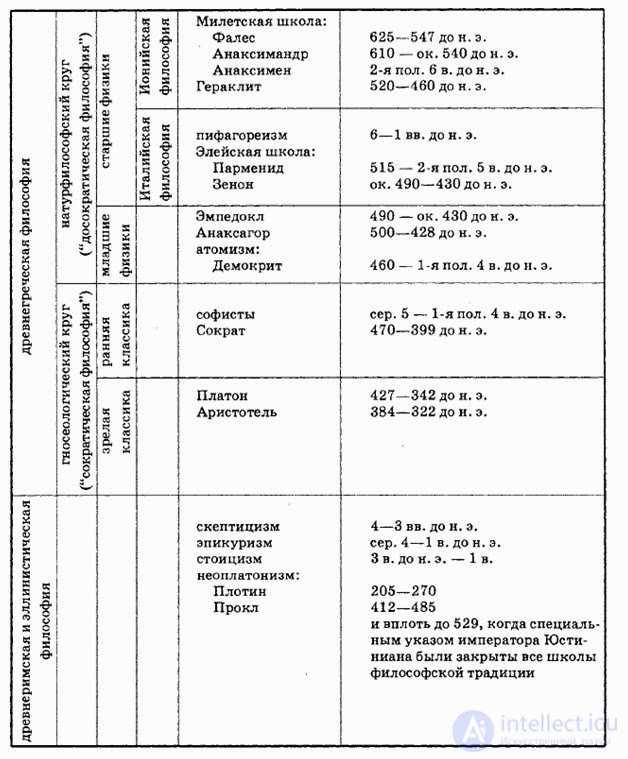
Fig. Ancient philosophy

Fig. The main concepts of the philosophy of the medieval era
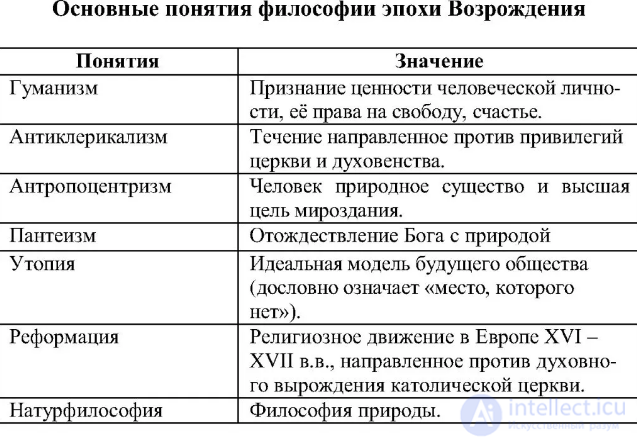
Fig. the main concepts of the philosophy of the Renaissance era
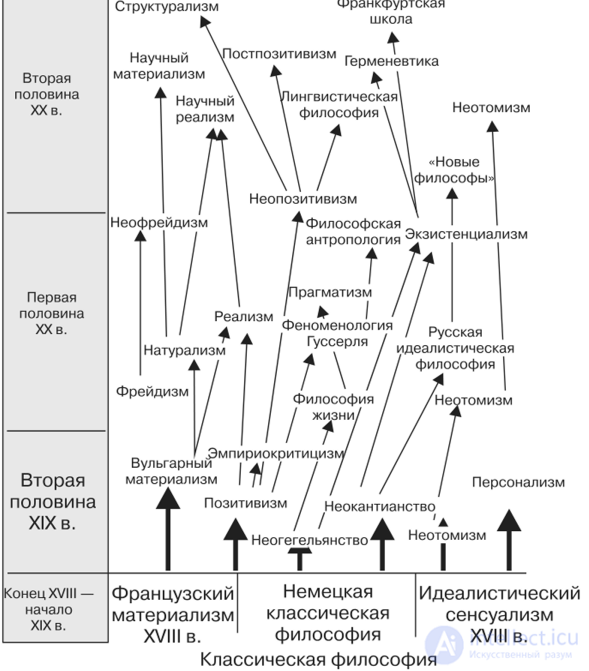
Fig. the main directions of contemporary philosophy
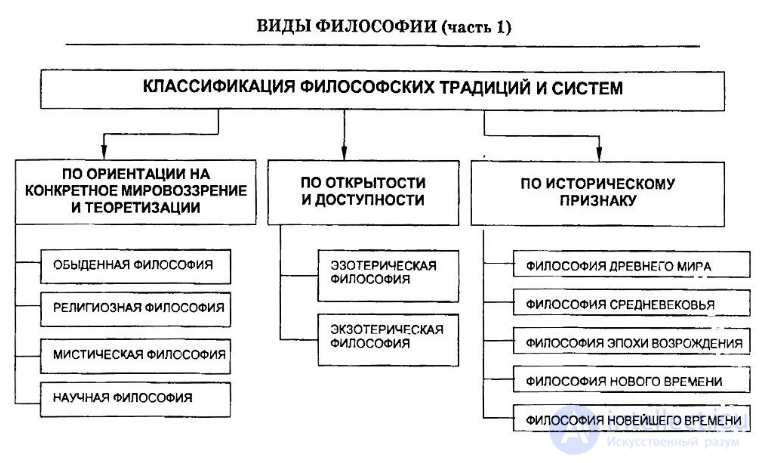
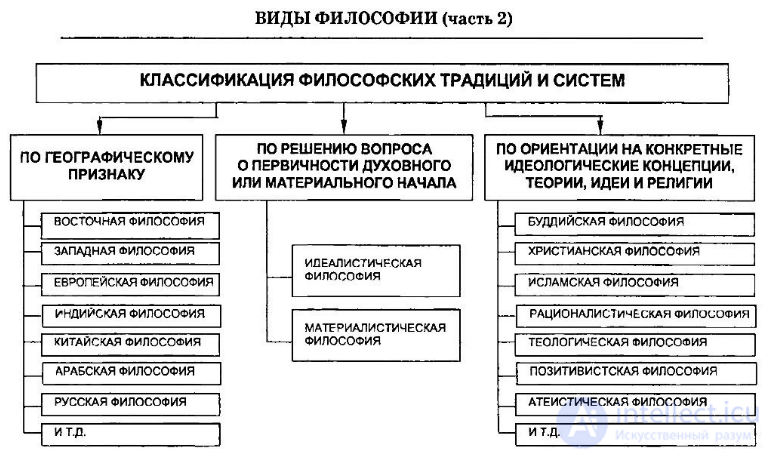
Fig. Types of philosophy
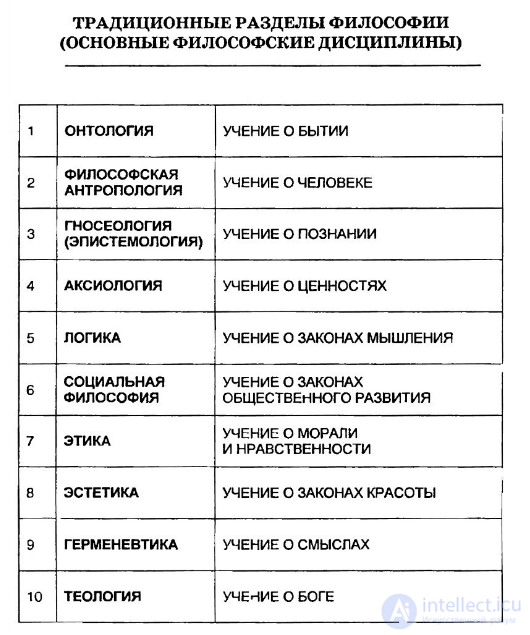
Fig. branches of philosophy

Comments