
Lecture
Knowledge is only knowledge when it is acquired through the effort of one's own thought, not through memory.
L. N. Tolstoy, «A Circle of Reading»
From this chapter you will learn:
To arrive at a more meaningful distinction between the concepts of «knowledge» and «information», it is important to turn to the definition of «learning». According to the interpretation given in the Great Soviet Encyclopedia, learning is «the process of transmitting and assimilating knowledge, abilities, and skills of activity...» . This traditional interpretation of the learning process is still found in many pedagogical textbooks today.
Despite the fact that this definition implies a two-way character to the learning process (the activity of the teacher — teaching, and the activity of the learner — studying), a natural question nonetheless arises concerning the possibility of the direct transfer of knowledge from teacher to student.
The Federal Law «On Education in the Russian Federation» [33] treats learning in a different light: the process of learning implies an organization of activity in which the learner masters a body of knowledge, abilities, and skills (see the glossary of terms).
In the definition presented here, firstly, nothing is said about who the bearer of the knowledge subsequently mastered by the student is — apparently it may be not only the teacher, but also a book, a distance course, and so on; secondly, the nature of the learner's activity changes — whereas the traditional definition spoke of the learner assimilating knowledge, the modern interpretation states that the learner masters knowledge.
The verb «to assimilate» means «to memorize», «to learn by heart». But knowledge cannot be memorized or learned by heart (nor can it be transferred). What can be memorized or learned by heart is information.
As for the verb «to master», in this case the meaning of the word is conveyed by the phrases «to make something one's own» or «to appropriate something for oneself». And this already speaks of activity and, as a consequence, presupposes the individual's agency.
To sum up, it is worth noting that the ideal outcome of learning is a formed system of knowledge in the student, one that allows him to find his bearings in the modern world and to continue his education in accordance with his personal interests. Thus, starting from the concept of «learning», one can arrive at an understanding of the difference between the definitions of «knowledge» and «information».
Interesting fact!
It has been proven that, on average, 90% of the information that students learn at school is forgotten if it is not reviewed after a certain interval of time. Moreover, the highest percentage of forgetting occurs precisely in the first hours after a lesson [18].
In pedagogy, as in any other science, there exist its own laws, known as regularities. One such regularity determines the quality and quantity of retention of educational material: unspaced repetition is less time-consuming and more effective in terms of results than spaced repetition [6, p. 80].
Fig. 2.1 clearly illustrates this regularity: curve 1 — the initial volume of educational information, curve 2 — the volume of educational information with unspaced repetition, curve 3 — the volume of educational information with spaced repetition. As can be seen from Fig. 2.1, the volume of retained educational information directly depends on its repetition, with unspaced repetition being far more effective than spaced repetition.
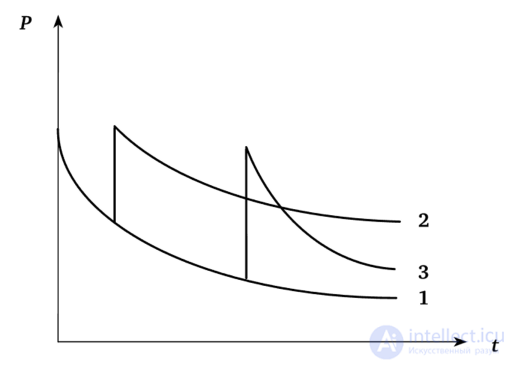
Fig. 2.1. The regularity of retention of educational information
The regularity of retention of educational information was discovered by H. Ebbinghaus and substantiated in his work «On Memory» in 1908 [39]. Since then, the regularity has been confirmed by a number of scientific studies by domestic psychologists and is expressed today as follows: the durability of the assimilation of educational material depends on the systematic direct and spaced repetition of what has been studied, and on its inclusion in previously covered and new material [26, p. 432].
Attention, a question
To date, there is no unified understanding in science of the meaning of the concept of «knowledge». This problem is due to the fact that there is a great diversity of opinions on the very nature of knowledge, as well as on its substantive, functional, and categorical components [13]. Moreover, this diversity and variability of viewpoints is observed not only in pedagogical science. Thus, the concept of «knowledge» is central to the philosophical-methodological discipline of epistemology (from the Greek episteme — knowledge, logos — study), which is concerned with studying the structure of knowledge, its functioning, and its development. At present, epistemology investigates the process of cognition, as well as its final result — knowledge in terms of its truth and reliability. This means that, in the philosophical sense, the concept of «knowledge» acquires the meaning of truth [34].
But philosophy is not alone in studying the nature of knowledge — besides it, the category of «knowledge» is investigated in psychology, linguistics, computer science, cybernetics, and, of course, pedagogy, which speaks to the interdisciplinary character of the concept under consideration.
If one turns to the definition of the term «knowledge» in the scholarly literature, one can notice a terminological inconsistency, manifested in the fact that knowledge and information are explained in definitions through each other.
Example
Knowledge is processed information, used and applied for making decisions and solving problems, as well as information about methods of processing information... [38].
Information is a certain sequence (implying orderliness) of data and knowledge that are actualized (obtained, transmitted, transformed, compressed, or recorded) by means of certain signs (symbolic, imagistic, gestural, auditory, or sensorimotor types) [11].
Most likely, the root of the problem lies in the following: the phrases «transfer of knowledge» and «exchange of knowledge» are figures of speech, not an actual process. Moreover, the reason also lies in the fact that these expressions are actively used not only in the language of science but also in everyday speech, and this, of course, leaves its mark — a difference in contexts arises and becomes entrenched [30].
Despite the fact that knowledge and information share certain common features (this question will be addressed further below), the categories in question still have serious substantive differences, manifested in the difference in their functions and, of course, in their personal value.
The difference between the concepts of «information» and «knowledge» is clearly illustrated in the diagram (Fig. 2.2).
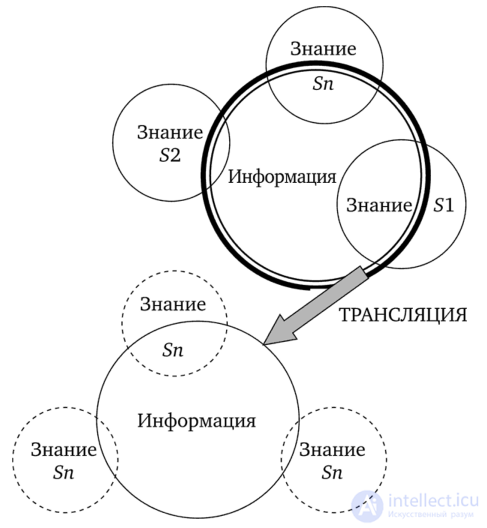
Fig. 2.2. The process of information turning into knowledge, and vice versa
The diagram shows that there exists a certain volume of information which, once, in the course of mental activity, is processed by subjects S1, S2, and Sn (upper circles) into personal knowledge.
As is known, a person cannot assimilate information in its entirety, for a number of reasons: firstly, the individual already possesses a certain individual experience relating to the information being assimilated, as well as an initial level of education; secondly, each subject perceives the information offered with regard to his own interests and educational deficits; thirdly, people have significant differences in the ways they process one and the same piece of information (for example, the educational information that a lecturer shares with students in a lecture will undergo differing degrees of processing, clearly reflected in the students' notes).
In any case, one and the same piece of information can be interpreted quite differently by the subjects working with it, and thus the volume, breadth, and depth of knowledge of individuals will also differ. This idea was best expressed by Professor V. P. Kolesov: «Knowledge arises as a result of a person's mental activity aimed at the perception, comprehension, systematization, and interpretation of information — that is, of streams of visual, auditory, and other signals and messages coming from the objects of the surrounding world» [Cited in: 38, p. 7]. Two important ideas can be drawn from this quotation:
Let us return to the diagram. When a person possesses some piece of knowledge, a need may arise at some point for its transmission (lower circles). But knowledge cannot be transferred directly to other subjects, so the individual S1 is forced to «translate» personal knowledge into information, which will serve as the «raw material» for the formation of knowledge in other subjects Sn. From the above it follows that information is a way of preserving knowledge. Thanks to this phenomenon, humanity is fortunately spared from having to reinvent the wheel each time.
In his article, O. Yu. Krasilnikov, citing A. Foskett, gives a quotation that excellently confirms what has been said above: «Knowledge is what I know, information is what we know» [Cited in: 14, p. 14].
Thus, knowledge cannot exist detached from a personality engaged in activity and thinking. Consequently, the fundamental condition for acquiring knowledge is a person's independent activity in processing information through such mental operations as analysis, synthesis, abstraction, comparison, and others.
It is worth noting that domestic scholars possessing undoubted authority in pedagogical science — V. V. Davydov , S. L. Rubinstein [29], M. I. Makhmutov [17], and others — also link knowledge to the mental operations of the individual.
For this reason, it seems appropriate to use the definition of the concept of «knowledge» presented in T. F. Efremova's explanatory dictionary, which comes down to the claim that knowledge is a product of the cognition of reality, reflected in the consciousness of the individual in the form of concepts and judgments (see the glossary of terms). And information, accordingly, is data about the surrounding world (see the glossary of terms).
In addition, it is important to draw attention to one more concept close in meaning to the concepts of «knowledge» and «information» — «data».
Attention, a question
What is data? How does data differ from information?
Data, if one tries to explain it briefly, is a certain collection of facts that are not connected with one another. According to S. I. Ashmarina and A. V. Filatova, data is the «lowest tier» of information [1, p. 12]. If one tries to convert data into a unified whole and attempts to interpret it, then the data is transformed into full-fledged information (see the glossary of terms).
Interesting fact
A team of American scientists from the Salk Institute for Biological Studies (California) published an article in the journal eLife in 2015, in which they reported the sensational news that, on average, the memory of one healthy person is capable of storing information with a total volume of one quadrillion bytes — that is, nearly one million gigabytes (original source of the article: https://elifesciences.org/articles/10778).
Speaking of the hierarchical system of data, information, and knowledge, one cannot avoid mentioning the DIKW model, popular today. This term gets its name from the combination of the first letters of the four words that make up the substantive basis of the model: from the English data, information, knowledge, wisdom [30].
Below is a diagram of the DIKW model (Fig. 2.3).
Attention, a question
What is notable about the DIKW model?
The DIKW model is interesting because it clearly reveals the relationships between the concepts of «data», «information», «knowledge», and «wisdom».
As we can see, the DIKW model is hierarchical in nature. Initially, the model's creator, Russell Ackoff, represented it in a simpler scheme: data —? information —? knowledge —> understanding —?> wisdom. According to the original version of the model, data are disparate facts; information is ordered facts; knowledge is information analyzed by an individual, which he can use to make decisions and perform certain actions; understanding is the ordering of a body of knowledge and bringing it into a certain logical system; wisdom is the ability to evaluate the results of one's activity on the basis of the knowledge one possesses, as well as to predict the development of a situation [1, p. 13].
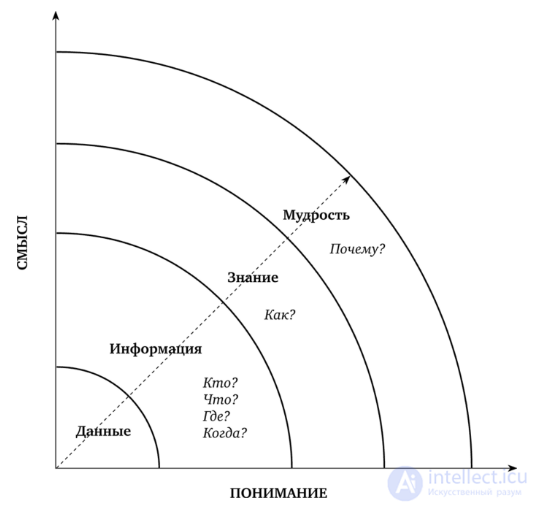
Fig. 2.3. The DIKW model
The modern DIKW model, besides the hierarchical nature of the relationships between the concepts, provides an understanding of an existing regularity: the higher the level of wisdom, the greater the understanding of the surrounding reality a person possesses, and the more meaning he sees in it.
Data: two children in the preparatory group of kindergarten N, as diagnostics revealed, turned out to be unready for schooling in the first grade of elementary school.
Information: Masha I. showed low intellectual maturity, Vanya P. — a low level of social maturity.
Knowledge: the intellectual immaturity of Masha I. consists in a low capacity for logical retention, as well as an unformed ability to grasp the basic connections between phenomena. A conversation with the child's parents revealed that six months earlier the girl had experienced severe stress — her parents' divorce. The low level of social maturity of Vanya P. is expressed in the boy's inability to communicate with his peers. In addition, the child belongs to the category of frequently ill children.
Wisdom: an individual development program has been built for the children for the coming academic year, taking into account their personal deficits. The implementation of the program is periodically monitored by the kindergarten psychologist N, and is also adjusted depending on the children's recorded results.
Domestic scholars (V. P. Sidyakin, V. Ya. Tsvetkov) limit themselves to only three components of the model. Thus, the concept of wisdom is not singled out as a separate level — it is part of knowledge. Therefore, the Russian model looks as follows: D —? I —> K, where D — data, I — information, K — knowledge [30].
It is important to present one more diagram, proposed by K. Nikolaev in his recently published book «Intellectual Stroke. How to Remain Human in a World of Robots and Not Lose Oneself» (Fig. 2.4).
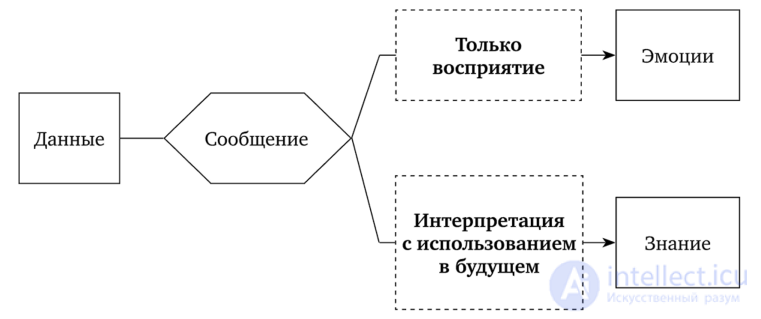
Fig. 2.4. The interpretation of data into emotions or knowledge
In addition to the term «data», already analyzed earlier, a new term — «message» — appears in the diagram. According to K. Nikolaev's theory, data is information without a comprehensible meaning, whereas a message is data whose meaning can be understood. In essence, both terms imply information.
However, for example, for one person the same piece of information may be data, whereas for another it may already be a message.
In any case, any comprehensible message was once simply a set of data. In order for data to pass into the category of a message, one must learn to perceive incoming information and carry out its analysis. Here memory plays an important role in this process, allowing information to be transferred from short-term storage to long-term storage.
After data has evolved into a message, that is, once the recognition of information has occurred, the process can proceed along one of two routes. In the first case, a person understands the information, perhaps accepts it, but it only evokes certain emotions. Television content is built on this principle, when terabytes of information reach viewers through television screens in a comprehensible and convenient form; however, such information does not pass (or passes extremely rarely) into the category of an individual's knowledge. For a message to evolve into knowledge, not merely an interpretation of the information by the person is needed, but also its further use by the individual (second route) [20, p. 95].
Whatever scheme we use, the essence remains the same: in order for an individual to become a possessor of knowledge, they must expend effort consisting of performing various kinds of mental operations.
Having dealt with the basic terminology of Chapter 2, we can confidently move on to another important question, concerning the explanation of how the processes of information assimilation and knowledge formation occur.
Attention question
It is impossible to answer this question unambiguously, so let us consider four theories on this matter (two domestic and two foreign).
Let us begin with the theories of Russian (Soviet) scholars.
Theory 1. In Russian pedagogical science the theory of the assimilation of educational information developed by V. P. Bespalko has become widely accepted.
In 1977 the scholar proposed a so-called "genetic structure for the formation of student mastery," which is expressed in two regularities:
— the process of assimilating educational information always has a hierarchical structure;
— a person can perform certain types of activity only after having assimilated information about the methods of performing that very activity.
The merit of V. P. Bespalko lies in the fact that, taking as a basis the criterion of independence in performing educational work, the author proposed distinguishing two types of learning activity — reproductive and productive-creative (Fig. 2.5).
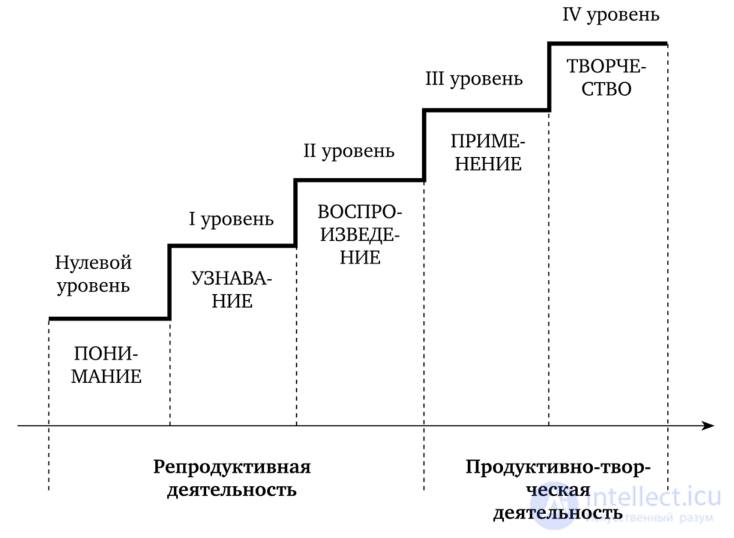
Fig. 2.5. Levels of assimilation of educational information according to V. P. Bespalko
Thus, reproductive activity has three levels of work with information: comprehension, recognition, reproduction (in ascending order).
The zero level (comprehension) involves the learner's perception of new educational information, its memorization and understanding. The first level (recognition) characterizes the learner's reproductive actions with previously studied information with the help of prompts and recommendations. The second level (reproduction) speaks to the independence of the student in working with information, although this independence is still manifested only in standard situations.
Productive-creative activity involves a deeper comprehension of information; this type of activity characterizes the student as an active subject of education, capable of making decisions based on previously assimilated information, transforming it creatively, and applying it in problem situations that require an innovative (creative) approach.
Productive-creative activity includes two levels: application and creativity proper.
The level of application characterizes the learner's ability to use previously assimilated information in entirely non-standard situations. The creative level indicates that the student has achieved mastery in the field of knowledge being studied, that is, they are capable of transforming reality by creating new products of activity.
It is worth noting that V. P. Bespalko's theory of the assimilation of educational information has not lost its relevance today, especially in school practice when assessing the quality of teaching.
Theory 2. N. F. Talyzina, based on P. Ya. Galperin's idea of the commonality of external and internal human activity, according to which the formation of knowledge occurs through the process of interiorization (that is, the transition of external/material activity into internal/mental activity), developed the theory of the step-by-step formation of mental actions.
According to N. F. Talyzina's theory, the formation of mental actions consists of five stages (Fig. 2.6). Moreover, mental actions are actions of consciousness that a person performs with the help of various mental operations (analysis, synthesis, abstraction, generalization, classification, comparison, etc.). Mental actions are expressed, first and foremost, in concepts [31].
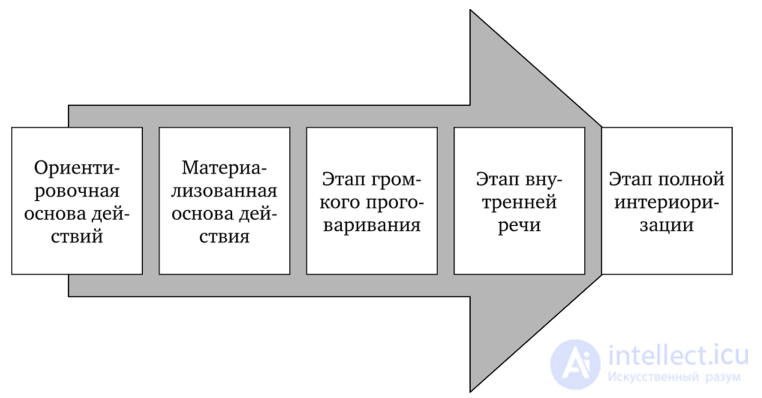
Fig. 2.6. Algorithm for the step-by-step formation of mental actions
The first stage (orientational) involves the learner's introduction to the action, during which an orientational basis for the action is formed, that is, a certain mental image of the problem situation in which the student has to work. The orientational basis of the action also implies the formation of motivation to carry out the activity, as well as a plan (method) for solving the problem task.
The second stage involves performing a material (materialized) action, representing, for example, work with information using diagrams, drawings, sketches, and other objects of a material nature.
The third stage — the stage of external speech — involves speaking aloud (often collectively) the actions that the learners are performing at a given moment. However, external speech can also occur in individual forms of work.
The fourth stage — the stage of internal speech — involves speaking "to oneself," which contributes to a more conscious understanding of the actions the learner performs.
And, finally, the fifth stage of interiorization represents the fully automated action of the student; the learner independently monitors their own activity and corrects it as necessary. The fifth stage indicates that the mental action has moved into the internal plane (consciousness), and therefore no longer needs external stimulation and control [32].
Today the theory of the step-by-step formation of mental actions is also relevant, since its application in practice enables learners to assimilate concepts and, accordingly, form a certain internal knowledge about a given object, as well as about the methods of working/interacting with it.
Within the framework of this question it is interesting to look at several learning theories developed by foreign scholars. Let us turn to them.
Theory 3 is associated with the name of J. Piaget [25] and the concept of cognitive development he developed. At present this theory has not only retained its relevance but has also developed further in the form of a special pedagogical philosophy called "constructivism."
The essence of the cognitive theory, which stands at the intersection of psychology, pedagogy, philosophy, and biology, is that all people, regardless of their age, throughout their lives construct their own understanding of the surrounding world based on already existing experience and personal knowledge. It turns out that the theoretical material offered by a teacher for memorization will never "fit" into personal knowledge if it holds no value for the students — that is one point [4, p. 44]; if it does not draw on the learner's experience — that is a second point [24, p. 19]. Thus, the traditional system of education, which assumes that a student has given the correct answer to a question posed, does not solve the problem of the student's development. Moreover, a memorized but not understood answer to a question is perceived by the learner as alien, and is therefore quickly forgotten afterward.
A diagram (Fig. 2.7) can help to visually understand the theory of constructivism.
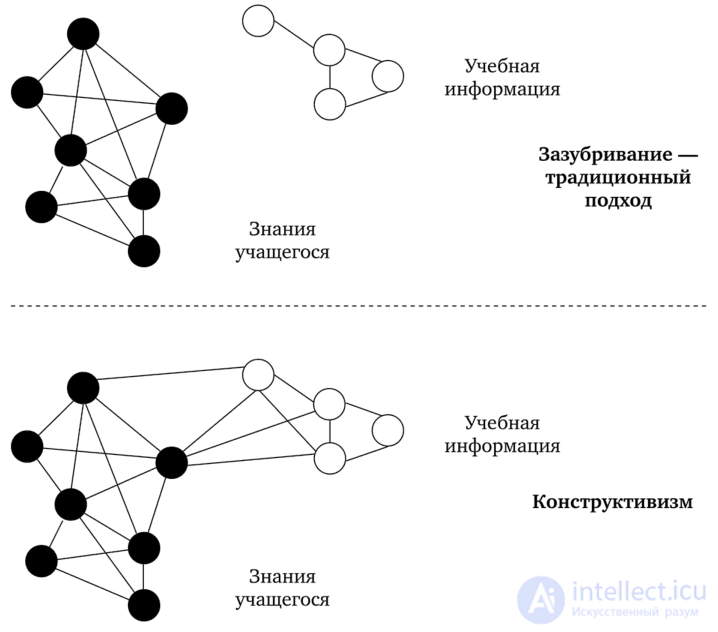
Fig. 2.7. A visual representation of the theory of constructivism
In the first (upper) part of the figure there is no connection between the new educational information and the student's knowledge, and for this reason no learning process as such occurs. Simple rote memorization aimed at giving an answer to a question posed by the teacher helps solve only a momentary task but does not form deep knowledge, as shown in the second (lower) part of the figure. The theory of cognitive learning suggests that the student builds their own understanding of educational information, which in turn allows it to be "fitted" into the already existing picture of the world. Only when new information is connected to already existing knowledge can it be used more productively, including when solving non-standard life situations.
Example
When a child is taught the operation of subtraction without reference to their personal experience (there were two apples, one was shared with Masha, how many are left?), the assimilation of new information occurs with much more difficulty than when the arithmetic operation of subtraction is demonstrated clearly in practice.
Analyzing constructivism as a philosophical-pedagogical phenomenon, Professor M. A. Choshanov identifies five principles that make it possible to put the theoretical ideas of constructivism into practice:
Interesting fact!
The theory of constructivism is notable in that it has now received confirmation from neuropsychologists and neurolinguists. It has been proven [24] that learning is a purely physiological process, during which new neurons form in the human brain. Meanwhile, the formation of neural connections linking to already established neural structures is impossible without the process of comprehension taking place.
In addition, it is important to know that building connections between new information and existing knowledge occurs thanks to special psychological structures — schemas, which represent concepts and categories of the surrounding world (see glossary of terms). It is precisely for this reason that constructivist learning requires the teacher to create special conditions that will promote children's self-regulation and the formation of conceptual structures in them through reflection and abstraction.
Theory 4. Another foreign theory relating to the question of information assimilation and knowledge formation belongs to the American scholar Benjamin Bloom (1956). Bloom's taxonomy is a hierarchical model of educational objectives, the achievement of which from level to level ensures the development of learners' cognitive sphere [19].
Analyzing the origins of the development of the taxonomy of educational objectives, M. A. Choshanov identifies four principles on which Bloom built his model:
Thus, the cognitive domain of Bloom's taxonomy has six required levels (Knowledge, Comprehension, Application, Analysis, Synthesis, Evaluation), each of which differs in its educational objectives.
Below is an adapted model of Bloom's taxonomy (Fig. 2.8).
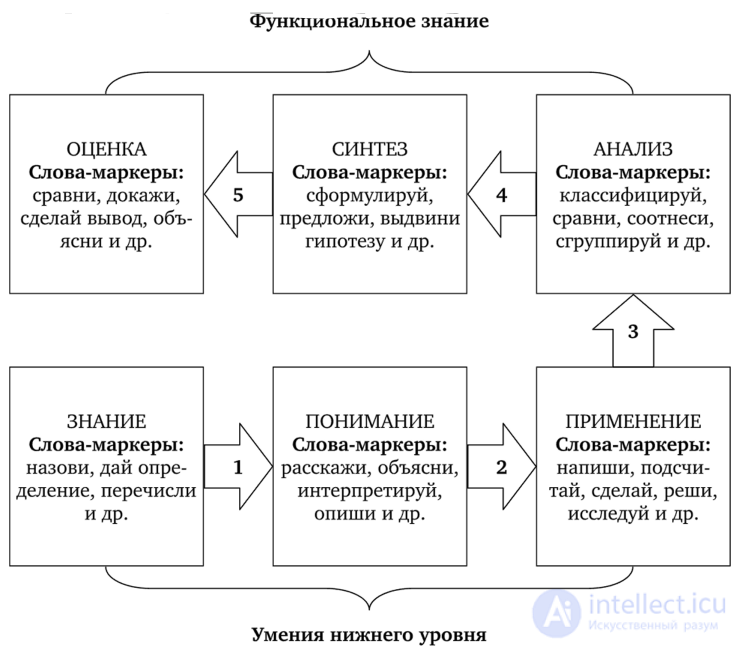
Fig. 2.8. Adapted model of Bloom's taxonomy
According to G. Petty, the first three levels of Bloom's taxonomy — Knowledge, Comprehension, Application — are lower-order skills, that is, ones that are easy to teach, but which are not sufficient on their own. Despite the reproductive nature of lower-level skills, they form the foundation for mastering functional knowledge (higher-order skills). Functional knowledge, in turn, is treated as a high-level mental skill that implies the possibility of its use not only within school learning, but also in everyday life [24, p. 23]. In essence, functional knowledge can be interpreted as meta-subject competencies. It is also important to note one regularity associated with Bloom's taxonomy: the mental workload increases the higher the level in the hierarchy of levels.
If we look at Bloom's taxonomy from a different angle, without changing the meaning invested in each level, it turns out that:
Example
Imagine that a person is learning a new program for them, Power Point. Then the content of the levels of Bloom's taxonomy can be illustrated as follows:
Knowledge: the ability to distinguish Power Point from other office programs.
Comprehension: the ability to explain how Power Point is opened, how slides are created, how a presentation is saved, etc.
Application: the ability to open Power Point and independently create a couple of simple slides.
Analysis: the ability to add several additional slides with charts and tables in order to more clearly illustrate the material.
Synthesis: refining the presentation, organizing the information presented on the slides, creating a slide with the presentation's table of contents.
Evaluation: the ability to assess how well the developed presentation matches the original concept; finding answers to the questions: "What could be improved in the presentation?", "What hinders the perception of information?" etc.
In 2016 the Australian Alan Carrington presented to the whole world the so-called "pedagogical wheel" (though it would actually be more accurate to call it the padagogical wheel) — named after the iPad, for whose system the application was in fact developed, allowing one to combine Bloom's taxonomy, the requirements placed on school graduates, and the levels of use of information and communication technologies in the educational process (Fig. 2.9).
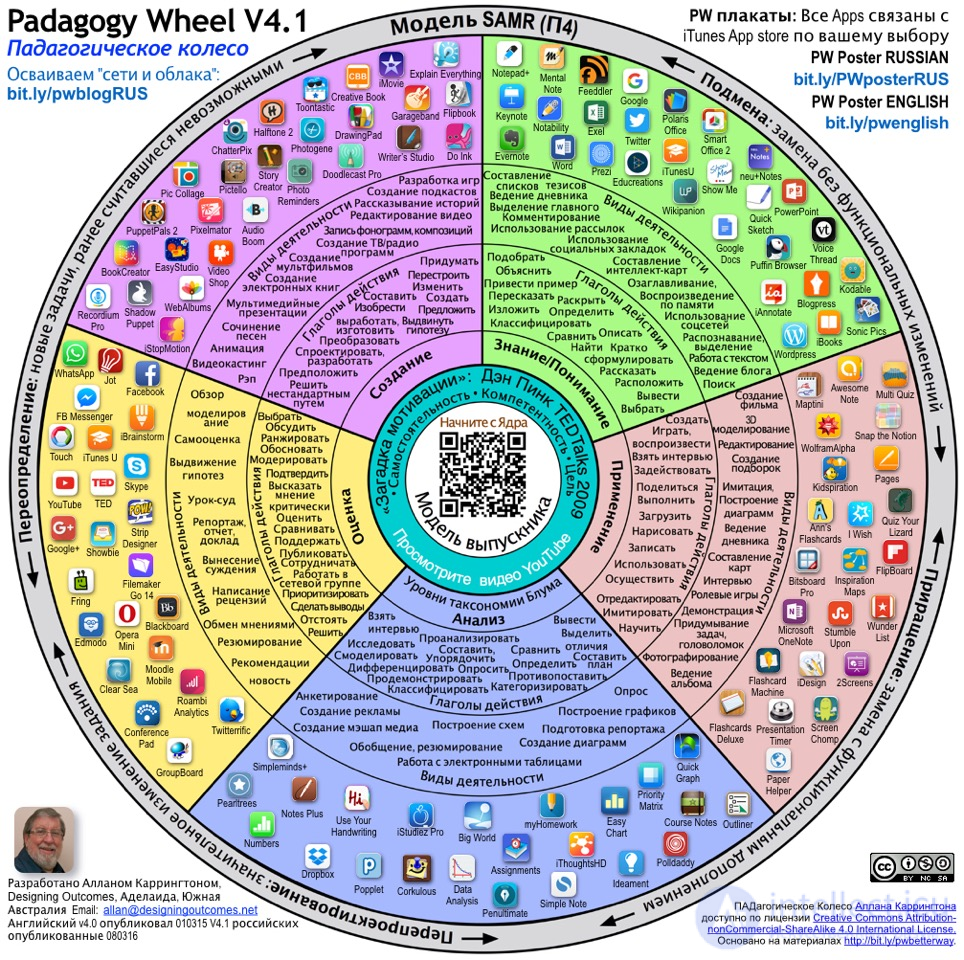
Fig. 2.9. Russian-language model of the pedagogical wheel
by A. Carrington
Thus, in each of the five sectors of the padagogical wheel (Knowledge/Comprehension, Application, Analysis, Evaluation, Creation) possible action verbs, types of activity, and applications are presented, allowing the goal of the sector to be achieved.
For example, in the Knowledge/Comprehension sector the following are indicated:
• action verbs — state, classify, explain, and others;
It is assumed that the padagogical wheel should become a reliable aid in the teacher's work — it can be used both for solving the everyday educational tasks of a specific lesson and for designing an entire course, as well as for compiling individual educational trajectories for students. In addition, the padagogical wheel will be of interest to students and schoolchildren themselves, since it allows them to look at intrinsic motivation to learn from a completely different angle. In fact, it is all fairly simple: Bloom's taxonomy has been rethought for the digital age, and has therefore received a new round of development and interest from the pedagogical community.
The theories listed above, in one way or another, share a common element that has already been mentioned more than once: mastering knowledge presupposes active mental activity on the part of the individual. Whatever stages a learner goes through, at least one of the stages (if not several) will involve independent mental operations, ultimately leading to the development of the individual's subjective relation to knowledge and the transformation of personal knowledge based on their own experience, level of education, degree of motivation, and so on [16].
When considering the question of distinguishing the concepts of "knowledge" and "information," one cannot fail to turn to the classification of knowledge from the point of view of neuropsychology, namely to the division of knowledge into implicit and explicit.
In 1958, Michael Polanyi proposed a new theory of cognition (or theory of personal knowledge), according to which an individual possesses two types of knowledge: explicit and implicit [27]. The difference between the two is that explicit knowledge can be expressed in a formal language within a sign system, for example, by means of a book, an audio recording, a video, and so on. Furthermore, explicit knowledge is transmitted from one person to another in oral, written, or digital form. Thus, explicit knowledge has a certain established conceptual apparatus by means of which the perception and assimilation of knowledge takes place [2, p. 64].
Implicit knowledge (otherwise known as tacit, or personal, knowledge) reflects the totality of a particular individual's knowledge of the surrounding world. The content of tacit knowledge cannot be encoded and transmitted by means of textbooks. Personal knowledge is demonstrated only through communication or activity [23, p. 197]. The distinguishing feature of implicit knowledge is that it is inseparably linked to the personal experience and value orientations of the individual.
Of course, the division of knowledge into implicit and explicit often turns out to be conventional. It is important to understand, however, that personal knowledge is the result of the work of consciousness, a process of active mental operations.
Attention, a question
So then, what interest does Polanyi's theory hold?
At present, in connection with the emergence and mass spread of the information revolution, Polanyi's theory can be viewed from a different angle. Thus, explicit knowledge corresponds to the modern notion of "information," which is transmitted from one person to another by means of special devices (including electronic and digital ones), as well as in the course of direct communication. However, explicit knowledge cannot become personal (implicit) knowledge without being understood through the experience of activity and the value orientations of the individual. Thus, personal knowledge, experience, and values cannot be considered in isolation from one another.
In order for the picture of the relationship between the concepts of "knowledge" and "information" to be more complete and clear, let us turn to their essential features. E. E. Panteleyev, on the basis of an analysis of numerous literary sources, identified five key features of information:
Knowledge is characterized by the following essential features (or qualities, according to I. Ya. Lerner and V. M. Polonsky):
1) systematicity — the key feature of knowledge, since knowledge is impossible without order and organization. Thanks to this feature a person is able to relate concepts, laws, theories, and so forth, building on this basis their own conceptual system;
In reality, however, knowledge and information share certain common aspects/characteristics. Thus, information is conveyed by means of concepts. And the form in which knowledge is stored is the conceptual system of the individual, which is the result of the activity of their consciousness. Since knowledge cannot be directly transmitted from one person to another, it has to be translated into a sign form, for example, a text, the perception of which will then be undertaken by another individual. In one way or another, knowledge and information are inseparable from one another, so it is important to understand their particular features and differences, which consist in the following propositions:
Tasks for understanding and reflecting on the material
Task 1
It can be said that one of the slogans of constructivist theory is the phrase "The more we know, the more we can learn!" Try to explain this thesis from the point of view of cognitive theory.
Task 2
Having studied the material of Chapter 2, as well as additional literature, fill in the comparison table.
|
Criterion for comparison |
Traditional approach in teaching |
Cognitive approach in teaching |
|
Principles of curriculum design |
||
|
Basic requirements for the learning process |
||
|
Role and functions of the teacher |
||
|
Role and functions of the learner |
||
|
Main forms of work, educational technologies, and methods |
||
|
Methods of assessing learning achievements |
Task 3
Think about how you could use Alan Carrington's Padagogy Wheel in your own professional activity.
Plan one lesson, taking into account information about the five sectors of the Padagogy Wheel:
Write out the action verbs, types of activity, and applications for each of the five sectors, but make sure that the plan contributes to achieving the goal of the lesson.
Answer the question: were you able to include all five sectors in the plan within a SINGLE lesson? Why or why not?
Glossary of terms
DATA — information, facts, characterizing someone or something, necessary for certain conclusions or decisions [10].
KNOWLEDGE — the practice-verified result of the process of cognizing reality, its adequate reflection in human consciousness in the form of representations, concepts, judgments, and theories [10].
INFORMATION — information about the surrounding world and the processes occurring within it, perceived by a person or by a special device [21].
LEARNING — a purposeful process of organizing the activity of learners aimed at mastering knowledge, abilities, skills, and competence, acquiring experience of activity, developing abilities, acquiring experience in applying knowledge in everyday life, and forming in learners a motivation for lifelong learning [34].
SCHEMAS (according to J. Piaget) — mental categories that organize experience; in infancy, schemas are based on actions and develop into abstractions in adolescence [12].

Comments