
Lecture
Philosophy of medicine — a branch of the philosophy of science that deals with the ontological, epistemological and ethical questions of medicine as a distinct sphere of theoretical and practical human activity . Philosophy of medicine is a system of generalizing philosophical judgments about the subject and method of medicine, the place of medicine among other sciences and areas of human activity, and its cognitive and social role in contemporary society as an integral system of natural-scientific and humanitarian knowledge. One of the most important branches of the philosophy of medicine and bioethics is medical ethics, which places the question of the interaction between doctor and patient at the forefront.
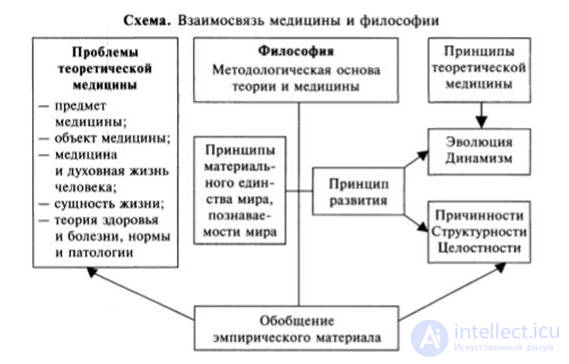
Medicine almost always encounters problems to which philosophy can provide answers. It is precisely the philosophy of medicine and pharmacy that develops and refines dialectical thinking — the pinnacle of a medical professional's mastery.
A philosophical culture allows physicians to overcome one-sidedness in approaching the problems they study, under conditions of increasingly narrow specialization in scientific and practical activity.
Without reliance on the theoretical propositions of philosophy — research in philosophical anthropology, the problems of cognitive activity — it is impossible to build a coherent theoretical basis for modern medicine. A clinician can act appropriately only when relying not only on particular knowledge, but also on knowledge of the general laws governing the functioning of the organism. Philosophy shapes modern scientific, logically coherent thinking.
The development of medicine provides enormous material both for the newest discoveries in the study of human vital activity in health and disease, and for the confirmation of philosophical regularities.
In the modern world medicine is undergoing a process of the most profound transformations. This is manifested in the interconnection of the methods of medicine and philosophy. The methods of the medical sciences, for all their diversity and refinement, cannot fully ensure knowledge of the enormous wealth of normal and pathological phenomena and their interdependence. But neither can the philosophical method replace the special methods of medical science. Contemporary philosophical research (philosophical anthropology, social philosophy) underlies the medical theory of adaptation – the general biological theory of medicine. Today medical reality needs philosophical reflection even more than in the past, reflection called upon to help all physicians understand the essence of the systemic-integrated character of the interconnection between the human being and the surrounding world, and the determination of health and disease in the cultural-social aspect of the development of the modern world.
Medicine as a science represents a «specific unity of cognitive and value forms of reflection and transformative activity». It accumulates knowledge about health and disease, treatment and prevention, the normal and the pathological, and the influence of natural, social and spiritual factors on the human being. Medicine possesses all the features of a specific field of knowledge. Besides having its own subject matter, it also has its own methods of study and its own sphere of practical application, namely: the prevention and treatment of diseases, as well as the strengthening of health. «Through its subject of research, medicine is connected with the social disciplines. Such branches of medicine as occupational, nutritional, housing and leisure hygiene are closely linked to a number of social disciplines». Since medicine studies the biological processes in the human organism, it is closely related to sciences such as biophysics, biochemistry, genetics, physiology, embryology, anthropology, microbiology, and others.
From the second half of the 19th century, medicine was regarded in its theoretical foundations as part of biology, and therefore the most widespread views in the sphere of philosophical questions of modern medicine proceed from the principles of the theoretical and methodological commonality of biology and medicine. However, the fundamental concepts of medicine — health, norm, disease, etiology, pathogenesis, nosological unit — although they intersect or interface with a whole series of concepts from biology, are not reducible to them or absorbed by them in their content. The undoubted interconnection of medicine with other sciences is in fact already determined by the very fact that the human being, as the object of medicine, represents the highest unity.
Modern medicine regards disease as the result of the «dialectically contradictory interaction» of the organism and the environment, of the internal characteristics of the organism and external environmental influences. In most cases external influences are unable to produce disease in the absence of favorable internal conditions — a «predisposition» of the organism to disease. For this reason, disease is a consequence of the interaction of the internal substrate of the organism with external etiological factors. However, some external influences in large doses (radiation, intoxication, etc.) can cause one or another disease even in the absence of a «predisposition» of the organism to disease. The relationship between the external and the internal in pathology is the problem of the interaction of environmental factors with the individual state of the organism. «Every disease is a complex totality of pathological processes, but not every pathological process is already a disease». A pathological process is only part of a disease; it is the local manifestation of a disease: local changes in tissues and organs which, taken together, constitute the disease. A correct understanding of the relationship between the concepts of «pathological process», «disease» and «health» is of great importance not only for clinical but also for social-preventive medicine.
Between states of health and disease many transitional and intermediate stages are often observed (doctors say: «no longer healthy, but not yet sick»). Such a state is called subclinical. The existence of transitional forms from the physiological to the pathological, as well as from the pathological to the physiological, is a «deeply dialectical process». Upon reaching a threshold level, one opposite passes into the other. This transition can occur in a rapid, one-time or protracted form. The use of concepts such as micro- and macro-leap helps in properly understanding the relationships between the physiological and the pathological, disease and health. «The transition from a normal, physiological state to a diseased, pathological one is a transition from one qualitative state to another, or a macro-leap. But within this macro-leap there may be several small qualitative transformations, or micro-leaps».
Medical reality includes not only disease but also health , and thus theoretical medicine must act precisely as a theory of health and disease . Moreover, «the philosophical attitude toward the phenomenon of health, which we find already in the most ancient conceptions of world understanding», and the examination of these philosophical conceptions can give contemporary researchers an example of how the concept of health is embedded within the subject of philosophy as a whole
I. V. Davydovsky wrote: «A person does not notice his health until it is disturbed; then he becomes interested in the cause of this disturbance, while remaining as ignorant as before of what health actually is. It is only clear that the latter cannot be reduced to the absence of disease».
Health is the ability of the organism to adapt, to adjust to changes in nature or society, together with a person's ability to maintain a normal sense of well-being in the process, and an orientation toward self-development and self-improvement.[16][K 7] A person's health is determined by the harmonious state of his life, conditioned by the combined action of both biological and social determinants, and besides its objective, or material, content, it also has an evaluative-epistemological and normative-attitudinal component. «This is a complex, qualitative state of the organism and of the person's personality. It is indivisible, singular, synthetic and personal». Alongside bodily and psychological health it is important to bear in mind spiritual health (close in meaning to moral health), which embodies a «full-blooded life of a human being, filled with the ideals of humanism and mutual aid, pervaded by socially optimistic aspirations».[18][K 8]
One of the most important principles constituting the theoretical foundation of medicine is the principle of integrity. Only by taking this principle into account can one understand the full complexity and distinctiveness of the interaction of the physical, chemical and biological processes occurring under conditions of both normal and pathological functioning of the human organism at the biomolecular, cellular, tissue, organ, system and organismal levels. Without taking this principle into account, one cannot understand the complex interconnection and interdependence of the local and the general, the localized and the generalized, in the emergence and development of diseases.
In the philosophy of medicine, debates around the positions of reductionism and holism lead, for example, to the question of the possibility of «reducing disease to its constituent components». In the broad sense, reductionism is a philosophical principle according to which complex objects can be fully described by means of the characteristics describing their constituent parts. In other words, the properties of the whole are simply the sum of the properties of the parts that compose it. Such reductionism, as distinct from epistemological reductionism, is often called metaphysical, or ontological, reductionism. Epistemological reductionism, meanwhile, addresses the study of complex objects and phenomena and their associated factors using a methodology that isolates individual components for subsequent analysis. Epistemological reductionism explains complex objects and phenomena and their associated factors only in terms of their constituent individual components. Holism is a philosophical principle proceeding from the qualitative distinctiveness and priority of the whole in relation to its parts, and proclaiming that the properties of the whole are not reducible to the properties of its components.[21] In ontology holism relies on the principle that the whole is always something more than the simple sum of its parts. Accordingly, its epistemological principle states that knowledge of the whole must precede knowledge of its parts. The development of the medical-biological sciences and clinical practice increasingly demonstrates the leading role of the general, integral state of the organism.
In accordance with the basic tenets of the theory of knowledge, medical diagnostics should be regarded as a specific form of cognition, one in which, at the same time, its general regularities are manifested
On a general theoretical level, diagnostics can be regarded as a «purely recognitive-identifying», algorithmic (proceeding according to previously known rules) process. In this view, diagnostics appears as a search within the bounds of known, already ready-made, formed and, as a rule, generally recognized clinical knowledge already in use by physicians. Proponents of this approach essentially understand diagnostics in exact accordance with the literal meaning of the term: diagnosing is recognition. Recognition amounts to identifying what is already known, containing no new knowledge about the object.[26] However, in making a diagnosis, the physician, while relying on the known, at the same time also comes to know the unknown, specifically connected with the particular patient. Any disease represents a complex and contradictory unity of the general, the recurrent and the specific, the unique, as well as of the known and the unknown. «A diagnosis can be regarded as subsuming the individual under the general by recognizing that general in the particular». A. M. Anokhin wrote:
«In medicine the clinician encounters at every step problems such as the external manifestations of a disease, the patient's complaints and the available data of objective examination, the correct interpretation of which is one aspect of understanding the phenomenon and its essence. Objective symptomatology does not always fit the physician's subjective conception of the disease; individual symptoms seem accidental, atypical. Nor is identity always found between the data of various methods of instrumental examination. All this requires of the physician not only the ability to single out the main, most essential elements from the diversity of available data on symptomatology, but also the ability to take into account the singular, the accidental, in the clinical picture of the illness»
As for theoretical medical knowledge, here the role of philosophy is exceptionally important, above all in the sphere of a deepened comprehension by physicians of the integral perception of the scientific picture of the world and of the human being within it. Philosophy has always been organically connected with theoretical medicine through two key functions.
The first function is methodological. Philosophy, as it were, offers medicine a universal method for the scientific-theoretical comprehension of life. The second function is axiological. It is connected with the inner ethical-semantic and social-moral orientation given to the physician as guardian of health. The main problems of the philosophy of medicine include the following:
Medical activity has a structure. Its main components are the subject and the object. Proceeding from the classical definition of medicine as a scientific and object-practical activity directed at preserving health, ridding people of disease and prolonging life, the object of medicine is the human organism in health and disease. At the same time, the human being is a social creature, and as his social qualities develop, as the system of diverse interconnections and interrelations in society develops, medical activity for the prevention and treatment of disease turns its attention not only to the particular individual but also to society. This testifies to the expansion of the object of medicine: whole collectives, social communities and strata of society become its object. The individual and social levels are dialectically interconnected: the need for medical care is social in character, but it is satisfied individually. In addition, the object of medical cognition includes the natural environment inhabited by the human being, and the various natural phenomena that influence the state of people's health. Thus the object of medicine is multilevel: individual – social, social – natural. Medicine can effectively perform its functions only when the human being is considered in unity with the natural and social environment.
The subject of medicine is just as complex as its object. On the one hand, this is the professional physician, possessing knowledge, skills, abilities and experience. It is precisely the physician who bears the burden of personal professional, social and moral responsibility for the life and health of the patient. On the other hand, medical activity is social in character. Medical collectives, research communities, medical services and organizations of various levels ensure the level of the population's health. And, finally, the person himself is above all responsible for his own health; the accuracy of diagnosis and the success of treatment largely depend on the level of his medical and general culture, and on his ability to objectively assess the state of his own organism. Therefore the patient, as a person with his own psychological characteristics, moral conceptions, level of culture and way of life, is also a subject of medical activity.
Philosophical hermeneutics developed as the art of interpreting texts. In contemporary philosophy hermeneutics has a broader meaning – as the doctrine of understanding. The fundamental task of hermeneutics is to work out ways of achieving adequate understanding.
In medical activity the problem of understanding is of special significance. First, understanding, as the basis of the cognitive process, is a necessary condition for the transmission of medical knowledge from theory into practice. Second, understanding is the basis of the diagnostic process; it serves as the foundation of communication between physician and patient. Third, understanding is necessary for the dissemination of medical knowledge and the development of the medical culture of society. Fourth, understanding is the basis for observing ethical-deontological norms in medicine.
Medical hermeneutics addresses three circles of problems:
The requirements placed on the professional conduct of a physician constitute the subject matter of medical ethics. Medical ethics studies the features of the origin and development of the professional morality of the medical worker, discloses the moral value of medical work, and the significance of moral principles in the fulfillment of professional duty.
The oldest medical-ethical document – the «Hippocratic Oath», which was taken by graduates of the ancient Greek school of the Asclepiads. In Hippocrates's works the problems of the relationship between physician and patient, medical confidentiality, medical error, and euthanasia are examined. In Russia an enormous contribution to the development of medical ethics was made by Pirogov, Botkin, Bekhterev, and Veresaev.
One of the most important branches of medical ethics is deontology – the science of the professional duty of the physician. In the 20th century, in connection with the development of new medical technologies, the need arose to reconsider many principles of medical ethics. In the 1970s a new science was formed – bioethics («the ethics of the living») – a discipline determining the measure of responsibility of those who make decisions about the choice of treatment method and about the application of new scientific knowledge and medical technologies in medical practice.
Modern medicine relies on the philosophical-moral teachings of Hippocrates, Galen, Cicero, and Kant concerning moral duty, and has become firmly merged with the requirement of selfless service to people. Such philosophical-moral requirements found their justification in deontology as the theoretical basis of professional medical ethics.
In 1979 the American philosophers T. Beauchamp and J. Childress, in the book «Principles of Biomedical Ethics», formulated four postulates of modern medical ethics. The scheme they proposed has now received the widest recognition. Besides the four principles, the scheme contains a number of rules based on them. The rules, in turn, serve for the moral justification of decisions and actions in specific situations. In brief the principles are as follows:
The first principle, going back to Hippocrates and being the oldest in medical ethics, is widely known in its Latin formulation: «primum non nocere». It requires the minimization of harm done to the patient in the course of medical intervention
The second principle emphasizes the physician's duty to make effective efforts to improve the patient's condition.
The third principle proclaims the autonomy (independence) of the patient. Respect for the patient's autonomy means that his choice, however much it may diverge from the physician's position, must determine the latter's actions. One of the sources of this principle is Kant's categorical imperative, according to which a person must always be regarded as an end and not as a means. This principle plays an important role in a situation involving a serious and, especially, an incurable illness.[36]
The last principle emphasizes the necessity, in the provision of medical care, both of a just and equal attitude toward patients and of a just distribution of resources, which are, as a rule, limited. In specific cases the requirements arising from these principles may come into conflict with one another. For example, the principle of respect requires reliably informing the patient of the diagnosis and prognosis of the disease, even if this prognosis is extremely unfavorable. But communicating such information to the patient may cause severe stress, aggravating the illness, which would be a violation of the «do no harm» principle. In such cases one is forced to violate one of the principles, that is, they are not absolute; one has to depart from them in specific situations.
Traditionally the main model of the physician-patient relationship was paternalism, expressed by the aphorism: «the doctor knows best» . The «paternalistic model» is characterized by the fact that here the physician's attitude toward the patient resembles a parent's fatherly attitude toward a child, or a priest's toward a parishioner. In many cases it remains the most appropriate and the one expected by the patient. However, the shortcoming of this model of relations is that it infringes on the rights of the patient as an autonomous individual seeking to make vital decisions independently and freely.
The modern patient not infrequently possesses a high level of culture and is sufficiently informed not only in matters of science or technology but also in medicine. He can critically evaluate and adequately understand certain features of medical care and act as an interested and useful partner in the discussion of a number of questions of examination, treatment, and prevention. In this case the «collegial model» of relations between physician and patient is appropriate, providing greater opportunities for the realization of the values of a free individual. Within this model the patient appears as an equal party in his interaction with the physician. In order to play this role, the patient must receive from the physician a sufficient amount of «truthful information» about the state of his health, treatment options, and the prognosis of the disease's development. Despite all the merits of such a model, its application is limited. But it can find application in cases of long-lasting chronic illnesses, when the patient's «competence» in the relevant sphere of medical knowledge may well approach the volume of the physician's professional knowledge.
The «contractual model» of the relationship between physician and patient is the most perfect in terms of protecting the moral values of the autonomous individual. Within this model the principles of preserving freedom, dignity, truthfulness, fidelity to obligations undertaken, and justice receive priority. The physician here is regarded as a provider of medical services, and the patient — as a consumer of these services.
The most morally deficient is the «scientific model». In this model the decisive significance is acquired by the solution of a «scientific» problem: by means of medical equipment and instruments, serviced by the corresponding specialists, to carry out diagnosis and eliminate the illness as a «malfunction» or «breakdown» in the organism of the patient, regarded as a kind of «impersonal mechanism». Here the patient is for the physician merely an object, described by an established set of parameters, and therefore the attitude toward him is devoid of any emotion; in turn, the patient's role is absolutely passive.[43] The prevalence of this model is stimulated by the development of the technical aspect of medicine and the growing specialization of medical care. To some extent its existence is becoming inevitable today, since in many cases the patient deals not with a single attending physician alone, but with an entire team of medical workers, most of whom perform fairly narrow technical functions.
The sphere of interest of the philosophy of medicine also extends to non-traditional medicine as an area of practical activity not connected with medical science, but having a bearing on human health. The attitude of professional physicians and philosophers toward alternative medicine is, as a rule, negative. However, a paradoxical fact has been noted: if a sick person, instead of turning to a professional physician, prefers to obtain advice from an acquaintance who is a nurse, pharmacist, or physiotherapist, and in this way copes with his ailment, then these people, who would seem to have a connection to official medicine, in fact act in the role of «healers».
The view has been expressed that one of the main reasons for the persistence of folk healing and other forms of «unscientific medicine» is the ideological immaturity of part of the population, the persistence of religious prejudices[K 13] and superstitions. Believers and superstitious people most often turn to various kinds of folk healers and «miracle workers»: the «healing» creed of religion has in many respects remained unchanged even in our time. The main reason to avoid the services of «home-grown healers» is that it has now become possible to diagnose many diseases early and effective methods of their treatment have been developed.
A purely biological view of man and illness also conditions a corresponding approach to methods of treatment. It is assumed that «breakdowns in the biological system» can be corrected exclusively by materialized means – pharmacological, surgical, and so on. In using medications, some physicians do not always take into account that they have a healing effect not only chemically, but also psychotherapeutically. Thus the «psychological field» in a person, left unoccupied and unused by physicians, is successfully exploited by representatives of alternative medicine.
The departure by part of the medical profession from a systemic, holistic, and personal understanding of the patient, «a one-sided orientation toward his somatic condition alone, a certain cult of laboratory-instrumental methods of investigation», and the use of not always appropriate diagnostic and therapeutic technologies, create favorable conditions for the spread and flourishing of «occult medicine» and folk healing, outwardly oriented toward a personal approach to the patient, toward his inner psycho-emotional world. Overcoming the one-sidedly biologized orientation among part of the medical profession, and eliminating elements of somato-centrism, are among the conditions necessary for strengthening the position of medicine in the struggle against various manifestations of «anti-medicine».
The suggestion has been made that in the future an increasing number of people will become «alternative physicians» for themselves, abandoning the role of an object of medical treatment. Having access to medical information, including methods of treatment, they will take responsibility for their own health upon themselves, will independently make decisions about the necessary measures, and will carry out (at least in those cases where surgical intervention is not required) «the appropriate medical actions».
Evidence-based medicine (EBM) is based on the study of ways of obtaining knowledge on key clinical questions, such as the effect of medical interventions, the accuracy of diagnostic tests, and the predictive value of prognostic markers. EBM provides an account of how medical knowledge can be applied in clinical care. EBM not only provides physicians with a strategy for best practice, but also, underlying it, a philosophy of evidence.
Interest in the philosophy of EBM evidence has prompted philosophers to examine the nature of the EBM hierarchy of evidence, which ranks different kinds of research methodologies, ostensibly, by the relative evidential weight they carry. While Jeremy Howick critically defends evidence-based medicine, most philosophers raise questions about its legitimacy. The key questions asked about the hierarchy of evidence concern the legitimacy of the methodologies for ranking in terms of the strength of support they provide; how instances of particular methods may move up and down the hierarchy; and how different types of evidence from different levels of the hierarchy should be combined. Critics of medical research have raised numerous questions regarding the unreliability of medical research.
Moreover, the epistemological merits of specific aspects of the methodology of clinical trials have been examined, chiefly, in particular, the special place given to randomization, the notion of the blind experiment, and the use of placebo control.
medicine as a science is a system of knowledge about the interconnection of the processes of normal and pathological functioning of the organism and of the human personality; this knowledge is used for the diagnosis, treatment, and prevention of diseases and for raising the level of people's health.

Comments