
Lecture
Personification (from Latin persona "face, mask" + facio "I do/make"; personification), prosopopoeia (from Ancient Greek πρόσωπον "face; person" + ποιέω "to make"), anthropopathism (Ancient Greek ἄνθρωπος "human" + πάθος "feeling") — the representation of natural phenomena and forces, objects, or abstract concepts in the image of acting persons, including human beings, or the attribution of human qualities to them; the ascription of properties of the human psyche to objects and phenomena of the real or imagined world: animals, plants, and natural phenomena. Personification is widespread in mythology, religion, fairy tales, parables, magic and cults, and in fiction and other forms of literature.
This article is about the representation of a thing or abstraction as a person. For the attribution of human traits, emotions, or intentions to non-human entities, see Anthropomorphism.
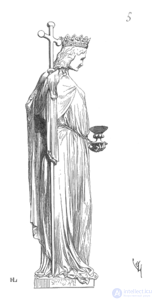
A statue at Strasbourg Cathedral — a personification of the Christian church. Illustration from E. Viollet-le-Duc's "Dictionnaire raisonné de l'architecture française du XIe au XVIe siècle".
Personification — a trope, the attribution of the properties and features of animate beings to inanimate objects.
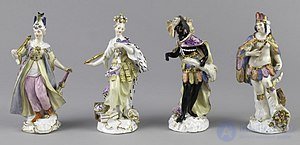
A set of porcelain figurines personifying the four continents, Germany, around 1775, left to right: Asia, Europe, Africa, and America. Of these, Africa has retained its classical attributes. Formerly the collection of James Hazen Hyde.
Personification is the representation of a thing or abstraction in the form of a human being. In other words, it is regarded as an embodiment or incarnation. In art, many things are commonly personified. These include numerous types of places, especially cities, countries, and continents; elements of the natural world, such as trees or the four seasons; the four elements; the four principal winds; the five senses; and abstractions such as the virtues, especially the four cardinal virtues and the seven deadly sins, the nine muses, or death.
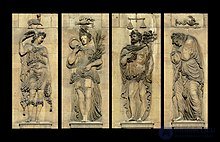
Jean Goujon, "The Seasons", reliefs on the Hôtel Carnavalet, Paris, around the 1550s.
In many early polytheistic religions, deities carried a strong element of personification, suggested by descriptions such as "the god of something." In ancient Greek religion and the related ancient Roman religion this was perhaps especially pronounced, particularly among minor deities. Many such deities, such as the tyches, or patron deities of major cities, survived the arrival of Christianity, now as symbolic personifications stripped of religious meaning. An exception was the winged goddess of victory, Victoria/Nike, who evolved into the visual form of the Christian angel.
On the whole, personifications lack narrative myths, although classical myth at least gave many of them parents among the major Olympian deities. The iconography of several personifications "retained a remarkable degree of continuity from late antiquity to the eighteenth century." Female personifications tend to outnumber male ones, at least up to the era of modern national personifications, many of which are male.
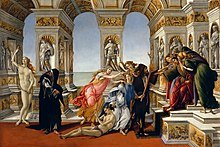
Sandro Botticelli, "The Calumny of Apelles" (c. 1494–1495), with 8 personified figures: (left to right) Hope, Remorse, Treachery, the innocent victim, Calumny, Fraud, Envy, Ignorance, the king, Suspicion.
Personifications are very common elements of allegory, and historians and theorists of personification complain that the two concepts are too often confused, or that discussion of them is overshadowed by allegory. Individual depictions of personifications tend to be called "allegory," which is perhaps incorrect. By the end of the 20th century, personification seemed to have largely gone out of fashion, but the semi-personified figures of superheroes in many comic book series came, in the 21st century, to dominate popular cinema in a number of superhero film franchises.
According to Ernst Gombrich, "we tend to take it for granted rather than ask questions about this extraordinary, predominantly female population that greets us from cathedral porches, crowds around our public monuments, marks our coins and banknotes, and appears in our cartoons and our posters; these women, dressed in various ways, of course, came to life on the medieval stage, they greeted the prince upon his entry into the city, they were mentioned in countless speeches, they quarreled or embraced in endless epics where they fought for the hero's soul or set the action in motion, and when a medieval poet went out one fine spring morning and lay down on a grassy bank, one of these ladies rarely failed to appear to him in a dream and explain her own nature to him in some number of lines."
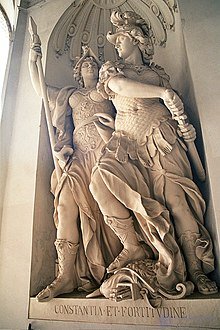
Constantia and Fortitude in Vienna. Early modern statues with classical iconography.
Personification as an artistic device is easier to discuss once belief in personification as an actual spiritual being fades; this appears to have happened in the ancient Greco-Roman world, probably even before Christianization. In other cultures, especially Hinduism and Buddhism, many personification figures still retain their religious significance, and so are not considered here. For example, Bharat Mata was conceived as a figure of a Hindu goddess to serve as a national personification by intellectuals in the Indian independence movement from the 1870s onward, but now has several genuine Hindu temples.
Personification occurs very widely in classical literature, art, and drama, along with the treatment of personifications as relatively minor deities or as a rather fluid category of demons. In classical Athens each geographical subdivision of the state, for purposes of local government, had a personified deity that received some cultic attention, as did Demos, the male personification of the governing assembly of free citizens, and Boule, the female personification of the ruling council. They appear in art, but are often hard to identify unless labeled.
Personification in the Bible is mostly confined to fleeting phrases that can probably be regarded as literary embellishments, with the important and widely discussed exception of Wisdom in the Book of Proverbs, 1–9, where a female personification is treated at some length and delivers speeches. The Four Horsemen of the Apocalypse from the Book of Revelation can be regarded as personification figures, though the text does not specify exactly what each one personifies.
According to James J. Paxson, in his book on the subject, "all personifications before the sixth century AD were... female"; but major rivers acquired male personifications much earlier, and are most often male, which often extends to "Water" among the Four Elements. The predominance of women is at least partly explained by the fact that Latin grammar assigns the feminine gender to nouns for abstractions.
Pairs of winged Victories decorated the vaults of Roman triumphal arches and similar spaces, and ancient Roman coinage was an especially rich source of such images, many of which bore their name, which was useful for medieval and Renaissance enthusiasts. Sets of tyches representing the empire's principal cities were used in the decorative arts. Most conceivable virtues, and practically every Roman province, were personified on coins at some point, with provinces often initially seated dejectedly as "CAPTA" ("captured") after their conquest, and later standing, producing images such as Britannia, which were often revived in the Renaissance or later.
Lucian (2nd century AD) gives a detailed description of a lost painting by Apelles (4th century BC) called "The Calumny of Apelles," which was followed by some Renaissance artists, most famously Botticelli. It included eight personifications of virtues and vices: Hope, Remorse, Treachery, Calumny, Fraud, Envy, Ignorance, Suspicion, along with two other figures.
Platonism, which in some of its forms proposed systems involving numerous spirits, was naturally favorable to personification and allegory and influenced its use from classical times through various revivals up to the Baroque period.
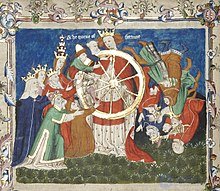
"The Queen of Fortune," aided by four other personifications, turns her wheel. English miniature for John Lydgate's "Troy Book," 15th century.
According to Andrew Escobedo, "literary personification orders inanimate things, such as passions, abstract ideas, and rivers, and makes them perform actions in the landscape of a narrative." He dates "the rise and fall of its [personification's] literary popularity" to "roughly between the fifth and seventeenth centuries." Late antique philosophical books that made active use of personification and were particularly influential in the Middle Ages include Prudentius's Psychomachia (early fifth century), with an elaborately worked-out plot centered on battles between the virtues and vices, and Boethius's Consolation of Philosophy (c. 524), which takes the form of a dialogue between the author and "Lady Philosophy." Fortune and the Wheel of Fortune were prominent and memorable in it, which helped make the latter a favorite medieval trope. Both authors were Christians, and the origins of the standard set of personifications in pagan classical religions had by then been left far behind.
A medieval creation was the Four Daughters of God, an abbreviated group of virtues consisting of Truth, Righteousness or Justice, Mercy, and Peace. There were also the seven virtues, made up of the four classical cardinal virtues of prudence, justice, temperance, and courage (or fortitude), which go back to Plato's Republic, together with the three theological virtues of faith, hope, and charity. The seven deadly sins were their counterparts.
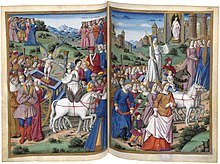
Two triumphal chariots, carrying Chastity and Love, from a lavishly illustrated manuscript (early 16th century) of Petrarch's "Triumphs."
Major works of Middle English literature had many personification characters, and often formed what are called "personification allegories," in which the whole work is an allegory largely driven by personifications. These include William Langland's "Piers Plowman" (c. 1370–1390), where most characters are explicit personifications named for their qualities, and several works of Geoffrey Chaucer, such as "The House of Fame" (1379–1380). However, Chaucer tends to steer his personifications toward more complex characters and gives them different names, as, for example, when he adapts part of the French "Roman de la Rose" (13th century). English mystery plays and later morality plays feature many personifications as characters alongside their biblical figures. Frau Minne, the spirit of courtly love in German medieval literature, had equivalents in other languages.
In Italian literature, Petrarch's "Triumphs," completed in 1374, is based on a procession of personifications carried on "chariots," a device that was becoming fashionable at court festivities; it was illustrated by many different artists. Dante has a few personification characters, but prefers to use real people to represent most sins and virtues.
In Elizabethan literature, many characters of Edmund Spenser's vast epic "The Faerie Queene," though given different names, are in fact personifications, especially of virtues. John Bunyan's "The Pilgrim's Progress" (1678) was the last great personification allegory in English literature, written from a pronounced Protestant standpoint (though see Thomson's "Liberty" below). A work such as Shelley's "The Triumph of Life," unfinished at his death in 1822, which many earlier writers would have felt required the inclusion of personifications, avoids them, as does most Romantic literature, with the exception of William Blake. Leading critics began to complain about personification in the 18th century, and such "complaints only grow louder in the nineteenth century." According to Andrew Escobedo, there is now an "unspoken scholarly consensus" that "personification is a kind of frozen or empty version of literal characters" that "drains fiction."
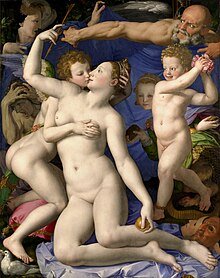
Venus, Cupid, Folly, and Time, c. 1544–45, Agnolo Bronzino.
Personifications, often in sets, appear frequently in medieval art, often illustrating or following literary works. Virtues and vices were probably the most common, and virtues appear in many major sculptural programs, for example on the façades of Chartres Cathedral and Amiens Cathedral. In painting, both virtues and vices are personified along the lowest zone of the walls of Giotto's Scrovegni Chapel (c. 1305), and are the principal figures in Ambrogio Lorenzetti's Allegory of Good and Bad Government (1338–39) in the Palazzo Pubblico in Siena. In the Allegory of Bad Government, Tyranny sits enthroned, with Avarice, Pride, and Vainglory above her. Beside her on the magistrate's bench sit Cruelty, Deceit, Fraud, Fury, Division, and War, while Justice lies bound tightly below. The so-called "Tarocchi of Mantegna" (c. 1465–1475) are sets of fifty educational cards depicting personifications of social classes, the planets and celestial bodies, and social classes.
A new pair, once widespread on the portals of large churches, is Ecclesia and Synagoga. Death, represented as a skeleton, often with a scythe and hourglass, is a late medieval innovation that became very common after the Black Death. It is, however, rarely seen in funerary art "before the Counter-Reformation."
Unless they illustrate literary texts or follow a classical model, as Botticelli does, personifications in art tend to be relatively static and to appear together in sets, whether as statues decorating buildings, or as paintings, prints, or media such as porcelain figurines. Sometimes one or several virtues triumph over vices and invariably defeat them. Other paintings by Botticelli are exceptions to such simple compositions, in particular his "Primavera" and "The Birth of Venus," in both of which several figures form complex allegories. An unusually powerful single personification figure is shown in "Melencolia I" (1514), an engraving by Albrecht Dürer. Agnolo Bronzino's "Venus, Cupid, Folly, and Time" (c. 1545) has five personifications besides Venus and Cupid. In all these cases the meaning of the work remains uncertain despite intense scholarly discussion, and even the identity of the figures continues to be disputed.
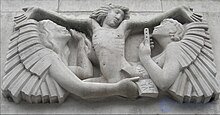
Ariel between Wisdom and Gaiety, with the Latin inscription obsculta, a word that means not only "to listen" but also "to obey," Eric Gill, Broadcasting House, 1932.
Around 300 BC, Demetrius of Phalerum became the first writer on rhetoric to describe prosopopoeia, which was already an established device in rhetoric and literature going back to Homer. Quintilian's extensive "Institutio Oratoria" gives a comprehensive description and taxonomy of common personifications; a more comprehensive description was not written until after the Renaissance. The leading Renaissance humanists to study the subject in detail were Erasmus, in his "De copia," and Petrus Mosellanus, in "Tabulae de schematibus et tropis," whose works were copied by other authors throughout the 16th century.
From the late 16th century, theoretical writers such as Karel van Mander, in his book Schilder-boeck (1604), began to treat personification from the point of view of the visual arts. At the same time, the emblem book, describing and illustrating emblematic images that were largely personifications, became extremely popular both among intellectuals and among artists and craftsmen in search of motifs. The most famous of these was Cesare Ripa's Iconologia, first published without illustrations in 1593, but from 1603 issued in many different illustrated editions involving different artists. This established, at least, the identifying attributes that many personifications retained up to the 19th century.
From the twentieth century into the twenty-first, past uses of personification have received significantly increased critical attention, just as the artistic practice of it has significantly declined. Among a number of key works, The Allegory of Love: A Study in Medieval Tradition (1936), written by C. S. Lewis, was a study of courtly love in medieval and Renaissance literature.
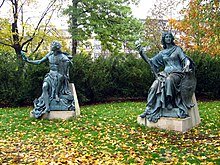
The sculptures Trade (male) and Tolerance (female) in Brno
The classical repertoire of virtues, seasons, cities, and so on supplied most of the subjects up until the 19th century, but some new personifications were needed. The 16th century saw a new personification of America, and the four continents became an attractive new set, since four figures suited many contexts better than three. The discovery of Australia in the 18th century was not followed as quickly by an addition to the set, if only for reasons of geometry; Australia is not included among the continents at the corners of the Albert Memorial (1860s). It has a set of three-figure groups representing agriculture, commerce, engineering, and manufacturing, typical of the requirements of major public schemes of the period. A rather late example is Alexander Hamilton's U.S. Custom House in New York (1901–07), which has large groups for the four continents at the entrance, as well as 12 figures personifying seafaring nations from history, high up on the facade.
The invention of movable-type printing led to Dame Imprimerie («Lady Printing Press») being featured in the pageants of Lyon, a major center of printing, alongside «Typosine,» a new muse of printing. A large gilded bronze statue by Evelyn Beatrice Longman, something of a specialist in «allegorical» statues, was commissioned by AT&T for the roof of their New York headquarters. From 1916 it was called at various times the Genius of Telegraphy, the Genius of Electricity, and, from the 1930s, the Spirit of Communication. Shakespeare's spirit Ariel was adopted by the sculptor Eric Gill as a personification of broadcasting and featured in his sculptures at Broadcasting House in London (opened in 1932).

A cartoon of the Entente from Punch by John Bernard Partridge, 1904; John Bull walks off with a defiant Marianne, turning his back on the Kaiser, who pretends not to care.
A number of national personifications adhere to old formulas, depicting a woman in classical dress bearing attributes suggestive of power, wealth, or other virtues.
Libertas, the Roman goddess of liberty, played an important role during the era of the Roman Republic and was somewhat awkwardly appropriated by the Empire; it was not regarded as an innate right, but as something granted to some under Roman law. She appeared on coins struck by the assassins of Julius Caesar, defenders of the Roman Republic. Medieval republics, mainly in Italy, valued their liberty highly and often used the word, but produced very few direct personifications. With the rise of nationalism and new states, many nationalist personifications incorporated a strong element of liberty, perhaps reaching a culmination in the Statue of Liberty. The long poem Liberty by the Scot James Thomson (1734) is a long monologue delivered by the «Goddess of Liberty,» describing her travels through the ancient world and then through English and British history up to the resolution of the Glorious Revolution of 1688, which confirmed her place there. Thomson also wrote the lyrics for Rule Britannia, and the two images were often merged into a single personified «British Liberty,» to which a large monument was erected in the 1750s at his estate at Gibside by a Whig magnate.
But sometimes, alongside these formal figures, a new type of national personification emerged, typified by John Bull (1712) and Uncle Sam (c. 1812). Both began as characters in more or less satirical literature but achieved fame when they were taken up in political cartoons and other visual media. Post-revolutionary Marianne in France, official since 1792, represents something of a mixture of styles, sometimes formal and classical, at other times personifying a woman of the streets of Paris. The Dutch Maiden is one of the earliest of these figures and was, from the outset, primarily visual, her efforts to resist unwelcome Spanish advances depicted in popular 16th-century engravings.

Comments