
Lecture
Law — a concept of jurisprudence, one of the types of regulators of social relations; a system of generally binding, formally defined rules of conduct, adopted in an established procedure and guaranteed by the state, which regulate social relations.
The specific definition of law depends on the type of legal understanding (pravoponimanie) held by a given scholar (that is, their conception of law). At the same time, the definitions offered by various schools together provide the fullest possible picture of law. That is why pluralism is especially important for the development of legal science, though it is not always achieved because of this field's traditional proximity to state power.
In some definitions or contexts, law may merge with the system of law (objective law, or simply legislation), or with the legal system . Here, law as a system of law finds expression in the sources of law, and its legal content is determined by legal norms. When law is discussed as a legal system, other legal phenomena besides the system of law are usually also implied: legal culture, legal consciousness, and the realization of law.

Various scholars identify the following as the most common characteristics of law :
Throughout the many-thousand-year history of jurisprudence, it has repeatedly been pointed out that universal definitions should be avoided in questions of law; there is no unified opinion on a generally recognized definition of law even in modern scholarship .
The Brockhaus and Efron Encyclopedic Dictionary states:
Law is the totality of rules (norms) determining the obligatory mutual relations of people in society; this definition of law indicates only the general outline of its content, while the question of the essence of law, its origin, and its foundations remains to this day one of the unresolved problems of scholarship.
The Great Soviet Encyclopedia presented the definition classic for Marxist-Leninist legal theory (the normative-positivist position):
Law is the totality of generally binding rules of conduct (norms) established or sanctioned by the state, compliance with which is ensured by measures of state influence.
The libertarian-legal conception:
Law is the unity of a norm and measure of freedom and justice that is equal for all.
At the same time, a definition of law can be given by means of the formal-legal method, through an enumeration, taken together, of all its principal characteristics.
The specific definition of law depends on the type of legal understanding held by a given scholar representing a particular legal school; their conceptions together allow the fullest disclosure of the essence of law.
In order to systematize the views of various scholars on the essence of law (the legal understanding of different scholars), classifications of conceptions of legal understanding and notions of law are constructed, with the latter created within the framework of these conceptions of legal understanding.
Most of these classifications consist in dividing legal understanding into the positivist and the philosophical-legal. V. A. Chetvernin calls them the potestary and the non-potestary; O. E. Leist calls them the legal understanding of the normativist school and of the moral school of law; V. S. Nersesyants calls them legist and juridical legal understanding.
For positivists, law consists of coercive norms established by an authority capable of ensuring their enforcement. It is precisely the coercive nature of these norms, rather than their particular content, that positivists consider the essential characteristic of law .
From the positivist standpoint, law is a system of formally defined, generally binding rules of conduct (legal norms) established or sanctioned by the state, regulating social relations and backed by the possibility of state coercion.
Thus, for example, the Marxist school speaks of the will of the ruling class raised to the status of law, and at the same time of a body of legal norms. According to this approach, law is a product of state activity, established by state power and protected by the force of state coercion; for positivists, law and statute (or, more precisely, law and its source, its form) are essentially the same thing.

From the positivist point of view, state coercive power is the sole distinguishing feature of law. Thomas Hobbes's statement is telling here: «The legal force of a law consists only in the fact that it is a command of the sovereign» . Similar conceptions were developed in the 19th century by J. Austin , S. Amos, and G. F. Shershenevich.
For the philosophical-legal schools, law possesses an independent essence.
Accordingly, a social norm (for example, one contained in a statute) can be said to be legal or non-legal depending on its conformity to the principles of law.

In natural-law doctrines, norms that contradict supra-positive, natural human rights are considered non-legal. In the Russian libertarian-legal school (V. S. Nersesyants, V. A. Chetvernin), norms that violate the principle of formal equality — the equality of all people in legal personhood — are considered non-legal.
Schools following the philosophical-legal conception of legal understanding regard law as a form of social consciousness.
Such legal schools are characterized by some version of a distinction between law and statute (between law and its form, its source). Here, law is understood as something objective, not dependent on the will, discretion, or arbitrariness of authority.
Given that human rights are recognized by most modern legal systems, one can speak of a predominance of the philosophical-legal approach in official conceptions of the nature of law.
In light of the doctrine of naturalistic jurisprudence proposed by the Ukrainian legal scholar A. N. Kostenko, law is the natural laws of the social life of people, embodied in legislation and in people's legal culture. The more fully these laws are embodied in the legislation and legal culture of the people of a given society, the more perfect the law of that society is. Building on the idea of social naturalism, the scholar develops a socio-naturalistic doctrine of legal understanding. According to this doctrine, if the legislation and legal culture of a people do not properly reflect the natural laws of social life, pseudo-law arises. One form of pseudo-law is so-called legal voluntarism. As historical experience shows, the means of counteracting legal voluntarism is naturalistic jurisprudence, in particular the ideology of natural law. Law determines the legal order in society: where pseudo-law, that is, legal voluntarism, prevails, a pseudo-legal order will correspondingly prevail in society as well (for example, under totalitarianism).
Within the philosophical-legal conceptions of legal understanding, among others, are the natural-law and libertarian-legal approaches.
From the standpoint of the natural-law approach, in addition to the law created by the state, there exists a certain «natural law» possessing greater force than positive law]. By this is meant conceptions of justice and the common good, in particular — the right to life, to liberty, to property, to equality, and so on.
The developer of the libertarian-legal approach is Academician of the Russian Academy of Sciences V. S. Nersesyants . According to this approach, law is understood as the normative expression of the principle of formal equality, which in turn includes the unity of three components: a norm and measure equal for all, freedom, and justice. The leading contemporary developer of libertarian-legal theory is Professor V. A. Chetvernin of the Higher School of Economics.
The attitude of Far Eastern countries toward the system of law is embodied in the statement «law is good for barbarians». In China, for example, there is a conception of law as an instrument of arbitrariness that disrupts the natural order of things. A respectable Chinese person may not regard law as anything significant and may not think about it at all, since a virtuous way of life should not lead to involvement with the justice system. In various situations a person should strive to achieve harmony with others informally, including through mediation, rather than relying on legal procedures. Laws may serve as a deterrent or other method for hardened criminals, people of immoral conduct, and foreigners who do not understand Chinese culture, but in any case they are regarded as documents that should not be applied. Toward those people who rely on laws and disregard the rules of good conduct and propriety, the Chinese «feel nothing but contempt». As the candidate of legal sciences S. V. Shankhaev notes, «the Chinese people get along perfectly well without law», are not interested in the legal system, and try to avoid participating in litigation.
Japan adopted the European model of law, but the Japanese themselves participate in litigation just as rarely as before. At the same time, Japanese courts strive to bring the parties to an amicable settlement and use a distinctive method of law enforcement consisting in avoidance of formal application of the law.
The first forms of institutions of power and the first generally binding norms of conduct took shape already at the primitive stage of society's development. This period is characterized by the absence of political power and state institutions. Social norms of this period take the form of customs, traditions, rites, and taboos. Whether these social norms can be considered law or proto-law is a matter of scholarly debate .

A legal norm regulates a specific type of social relation, contains rules of conduct established or sanctioned by the state, generally binding within the sphere of its application, backed by the coercive force of the state, and reflected in a source of law .
Characteristics of a legal norm :
Structure of a legal norm
All legal norms taken together make up the system of law, and those regulating a particular circle of social relations make up a branch of law. Within branches, norms are further grouped into legal institutions.

As a rule, the term «source of law» is understood to mean the external form in which objective law (the totality of all legal norms, the system of law) is expressed. In this sense, the sources of law are: normative agreements, legal custom, judicial precedent, normative legal acts, and legal doctrine.
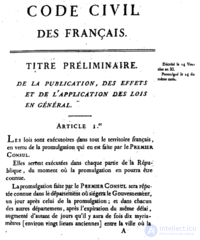
Systematization of normative acts — activity aimed at the internal and external ordering of normative acts. Its forms are:
Codes are widespread in countries of the Romano-Germanic legal family.
A legal system is the totality of the system of law, legal consciousness, and legal practice (the implementation of law). The concept of a legal system is often used to denote everything connected with law in a given country, to characterize the historical, legal, and cultural differences in the law of different states and peoples.
The legal system should not be confused with the system of law, which is only a part of the legal system.
System of law — the totality of norms, institutions, and branches of law in their interrelation.
The system of law comprises four components:
The division into private and public law is made according to the criterion of whose interests the relations regulated by the norm affect — individual or public. This division in law is characteristic only of the Romano-Germanic system and traces its origins back to Roman law.
Private law — regulates relations arising on the basis of autonomy and equality of the parties between private subjects (individuals, collectives, organizations, etc.).
Public law — regulates relations of power based on subordination, which affect the interests of society as a whole. As a rule, one of the parties to such relations is the state, so the parties here are not initially in an equal position.
Within the system of law, a distinction is made between substantive and procedural branches of law.
Substantive law — the totality of norms in the system of law that directly regulate social relations, and the set of branches of law in which the main emphasis is placed on establishing the rights and duties of subjects.
Procedural law — the totality of norms of the legal system regulating the procedure for implementing the norms of substantive law. In particular, they regulate social relations arising during the investigation of crimes and the consideration and resolution of cases in criminal, civil, administrative, and constitutional proceedings.
National law forms the aggregate body of branches of law regulating relations within a single state and distinguished by the distinctive national, historical, and cultural features of a particular people.
International law concentrates the aggregate experience of human civilization and is the result of the reconciliation of the wills of subjects of international relations, chiefly states.
Legal culture — a system of values, legal ideas, beliefs, skills, and behavioral stereotypes, and legal traditions accepted by members of a particular community (state, religious, ethnic) and used to regulate their activity.
Multinational and multireligious societies are characterized by the simultaneous existence of several legal cultures within a single state. For example, Russia is a multinational state, so it simultaneously contains elements of Russian, Muslim, Roma, and other ethnic legal cultures. A distinction is also made between the legal culture of society as a whole and that of an individual person. Different types of legal cultures are not comparable with one another, each having its own inherent worth.
The legal culture of a society depends on the level of development of the population's legal consciousness, the level of development of legal activity (law-making and law-applying), and the level of development of the entire system of legislation .
An individual's legal culture is expressed in the ability to exercise one's rights, to act within the bounds of law, and also in possessing legal literacy .
Legal consciousness — a form of the subjective perception of legal phenomena by people.
A distinction is made between individual, group, and social legal consciousness. It is also divided into law-approving, law-abiding, and law-violating.
Legal practice — the process of carrying out legal prescriptions, translating these prescriptions into life, into people's behavior, and the final result of this process.
The forms of implementing law are:

Each legal system is unique; however, comparative law allows, by ascertaining their similarities and differences, a typology of legal systems to be constructed. In this way, types of legal systems known as legal families are formed.
The best-known classification of legal systems is that of the French scholar René David, according to which the following are distinguished: the Romano-Germanic legal family, the Anglo-Saxon legal family, the religious legal family, the socialist legal family, and some other legal families .
The Romano-Germanic legal family unites the legal systems of all the countries of continental Europe. This legal family arose on the basis of the reception of Roman law. The principal source of law in the legal systems of this family is the normative act.
The Anglo-Saxon legal family includes, among others, the legal systems of the United Kingdom (except Scotland), Canada, the USA, Jamaica, and Australia. England was the progenitor of this legal family.
At the foundation of this legal system is the principle of stare decisis (Latin — "to stand by things decided"), meaning that in reaching a decision, the court is governed chiefly by precedent.
A religious legal system is a legal system in which the principal source of law is a sacred text. The best-known examples are Islamic law (Sharia) and Jewish law (Halakha).
The traditional legal family is characterized by the fact that legal custom occupies the dominant place among the other sources of law here. Numerous customs and traditions, formed over centuries, have become habitual for people through repeated application and are unwritten rules of conduct.

Roman law — a legal system that arose in ancient Rome and developed up to the fall of the Byzantine Empire. Roman law served as a model or prototype for the legal systems of many other states and is the historical foundation of both the Romano-Germanic and Anglo-Saxon legal families.
Roman legal consciousness sees justice, derived from equality of rights, as the fundamental principle of the implementation of law. Latin: "Ius est ars boni et aequi" — states the maxim of Domitius Ulpianus, translated as "Law is the art (science) of the good and the just." The casuistic character of Roman law rests on an awareness of the high role of judicial power; "I have a claim — therefore I have a right" describes this attitude in a Roman saying. Utilitarianism is the term given to the treatment of benefit (utilitas) as the meaning of law, characteristic of the Roman attitude toward law: "Benefit is the mother of the good and the just."
During the reign of Justinian I, Roman law underwent reform; the intention was for it to become just as unsurpassed in formal legal terms as it had been three centuries earlier. The three principal components of the renewed Roman law — the Digest, the Code of Justinian, and the Institutes — were completed in 534.
Inca law, or the Laws of the Incas, — a legal system that arose on the basis of Andean cultures and developed up to the fall of the Inca Empire, continuing to exist for several decades (and in some cases several centuries) after the Spanish conquest.
The laws of the Incas survive only in fragments, but their content is known from numerous Spanish colonial sources compiled from oral tradition. Laws were registered and "recorded" by dedicated officials on quipu, and proclaimed by other officials — heralds — in one of the squares of the empire's capital, Cusco — Rimac. Inca law is characterized by a high degree of severity in the application of punishment — in most cases the death penalty — resulting in the near-total absence of certain kinds of crime among the indigenous population (petty theft, robbery, corruption, murder), which was admired by Spanish officials, missionaries, and soldiers. This, however, may indirectly indicate the totalitarian and command-administrative character of the Inca state's governance.
In the second half of the 1980s and the first half of the 1990s, the construction of a new legal system began in Russia. During perestroika, through numerous amendments to the 1978 Constitution, political pluralism, the principle of separation of powers, private property, and freedom of enterprise were recognized. On November 22, 1991, the RSFSR ratified the Declaration of the Rights and Freedoms of Man and Citizen. With the dissolution of the USSR in 1991, the Russian Federation was formed as a sovereign state.
On December 12, 1993, a new Constitution of the Russian Federation was adopted by nationwide vote.
The sources of law in Russia are laws and subordinate acts, international treaties and agreements of the Russian Federation, domestic normative treaties, acts of the bodies of constitutional review, and customs recognized by Russian law.
In the system of federal normative acts of Russia, the Constitution of the Russian Federation has supreme force; next in legal force come federal constitutional laws and federal laws, and laws also include laws on amendments to the Constitution of the Russian Federation (which were adopted in 2008).
Ratified international treaties of the Russian Federation have greater legal force than federal laws, but lesser force than the Constitution (Art. 15, para. 4 of the Constitution of the Russian Federation).
Russia's legal system is based on the traditions of Roman law, refracted through the development of French law since the time of the Republic. For example, French codifiers served as the basis for criminal legislation. At the same time, the Russian legal system has also adopted certain elements of case law, which apply, for example, to non-codified areas of relations in civil law or to the judicial and legal activity of the Constitutional Court.

The legislation of the United States is multilevel (state and federal) and consists of codified and non-codified legal acts, among which the Constitution of the United States occupies the most important place. It is precisely its existence, along with the codification of common law, that distinguishes the American legal system from the English one. The Constitution establishes the boundaries of federal legislation, which consists of legislative acts of Congress, international treaties ratified by Congress, constitutional provisions and acts adopted by the executive branch, as well as case law formed by the federal judicial system.
The basis for the construction of the state system in the USA lies in the fact that it is built from the states toward the federation, and not the other way around, and each state possesses full sovereignty on its own territory, except for what has been delegated to the federal government. Therefore, states adopt their own laws, may grant their citizens broader rights than are established by federal legislation, and the constitutions of many states are far longer and more detailed than the Constitution of the USA. However, the constitutions and laws of the states must not contradict the Constitution of the USA.
One of the central places in the US legal system belongs to common law, which is formed both at the federal level as a whole and at the level of each state. Louisiana is the only state where, broadly speaking, a civil-law (Romano-Germanic) system operates, while Anglo-Saxon common law, based on precedent, has penetrated here only to a very weak degree.
The United Kingdom does not have a single legal system. It consists of three relatively independent parts: in England and Wales, English law applies; in Northern Ireland — English law together with acts of the Irish Parliament adopted before 1921 and acts of its own parliament; in Scotland its own legal system applies, which is mixed and represents a dualism of Romano-Germanic and common law.

The United Kingdom does not have a single written constitution; it is replaced by a body of acts of various kinds, as well as norms of common law and certain constitutional conventions. The most important acts forming the British constitution are the Magna Carta (1215), the Habeas Corpus Act, the Bill of Rights (1689), and the Act of Settlement (1701).
In English law, the main sources are judicial precedents, statutes issued by Parliament, and acts adopted by the government under delegated lawmaking. Judicial precedents form the norms of common law and the norms of equity, the latter having developed from the decisions of the Court of Chancery up to 1875 and subsequently merged with common law. Scots law recognizes as its sources legislation adopted by its own parliament and government, judicial precedents, legal doctrine (the scholarly works of Scottish jurists), and custom. Scottish common law differs from English law in the principles of its application by the courts, and there are also differences in content and terminology, since certain institutions of Roman law were used in it. Certain English laws apply in Scotland, extending either to the territory of the whole country or having been specially adopted for Scotland .
The Supreme Court of the United Kingdom is the highest judicial authority in the country for all criminal and civil cases in England, Wales, and Northern Ireland; in Scotland — only for civil cases, while for criminal cases an independent High Court of Justiciary operates. The Supreme Court was established in 2009 and replaced the Appellate Committee of the House of Lords, which had served as the court of last resort since 1876
The main features of the current German legal system arose immediately after the unification of a number of German states into the North German Confederation in 1867 (the German Empire from 1871). It was from this moment that the process of issuing all-German laws, which influenced its formation, began.
German law, like Romance law, is based on the reception of Roman law and is one of the main components of the Romano-Germanic legal family. It had a great influence on the formation of the national legal systems of Central European and Baltic countries, Greece, Turkey, Japan, and others.
In the modern legal system of the FRG, the Constitution (Basic Law), adopted in 1949, has decisive significance. It mainly establishes the order of relations between the federation and the states, where the decisive role in the sphere of legislation belongs to the federation, while the states regulate only a certain range of issues. All branches of law are classically divided into public (German Öffentliches Recht) and private (German Privatrecht). Judicial decisions are not sources of law here, but decisions of the Federal Constitutional Court of Germany are given special significance.
The legal system of France was formed after the Great French Revolution, mainly during the reign of Napoleon (1799—1814). The most important legal acts that influenced its formation and development are the Declaration of the Rights of Man and of the Citizen of 1789, the Civil Code of 1804, the Code of Civil Procedure of 1806, the Commercial Code of 1807, the Code of Criminal Procedure of 1808, and the Criminal Code of 1810.
The French Civil Code had an enormous influence on the development and codification of civil law throughout continental Europe, in North America (in Louisiana and Quebec), Latin America, and all countries that were French colonies.
In France, sources of law are conventionally divided into primary and secondary . The primary sources include normative acts, among which the main place is occupied by laws adopted by parliament. There are organic laws, which supplement important constitutional provisions, and ordinary laws, which regulate other legal relations. A special place is given to ordinances — acts whose adoption has been delegated by parliament to the government. Secondary sources include judicial decisions, which interpret the norms of the primary sources.

International law is a special legal system that regulates interstate relations for the purpose of ensuring peace and cooperation . It serves as a necessary foundation for organizing stable international relations. International law differs from national legal systems in that it primarily regulates relations between states, not between private individuals. Norms of international law are created through agreement among interstate subjects, such as sovereign states, international organizations, and state-like entities (a nation fighting for self-determination, insurgent movements, a belligerent party).
International law is not a supranational law — this means that member states of the international community are not obliged to comply with certain norms of international law if they clearly violate their state sovereignty . At the same time, compliance with norms such as Jus cogens and Erga omnes is an inalienable obligation of all states without exception. In addition, in accordance with the principle of sovereign equality, if a state assumes certain international obligations, it is obliged to fulfill them fully and in good faith
International organizations play a significant role in international legal relations. For example, such a universal organization as the UN, created in 1945 immediately after the Second World War, is responsible for the development of modern international law.
Three main directions are distinguished within international law: public international law, private international law, and supranational law (a vivid example of which is European Union law).
Legal (juridical) sciences — a group of social sciences that study law and all legal phenomena.
The theory of law and the state is a legal science that studies the most general laws governing the emergence, development, and functioning of law and the state. Within the theory of law and the state, general legal terminology is developed, the essence of law is studied, its concepts and doctrinal understandings are worked out, and the problems of the subject and method of jurisprudence are developed.
Sometimes the philosophy of law is distinguished from the theory of law — a branch of philosophy and jurisprudence concerned with investigating the meaning of law, its essence and concept, its foundations and place in the world, its value and significance, its role in the life of the individual, society, and the state, and in the fates of peoples and humanity.
In pre-revolutionary Russia there was a fairly clear division into the philosophy of law, the theory of law, and the encyclopedia of law, whereby the theory of law (legal dogmatics) studied positive (objective) law, the philosophy of law studied supra-positive (natural) law, and the encyclopedia of law studied the conceptual apparatus of jurisprudence.
The name «theory of state and law» became widespread in the Soviet period, when the primacy of the state in relation to law was emphasized. Today there is a tendency to use the term «theory of law and state», placing law first, a tendency especially consistently followed by adherents of the libertarian-legal school of law.
In Russian universities, law students usually study the course «theory of state and law» in their first year and a more in-depth course, «problems of the theory of state and law», in their fifth year.
In American law schools there is an academic discipline called Legal Theory or Legal Theory and Philosophy of Law. Many of its elements are studied by students at Russian universities within a separate course — «history of political and legal doctrines».
The branch legal sciences make up the largest group and are the most dynamic. Among the branches of law, the most important and traditional for practically all legal systems of the world are constitutional (state) law, civil law, administrative law, and criminal law.

Constitutional law is a branch of law that establishes the foundations of the relationship between the individual and the state, the constitutional characteristics of the state, and regulates the organization of state power in the country and other relations of a constitutional-legal nature.
The core of constitutional law is the constitution — a legal act or set of legal acts possessing the highest legal force and regulating the foundations of the organization of the state and the relationship between the state and the citizen.
Constitutional law regulates the most important social relations (for example, the foundations of the state system and the judicial system, the electoral system) and establishes fundamental (constitutional) rights (such as the right to work, etc.). Constitutional law also determines the basic rights and duties of the state and the citizen, which are specified in laws and other legal acts belonging to other branches of law.
Administrative law is a branch of law that regulates social relations in the sphere of the managerial activity of bodies and officials in the performance of the public functions of the state and municipal entities.
In many countries it is called administrative (managerial) law. In pre-revolutionary Russia this branch of law was also called police law.
Civil law is a term whose usage has varied greatly and continues to vary across different legal systems.
The concept came from Roman law, where «civil law» (Latin Ius civile) was understood as the law valid for citizens of Rome and used by praetors to resolve disputes between Romans, as opposed to the «law of nations» (Latin Ius gentium), used to resolve disputes between inhabitants of dependent lands and foreigners located in territory controlled by Rome.
In America, «civil law» (English Civil law) is generally used to refer to the legal systems of the continental (Romano-Germanic) legal family.
In Europe, the category «civil law» either merges with private law or denotes its central branch, the one least subject to connection with public law. For a long time, European private law was characterized by a division into civil law and commercial law, regulating entrepreneurial activity; however, over the course of the 20th century this division fell away for most European countries, and unified civil codes were adopted.
For Russia, the relevant meaning of «civil law» is as a branch of law that regulates property relations and the related non-property relations connected with them. At the same time, other private-law branches, such as labor law and family law (primarily those that have their own codifications, separate from the Civil Code of the Russian Federation), are generally not considered part of civil law; however, this terminology has not yet become firmly established, since for a long time the term «private law» was not used at all in Russia. The use of the term «civil law» in Soviet scholarship instead of «private law» was primarily due to the position of Marxist-Leninist science, which rejected everything «private» in the economic sphere.
Criminal law is a branch of law that regulates social relations connected with the commission of criminal acts, the imposition of punishment, and the application of other measures of a criminal-legal nature, and that establishes the grounds for criminal liability or for release from criminal liability and punishment.
In countries of the Romano-Germanic legal family, only offenses of the greatest social danger are recognized as crimes.
Applied legal sciences do not study law itself; they study phenomena closely connected with law. Therefore, classifying them as legal sciences is quite conditional. Applied legal sciences draw on the achievements of the natural, technical, and other sciences necessary for specific legal activity. These include, for example, criminalistics, criminology, forensic medicine, forensic psychiatry, forensic accounting, forensic expertology, legal psychology, and others.
An extremely important role in liberal democratic states is played by the institutions of human rights, separation of powers, justice and the independence of the courts, the institution of a representative legislative body, and civil society.

Human rights — rights that form the basis of an individual's status in a rule-of-law state, considered innate and inalienable for every person regardless of citizenship, sex, age, race, ethnic, or religious affiliation. All of them, or part of them, are regarded as the natural rights of man. In international law, human rights were first enshrined in the UN Universal Declaration of Human Rights. They also form the basis of the constitutional law of rule-of-law states. The concrete expression and scope of these rights in the positive law of various states, as well as in various international legal treaties, differ.
The Universal Declaration of Human Rights establishes:
The separation of legislative, executive, and judicial powers is one of the most important principles of the organization of state power and the functioning of a rule-of-law state.
The idea of the principle of the separation of powers was already voiced by Aristotle. The further development of the theory of the separation of powers is associated with the names of John Locke and Charles-Louis de Montesquieu, who synthesized all these ideas and worked out this principle most thoroughly. The Founding Fathers of the USA (A. Hamilton, T. Jefferson, J. Madison, J. Jay), in the Constitution of 1787, developed the classical model of the separation of powers, supplementing it with a system of "checks and balances," that is, a system in which each branch of power keeps watch over the others.

Justice — a type of law-enforcement activity concerned with the examination and resolution of various categories of cases. It ensures the rule of law, the sovereignty of the individual, and protects the rights and freedoms of citizens. Through justice, the state bears responsibility before the individual.
In liberal democratic states, justice is administered only by the courts, on the principles of legality, the inviolability of the person, adversarial proceedings, and equality of the parties in the process. The creation of extraordinary courts is not permitted.
In common law countries, court decisions acquire a force equal to that of the applicable legal norm (judicial precedent).
Civil society — the most important institution of modern society, representing the totality of non-political relations and social groups and collectives, which are united by specific interests (economic, ethnic, cultural, and others), realized outside the sphere of activity of state-power structures and allowing the actions of the state to be monitored.
A developed civil society is the most important precondition for building a state governed by the rule of law and is its equal partner.
The classical understanding of civil society traces back to the teachings of T. Hobbes and J. Locke . They believed that the idea of the peaceful coexistence of people in society could be secured only through social contracts and agreements based on natural-law principles. Therefore, the possession of absolute power by the state is fundamentally incompatible with civil society and contradicts it. Nevertheless, they did not believe that civil society should be separated from the state. Later, Hegel completely transformed the understanding of civil society, pointing to its opposition to the state and defining it as the sphere of purely private interest.
Freedom of speech, freedom of association, and many other individual rights allow people to gather, discuss, criticize, and hold their governments accountable. The best-known institutions of civil society are the family, trade unions, business associations, charitable organizations, non-governmental organizations, the church, and religious associations.

Comments