
Lecture
The social sphere of society is a system of interconnected people and groups who satisfy various human needs, such as housing, clothing, food, education, health, and protection from natural hazards. It includes various aspects of social activity, such as everyday life, services, education, health care, social security, and leisure, which are aimed at satisfying the vital needs of people.
The social life of society is the activity of people and social groups, as a result of which human qualities are formed. These qualities develop both naturally, in all aspects of social life, and through the specialized activity of professionals, such as doctors, teachers, and ideologists, who are engaged in the "production of the human being" and are specifically directed toward creating the conditions for human life.
The social life of society encompasses various aspects of human interaction in society, including social relations, norms, values, institutions, and culture. It is determined by the interaction of people and their social roles within groups, communities, organizations, and society as a whole.
The social life of society can manifest itself in various forms. Within the family, people exchange emotional support and care, and raise children. Within friendships, people find like-minded people, have fun, share interests, and help one another. The work environment offers opportunities for cooperation, professional growth, and interaction with colleagues. Public organizations and communities allow people to unite around common goals and participate in public life.
The social life of society also includes various institutions, such as the government, the judicial system, education, and health care. These institutions establish rules, norms, and procedures that regulate people's behavior in society.
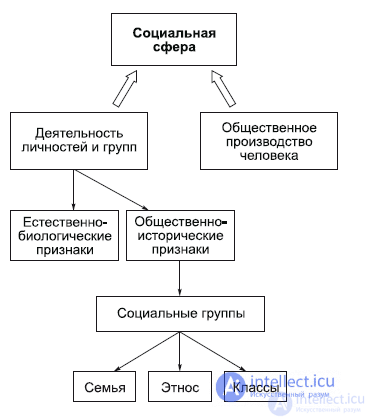
Society contains various groups of people. The features that define the specifics and differences among groups of people are divided into natural-biological and social-historical. The former include sex, age, and race. Groups of people differ by sex, by age, and by racial affiliation. Races – groups of people characterized by common external morphological features – skin color, head shape, eye shape, and so on. These features are the result of the influence of natural and geographic conditions. Three main races are distinguished: Europeoids – people with white skin, Negroids – with black skin, Mongoloids – with yellow skin and slanted eyes.
As for social-historical communities, among them one distinguishes mass and group communities. A mass community is an unstable, internally unordered aggregate of people, linked by participation in some episodic activity (for example, participants in a rally, fans at a stadium, admirers of a pop star, and so on). A group community (social group) is a stable aggregate of people who share common interests, values, norms of behavior, and so on. These groups are organized and internally structured.
The most important social groups are the family, the ethnos, and classes.
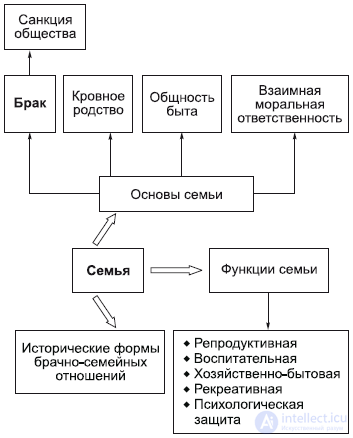
Marriage is understood as a form of relations between a man and a woman that is sanctioned and regulated by society, establishing their rights and obligations toward each other and their children. A family is a small group based on marriage or blood kinship, whose members are linked by shared everyday life, mutual moral responsibility, and mutual assistance. The legal basis of a family is the formalization of marital relations between a man and a woman in accordance with the laws existing in society. The moral-religious foundation of the family rests on the authority of the church.
The family is the primary, elementary unit of society, representing the relations between husband and wife, parents and children; the family functions as a stable social community. The family performs a number of functions:
The family is a complex phenomenon, encompassing not only the natural relations between the sexes but also economic and moral relationships between husband and wife, parents and children. Every person has a need for intimate communication, in which they can express their views and feelings, and find support, comfort, advice, interest, and empathy, which help in solving social and personal problems. In a marriage based on love, a family creates a special atmosphere of openness, trust, and mutual respect.
Voluntariness and equality of relations between a man and a woman should exist everywhere in principle, especially in the family. Marriage should not be the result of economic necessity, nor the result of parental coercion. Marriage should ideally be based on love.
Love aside, one of the important factors of family relations is everyday life. In the broad sense, everyday life is understood as the sphere of non-productive life, the conditions in which a person finds themselves outside of production and social activity. Everyday life is not reduced to domestic comfort and is not limited to family relations. Everyday life is the diverse forms of people's daily existence: how and where they eat, how they dress, how they rest, what their daily routine is, their customs and habits, how they communicate with one another, and so on.
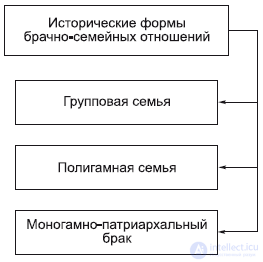
Marital and family relations change historically. Let us consider the main stages in the evolution of marital and family relations.
Primitive society was made up of clans – groups of people linked by blood kinship. Within the clan, freedom of sexual relations was restricted; relations between parents and children, brothers and sisters were not permitted. Group marriage arose, in which marital relations existed between clans. All the women of one clan were the common wives of all the men of another clan, and vice versa. Children belonged to their mother's clan. Within the clan, a man who came from outside was in a certain subordinate position to the women. This state was called matriarchy.
The emergence of private property and the development of animal husbandry and agriculture, in which man occupied the main place, led to the increasing social significance of men's labor. Man becomes the head of the family. Private property gave rise to the striving of male owners to increase their accumulated wealth and pass it on to their children by inheritance. A monogamous patriarchal family arises, a kind of community headed by the father – the patriarch, together with his children, grandchildren, and so on.
The patriarchal family is characteristic of the period of the disintegration of primitive society and the emergence of slaveholding society. Private-property monogamy was established as a result of the emergence of private property, and not at all as a triumph of mutual love. The conclusion of marriages was a matter decided not by those entering into marriage themselves, but by their parents, and marriages were concluded on the basis of economic calculation. No one usually asked about the mutual love of those entering into marriage; their wishes were not taken into account if they diverged from economic calculations.
Marriage in slaveholding society existed only between free citizens. Conjugal relations between slaves were considered mere cohabitation. A slaveholder could separate husband and wife, parents and their children, sell them to different owners, and so on.
Under feudalism, within the monogamous family, the role and authority of the lawful wife increased somewhat. This was because the head of the family – the feudal lord – was often absent for long periods, being in the service of his liege lord or on military campaigns, and the household fell on the shoulders of the wife. But in the peasant family, the wife was completely subordinate to her husband, and her lot was not an easy one.
Marriage in feudal society became in fact indissoluble. The church appropriated for itself the monopoly right to conclude marriages. Christian morality bound the wife to her husband even more tightly.
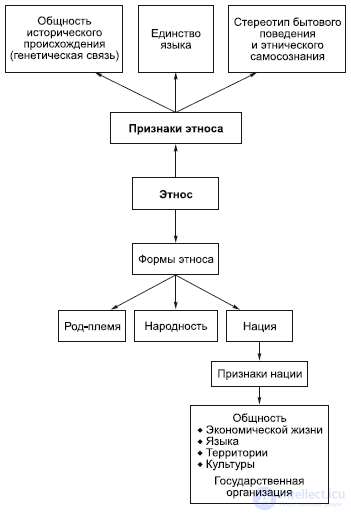
An ethnos (from the Greek ethnos – tribe, people) is a group of people whose members are united by an awareness of their genetic connection with other representatives of this group, by a shared historical origin, and a unity of language. Within this group, a particular ethnic culture (a «behavioral stereotype», an «ethnic self-awareness») takes shape.
Within the behavioral stereotype, one distinguishes the stereotype of everyday behavior (also called the «way of life»). The stereotype of everyday behavior is made up of many factors: the specifics of food, clothing, dwelling, hygiene, transport, the nature of family relations, the distribution of the family budget, the ratio and alternation of labor and rest, and style of communication. In addition to the everyday stereotype, there is a stereotype of non-everyday activity; thus, there is a stereotype of the behavior of the nobility, which differs from country to country. As an example, one can compare the behavioral stereotype of the French and English nobility in the 17th–18th centuries; the former was oriented toward service to the absolute monarch, while the latter did not consider it shameful to engage in commerce. The combination of the everyday and non-everyday stereotype forms, as a whole, the behavioral stereotype of the ethnos.
The behavioral stereotype of an ethnos is reflected in ethnic self-awareness (both on the emotional and the rational level). Quite often, ethnic self-awareness exhibits the fact of ethnocentrism – an emotional experience of the «superiority» of one's own ethnos over others and, at the very least, an experience of opposition: us – them.
Ethnic groups strive to preserve their behavioral stereotype, their way of life. The preservation of the stereotype is determined by both objective and subjective factors. The former include geographic and political factors, as well as the presence of a political institution – the state. The latter include the stability of ethnic self-awareness, supported by a particular system of upbringing.
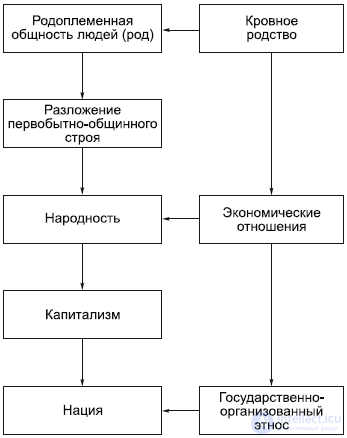
Historically, the first form of ethnos was the clan-tribal community of people. It took shape when the formation of the modern type of human was completing. Its emergence was conditioned by the nature of the productive forces. When tools of labor were quite primitive, people could obtain the means of subsistence only through collective labor, mutually helping and supporting one another. Such a collective became the clan – a group of people linked by joint collective labor, common property, and blood kinship. People united for a shared life on the basis of blood kinship, although this union itself was dictated by the needs of production. Members of the clan considered themselves descendants of a common ancestor – real or mythological.
Clans united into tribes, and tribes – into tribal unions. Judging by the clan-tribal organization among the Iroquois and other communities of this type, a tribe usually consisted of an even number of clans, linked to one another in pairs by intermarriage relations. A tribe had its own language or dialect and its own territory; it was governed by a tribal council, consisting of the heads of all the clans. To resolve the most important issues, an assembly of the whole tribe was convened, in which everyone could participate on equal terms.
The development of the productive forces, the division of labor, and the emergence of private property led to the disintegration of the primitive-communal system and the emergence of class society. A new form of ethnos takes shape – the nationality (narodnost).
A nationality was usually formed from several tribes close in origin and language. As a result of the development of production, exchange, and trade, members of clans and tribes relocated, and clans and tribes lost their separateness. In place of blood-kinship ties, economic relations come to the fore. Moreover, if the economic basis of the clan-tribal community of people was communal property and shared labor, now the economic cell of society becomes the individual family – the bearer of private property.
A nationality is a community of people living in the same territory, having a common language, a common way of life, and customs; a connecting factor was also the local economy. Nationalities are characteristic of slaveholding and feudal society.
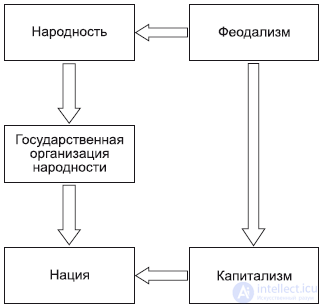
With the transition from feudalism to capitalism, a new form of human community took shape – the nation. Capitalism needs such a community of people as would make possible free and broad exchange of goods and the concentration of the means of production. The development of the capitalist mode of production, the establishment of trade relations between various regions, and the merging of local markets into a general market – all this bound together the fragmented population of the various regions of a given country into a single whole. The elimination of the economic disunity of individual regions, the strengthening of ties between people of one nationality and nationalities close to it, and the formation of a common language for them – all this forms nations. The decisive factor in the formation of a nation is the state organization of nationalities. Nations took shape as state-organized ethnicities.
Of course, in defining a nation, one cannot disregard such factors as the self-awareness of this social group, the sense of community, and so on.
In understanding the nation, Marxist philosophy proceeded from the premise that economic factors play the decisive role in the union of people into a nation. In addition, the concept of a nation included the following features: a common language, a common territory, and a shared culture. It was emphasized here that none of these features taken individually is sufficient to define a nation. (For example, England and Ireland, as well as England and the USA, have a common language, but these are different nations, since they occupy different territories and have independent economies.) In addition to the concept of nation, the concept of nationality (in the sense of ethnic affiliation) is also used. When a person identifies themselves with a certain nationality, this in fact means that, by some criteria, they do not belong to the nation, but in their own consciousness, in certain elements of their psychological makeup and culture, they regard themselves as a member of a particular nation (for example, this is how the Russian-speaking population in some countries other than Russia refers to itself as Russian). Today, in addition to the features of a nation listed above (community of economic life, language, territory, and culture), a political parameter is added: a nation takes shape as a state-organized ethnos.
What is expected of nations? The most widespread forecast is that in the future, on the basis of globalization, the formation of a unified world economy, the development of means of communication, and the formation of a unified culture, a convergence of nations will occur, up to and including their merging into a single humanity on a single territory – our planet.
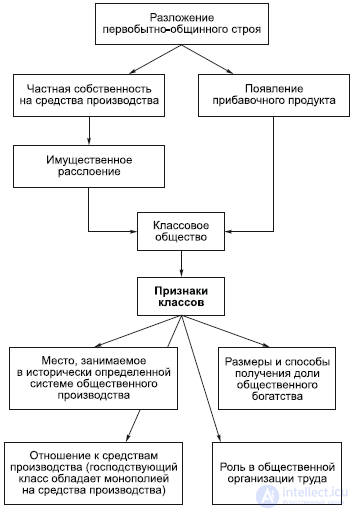
Class society arose as a result of the disintegration of the primitive-communal system. The exploitation of one class by another became possible once the development of the productive forces and the growth of labor productivity led to the appearance of a surplus product. The clan community breaks up into families, and the division of labor leads to the development of exchange. Communal ownership of the means of production is replaced by private property. The clan nobility (elders, military leaders, priests) used their position to seize part of the communal property. Private property inevitably led to property inequality, to the enrichment of part of society.
The different position of classes in society follows from the different relation of classes to the means of production. The ruling class holds a monopoly on the means of production; all the most important means of production belong to it, while the oppressed class is deprived of these means of production and finds itself in economic dependence. Wherever one part of society monopolistically owns the means of production, the worker must, in addition to the working time necessary for their own upkeep, also expend surplus working time to support the owner of the means of production.
From the differing relations to the means of production follow the other characteristics of classes: the role of classes in the social organization of labor. The ruling, exploiting classes, making up a minority of the population, concentrate in their hands the management of production and the administration of state affairs, and turn intellectual labor into their monopoly, whereas the majority of the population, belonging to the oppressed, exploited classes, is condemned to hard physical labor.
The differing relation to the means of production also determines the difference in the ways of obtaining and the size of the share of social wealth at each class's disposal. The exploiting classes, representing a minority of the population, appropriate the larger part of social income (or a disproportionate share relative to their numbers).
The characteristics of classes were summarized by V. I. Lenin in the following definition: «Classes are large groups of people differing in their place in a historically determined system of social production, in their relation (for the most part fixed and formalized in laws) to the means of production, in their role in the social organization of labor, and consequently, in the ways of obtaining and the size of the share of social wealth at their disposal» .

Comments