
Lecture
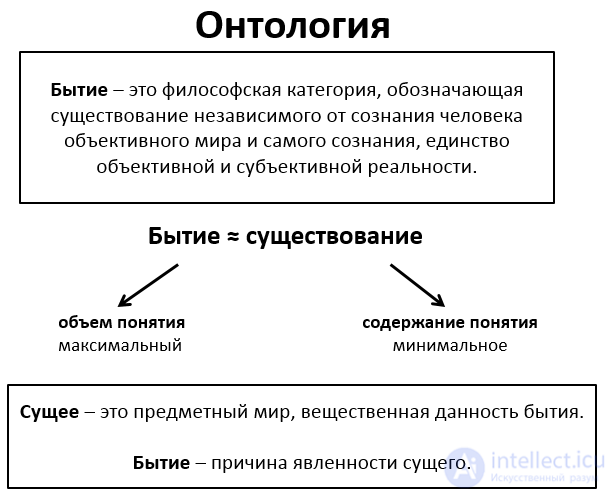
Ontology – the theory of being. The problem of being is one of the oldest in philosophy. In all developed philosophical systems known to us there is a doctrine of being. But the understanding of being differs fundamentally between idealism and materialism. In general, there are two basic variants of ontology.
The specificity of human being:
Reflection is the process by which a subject engages in self-knowledge of internal mental acts and states.
Introspection.
Matter - is an objective reality that exists independently of human consciousness and is reflected by it.
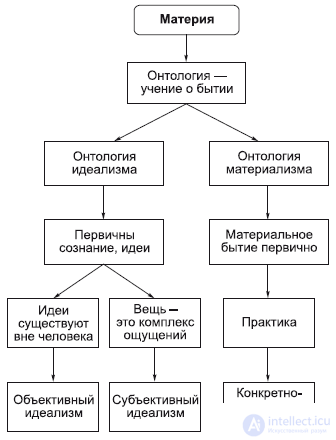
In objective idealism the existence of a special world of spiritual entities outside of man is asserted. This world underlies the sensibly perceived world of things, phenomena, and so on. Here one may recall Plato's conception.
But does ontology exist in subjective idealism? Since it is asserted that things, objects, etc. are a product of human consciousness, of its activity, it might seem that subjective idealism has no ontology. But this is not so. Let us recall Berkeley's conception. A thing is a complex of sensations and perceptions. A thing exists, possesses being, insofar as it is perceived. A person has perceptions and sensations, and they possess being, while the being of things depends on the being of perceptions. Thus, subjective idealism also has an ontology, but a specific ontology that places the being of human consciousness at its foundation.
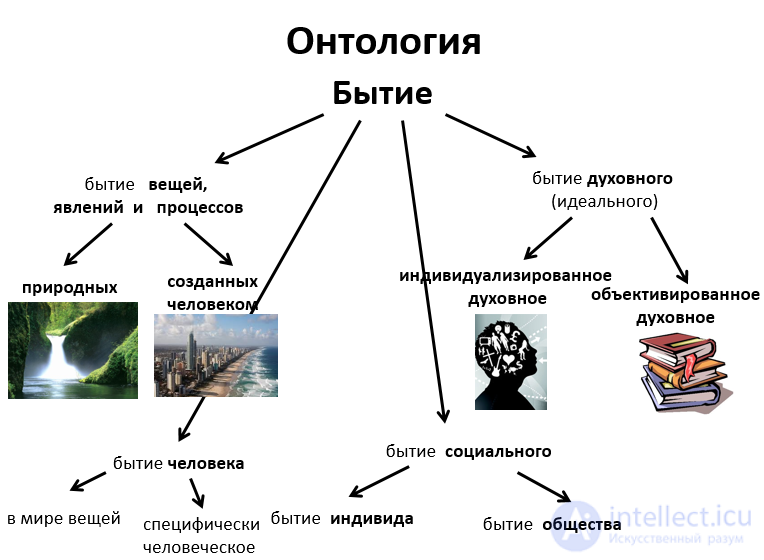
In materialism an ontology of a different type is asserted. At its foundation is the assertion of material, objective being as primary in relation to subjective being (the being of consciousness, the ideal).
Dialectical-materialist ontology rejects scholastic discussions of "pure being" and "being in general." There is material being and spiritual being; the latter depends on the former. It follows that the concept of being ultimately means the being of matter. Dialectical-materialist ontology is a philosophical theory of material being, of matter.
In the course of the development of philosophical thought, various conceptions of matter were proposed. In the philosophy of the ancient world the idea took shape that in the diversity of things and phenomena of the surrounding world there is some unifying first principle.
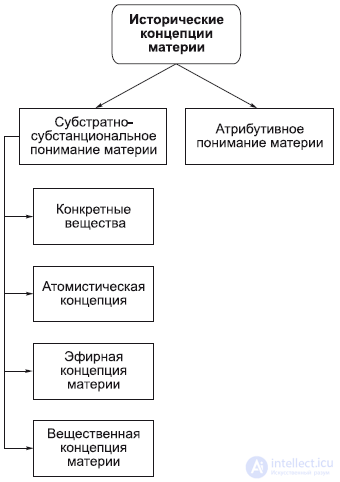
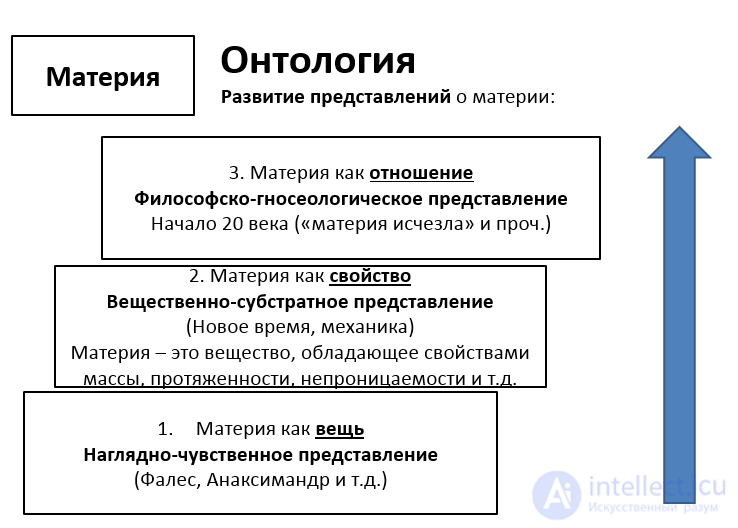
Specific substances were proposed as matter, as the first principle: water, air, fire, and so on – either singly or in groups (five first principles in the natural philosophy of ancient China, four in the philosophy of ancient India and ancient Greece). Later an important role in materialism was played by the atomistic conception, in which matter was understood as a multitude of atoms (unchanging, indivisible, uncreated and indestructible minute particles) that move in the void, collide with one another, and, combining, form various bodies.
The atomists explained the difference between things by the fact that atoms differ in shape, weight, and size and form various configurations when combined.
The idea that all things and phenomena of the world have a universal, single material basis is one of the founding ideas of materialist philosophy. This unified basis was called either by the term "substance" or by the term "substratum" (a substratum is that of which something consists). This is the substrate-substantial understanding of matter.
Subsequently, other variants of the substrate-substantial concept of matter were proposed. In the 17th century, Descartes and his followers proposed the "ethereal" conception of matter .
Descartes' conception was later developed by Maxwell. He postulated the existence of an "ether" filling all space. Electromagnetic waves propagate in the ether.
In the 18th–19th centuries the leading role passed to the substantival conception of matter. Matter is understood as substance, a set of physico-chemical bodies and the ether. Because of this duality, the explanation of some phenomena relies on atomistic notions (for example, in chemistry), while the explanation of others (for example, in optics) relies on notions of the ether. The successes achieved by natural science in the 19th century on the basis of this conception led many scientists to the conviction that it gave an absolutely correct picture of matter.
The substrate-substantial understanding of matter as a whole rests on two ideas: a) matter (substance) is usually characterized by a small number of unchanging properties, these properties being drawn from empirical data and given universal significance; b) matter (substance) is regarded as a certain bearer of properties, distinct from them. The properties of material objects are, as it were, "hung" on an absolutely unchanging foundation. The relation of substance to properties is in a certain sense similar to the relation of a person to clothing: a person, being the bearer of clothing, exists without it as well.
The substrate-substantial understanding of matter is metaphysical in its essence. It is no accident that it was discredited in the course of the revolution in natural science at the end of the 19th and beginning of the 20th century. It was discovered that such characteristics of atoms as immutability, indivisibility, impenetrability, and so on, lost their universal significance, while the supposed properties of the ether are so contradictory that its very existence became doubtful. In this situation a number of physicists and philosophers concluded: "Matter has disappeared." Matter cannot be reduced to some particular, concrete form or state of it, or regarded as a certain absolute, unchanging substance.
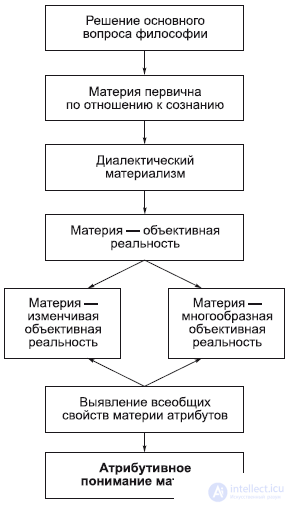
Dialectical materialism rejects the understanding of matter as an absolute substratum, a substance. Even before the revolution in natural science, Engels spoke of the futility of searching for "matter as such." There is no matter as a special substratum, a first principle that serves as the material for constructing all concrete things and objects. Matter as such, Engels pointed out, unlike concrete things and phenomena, no one has ever seen or experienced in any sensory way.
In dialectical materialism the definition of matter, first of all, is given on the basis of the solution to the fundamental question of philosophy. The materialist solution to the first side of the fundamental question of philosophy points to the primacy of matter in relation to consciousness, while the solution to the second side of the fundamental question of philosophy points to the knowability of matter. Bearing this in mind, V. I. Lenin defined matter as an objective reality, existing outside of and independently of consciousness and reflected by it.
Secondly, dialectical materialism points to the futility of any attempt to improve the substrate-substantial understanding of matter. The point is that this understanding in principle presupposes the assumption of the existence of absolutely elementary, unchanging "atoms." But this assumption leads to insoluble difficulties, in particular to the conclusion that such "atoms" are structureless, that they lack internal activity, and so on. But then it remains entirely unclear how material objects consisting of such "atoms" could form and develop. Willingly or not, one would then have to appeal to forces external to matter, with all the consequences that follow from this.
There is no absolute substance; matter is a diverse and changeable objective reality. In dialectical materialism, instead of the substrate-substantial understanding, an attributive understanding of matter is developed.
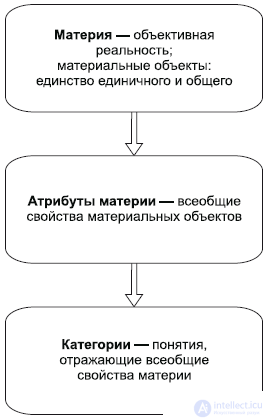
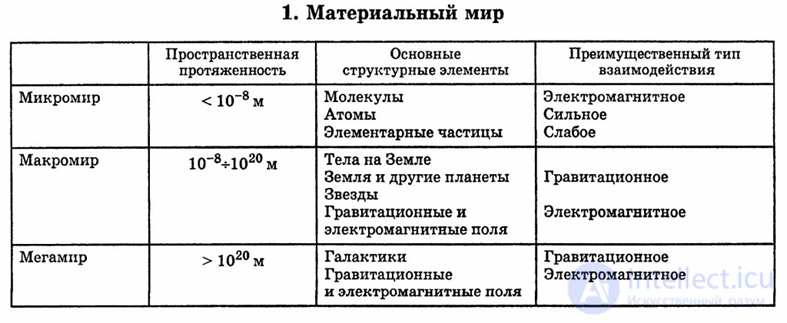
The material world represents an infinite multitude of structurally organized, qualitatively diverse individual material objects, existing in manifold interconnections and changes.
In his practical interaction with the material world, a person deals precisely with individual material objects . These objects are perceived as something specifically individual. As a result of comparing various individual material objects, their similarity and commonality in certain respects is discerned. There are different classes of similar objects, smaller and larger in the number of their members. To denote that which is inherent in all material objects, the term "universal," or "attribute," is used.
1) systemicity;
A system is an ordered set of interconnected elements.
A structure is a set of stable connections and relations between elements.
2) motion;
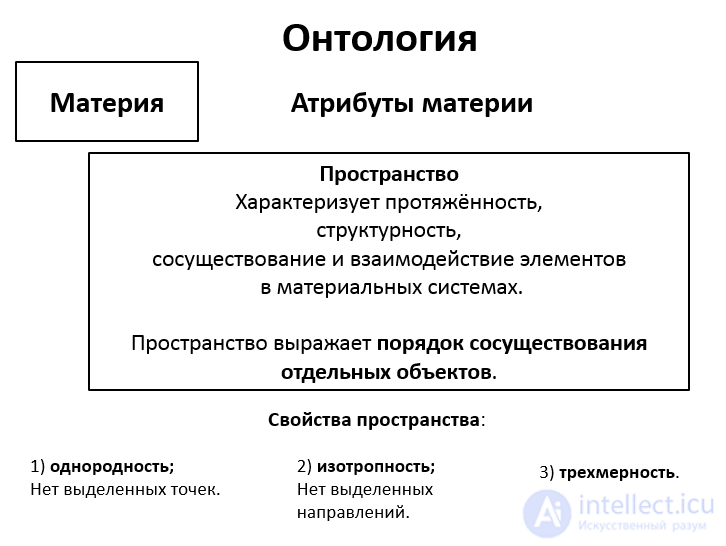
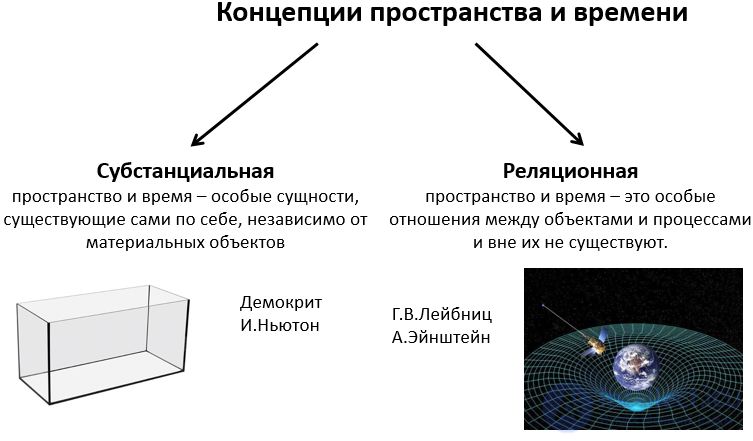
3) space;
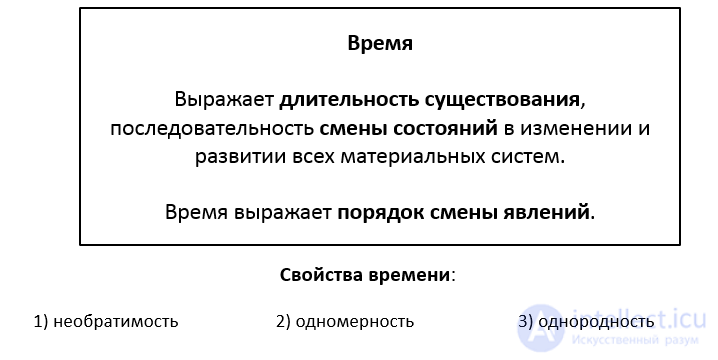
4) time
The attributes of matter are reflected in philosophical categories. In ordinary usage the term "category" is used as a synonym to denote some multitude of objects. In philosophy, however, categories are understood as concepts reflecting the universal.Categories that denote and reflect the attributes of matter are called ontological categories.
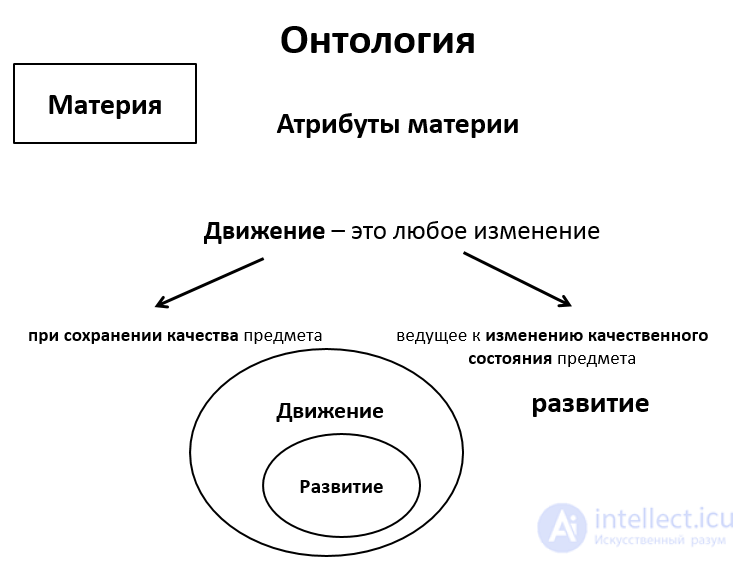
One should not identify the attributes of matter with ontological categories. For the attributes of matter exist objectively, while categories exist in cognition and consciousness. The conflation of attributes and categories often occurs because both may be denoted by the same word. Take, for example, the word "time." It can denote real time itself (an attribute of matter) and the concept of time (a category). In such cases it is necessary to clarify the meaning in which the word is used in various contexts.
Since the universal (attributes) exists in individual objects in connection with the particular, concepts about the content of the attributes of matter have the same source as concepts about the particular – namely, experience, social and historical practice. The content of the attributes of matter is revealed not through scholastic, speculative operations, but on the basis of studying concrete kinds of matter (various inorganic, organic, and social objects).
The attributes of matter are interconnected with one another. The dialectical concept of matter not only points to individual attributes but also reveals their substantive interconnections. To construct a system of attributes it is necessary and appropriate to apply the dialectical method (above all, dialectical analysis and dialectical synthesis).

Comments