
Lecture
Philosophy arose during the period of the formation and development of slave-owning society almost simultaneously in Ancient China, Ancient India, and Ancient Greece. Over the three-thousand-year history of philosophy, a wide variety of philosophical doctrines have been proposed, ultimately reflecting the level of the socioeconomic and political development of society and the development of knowledge in the specific sciences. In order to make sense of the diversity of philosophical doctrines, one must identify the initial, most important problems of philosophy and the ways of resolving them.
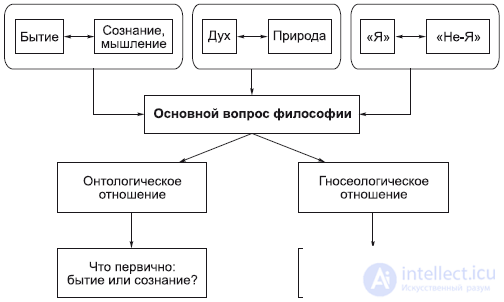
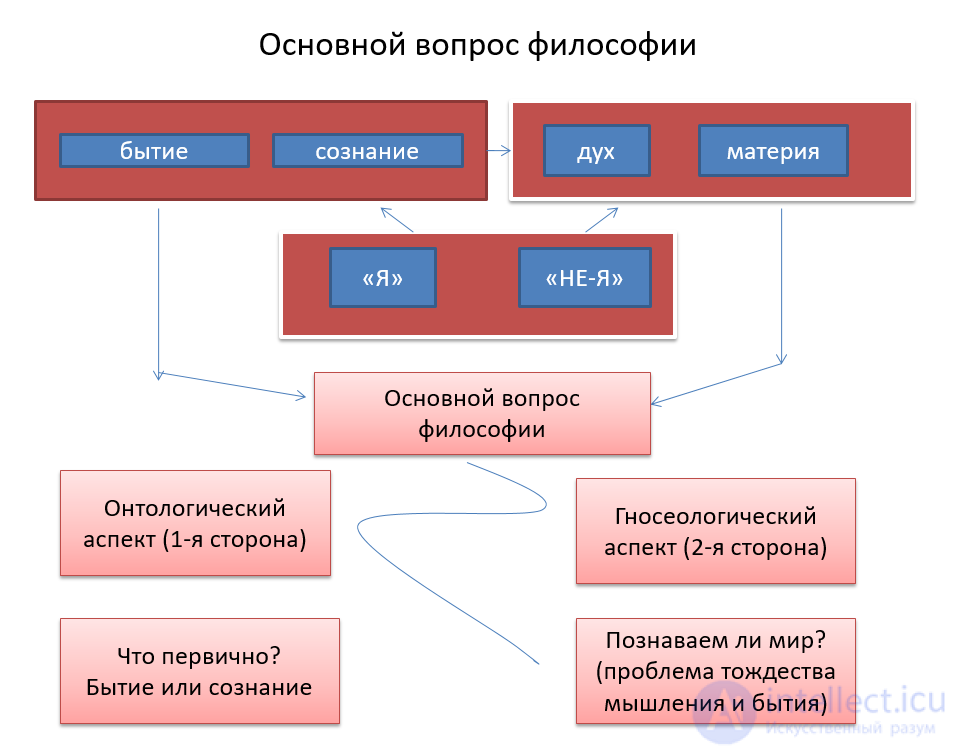
The worldview problem of man and the world is posed in philosophy, above all, as the problem of the relation between being and consciousness. This problem exists in various formulations: as the relation of spirit to nature; of thought to being; of the relation of soul and body; of the "I" and the "not-I"; in the form of the question – was the world created by a spiritual principle, or does it exist eternally, and so on. The posing of the problem of the relation between being and consciousness is conditioned by the very existence of man as a thinking and acting being. The problem of the relation of thought and being, in German philosophy (for example, in F. Schelling, F. Engels), came to be called the fundamental question of philosophy.
The fundamental question of philosophy can be formulated as the question of the relation between two types of reality – the objective and the subjective.
When philosophers set themselves the task of identifying the relation between subjective and objective reality, then, as the history of philosophy shows, in the first place what is meant is the so-called ontological (genetic) relation. Being and consciousness exist. How do they relate to one another: which of them is fundamental and which derivative, which is the cause and which the effect, which is primary and which secondary?
But the fundamental question of philosophy is not reducible solely to the ontological relation. In the question of the relation of thought to being there is contained, in the second place, another, so-called epistemological relation. How do our thoughts about the world around us relate to that world itself; is our thinking capable of knowing the world; can we, in our representations and concepts of the world, form a correct reflection of reality?
Thus, the fundamental question of philosophy has two sides: the question of primacy and the question of knowability.
The question of the relation of thought to being is called fundamental because it is with this question that the formation of a philosophical worldview begins, and the resolution of other philosophical problems depends on it. This or that answer to this question determines the specific character of various philosophical directions and schools.
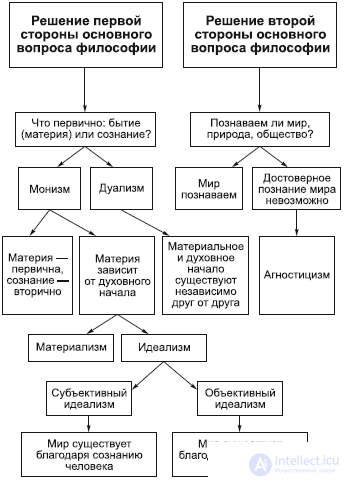
In resolving the first side of the fundamental question of philosophy, philosophers divided into two large camps – idealists and materialists. Those who maintained that subjective reality, spiritual entities, existed prior to nature, to material being, and gave rise to it, formed the idealist camp. Those who took nature, matter, as the starting point joined the camp of the materialists.
Here an important point should be stressed. It would be wrong to suppose that these philosophical directions differ in what they consider to have "arisen" first, and what afterward. The fact is that idealists do not pose the question of the origin of consciousness, of spirit, and materialists do not pose the question of the origin of matter. Primacy is spoken of not in the sense of what "arose" first (out of what?), but in the sense of the primacy of one thing in relation to another. In the strict, philosophical sense, idealism and materialism differ in how they understand the ontological relation between thought and being. In resolving the first side of the fundamental question of philosophy, since it concerns the relation of thought and being, it is necessary to clarify how being, reality, and the external world are understood. There are three variants.
Being, the external world, things, and so forth – are reality that exists outside of and independently of our consciousness (and indeed of any consciousness, any spirit), and is primary in relation to it. This is materialism. The external world, things, and so forth exist thanks to human consciousness, and are a product of its activity – this is subjective idealism. The external world, things, and so forth, as well as our consciousness, exist thanks to some higher, spiritual principle (world reason, world Will, God) – this is objective idealism.
Both materialism and idealism are monistic philosophical doctrines. But besides monistic philosophy there also exist dualistic conceptions. An example of dualism is the teaching of Descartes (1596–1650), who held that matter and consciousness are substances independent of one another.
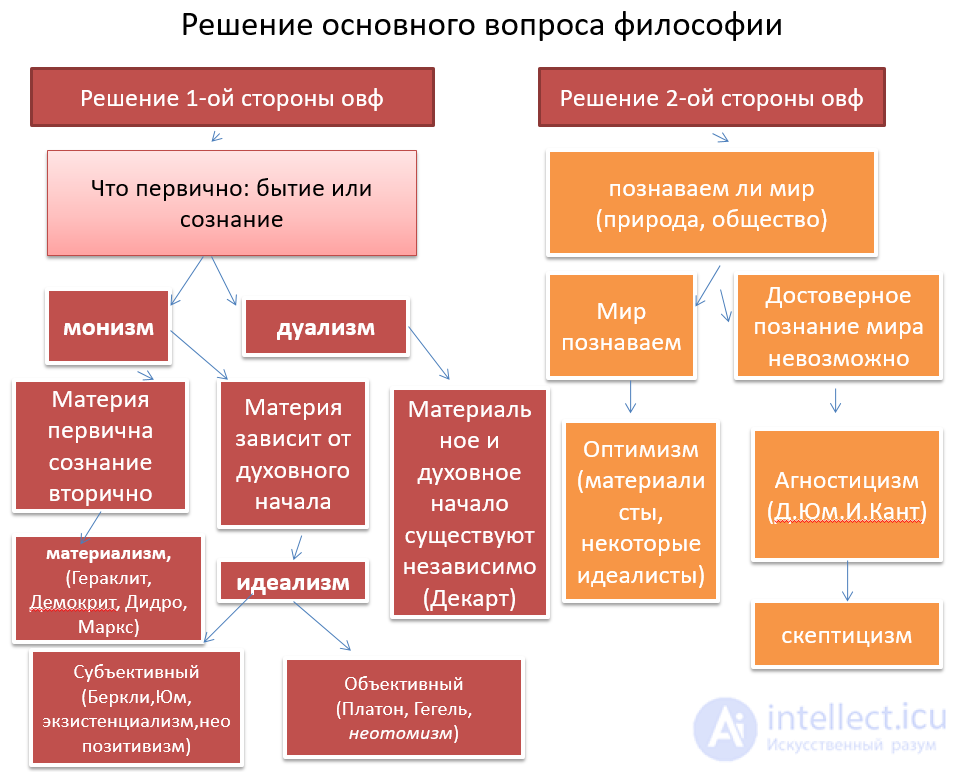
In connection with the second side of the fundamental question of philosophy, the question of the knowability of the world, various points of view likewise exist. Most philosophers, and indeed most ordinary people, answer this question affirmatively. And for the position of this majority no commonly used term has historically taken shape. But there is a group of philosophers who, in one form or another, dispute the possibility of reliable knowledge of the world, and speak of fundamental limits to human cognition. This philosophical position has come to be called "agnosticism."
[[b8152]]

Comments