
Lecture
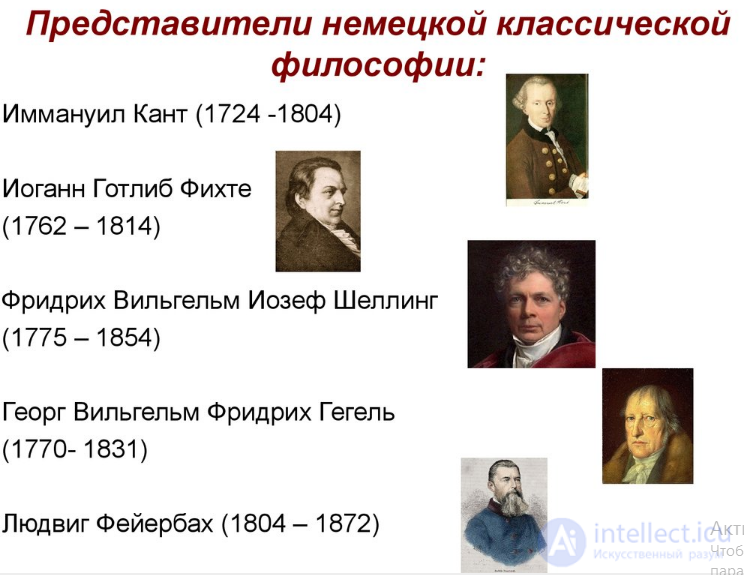
The work of I. Kant (1724-1804) laid the foundation for the period that came to be known as German classical idealism. It developed in the eighteenth and early nineteenth centuries, and its main representatives are J.G. Fichte (1762-1814), F.W. Schelling (1775-1854), and G.W.F. Hegel (1770-1831).
The philosophers of this period, like the philosophers of the seventeenth and eighteenth centuries, regarded philosophy as a science – and moreover a science that should lay the foundation for and serve as the legislator of all other sciences. But the scientific character of philosophy did not necessarily mean resemblance to the natural and exact sciences, as had previously been thought. Philosophy is called upon to give a unified picture of the universe, to indicate the place of the human being within it, and thereby to reveal (or impart) purposiveness in the world.
Since philosophy must perform a synthesizing function, creating unified knowledge of the world, the question of the systematicity of knowledge acquires a special place in German classical idealism. All parts of the universe – nature and spirit, being and thought – are conceived as existing in unity, although fundamentally distinct from one another.
It is precisely in German classical idealism that the idea of the unity of opposites and of development through opposition takes shape, which in Hegel's philosophy attains its completed form in the doctrine of the dialectical character of the development of the being of the universe. Philosophy arrives at this idea through Kant's discovery of the subject as an acting force, as activity.
This discovery, merging with the spirit of the Enlightenment and the great French Revolution, is embodied in another theme uniting all these philosophers – the problem of freedom. If the seventeenth and eighteenth centuries passed under the banner of the assertion of determinism in philosophy, then Kant and the thinkers who followed him revealed the possibility of opposing natural necessity with human freedom, which, however, is not given directly but must be attained and realized in practical activity.
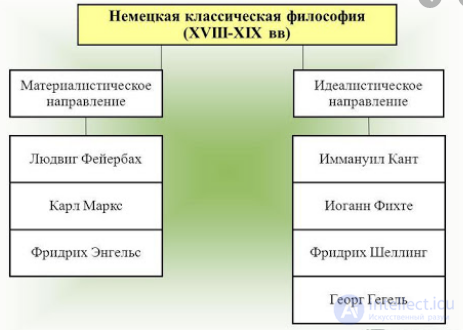
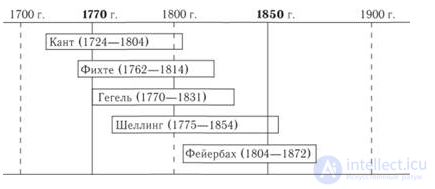
Diagram 1. German classical philosophy: chronological framework
The main works of I. Kant (1724-1804): «Critique of Pure Reason» (1781), in which Kant set out the foundations of a new theory of knowledge; «Critique of Practical Reason» (1788), which set out a new ethical doctrine; and «Critique of Judgment» (1790), devoted to questions of aesthetics. These three works formed the Kantian system of philosophy, which Kant himself called transcendental or critical, and which, in Kant's view, should answer four questions: 1) what can I know? 2) what ought I to do? 3) what may I hope for? 4) what is the human being?
In the preface to «Critique of Pure Reason» Kant formulates the task before him. It consists in a critical examination of reason's capacity in general to acquire knowledge. Kant begins his work with a critique of dogmatic metaphysical systems (for example, that of Leibniz), which saw the ultimate ground of the possibility of knowledge in God, and of skeptical empiricism (for example, that of Hume), which demonstrated the impossibility of scientific knowledge (universal and necessary) grounded in experience. Therefore, in order to ground the possibility of scientific knowledge, Kant sees the need for a critical investigation of reason with respect to its cognitive capacities, which, in Kant's view, should answer the questions: 1) how is mathematics possible? 2) how is natural science possible? 3) how is metaphysics possible?
Before Kant, the process of cognition was traditionally associated with obtaining, in the course of experience, «impressions», ideas of things. Kant shows, however, that in that case it is impossible to explain the mechanism by which our ideas correspond to the objects being known, and therefore this theory does not lay a reliable foundation for objective science. Kant proposes to carry out a so-called «Copernican revolution». He observes that all the sciences considered objective and exact (mathematics and natural science) became such only when they ceased merely observing nature and began instead to model their objects (there are no triangles, points, or bodies in nature). Kant therefore supposes that the mechanism of cognition consists not in our knowledge conforming to objects, but in objects conforming to our cognition, i.e. objects are cognized only insofar as the capacities of our reason allow. This does not mean that real objects are transformed depending on our cognition. Kant introduces the distinction between the noumenon, the thing in itself, the really existing object, and the phenomenon, the appearance, that is, how the object appears to our consciousness. It is precisely the phenomenon that conforms to our cognition, while about the thing in itself we can say nothing, since by definition it is never given to us in perception. That is, in principle we do not know what the world truly is; we know only how it appears to our consciousness – Kant's agnosticism. Kant is nevertheless firmly convinced that things in themselves exist, since it is precisely they that affect our sensibility (act upon it).
In connection with this division, Kant clearly distinguishes the sphere of science from the sphere of conjecture: science must speak only of phenomena, i.e. objects of possible experience. Such objects as the soul, freedom, God, and so on belong to noumena, i.e. things in themselves, which can never be given to us in experience. Such objects should not be objects of scientific investigation.
Since Kant speaks of phenomena as objects that conform to the capacities of our cognition, he speaks of certain forms of cognition that are given a priori, i.e. prior to experience. Only thanks to the presence of these a priori forms can scientific cognition take place at all, since there is nothing in the objects themselves that would allow us to make the necessary and universal judgments that constitute the basis of scientific knowledge.
Thus, our cognition depends in large measure on the capacities of our pure (i.e. free from the empirical) reason, which Kant investigates in the Critique of Pure Reason with regard to how they make science and philosophy possible. Kant calls such an investigation transcendental. The transcendental is that which precedes experience (a priori) and makes any experiential cognition possible (i.e. that on which any act of cognition is grounded). The term «transcendental» must not be confused with «transcendent», since by the transcendent is understood that which is inaccessible to our cognition, i.e. the thing in itself, the noumenal world lying beyond the bounds of our possible experience.
Kant identifies three transcendental faculties of cognition: sensibility, understanding, and reason. In accordance with the investigation of these faculties, Kant's epistemology is divided into transcendental aesthetic, transcendental analytic, and transcendental dialectic.
In the transcendental aesthetic a distinction is drawn between the matter of cognized objects (i.e. the sensible content of appearances) and the a priori forms of sensible intuition, which are space and time. That is, any sensory experience occurs within the space and time already given to it in advance. Our consciousness itself is organized in such a way that it can perceive something only within a spatio-temporal coordinate system. Kant asserts that time and space are given to us independently of empirical experience (they are a priori), but not apart from it. A distinctive feature of the a priori forms of sensible intuition is that they are activated only at the moment of intuition and are not given in themselves. However, since space and time are forms of our perception of objects, we cannot say that things in themselves exist in space and time. About them we can say nothing at all.
In the transcendental analytic Kant examines scientific rational cognition, which operates with formal logic and epistemological categories. Whereas, Kant writes, objects are given to us for intuition by means of sensibility, they are thought by means of understanding. Accordingly, the transcendental analytic investigates the a priori forms of thought, to which the categories belong. By means of the categories, the understanding orders the manifold of sensory perception. These categories are divided into four groups: 1) quantity; 2) quality; 3) relation; 4) modality. As a result of the activity of the understanding, the manifold of experience is transformed into a synthetic unity of judgments bearing a necessary and universal character, which constitutes scientific knowledge.
The combination of the a priori forms of the understanding and the sensible matter of experience occurs, according to Kant, by means of the productive power of imagination, which serves as a mediator between thought and sensibility. In this way Kant emphasizes the activity of the subject in the process of cognition: the subject does not passively receive imprints of things, as had previously been thought, but actively synthesizes the perceptions it receives.
Transcendental dialectic is meant to answer the question of whether metaphysics (i.e. the doctrine of the supersensible principles of being) is possible as a rigorous science. Here Kant moves from the understanding with its categories to reason with its ideas. Whereas the understanding receives its material from sensibility, and thus deals with the sphere of possible experience, reason formulates ideas about things in themselves, i.e. goes beyond the sphere of possible experience. In doing so, however, we lose the criterion for testing the judgments of reason, and as a result we obtain antinomies, in which we can prove opposite assertions with equal certainty. Thus, according to Kant, metaphysics as a rigorous science of God, the soul, and things in themselves is impossible. Ideas embody illusions of reason, and the overcoming of such illusions is the true (i.e. critical) task of philosophical science.
The second question that Kant set for philosophy is answered by the work Critique of Practical Reason. This is the same human reason as a legislative principle, but now taken not in relation to the cognition of nature, but in relation to guidance in practical action.
The quintessence of Kant's ethics is the doctrine that the human being is not only a natural being but also a free one. If every thing that has a phenomenal side also has a noumenal one, then the human being too is not simply a natural phenomenon: he is also rooted in the world of things in themselves. And if, as phenomenon, the human being is subject to natural causality, then, as noumenon, he is free. However, in order to be free, according to Kant, one must escape subjection to nature. This is possible when, in his actions, a person is guided not by desires, which are dictates of nature, but by so-called imperatives – prescriptions of reason.
Kant divides the imperatives of practical reason into two kinds. The first are hypothetical imperatives, containing only prescriptions of skill; the second, by contrast, are categorical and purely practical laws. Reason is instrumental only when it produces hypothetical imperatives, which are nothing other than prescriptions of how one ought to act in order to achieve ends already set by the faculty of desire. Moreover, they are purely subjective principles, since desires and objects of desire differ from person to person; there is nothing universally binding in such imperatives, nothing independent of our own willing. (Example: «In youth one must work and be thrifty, so as not to suffer want in old age»). Being instrumental is natural for practical reason. For human life unfolds in the world of objects, in which life sets before the human being various ends and compels him to solve various tasks. But these tasks depend on human nature, and therefore do not allow him to act as a truly free being.
Unlike hypothetical imperatives, categorical imperatives are unconditional, universal prescriptions that must be fulfilled by everyone and demand fulfillment in any situation regardless of one's willingness to do so. They are not even directed at preserving human life; they are so severe that they demand fulfillment even at the threat of death. A person is capable of submitting to natural causality if and only if he lives in nature. Hence, insofar as categorical imperatives stand «above» even human life itself, they cannot proceed from natural causality; they stand «above» that causality, «above» everything phenomenal. Inasmuch as they exist, it is clear that they can be rooted only in the noumenal depths of the human being. It is from there that the voice of practical reason issues in the form of the categorical imperative, in the form of the unconditional command of duty: «Act only according to that maxim whereby you can at the same time will that it should become a universal law». Thus, in obeying the categorical imperative, the human being opposes the internal principle of his own reason to the external compulsion of natural law.
Pure practical reason has an advantage over theoretical reason, for the latter, taken by itself, is incapable of pronouncing a single categorical judgment, becoming entangled in antinomies, and is incapable of knowing those great things of which it speaks: God, the possibility of freedom, the immortality of the soul, the world as a whole. Practical reason, however, gives us the categorical imperative, and with this given we cannot but reckon. Lacking the ability to know theoretically the possibility of freedom, we can realize it practically in our moral conduct. Yet both theoretical and practical reason form a single whole and constitute the basis of human spirituality. In the conclusion of the Critique of Practical Reason, Kant writes: «Two things fill the mind with ever new and increasing admiration and awe, the more often and the more steadily one reflects on them – the starry heavens above me and the moral law within me»1. Reflection on such things as the starry heavens awakens the cognitive impulses of reason, drawing it toward ever new and boundless horizons of knowledge, while at the same time making clear the limitations of the human being as an empirical creature. The moral law infinitely elevates the value of the human being as a thinking being, since it makes it possible to be free and to speak of the meaning of life. Later, in the Critique of Judgment, Kant would link these two reflections through the concept of the sublime.
It was precisely the prospect of the freedom of the human spirit, opened up in Kant's Critique of Practical Reason, that inspired J.G. Fichte to create his own philosophy. His aim was to overcome the gap between cognizing reason and acting reason, showing them to be one and the same. Fichte regards philosophy as a science that must be derived from a single foundation. This foundation must lay the basis for the very possibility of scientific cognition, which is why he calls his philosophy the «theory of science» (Wissenschaftslehre).
The philosopher contrasts the standpoints of materialism and transcendental idealism. Materialism conceives the sensibly given world as existing outside and independently of us, as a thing in itself. Fichte allows the possibility of such a standpoint, but in that case we cannot ground the possibility of other thinking beings, and the human being becomes wholly subject to the laws of nature and appears as unfree. From the standpoint of idealism, «reason… according to idealism, is in itself active and absolute, not passive, for it is the first and highest principle, preceded by nothing… For idealism reason is action, and nothing else… everything else is derived», while «nature is, absolutely, only the counterpart constructed by absolute thought in opposition to the absolute force of free and spiritual life, necessarily constructed in order to make this force, invisible in itself, visible»2. Thus, Fichte gives priority, in terms of grounding and prospects, to transcendental idealism.
Therefore, as the foundation of his system, Fichte takes the self-consciousness of the I, that is, the capacity of the I to think itself, and not merely the surrounding objective world. From Fichte's standpoint, the thinking of the I is a free activity, and not the passive grasping of sensory data, since the I actively chooses what and how to think. In becoming conscious of itself, the I opposes to itself the not-I, the objective world as something distinct from itself, something that sets a limit to its freedom. In general, it is characteristic of all German classical idealism to hold that freedom must be realized in action as the overcoming of objective obstacles that limit it. The totality of the world of self-consciousness (the intelligible, i.e. that which is grasped by the intellect) and the sensible world forms the world in which the human being exists: the I cannot exist for itself without being something, and this is possible only in the sensible world. But it is likewise impossible to exist for itself without being an I, and this I exists only for the intelligible world, which is given by means of intellectual intuition. But the ontological ground of such a world, in Fichte's transcendental idealism, is precisely the thinking of the I.
In choosing the path of transcendental idealism, Fichte makes a choice in favor of freedom. The goal of the human being is to become conscious of himself as a free, thinking being who realizes freedom in his activity: «I want to be myself the ultimate ground, the ultimate cause of that which determines me… I want to possess a power inherent within me… I want freely to will in accordance with a freely chosen end»3, «I want to be free – this… means: I want to make myself, myself, into what I shall be»4. Herein lies the essence of the human being, his distinction from nature, in that he possesses the capacity for free action in thought, for overcoming his own natural limitation.
If Fichte, of the possibilities of materialism (dogmatism) and idealism, chose the standpoint of idealism, then his pupil F.W.J. Schelling considered both of these alternatives to be limited. In the world, the subjective and the objective are not separated in an absolute manner; they are given in interconnection. Therefore, if the standpoint of dogmatism takes the objective as its foundation, and the standpoint of idealism the subjective, then, according to Schelling, it is necessary to think both simultaneously, bound together in indissoluble unity. That is why he writes, on the one hand, a philosophy of nature, in which he proceeds from the objectivity of matter and shows how the subjectivity of consciousness is gradually born from it. Nature appears in Schelling as «visible spirit» – a living, unified organism, connected in all its parts, endowed with inner activity and the capacity for development.
He then develops the idealist path, in which the activity of self-consciousness is taken as the foundation, and its interaction with objective reality in cognition, and the realization of freedom in practical activity, are examined.
But since both paths are merely different points of view on one and the same thing, the ultimate foundation of Schelling's philosophy is the concept of the Absolute as the identity of subjectivity and objectivity, of the conscious and the unconscious, of spirit and nature, that is, the coincidence of opposites. Schelling holds that the philosophy of identity overcomes the standpoints of realism and idealism, and therefore calls his own standpoint ideal-realism.
Hegel believed, like all representatives of German idealism, that philosophy as a science must constitute systematic knowledge. For him this meant that it had to be presented as an organic unity of interdependent elements, which develops in accordance with an inner law such that all content appears as separate moments within a totality that develops through differences.
Hegel called this whole the «absolute idea,» or spirit, and accordingly called his own philosophy «absolute idealism.» All development of the world is conditioned by the development of the absolute idea. Reality as such is infinite spirit in its development. Hegel rethinks the concept of substance: for him spirit is not something that has become, but a subject, that is, an activity, a process, a self-movement. The goal of the development of the world, according to Hegel, is precisely the coming to awareness by spirit of itself as such a subject of development. Hegel's system is therefore intended to demonstrate this process clearly at all levels of the unfolding of spirit. All phenomena of the world are manifestations of spirit at one or another level of development.
This process of movement is called dialectic. Dialectical development, according to Hegel, passes through three stages. To bring out the essence of the dialectical movement more clearly, Hegel terminologically varies the designation of these stages; let us give the most widespread of them:
|
1. thesis |
simple positing |
being-in-itself |
|
2. antithesis |
negation, otherness |
being-for-others |
|
3. synthesis |
mediation of thesis and antithesis, speculative sublation of contradiction |
being-in-itself-and-for-itself |
The essential moments of this development are that the antithesis follows directly from the thesis itself. Synthesis, in turn, means something that has removed the contradiction but has preserved something essential and thereby raised it to a new level. Synthesis in turn becomes a new positing (thesis), but at a higher level.
Dialectical development in Hegel is thoroughly concrete, since the whole of the universe is dialectical, and dialectic can be found in absolutely any phenomenon. As an example of dialectic, where development moves through contradiction, let us cite a simple example with which Hegel himself illustrates this principle: «The bud disappears when the blossom breaks through, and one might say that the former is refuted by the latter; in the same way, when the fruit appears, the blossom is shown up by the fruit as a false manifestation of the plant, and the fruit now emerges as the truth of it instead. These forms are not just distinguished from each other, they also supplant one another as mutually incompatible. Yet at the same time their fluid nature makes them moments of an organic unity in which they not only do not conflict, but in which each is as necessary as the other; and this mutual necessity alone constitutes the life of the whole»5.
The goal of the dialectical unfolding of the absolute idea is the discovery of truth. Hegel held that truth is not a minted coin that can be handed over ready-made and pocketed; it is not something finished. Truth is grasped in the course of a lengthy development of cognition, in which each step is the direct continuation of the preceding one. Since each synthesis includes, in mediated form, all the preceding stages of development, the final result contains within itself its entire history. Consequently, truth is both the result achieved and the path to it. Therefore, according to Hegel, truth must always be given in its becoming, its unfolding, its movement. Only concrete universality (that is, spirit that has passed through all the stages of development) possesses truth.
Hegel called the method that can adequately express this dialectical development of reality speculative thinking. This means not eliminating the opposites, as is done in formal logic, but developing a thought capable of perceiving contradiction as it is and regarding it as the driving force of development.
Hegel's principal works, in which he shows the dialectical development of reality, are: «Phenomenology of Spirit,» «Science of Logic,» «Encyclopedia of the Philosophical Sciences.» In its finished form, Hegel's system is presented in the «Encyclopedia of the Philosophical Sciences,» which consists of three parts: the science of logic, the philosophy of nature, and the philosophy of spirit. These parts describe the development of the universe through the three stages of dialectic in the form of 1) the Idea (the ideal-logical structure of being), 2) Nature (the otherness of the idea), and 3) Spirit (the return of spirit to itself, the coming to awareness of its own essence, of itself as spirit, being that possesses knowledge of itself). Since the dialectical development of reality has a logical character, in Hegel being is identical with thought. Thought does not reflect reality but is the result of the development of spirit in the direction of self-knowledge. The ideal structure of the world engenders nature out of itself as its otherness, which, in turn, engenders human consciousness and, in the end, the coming to awareness by spirit of itself in art, religion, and philosophy.
From the standpoint of the dialectical logic of his system, Hegel also examines the essence of the historical process. History, arising from the dialectic of states, is nothing other than the unfolding of Reason. History is the self-revelation of Spirit in time, just as Nature is the unfolding of the Idea in time and space. The philosophy of history, therefore, is a vision of history from the standpoint of its rationality, not from the ordinary point of view. Here Hegel's thesis is fully realized: «All that is actual is rational, all that is rational is actual.»
Every thing is necessary and possesses absolute meaning. All the events of history, the rise and fall of states, are merely moments of the constant becoming of the universal, passing through the stages of dialectical development. Wars are therefore necessary as a moment of negation, allowing an ascent to a new thesis.
If the world spirit is a developing universal, then the spirit of one particular nation is the particular. Progress is carried forward by only one nation at a time, the one that is the bearer of the world spirit, while the others have either outlived their purpose or their time has not yet come. The goal of world history is the self-knowledge of the world spirit. Each nation also fulfills this goal, but after attaining self-knowledge, decline sets in for the nation (though not for the spirit!), since, having come to know itself, it sees its own limitation and yields the way to the spirit of another nation. Thus there is continuity. The fruits of the development of one nation do not vanish without a trace; they pass to another nation. The criterion of this whole process is progress in the consciousness of freedom. World history passes through dialectical stages in the course of which humanity arrives at an ever deeper understanding of freedom: from Oriental society (the freedom of one) to the Greco-Roman world (the freedom of a few), and from it to the Germanic-Christian world (the freedom of the whole nation).
Heroes are particular moments of the world spirit. Their actions are not dictated from within; through them spirit realizes its designs. Such people have as their goal that which is adequate to the goal of spirit in and for itself. They are, as it were, marionettes, puppets of the world spirit. Hegel calls the «cunning of Reason» its capacity not to hinder the play of irrational passions and, on occasion, to make use of it.
Hegel's system of «absolute idealism» is grandiose in its scope. In it Hegel sought to embrace the whole totality of human knowledge of his era and to bind it into a strictly systematic unity, the foundation of which is the consistently maintained position of objective idealism, as well as the position of dialectic.
German classical philosophy became one of the most important stages in the development of European philosophy. The concept of classical German philosophy was introduced by F. Engels in his work «Ludwig Feuerbach and the End of Classical German Philosophy,» to designate that line in the development of modern European thought represented by the teachings of I. Kant, J.G. Fichte, F.W.J. Schelling, G.W.F. Hegel, and L. Feuerbach.
German classical philosophy spans the period from the 1770s (from the beginning of the critical period in I. Kant's work) to roughly the middle of the 19th century — the time of Schelling's death and the end of Feuerbach's active philosophical activity.
Despite all the differences in the conceptions of these thinkers, their work is united by common features and characteristics:
epistemological problems dominated the content of classical German philosophy: the possibilities and limits of human cognition were investigated; the structure of the cognitive process and the history of the formation of cognitive activity; the specificity of the cognizing subject and the nature of its activity; the concept of truth and its criteria. In addition to epistemology, methodology occupied an important place, which found expression in the theoretical grounding of the dialectical method. These traditional problems of modern European philosophy were supplemented by new approaches in the field of philosophical anthropology. In particular, while giving pride of place to human reason, philosophers attempted to discover those areas of human being that do not always lend themselves to rational explanation but can play an essential role in the structure of human experience; in other words, those aspects of human life that confirm the thesis that the sum of our existence, divided by reason, will never divide without remainder. Special place was given to ethical problems – human behavior in culture, society, and personal life;
in form, the philosophical systems of this movement are presented as classical, exemplary philosophical works, written for a rather narrow circle of readers – professionals, competent specialists, and students of philosophy faculties. They abound in terms, concepts, and abstractions that are unintelligible to the uninitiated; their language is dry and ponderous. Unlike the philosophers of the Enlightenment, with which classical German philosophy was closely connected by a continuity of problems, the thinkers of this school never sought to popularize their ideas and teachings or to make them the property of the broad public.
in terms of its influence on the further development of philosophical reflection, classical German philosophy occupies a unique place. On the one hand, it accumulated, synthesized, and deepened the problems that had emerged in the philosophy of the modern era, ensuring the continuity of the philosophical tradition. On the other hand, virtually all contemporary directions of philosophical thought trace their origin, to one degree or another, back to classical German philosophy [1, pp. 189-190].
The development of German classical philosophy was one of the most important expressions of the epochal rise of spiritual culture that began in the German states in the middle of the 18th century. This rise was part of the pan-European movement of social thought known as the Enlightenment. Although the economically fragmented and politically divided conglomerate of German states (their number approached 400!) lacked, at that time, the objective conditions for carrying out an anti-feudal and anti-monarchical revolution (the German bourgeoisie, owing to its weakness, was incapable of playing the role, necessary for such a revolution, of the class leading the struggle of the peasant masses), the leading figures of German culture, who came mainly from the burgher milieu, managed to express with great force the protest, characteristic of the Enlightenment, against feudal oppression, the despotism of crowned rulers, and clerical domination. In their social ideals, German classical philosophy and literature, which experienced an enormous influence from events that had taken place in other European countries (above all England and France), anticipated the prospects for the progressive development of Germany.
German classical philosophy developed in an era of the most profound changes taking place in the economic, socio-political, and spiritual-ideological life of the whole of Europe, directly or indirectly affecting the German states as well and becoming a subject of reflection for the philosophers living in them, whose worldview horizon, for all that it was conditioned by the circumstances of their own country, was not nationally limited.
German classical philosophy appeared in the history of world culture as a phenomenon that was both lawful and unique.
Lawful, because humanity (as history demonstrates) needs to take stock, to sum up civilization with concentrated emphases, without which it cannot move on to its next level of existence. And unique, because every such period is unrepeatable, exceptional in its cultural and spiritual characteristics, its combination of events, and its value orientations [4, p. 203].
1. For Germany, the second half of the 18th century was the age of the Enlightenment. A cult of reason and rational knowledge, a deep faith in the progress of humanity as the highest goal of nature (historical optimism), the ideas of humanism.
2. A period of the creation of five philosophical systems – a system-building philosophy.
3. Transcendental idealism sets itself the task of investigating the cognitive activity of the subject in order to establish the laws of human reason and its limits.
4. The main philosophical achievement of the era – dialectic. In Hegel's philosophy it acquired the status of a universal method of cognition with three laws.
5. In the theory of knowledge, the relation of subject and object was reconsidered. In earlier philosophy, the process of cognition was represented as a passive reception of images coming from outside. German classical philosophy for the first time proclaimed the activity of consciousness, the intrusion of the subject into the object and their continuous interaction. Knowledge arises as a result of the synthesizing activity of the subject: consciousness not only reflects the world but also creates it. 6. In the 18th century a new science appeared – the «philosophy of history.» GCP grounded the idea of social lawfulness. Historicism as a principle of thought entered philosophical usage: the world came to be understood as a developing, contradictory whole. An attempt was made to see, in the history of humanity, the lawful stages of progressive, though contradictory, development. A characteristic feature of German classical philosophy is anthropo-sociocentrism. The human being is understood as a cultural-historical being that creates itself in society and in history.
7. Another "new science" was aesthetics. For the first time, art entered the sphere of systematic philosophical examination.
8. In ethics, the idea of duty arose as the absolute motivating force of moral behavior. The problem of the ideal was posed. The problem of happiness was discussed.
9. The problem of man came to the center of attention of philosophy. This is the main question of Kant's philosophy.
German classical philosophy is the most significant stage in the development of philosophical thought and human culture. It is represented by the philosophical work of Immanuel Kant (1724–1804), Johann Gottlieb Fichte (1762–1814), Friedrich Wilhelm Schelling (1775–1854), Georg Wilhelm Friedrich Hegel (1770–1831), and Ludwig Andreas Feuerbach (1804–1872).
Each of these philosophers created his own philosophical system, distinguished by a wealth of ideas and concepts. At the same time, German classical philosophy constitutes a single spiritual formation, characterized by the following common features:
A distinctive understanding of the role of philosophy in the history of humanity and in the development of world culture. The classical German philosophers held that philosophy is called to be the critical conscience of culture, a "confronting consciousness," one that "smiles mockingly at reality," the "soul" of culture.
Not only human history but also human essence was studied. In Kant, man is regarded as a moral being. Fichte emphasizes the activity and effectiveness of human consciousness and self-consciousness, and examines the structure of human life according to the demands of reason. Schelling sets himself the task of showing the interconnection of the objective and the subjective. Hegel expands the boundaries of the activity of self-consciousness and individual consciousness: for him, an individual's self-consciousness relates not only to external objects but also to other self-consciousnesses, out of which various social forms arise. He investigates various forms of social consciousness in depth. Feuerbach creates a new form of materialism — anthropological materialism — at the center of which stands the really existing human being, who is a subject for himself and an object for another person. For Feuerbach, the only real things are nature and man as part of nature.
All representatives of classical German philosophy treated philosophy as a special system of philosophical disciplines, categories, and ideas. Kant, for example, singles out epistemology and ethics above all as philosophical disciplines. Schelling — natural philosophy and ontology. Fichte, regarding philosophy as a "theory of science," saw within it such sections as the ontological, the epistemological, and the socio-political. Hegel created a broad system of philosophical knowledge, which included the philosophy of nature, logic, the philosophy of history, the history of philosophy, the philosophy of law, the philosophy of morality, the philosophy of religion, the philosophy of the state, the philosophy of the development of individual consciousness, and others. Feuerbach examined ontological, epistemological, and ethical problems, as well as philosophical problems of history and religion.
Classical German philosophy develops a holistic conception of dialectics.
Kant's dialectics is the dialectics of the boundaries and possibilities of human cognition: of the senses, the understanding, and human reason.
Fichte's dialectics comes down to an investigation of the creative activity of the Ego, and of the interaction of the Ego and the non-Ego as opposites, on the basis of whose struggle the development of human self-consciousness takes place. Schelling transfers to nature the principles of dialectical development worked out by Fichte. For him, nature is a becoming, developing spirit.
The great dialectician is Hegel, who presented a developed, comprehensive theory of idealist dialectics. He was the first to present the entire natural, historical, and spiritual world as a process, that is, he examined it in continuous motion, change, transformation, and development, in contradictions, in quantitative-qualitative and qualitative-quantitative changes, in breaks of gradualness, in the struggle of the new with the old, in directed movement. In logic, in the philosophy of nature, in the history of philosophy, in aesthetics, and so on — in each of these fields Hegel sought to find the thread of development.
The whole of classical German philosophy breathes dialectics. Feuerbach deserves special mention. Until recently, in Soviet philosophy, Engels's assessment of Feuerbach's relation to Hegel's dialectics was interpreted as Feuerbach's rejection of all dialectics whatsoever. However, this question should be divided into two parts: first, Feuerbach's relation not to dialectics alone but to Hegel's philosophy as a whole; second, Feuerbach, in truly criticizing Hegel's system of objective idealism, "threw out the baby with the bathwater," that is, failed to understand Hegel's dialectics, its cognitive significance, and its historical role.
Feuerbach himself, however, does not avoid dialectics in his own philosophical investigations. He examines the connections among phenomena, their interactions and changes, the unity of opposites in the development of phenomena (spirit and body, human consciousness and material nature). He makes an attempt to find the interconnection between the individual and the social. It is another matter that anthropological materialism did not release him from its "embrace," although a dialectical approach in examining phenomena was not entirely foreign to him.
Classical German philosophy emphasized the role of philosophy in working out the problems of humanism and undertook attempts to comprehend human life activity. This reflection proceeded in different forms and by different paths, but the problem was posed by all representatives of this trend of philosophical thought. Among the socially significant contributions are: Kant's investigation of the entirety of human life activity as that of a subject of moral consciousness, of his civic freedom, of the ideal state of society and the real society with its persistent antagonism among people, and so on; Fichte's ideas on the primacy of the people over the state, his examination of the role of moral consciousness in human life activity, and of social peace as a world of private property protected by the state; Hegel's teaching on civil society, the rule-of-law state, and private property; Schelling's hope in reason as a means of realizing a moral goal; Feuerbach's aspiration to create a religion of love and a humanistic ethics. Such is the distinctive unity of the humanistic aspirations of the representatives of classical German philosophy.
It can be said with certainty that the representatives of classical German philosophy followed in the footsteps of the Enlightenment thinkers of the 18th century, and above all the French Enlightenment thinkers, proclaiming man the master of nature and spirit, affirming the power of reason, and turning to the idea of the lawfulness of the historical process. At the same time, they were also expressions of the socio-economic, political, and spiritual atmosphere that directly surrounded them, that served as their own mode of being: the feudal fragmentation of Germany, the absence of national unity, the orientation of the developing bourgeoisie toward various compromises, since after the Great French Revolution it experienced fear of any revolutionary movement; and the desire to have strong monarchical power and military might.
It is precisely this compromise that finds its philosophical justification in the works of Kant, Fichte, Schelling, Hegel, and Feuerbach. And although the last of these represents a different worldview orientation — the materialist one — he too considers the solution of social problems along the path of reforms, promising civic peace and tranquility in society.
Classical German philosophy is one of the most important expressions of the spiritual culture of the 19th century [5, pp. 217-219].
The founder of classical German philosophy, Immanuel Kant (1724-1804), in the early period of his career was much occupied with questions of natural science and put forward his own hypothesis of the origin and development of the solar system.
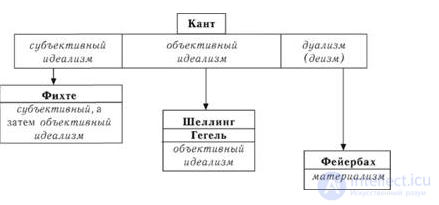
Kant was the first to raise the question of the limits of human cognition. In his view, all objects and phenomena ("things") are divided into two classes. He calls the first class "things in themselves." Things in themselves are objects and phenomena that exist independently of our consciousness and cause our sensations. Concerning what lies beyond our consciousness, we cannot say anything definite. Therefore, Kant believes, it is more correct to refrain from judgment about this altogether. Kant calls the second class of objects "things for us." These are the product of the activity of the a priori forms of our consciousness. An example of this opposition could be the antinomy of the concepts "weight" and "mass." The former cannot be understood or measured, but only experienced. The latter is fully comprehensible and investigable.
Space and time, according to Kant, are not objective forms of the existence of matter, but merely forms of human consciousness, a priori forms of sensory intuition. Kant raised the question of the nature of the basic concepts, the categories, by means of which people cognize nature, but he too resolved this question from the standpoint of apriorism. Thus, he considered causality not to be an objective connection, a regularity of nature, but an a priori form of human understanding. All the categories of the understanding, as noted above, Kant declared to be a priori forms of consciousness.
According to Kant's teaching, the object of cognition is constructed by human consciousness out of sensory material by means of the a priori forms of the understanding. Kant calls this object, constructed by consciousness, nature. Nature, according to Kant, appears as a world of total necessity. Here everything is predetermined, everything is given in advance. Human freedom is realized in another world, the world of morality. Kant called his own life his chief work. To live one's life morally is the highest and most difficult human and philosophical task. The difficulty here lay in the fact that, in Kant's view, any moral act in life is punished, leads to suffering. To live morally, knowing the consequences of one's life — this is the meaning of the great German philosopher's ethical teaching.
Kant's contribution to the theory of knowledge lies in the fact that he established the insufficiency of the analytic method for science and raised the question of the cognitive role of synthesis in scientific investigation. Kant rejected the view, widespread among metaphysicians, that the scientific method is reducible solely to analysis. The outstanding German philosopher defended the fruitful idea of the fundamental importance of synthesis as a method of scientific cognition.
Kant's critique of the operation of the understanding had a dialectical character. Kant distinguished between the understanding and reason; he held that rational cognition is higher and is dialectical by its very nature. In this respect, his doctrine of the contradictions ("antinomies") of reason is of particular interest. According to Kant, reason, in deciding the question of the finitude or infinitude of the world, its simplicity or complexity, and so on, falls into contradictions.
Dialectics, in Kant's view, has a negative sense: it is possible to prove with equal persuasiveness that the world is finite in time and space (the thesis) and that it is infinite in time and space (the antithesis). As an agnostic, Kant held that such antinomies are unresolvable. Nevertheless, his doctrine of the antinomies of reason was directed against metaphysics, and the very posing of the question of contradictions contributed to the development of a dialectical view of the world.
Dialectics reached the highest stage of its development in idealist form in the philosophy of Hegel (1770-1831), who was the great representative of objective idealism.
Hegel's system of objective idealism consists of three main parts. In the first part of his system ("The Science of Logic"), Hegel depicts the world spirit (which he here calls the "absolute idea") as it was before the emergence of nature, that is, he recognizes spirit as primary. His idealist doctrine of nature is set forth in the second part of the system — in the "Philosophy of Nature." Hegel, as an idealist, regards nature as secondary, derivative from the absolute idea. Hegel's idealist theory of social life makes up the third part of his system — the "Philosophy of Spirit." Here, according to Hegel, the absolute idea becomes the "absolute spirit." Thus, Hegel's system of views bore a pronounced idealist character. An essential positive feature of Hegel's idealist philosophy lies in the fact that the absolute idea, the absolute spirit, is examined by him in motion, in development. Hegel's teaching on development forms the core of Hegel's idealist dialectics and is directed entirely against metaphysics. Of particular significance in Hegel's dialectical method were three principles of development, understood by him as the movement of concepts, namely: the transition of quantity into quality, contradiction as the source of development, and the negation of the negation. In these three principles, though in idealist form, Hegel revealed the universal laws of development. For the first time in the history of philosophy, Hegel taught that the source of development is contradictions inherent in phenomena. Hegel's thought about the internal contradictoriness of development was a precious acquisition for philosophy.
Opposing the metaphysicians who considered concepts apart from their connections with one another, absolutizing analysis, Hegel put forward the dialectical thesis that concepts are interconnected. Thus, Hegel enriched philosophy through his development of the dialectical method. His idealist dialectics contained a profound rational core. In examining the basic concepts of philosophy and natural science, he approached the interpretation of nature dialectically to a certain extent, although in his system he denied the development of nature in time.
In Hegel's philosophy there is a contradiction between the metaphysical system and the dialectical method. The metaphysical system denies development in nature, while his dialectical method recognizes development, the replacement of some concepts by others, their interaction, and movement from the simple to the complex. Hegel saw the development of social life only in the past. He held that the history of society would culminate in a constitutional estate-based Prussian monarchy, and he declared his own idealist system of objective idealism to be the crowning achievement of the entire history of philosophy. Thus, Hegel's system prevailed over his method. However, Hegel's idealist theory of society contains many valuable dialectical ideas about the development of social life. Hegel put forward the idea of regularities in social progress. Civil society, the state, and legal, aesthetic, religious, and philosophical ideas, according to Hegel's dialectics, went through a long path of historical development. While the idealist system of Hegel's views bore a conservative character, Hegel's dialectical method had enormous positive significance for the further development of philosophy, and served as one of the theoretical sources of dialectical-materialist philosophy.
Thus, the historical role of the philosophical teachings of the German philosophers of the late 18th and early 19th centuries consisted in the development by these outstanding thinkers of the dialectical method, and in the posing of problems still being resolved by philosophers of different countries.
But the speculative systems of the German philosophers needed to be overcome in the interest of the further development of philosophical thought, while retaining what was valuable in them. This was achieved to a considerable extent by L. Feuerbach (1804-1872). As the ideologist of the radical democratic circles of the German bourgeoisie during the preparation and enactment of the 1848 revolution in Germany, Feuerbach restored materialism to its rights.
Before becoming a materialist, Feuerbach passed through the school of Hegelian philosophy. However, he soon discovered its limitations. He revived the Franco-British materialist worldview. The old, idealist philosophy, said Feuerbach, was allied with theology, while the new philosophy relies on the achievements of natural science. Nature is the basis of all that exists, Feuerbach taught. The distinctive feature of Feuerbach's philosophy is that it is anthropological materialism. Criticizing Hegel's philosophy for its neglect of the living human being, for its disregard of the senses as a source of knowledge, Feuerbach takes the living human being as the starting point of his teaching. This, in Feuerbach's view, constitutes his anthropological approach to philosophy. Feuerbach rejects the idealist doctrine of the priority, the primacy, of thought over being. He argues that human consciousness is a special property of the brain, that it is ultimately secondary in relation to matter.
Feuerbach, while recognizing the knowability of the world, sharply criticized agnosticism. He regarded sensation as the starting point in the process of cognition, providing a person, in his view, with all the necessary information about the surrounding world. A strong side of Feuerbach's materialism was that he firmly emphasized the connections of idealism with religion, uncovered their epistemological roots, and offered sharp criticism of religion. However, Feuerbach paid little attention to the doctrine of dialectics. This was one of the major shortcomings in his views. Despite all the limitations characteristic of Feuerbach's philosophy, his materialism had a great influence on the further development of philosophical thought [3, pp. 375-379].
Reality consists of separate, individual things which, acting on our organs of sense, produce sensations in consciousness. Experience gives knowledge only of the particular, the separate.
Problem: How do we know that sensations are caused precisely by real, material things? After all, only sensations are given to the cognizing consciousness, and it cannot break out of their circle. If thought is capable of producing only an analysis of its own content, then it will become entirely clear that
scientific knowledge of real, objective reality is unattainable.
Empiricism in its pure form logically and inevitably leads to a denial of the possibility of scientific knowledge.
Rationalism, too, was unable to substantiate and justify scientific knowledge. Pre-Kantian rationalism is a theory that
recognizes thought, reason, as the sole source of true knowledge.
PROBLEM:
Thought is not directly connected with reality.
The question arises as to how thought can come to know reality, which is not given to it and cannot be given to it.
This question seems all the more insoluble because knowledge, from the standpoint of rationalism, represents a reflection of reality.
The result is a strange situation: In the process of cognition, that is, the reflection of reality, one must eliminate the data of experience
— sensations, perceptions.
What remains is "pure thought." But pure thought is, after all, a nonexistent thought; it is empty, since thought is always
thought of something, thought about something.
• The emergence of Kant's theoretical philosophy is conditioned by the cognitive programs of empiricism and rationalism, by their positive and negative aspects.
• Kant already clearly sees the shortcomings and one-sidedness of both empiricism and rationalism and tries to overcome them with his own theory.
• Kant's theoretical philosophy is an attempt to justify scientific knowledge. Kant accepts the fact of science; the question for Kant is not whether the sciences actually exist, but rather the question of their right to exist.
Scientific knowledge has an objective character, and therefore the question posed by Kant can
be formulated as follows: do the propositions of the given sciences have an objective character? What are the conditions of genuine, objective knowledge — and this is
equivalent to the problem of finding the necessary and sufficient conditions that can justify scientific knowledge.
• Kant regards cognition as an activity proceeding according to its own laws. For the first time, it is not the nature and structure of the substance being known, but the specific character of the knowing
продолжение следует...
Часть 1 The Classical Stage of Modern Philosophy: German Classical Philosophy (Late 17th – Early 19th Centuries)
Часть 2 The stages of cognition according to Kant: - The Classical

Comments