
Lecture
The Overton window (also the window of permissible discourse) — a concept describing the frame of the range of opinions acceptable in the public statements of politicians and activists from the standpoint of current discourse. The concept is used by political scientists, political analysts, historians, culturologists and the like all over the world . The name of the concept was conceived as a memorial to its author — the American lawyer and public figure Joseph Overton.

The concept of the discourse window was proposed by Joseph Overton in the mid-1990s while working at the Mackinac Center for Public Policy (Eng.)Rus. as a convenient model for assessing judgments by degree of their acceptability for open political discussion . The concept was actively used in the Center's internal seminars, but was first formulated in a publication for the wider public only in 2006, three years after Overton's death. The idea of the discourse window gained recognition, and the Mackinac Center's staff put a great deal of effort into popularizing and developing the idea, creating a series of materials devoted to the Overton window.
The neoconservative publicist and politician Joshua Treviño developed the idea of the discourse window, proposing in 2006 a six-step rating scale for classifying ideas by degree of their permissibility in open discussion, and marking the boundaries of the discourse window on the scale. Treviño also suggested that shifting the frames of the Overton window could be used to deliberately shift the public consensus . Later, the concept was developed and popularized by the political commentator Glenn Beck in the novel-thriller The Overton Window . Beck himself also initially stated that his novel merely modified Overton's idea that “a politician receives support depending on the acceptability of his ideas to the audience” into “a conspiracy theory, in which this window does not determine the permissibility of a politician's words for his audience, but instead determines the very norm through the politicians themselves” . After that, the already transformed idea of the window was published by Joe Carter, in his study, sponsored by a religious center: “How to destroy a culture in 5 easy steps” . The work itself came under enormous criticism, but given the noise surrounding it, the idea of the conspiracy became extremely popular among the population of the USA, and then of the whole world
Thus, Overton's original idea that politicians are forced to adapt to public opinion was transformed into a conspiracy theory that politicians shape public opinion on this or that issue
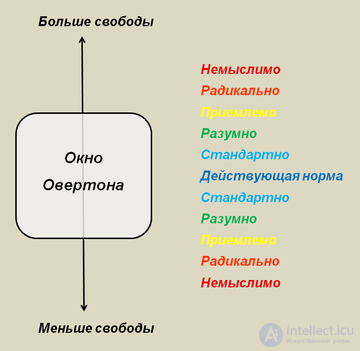
Overton believed that the axis of political discourse was the greater or lesser degree of freedom, which he linked to the degree of regulation of public institutions by the state . According to Overton's model, at any given moment some ideas make up the current norm, forming a reference point, while the remaining ideas may either fall within the range of the acceptable or not. Later, the American neoconservative Joshua Treviño proposed the following scale for assessing the permissibility of ideas:
Treviño proposed that the boundaries of the window of neutral political discourse be considered the ideas falling into the acceptable category. Statements lying within the discourse window can be considered politically safe, risk-free for a public politician wishing to preserve an image of predictability and reliability in order to continue his political career. Overton himself considered support for ideas outside the frame to be risky and potentially harmful to a political career. Comparing the actual statements of politicians with their declared political positions allowed Overton to conclude that the behavior of most democratically elected public politicians is mainly determined by public opinion, lies within the discourse window, and depends only weakly on their personal beliefs. The emergence and consolidation of new ideas in politics, according to the model, occurs through the shifting of the discourse window, which makes it possible to safely discuss ideas and decisions previously considered too radical.
The subsequent development of the concept after Overton's death mainly concerned the study of the evolution of the window's frames under the influence of current political events and the discourse of the mass media. In particular, Joseph Lehman (Eng. Joseph Lehman), president of the Mackinac Center for Public Policy. expressed the opinion that the most stable shifts of the political discourse window are consequences of profound social changes . As an example of a weakly justified political shift, Lehman cited “Prohibition”, noting, on the one hand, the existence of a social demand for banning the consumption of alcohol, and on the other hand, an insufficient social base for the long-term sustainability of this policy . Lehman also noted that the deliberate support of ideas outside the Overton window is, as a rule, characteristic either of strong leaders, whose actions and statements shift the frames of discourse, or of political outsiders, for whom, under conditions of representative democracy, such support would mean a noticeable loss of political capital.
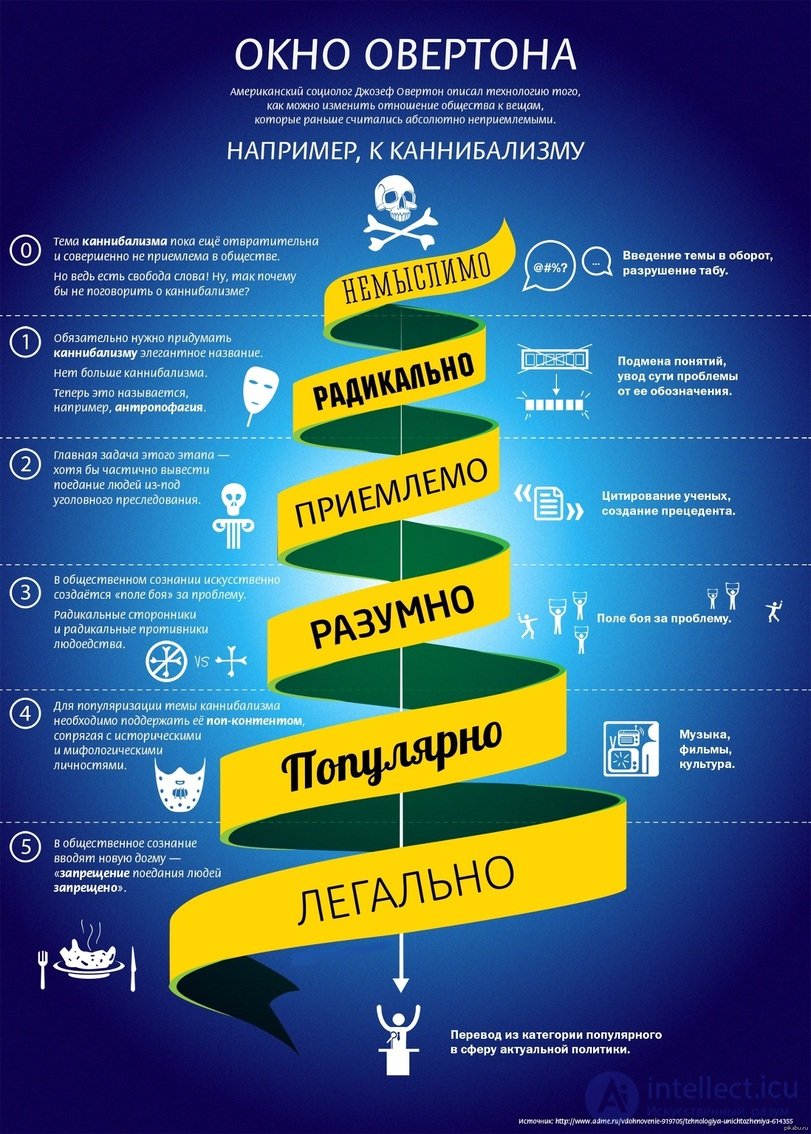
The simplicity and clarity of the idea gave the term considerable popularity, and in the process some authors added to the original concept the idea of possible deliberate manipulation of the discourse window's frames . The author himself and the popularizers of the term, although allowing for the possibility of manipulating the frames of discourse, considered the spread of false information to be bad policy
The concept has been invoked to explain unexpected phenomena in the public and political life of various countries of the world; in particular, attempts have been made to explain by manipulation of the frames of discourse the victory of Donald Trump, the outcome of the Brexit vote, and the sudden rise in popularity of the left-wing politicians Jeremy Corbyn and Bernie Sanders .
In Russian-language commentary and the blogosphere, the term came into widespread use from the beginning of 2014 as a designation for the technology of deliberate manipulation of public opinion for unseemly purposes . It was noted that the name of the concept allows it to be perceived as external to Russian political discourse
The Overton window, in the presentation given by Joshua Treviño and Joe Carter, has been criticized by social-science specialists both for oversimplifying the theory of social frames , and for effectively reducing the idea to a conspiracy theory. It was also noted that, owing to the diversity of social strata in modern society, the idea of a single “discourse window” for everyone may simply be inapplicable.
In the dystopia “Boomsday”, published in 2007, (Boomsday) . by the writer Christopher Buckley, the characters introduce into public discourse the idea of “voluntary departure” at age 70 to relieve the burden on the social welfare system in the United States.
In 2010, Glenn Beck's political thriller “The Overton Window”. was published, telling of a large-scale manipulation of American public opinion to justify the occupation of US territory, which represented the author's own interpretation of the concept. This book apparently was what made the term widely used in the USA.

Comments