
Lecture
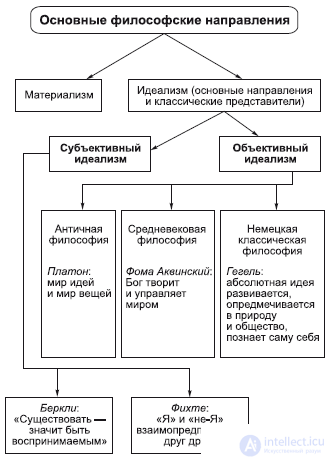
Idealism exists in two forms: objective and subjective.
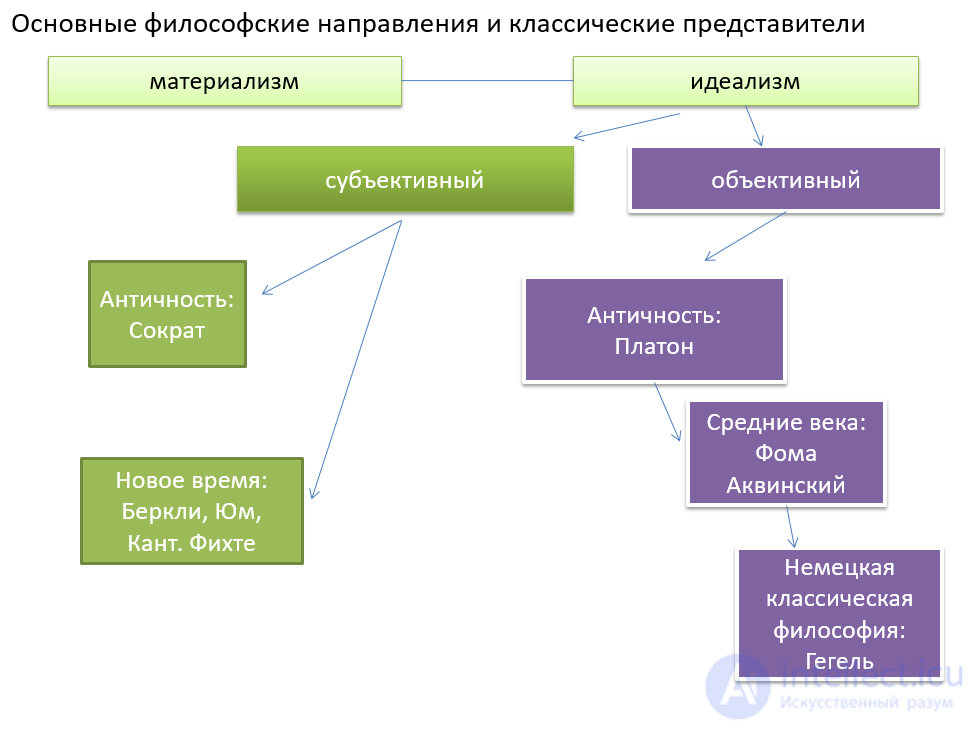
Objective idealism takes as its starting point world consciousness, world reason. In different philosophical teachings this starting point is called by different names (Spirit, Brahman, Idea, Will, etc.). This ideal, spiritual principle gives rise to the world of things, of objects, as well as to human consciousness. Since this principle exists outside human consciousness, objectively, this form of idealism is called objective idealism.
The classical representatives of objective idealism in European philosophy are Plato (428–347) – in antiquity, Thomas Aquinas (1225–1274) – in the Middle Ages, Hegel (1770–1831) – in the philosophy of the modern era; in Indian philosophy – the orthodox darshanas (for example, Vedanta).
Plato speaks of two worlds: the world of ideas and the world of things. Every kind of thing has its prototype in the form of a corresponding idea. Plato introduces into his philosophical system a deity, a demiurge, who, with the help of the world soul, creates the world of things on the basis of ideas as prototypes. Here it is important to note that, for Plato, the world of things is created out of a certain passive, indeterminate matter. The idea of the creation of matter was represented in Christian philosophy in the form of the principle of creationism, which asserts the creation of the world out of nothing. This principle was held by Thomas Aquinas.
If for Plato the starting point was the world of ideas, then for Hegel the starting point asserted was the «absolute idea».
In subjective idealism the dependence of the world, of things, etc. on man, on his consciousness, is asserted. Well-known representatives of subjective idealism are Berkeley (1685–1753), Fichte (1762–1814), some existentialists, and others.
The path to subjective idealism is built by Berkeley as follows. First of all, he asserts the relativity of perceived qualities. Thus, depending on distance, one and the same object seems to us now large, now small. Further, everything we know about objects reduces to sensations of size, shape, hardness, color, smell, taste, and so on. Therefore, what we call a thing is nothing other than a combination of our sensations, our perceptions. From this followed Berkeley's famous thesis: Esse–percipi – «To be is to be perceived». As for objective existence, that is, existence outside of and independent of perceptions, from Berkeley's point of view one cannot speak of it at all. Subjective idealists say that the world is as we imagine it to be, and so on.
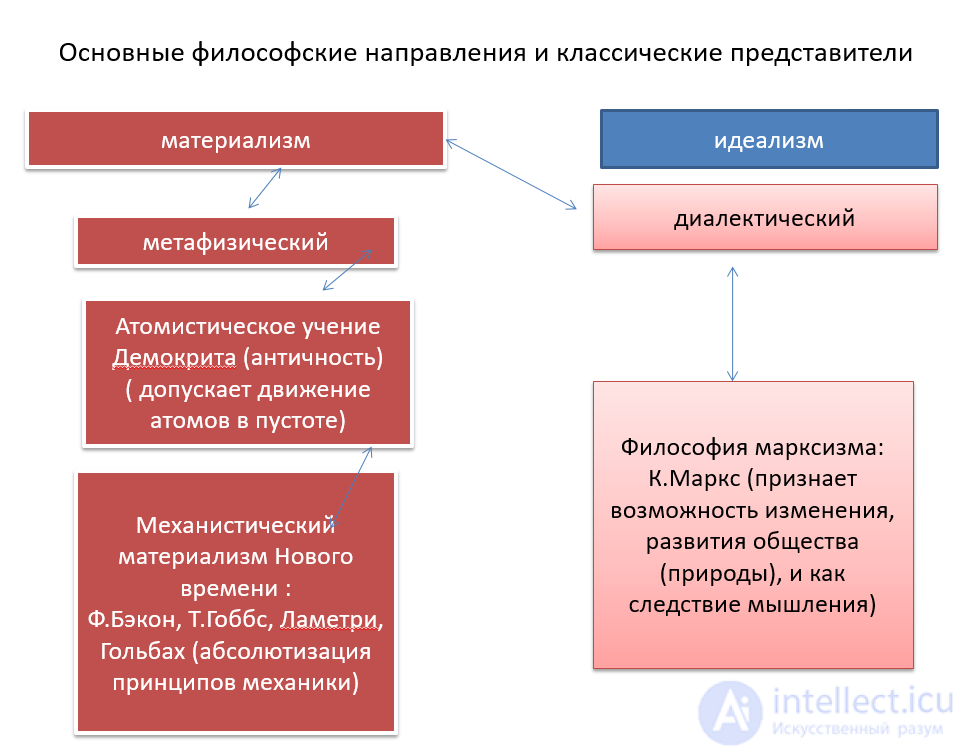
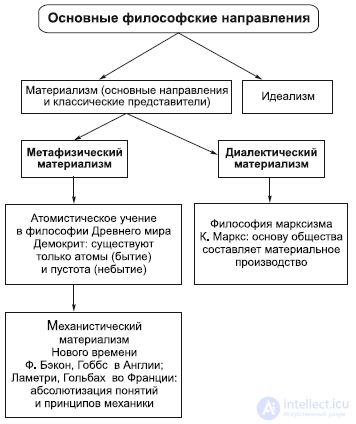
Materialism has a long history. The beginnings of materialism were present in the philosophy of the ancient world (for example, Taoism in ancient China, Charvaka-Lokayata in ancient India, the Milesian school in ancient Greece).
The first basic form of materialism is mechanistic materialism. Approaches to it are already found in antiquity (for example, the atomistic doctrine). This form of materialism developed further in the philosophy of the modern era. Its well-known representatives are: F. Bacon (1561–1626), Hobbes (1588–1679) – in England, La Mettrie (1709–1751), Holbach (1723–1789) – in France, and others. This materialism relies on the achievements of natural science, mainly on mechanics, which for a long time was the leading branch of natural science. Philosophers absolutized a number of concepts and principles of mechanics, as a result of which the material world was presented as a highly complex and unchanging mechanism in which everything is causally determined and necessary.
Mechanistic, metaphysical materialists were materialists in explaining nature, but did not rise to materialism in understanding society; believing that there is no mechanical causality in society, they asserted that moral principles operate in it, that «opinions rule the world», and so on.
History shows that there were dialectical moments within mechanical, metaphysical materialism and natural science. The point is that, owing to the objectivity and universality of development, even a philosopher or scholar who thinks metaphysically as a whole cannot fully abstract from it and, in some way, sometimes even unconsciously, reflects development. What is different is that this reflection was one-sided and inadequate.
The highest, contemporary form of materialism is dialectical materialism. Its starting foundation was the philosophical views of Marx (1818–1883) and Engels (1820–1895). Subsequently the views of the founders of dialectical materialism were to have a dual fate. For quite a long period they were canonized in the countries of socialism. But then they underwent development, concretization, and refinement; some of their propositions were abandoned (mainly in socio-philosophical conceptions), and new ideas were put forward. Problems of ontology, epistemology, methodology, and other branches of philosophy are being intensively developed within the framework of dialectical materialism.
Materialism, in the social sense, has its grounds in the activity and ideology of advanced social groups; materialism is oriented toward reflecting the data of science and practice, toward mobilizing forces for the progressive transformation of social life.
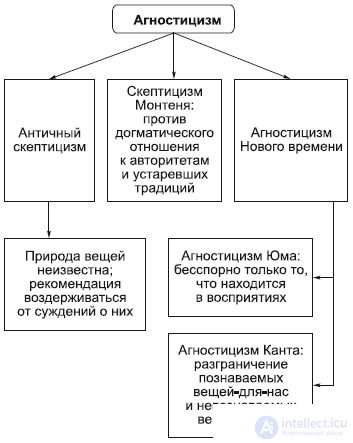
Turning to the second side of the fundamental question of philosophy, we saw two positions: the recognition of the knowability of the world, and doubt about, or even the denial of the possibility of attaining truth. The latter position, we recall, is called agnosticism.
Agnosticism, too, has its own history. In ancient agnosticism it existed in the form of skepticism. The Greek skeptics posed three questions:
1) what is the nature of things?
2) how should we relate to them?
3) what will follow for us from this relation? The following answers were given to these questions:
a) since to every thesis about the nature of things an equally well-founded antithesis can be opposed, the nature of things is unknown to us;
b) one must relate to things, unconditionally, skeptically, refraining from categorical judgments about them;
c) the suspension of judgment brings with it equanimity and the absence of suffering, in which happiness consists.
In the Renaissance and the beginning of the modern era, the skepticism of Montaigne (1533–1592) and Bayle (1647–1706) was directed against a dogmatic attitude toward authorities and fought against prejudices and outdated traditions.
The agnosticism of the modern era is represented by Hume (1711–1776) and Kant (1724–1804). Hume asserted that we can only guess whether there is anything behind our perceptions; Hume paid particular attention to the critique of habitual notions of causality. Kant said that we know that which is the object of our senses («things for us»), but that we cannot in principle know what things are in themselves («things in themselves»). In trying to know «things in themselves», for example in trying to decide whether the world is finite or infinite, reason falls into contradiction, into an antinomy, and the question remains in principle unresolvable.
A tendency toward agnosticism also appears in a number of currents of contemporary philosophy. Thus, in existentialism some of its representatives assert the unknowability of human existence, proposing moreover to evaluate this unknowability positively, since «knowledge weighs down existence».
Agnosticism has certain ontological grounds. The point is that material objects are dialectically contradictory, representing a unity of the external and the internal, of appearance and essence. A metaphysical interpretation of their relation, an absolutization of one of the sides of their unity, opens the way to agnosticism. Agnosticism also has social preconditions; it is advantageous for those in power to instill in people the opinion that the world cannot be changed, since it is unknowable.
The history of the development of philosophy in Russia is an integral part of the worldwide historico-philosophical process. Philosophical thought went through a difficult path during the Soviet years. It reflected the cultural and historical development of Russia. Domestic philosophical thought arose later than in neighboring countries and experienced a strong influence, first of Byzantine and ancient thought, and then of Western European philosophy. With the arrival of Bolshevik power, Russian philosophy developed mainly as Marxist philosophy, while destalinization and the «Khrushchev thaw» created a new atmosphere marked by a revival of creative thought in philosophy.
Russian philosophy as an original direction of world philosophy arose only in the first third of the 19th century and existed until the beginning of the 1920s. Before that time there was a lengthy preparatory stage (from the baptism of Rus at the end of the 10th century to the era of Peter I), in which a negative attitude toward philosophy prevailed under the dominant Orthodoxy, and an enlightenment stage in the 18th century, in which philosophy was recognized as an independent science. Following Aristotle, philosophy was traditionally divided into theoretical and practical parts. Among theoretical tasks the Enlightenment thinkers traditionally distinguished natural-philosophical and cognitive ones (M.V. Lomonosov); among practical ones – socio-political (A.N. Radishchev) and anthropological (A.I. Galich).
"Russian philosophical thought, from the time its first glimmers appeared in the 18th century and for a very long period thereafter, led a wretched and meager existence. Its main defect was the complete absence of originality – of independent speculative creativity that might have expressed itself in literary form and led to definite and systematic results. Russian philosophers were only followers of Western Europeans, and moreover, secondary followers at that" (L.M. Lopatin, "Philosophical Characteristics and Speeches").
Mikhail Vasilyevich Lomonosov (1711-1765) sought to found "rules of life" on the laws of the "surrounding world". In his opinion, truth is twofold – there is divine truth and there is worldly truth. He shared Parmenides' view that being is, and non-being is not. Nature strictly observes the laws of nature and excludes everything that contradicts them, that is, miracles. The indestructibility of being is compatible with its motion. Thanks to motion, being is able to preserve itself: "As much matter as is added to one body, so much is taken away from another" (M.V. Lomonosov, Letter to Leonhard Euler, July 5, 1748).
Alexander Nikolaevich Radishchev (1749-1802), in his book "Journey from St. Petersburg to Moscow", subjected serfdom and absolutism to devastating criticism. Dreaming of a just redistribution of social wealth, he hoped for reforming wisdom on the part of the tsar and the enlightenment of the nobility. According to Radishchev, man by nature is neither good nor cruel; everything depends on circumstances. The cultivation of mind and feeling is the most important condition for social progress.
"Labor with your body; your passions will have less violent turmoil; labor with your heart, exercising tenderness, sensitivity, compassion, generosity, forgiveness, and your passions will be directed toward a good end. Labor with your reason, exercising it in reading, reflection, and the search for truth or events; and reason will govern your will and your passions" (A.N. Radishchev, "Journey from St. Petersburg to Moscow").
Alexander Ivanovich Galich (1783-1848) considered anthropology the most important of all the philosophical sciences. In his opinion, this science should become the foundation of all the social sciences, including theology, for in man "all the radii of the universe" converge. Man is a whole being and must build his life on the principles of love, justice, and unanimity. Harmony with the conditions of social life is the main guarantee of the integral development of man.
The topic «The main directions in the development of domestic philosophy after 1917» is relevant, since we can trace how philosophical thought survived while «packaged» within the party's Leninist-Marxist shell, and what form it took after being freed from it.
The aim of this work is to trace the historical chain of the development of domestic philosophy from the October Revolution to the present time. To achieve this aim it is necessary to solve the following tasks: to present the main directions of domestic philosophy of the Soviet and post-Soviet periods, and to illuminate the emergence and development of philosophical schools.
In the development of domestic post-revolutionary philosophy one can distinguish a number of periods corresponding to particular stages in the development of society: the arrival of Bolshevik power, the harsh dictatorship of Stalin, destalinization and the «thaw», and the post-Soviet period. The most significant changes occurred after the condemnation of the Stalin cult. As a result of the weakening of ideological control and the successes of science and technology, new tendencies arose in philosophical research, which often ran counter to official doctrine. New directions and disciplines took shape.
Gradually, philosophers moved away from Marxist canons, and schools formed in the history of philosophy, epistemology, logic, philosophy of science, and philosophical anthropology. The unified version of Marxist philosophy gave way to non-traditional, more flexible approaches.
After the collapse of the USSR, a reassessment of values took place, along with a rejection of «Soviet Marxism». At the same time, the positive achievements of creatively thinking philosophers of the Soviet period contributed to creating the intellectual preconditions for the subsequent period of Russian philosophical thought. The potential of these achievements combines with a new understanding of the history of both Russian and foreign philosophy, especially of ideas that resonate with contemporary needs to develop an updated system of values.
According to historians, the original development of Russian philosophy begins after the victory over Napoleon in the Patriotic War of 1812 and the campaign of the Russian army in Europe in 1813-1814. These events, together with the Decembrist uprising of 1825, awakened the historical self-consciousness of the Russian intelligentsia and gave impetus to discussions about the historical role (mission) of Russia. This problem determined the main direction of the development of Russian philosophy for many years. It was resolved not in the quiet of studies but in real polemics with the authorities. It was investigated not by professional philosophers but by writers, revolutionaries, clergy, and scholars. Exile, prison, hard labor, or banishment from the homeland often served as the reward for the ideas defended. Russian philosophy comes to an end in the 1920s.
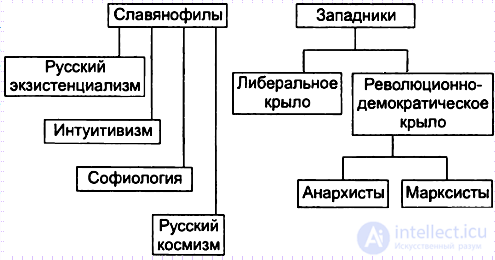
There are many grounds on which one can classify Russian philosophy of the 19th century. Depending on how the problem of Russia's historical self-determination is resolved, two opposing directions are distinguished – the Westernizers (V.G. Belinsky, A.I. Herzen, T.N. Granovsky, N.A. Dobrolyubov, D.I. Pisarev, N.V. Stankevich, P.Ya. Chaadaev, N.G. Chernyshevsky) and the Slavophiles (K.S. Aksakov, N.Ya. Danilevsky, I.V. Kireevsky, K.N. Leontiev, Yu.F. Samarin, V.S. Solovyov, N.N. Strakhov, A.S. Khomyakov).
The Westernizers believed that Russia's future lay in its Europeanization, in joining the world history of humanity. The whole history of Russia was, for them, an example of how one should not live. The Slavophiles, on the contrary, held that Russia had its own special path of development – the building of a Russian Christian socialism founded on the revival of the values of Orthodoxy and the communal way of life. Catholicism, in A.S. Khomyakov's view, is deprived of ecclesiastical freedom, since it accepts the dogma of the infallibility of the Pope. Protestantism, on the contrary, absolutizes human freedom and individuality, which destroys ecclesiality. Only Orthodoxy, he believed, harmoniously combines freedom with necessity, individual religiosity with ecclesiastical organization. Later, V.S. Solovyov proposed uniting the Catholic and Orthodox branches of Christianity and creating a single monarchy on this basis. In his view, it was to embody the ideals of a "Godmanhood union", a "free theocracy", and a truly "Christian world". Russia, the Slavophiles believed, was called to show all other countries how one ought to live.
The Westernizers were divided into two branches – a liberal one (T.N. Granovsky, N.V. Stankevich) and a revolutionary-democratic one (A.I. Herzen, N.G. Chernyshevsky). Russian anarchists (M.A. Bakunin, P.A. Kropotkin) and Marxists (G.V. Plekhanov, V.I. Lenin) can be regarded as the chief outcome of the development of the revolutionary-democratic branch of Westernism.
The Slavophiles likewise do not represent a homogeneous movement. They are divided into different currents depending on the form taken by the revival of Orthodox values: religious existentialism (N. A. Berdyaev, L. I. Shestov), intuitivism (N. O. Lossky), sophiology (V. S. Solovyov). An interesting product of the development of Slavophilism was Russian cosmism (N. F. Fyodorov, K. E. Tsiolkovsky, V. I. Vernadsky, A. L. Chizhevsky), which, besides scholars, was also supported by prominent Slavophiles.
The discussion of Russia's place in world and European history was set in motion by the publication, in the journal "Teleskop" in 1836, of the first (and last) of the eight "Philosophical Letters" of Pyotr Yakovlevich Chaadaev (1794-1856), after which the philosopher was officially declared insane and placed under house arrest, and the journal was closed.
In that letter Chaadaev stated a problem that remains relevant to this day: Russia is neither West nor East: "One of the saddest features of our peculiar civilization is that we are still discovering truths that have become commonplace elsewhere, and even among peoples who are in some respects more backward than we are. The fact is that we have never walked alongside other peoples; we belong to none of the known families of the human race, neither to the West nor to the East, and possess the traditions of neither. We stand as if outside of time, and the universal education of the human race has not extended to us" (P. Ya. Chaadaev, "Philosophical Letters").
The cause of Russia's backwardness, Chaadaev believed, lay in its choice of the Orthodox version of Christianity. This unfortunate choice predetermined Russia's estrangement from Europe and its cultural and social isolation. The solution to all of Russia's problems lies in a return to true Christianity – Catholicism. "I repeat once more: of course, in the countries of Europe not everything is filled with intelligence, virtue, and religion, far from it. But there everything is mysteriously subordinated to the power [of the Roman church], which reigned undivided for centuries; everything is the result of that prolonged chain of acts and ideas by which the present state of society has been created…" (P. Ya. Chaadaev, "Philosophical Letters")
With the Bolsheviks' rise to power, the field of philosophical activity shrank considerably. In the first post-October years, Marxist philosophical research in the country most often appeared under the general heading of «historical materialism». An ideological offensive began against non-Marxist philosophical currents, a struggle for the monopoly of Marxism. Some of the old philosophical societies and journals were closed. The leadership of the Bolshevik party sought to permeate society with the spirit of Marxism. Philosophers who were ideologically unwelcome at the time, especially philosophers of the old school, were expelled from the country. This fate befell N. A. Berdyaev, S. N. Bulgakov, I. A. Ilyin, I. I. Lapshin, S. L. Frank, L. P. Karsavin, and N. O. Lossky. Many philosophers perished in prisons and exile. Adherents of the Marxist worldview launched a frontal offensive against various idealist schools, subjecting them to criticism. For the first time in its history, the Marxist worldview received state support and was proclaimed the theoretical foundation for the development of social being and consciousness, and of the state's domestic and foreign policy.
Until the end of the 1920s, intellectual and philosophical life retained a pluralistic character. Alongside the scholarly institutions where units devoted to Marxist philosophy operated, there were still institutions employing mainly philosophers of the old formation. Works far removed from Marxism still appeared. Some journals still published the neo-Hegelian Ilyin, the Nietzschean Shestov, the idealist Chelpanov, and others. Private publishing houses issued books and pamphlets by philosophizing reactionaries. In the press and in institutions of higher learning, fierce ideological struggle raged. Beyond the bounds of the dominant official philosophy, trends were emerging that were generated by the contradictory socio-cultural situation and the intensive development of the natural sciences and psychology. It was precisely in the 1920s-30s that new ideas appeared in the fields of cultural studies, tectology, hermeneutics, the noosphere, and others, which received their further development later – after the 1960s.
In the 1920s a discussion unfolded on the relationship between the philosophical worldview and natural science, between the universal philosophical method and particular methods of cognition. The leaders of the disputing sides were I. I. Stepanov (Skvortsov) and A. M. Deborin. Followers of the former came to be called «mechanists», and of the latter – «dialecticians». And although over the course of the discussion the disputing sides gradually converged, it was nonetheless the «dialecticians» who prevailed. One reason for this was that the «dialecticians» in effect oriented philosophy toward «governing» the sciences, toward «commanding» them. This orientation was in keeping with the understanding of philosophy's special role that had taken shape in the second half of the 1920s, according to which philosophy was assigned the task of theoretically justifying the party's practical-political line and of directing all spheres of science and culture. In time, however, it turned out that the «Deborinites» too ceased to suit Stalin's political leadership. In the 1930s political labels began to be attached to the disputing sides: the «mechanists» were branded a «right-wing political deviation», and the «dialecticians» «Menshevizing idealists».
After the establishment of Stalin's personal rule, the country's philosophical life proceeded under conditions of harsh and brutal political-ideological control, accompanied by repression against philosophers. Textbooks published in the early 1930s formed a specific image of Marxist philosophy. They upheld the principle of partisanship and emphasized the role of class struggle in the history of society.
Those who headed the administration of philosophical scholarship – M. B. Mitin, P. F. Yudin, G. F. Alexandrov, E. P. Sitkovsky, M. M. Rosenthal – glorified Stalin as a philosopher under the guise of strengthening the party line. Philosophy came to be practiced as a form of politics.
This glorification intensified especially after Stalin wrote the chapter «On Dialectical and Historical Materialism» in the «Short Course on the History of the CPSU(b)» in 1938. This work was proclaimed the «pinnacle» of Marxist philosophy. In reality it was marked by schematism and oversimplification. In Stalin's conception, the dialectical method and materialist theory were treated as a single doctrine: about being, about the world, about the laws («features») of objective reality. He defined the method of cognition merely as the laws of development of the objective world. The law of the unity and struggle of opposites was reduced to the law of their struggle. The law of negation was removed altogether (as a kind of «vestige» of Hegelianism). Concrete political recommendations were derived «directly» from abstract philosophical premises.
The intellectual and philosophical climate was greatly affected by the 1946 discussion of G. F. Alexandrov's book «A History of West European Philosophy». A. A. Zhdanov called the entire «pre-Marxist» history «unscientific» and set against it the «scientific» Marxist philosophy. Zhdanov advanced a number of theses on the subject and tasks of Marxist philosophy that diverged from the prevailing views. In his opinion, dialectical materialism was not a science of sciences but an instrument of cognition, and Marxist philosophy should not stand above the other sciences.
As a result, the share of research devoted to problems of the theory of knowledge and dialectical logic already increased significantly, and discussions took place on the relationship between dialectical and formal logic. The process of differentiation of philosophical knowledge and the growing autonomy of its individual branches intensified. Soviet philosophy was transformed into a system of philosophical disciplines.
In 1956 the condemnation of Stalin's cult of personality opened up possibilities for the development of philosophical thought in the country, thanks to a weakening of the harsh ideological control over the social sciences. A generation of new philosophers and cultural figures emerged, striving to overcome dogmatism and stereotypes. At the turn of the 1950s-60s, psychology emerged as an independent discipline, ethics and aesthetics became more autonomous, and axiology, sociology, and other sciences took shape.
At the turn of the 1950s-60s, the problems of epistemology and the theory and logic of cognition became the center of philosophical research. A prominent role here was played by E. V. Ilyenkov, B. M. Kedrov, P. V. Kopnin, and their followers. Ilyenkov made an important contribution to the development of the theory of materialist dialectics as logic, and to the creation of a system of logical-dialectical categories. He regarded the ascent from the abstract to the concrete as the «universal method of thought in science in general». This same problem began to be studied by philosophers of the older generation, M. M. Rosenthal, L. A. Mankovsky, and others. E. V. Ilyenkov's ideas in the theory of knowledge influenced G. S. Batishchev, who moved on to analyzing problems of philosophical anthropology and created his own school of analysis of profound communication. V. A. Lektorsky, L. K. Naumenko, D. M. Abdildin, A. Kasymzhanov, and others also developed their own epistemological and methodological conceptions.
A. A. Zinoviev, in works devoted to the logic of «Capital», focused on the analysis of various logical devices. From Zinoviev's school came B. A. Grushin's studies of the methods of historical analysis, as well as the first works of M. K. Mamardashvili, devoted to the processes of analysis and synthesis and to the relationship between form and content in theoretical thought. G. P. Shchedrovitsky, who later founded his own school, also came out of this school.
The works of M. K. Mamardashvili occupy a special place. He moved from the study of problems of logic, methodology, and the theory of knowledge to the study of problems of consciousness, and created an original philosophical-anthropological conception, drawing on the ideas not only of Marx but also of phenomenology and existentialism.
In the 1970s-80s, the school of V. S. Bibler worked intensively. He developed an original conception of thought as a dialogue of different logics and moved on to the study of problems of cognition within the framework of the philosophical theory of culture.
The school of logic and methodology of science arose in the 1960s in Kyiv, led by P. V. Kopnin, who developed principles for combining substantive and formal-logical analysis of scientific knowledge. Within the Kyiv school a number of studies were produced by M. V. Popovych, S. B. Krymsky, and P. S. Dyshlevy.
In Minsk a school of the methodology of science arose, based on the ideas of V. S. Stepin. Its focus was on the problems of the genesis of theoretical knowledge within the interaction of the scientific picture of the world, theoretical schemas, formal apparatus, and practical and ideal operations.
In Novosibirsk a school of the methodology of science worked productively, based on M. A. Rozov's ideas about social memory and «social relays».
On the whole, the study of problems in the theory of knowledge and the methodology of science experienced a rise in the 1960s-80s. During this time the following problems were studied: the relationship between theory and empirical data, idealization and formalization, explanation and description, the problems of modeling, the hypothetico-deductive model of the development of science, the role of constructs and ideal objects in the construction of theories, the axiomatic method of constructing theory, knowledge as a historical process, and the commensurability of theories.
System-structural studies played an important role in the development of problems in the methodology of science. In the context of these studies it became possible to examine such problems as systemicity, wholeness, organization, structure, and the structural approach to the analysis of change. In the 1960s a number of philosophers became engaged in constructing various models of the subordination and systematization of philosophical categories, but this enthusiasm later declined.
The study of problems in contemporary formal logic proceeded with great success. A. A. Zinoviev had a major influence on the reorientation of logical research and took up symbolic logic. This reorientation of formal-logical research toward contemporary problems was supported by P. V. Tavanets and later developed by V. A. Smirnov, who created and headed an original logical school. Research into the history of logic developed. Logician-philosophers were actively supported by logician-mathematicians. The works of domestic logicians received international recognition.
Philosophical problems were intensively developed during these years. A large field arose with a diverse and branching set of topics: the problem of causality in contemporary science, the correspondence principle, the complementarity principle, the observability principle, the reduction principle, the problem of global evolutionism, and others. Major scholars from various specialties took an active part in developing the philosophical problems of natural science
In the 1960s-70s works appeared that can rightly be attributed to the nascent philosophical anthropology. A number of philosophers in these years arrived at the idea that it was impossible to study the problems of the theory of consciousness outside the framework of a holistic philosophical-anthropological conception. Research broadly developed on the theory and history of aesthetics, on the structure of aesthetic categories (the sublime, the beautiful, the tragic, the comic), on the relationship between mass and elite art, and on the critical analysis of contemporary European aesthetics.
A rise began in the study of the history of Western philosophy. Methodological problems of historical-philosophical research were developed. Historical-philosophical scholarship was enriched with works on ancient, medieval, Renaissance, and modern and contemporary philosophy. Various trends of contemporary Western philosophy were studied – phenomenology, existentialism, neo-Thomism, philosophical anthropology, critical rationalism, pragmatism, neopositivism, hermeneutics, structuralism. Serious studies of the formation and development of K. Marx's views appeared.
The study of the history of Russian philosophy was conducted one-sidedly. The history of Russian idealism was practically not studied. And yet even in this area serious studies appeared. These were works on the history of Russian "lyubomudrie" (philosophic wisdom) of the 1920s-30s. The study of the history of philosophy in the countries of the East – China, India, Japan, Iran, and the Arab countries – developed into an independent field.
By the early 1970s, national and regional philosophical communities with their own problems and research programs had taken shape in the USSR. At the same time there was intensive interaction among these communities. As a result, interesting research findings became the common property of all Soviet philosophers. Thus, for example, the research of Leningrad philosophers was oriented primarily toward ontological problems and the philosophical questions of natural science. In Rostov-on-Don a group of researchers into the philosophy of culture took shape. In Novosibirsk, besides the activity of M. A. Rozov's school, research was conducted on the philosophy of science and the study of intellectual systems. In Sverdlovsk problems of social philosophy, philosophical anthropology, and the theory of knowledge were developed. In Tomsk a group of philosophers worked on the methodology of science. In Voronezh the probabilistic picture of the world was studied
In the republics of the USSR, philosophical communities also had their own research programs. In Ukraine the school of logic and methodology of science and the school of philosophical anthropology worked successfully. In Belarus interesting results in the philosophy of science were obtained within the school of V. S. Stepin. The works of Kazakh philosophers on the theory of dialectics, stimulated by the ideas of E. V. Ilyenkov, gained recognition. In Tajikistan productive work was done on philosophical questions of cosmology and on the history of philosophy. In Kyrgyzstan research was carried out on problems of communication and understanding. In Georgia research was conducted on the history of contemporary philosophy, on aesthetics, and on current problems of logic. Armenian philosophers intensively developed problems of semiotics and the philosophy of culture. The Tartu school of semiotics (headed by Yu. M. Lotman) gained worldwide fame. In Estonia, too, problems of the theory of knowledge and the methodology of science were successfully studied. In Lithuania philosophical problems of contemporary formal logic and ethics were studied.
Thus, although in these years Soviet philosophers could not but declare their adherence to the ideas of Marxism, within these bounds different philosophical schools in fact developed productively, arguing with one another and enriching one another. All of them stood opposed to the philosophical dogmatism imposed by the ideological leadership, which manifested itself above all in the teaching of philosophy. At the same time, the different schools also differed from one another in their attitude toward the Marxist heritage. While some of them tried to develop, under contemporary conditions, the ideas contained in Marx's works, others used Marxist terminology to develop ideas close to neopositivism, existentialism, or phenomenology. Some philosophers, who had earlier been zealous adherents of the ideas of the young Marx, later began to combine his ideas with the ideas of phenomenology, existentialism, and other trends of contemporary philosophy
The publication in 1960–1970 of the five-volume «Philosophical Encyclopedia» had a significant influence on the development of philosophical research in the USSR. This encyclopedia introduced many problems and concepts that were new for that time.
A very important role in Soviet philosophy of these years was played by the journal «Voprosy Filosofii» (Problems of Philosophy), especially in the second half of the 1960s and the 1970s, when its editor-in-chief was I.T. Frolov, and his deputy was M.K. Mamardashvili. During these years the journal became something of a distinctive gathering place for many of our intellectuals. It discussed problems of the philosophy of science, culture, education, and history, which were connected with the principal worldview quests of the time. The regular publication of the journal «Filosofskie Nauki» (Philosophical Sciences) was also significant for the development of philosophy, as it discussed not only theoretical problems of philosophy but also questions of teaching philosophy.
At the same time, the development of philosophy in these years took place under difficult conditions. Whereas in the field of epistemology, the philosophy and methodology of science, logic, and in a number of areas of philosophical anthropology, ethics, aesthetics, philosophy of culture, and history of philosophy it was possible not only to put forward new ideas but also to create actively working scholarly schools, in the field of social philosophy this was far more difficult. Nevertheless, such attempts were made. These included the development of an authentic Marxian understanding of the socio-economic formation and the demonstration of its contemporary significance; the study of methodological problems of historical science; and the investigation of particular questions of social philosophy. At this time thorough research into the philosophy of religion also began.
Certain areas of philosophical knowledge, such as political philosophy, for example, could not exist at all during these years. Russian religious philosophy, which is an integral part of Russian culture, was practically forbidden. Although the first studies of this kind did nevertheless appear in the «Philosophical Encyclopedia», further work in this direction was halted. At that time domestic philosophical thought had difficulty finding ways to engage in dialogue with various currents of world philosophy. But a number of steps were taken: works by contemporary Western authors were translated, especially on problems of logic and the methodology of science, and Soviet philosophers began to take part regularly in World Congresses of Philosophy and congresses on logic, philosophy, and the methodology of science. However, there was no ongoing working interaction with Western colleagues, especially those who were developing the fundamental problems of metaphysics, philosophical anthropology, and social and political philosophy.
The authorities continued to demand of philosophers ideological support for party policy in the form of developing questions of scientific communism, philosophical commentary and propaganda for current party decisions, and the preparation of textbooks that set out the official version of philosophy. The public judged Soviet philosophy primarily by these works, which killed any taste for genuine philosophical thought in those who read them. Our greatest philosophers were known only within narrow circles of the intelligentsia.
In the 1990s and at the beginning of the 21st century, philosophy began to develop in an entirely new intellectual and cultural situation, amid the disappearance of the official ideology and the possibility of developing various philosophical conceptions. The situation that arose at the beginning of the 1990s was so new that some philosophers were tempted to begin working in culture, and in philosophy as part of it, as if starting from scratch. And if it is truly impossible to start entirely from scratch – for without traditions no creative endeavor is possible – then, at the very least, some of our philosophers began to think it would be best to «skip over», simply not to notice everything that had been done in our culture during the gloomy decades of ideological dictatorship. To try to work out in detail what had been done then, to try to separate the bad from the good, seemed pointless. For even what was then considered good, «progressive» (and perhaps was indeed so under those difficult conditions), can hardly serve as a foundation for philosophizing today. After all, today we already see clearly that even the best representatives of our philosophy of that time were affected by the deadening influence of outmoded dogmas. It could not have been otherwise for those who were born, grew up, and lived at that time. Therefore, the development of contemporary Russian philosophy must rely on other traditions. Some in this connection proposed continuing what had been done in Russian religious philosophy, drawing on this source of ideas connected with Orthodoxy and the culture of the Silver Age. In this regard particular significance was attached to the philosophical ideas of A.F. Losev, who lived, worked, and published in the USSR, but in essence developed, under the new conditions, the ideas of Russian religious philosophy of the early century. Others saw a possible source of new philosophical creativity in the assimilation of the ideas of contemporary Western philosophy, in particular phenomenology and postmodernism.
New opportunities for philosophy have now arisen in our country. Works by the classics of Russian religious philosophy are being republished.
And yet the view that philosophy in Russia can develop only from these two sources – the assimilation of the heritage of Russian religious philosophy and contemporary Western philosophy – is mistaken. The fact is that, for all the importance of assimilating the heritage of Russian religious philosophy, this assimilation cannot replace the need for independent philosophical creativity and the solving of problems that did not exist for that philosophy. To claim simply to restore the line of development of Russian philosophical thought that was interrupted by the revolution of 1917 is impossible, for our country is now an entirely different one, and the world in which we live has also moved far from what existed in the first decades of our century. As for the assimilation of the classics of 20th-century Western philosophy and contemporary Western philosophical thought, this too is necessary and important. But the point is that the human meaning of philosophy, its social and cultural role, is connected with helping us understand how universal and «eternal» problems relate to the concrete, unique cultural and historical situation specific to a given culture and a given time. Our Russian culture, in its past, present, and future, needs self-awareness (such self-awareness is in general a necessary condition for the development of every culture). It is domestic philosophy that is called upon to attend to this. Contemporary Western thought, like the heritage of domestic philosophy, can substantially help in this, but cannot replace independent thinking. One might even say that if Russian culture has a future, an original philosophical thought cannot fail to exist in our country. Moreover, one can learn to philosophize in only one way: by independently solving philosophical problems. Assimilation of heritage (one's own and others') is necessary but not sufficient, while imitation of others' activity is of little value.
On the whole, over the course of the country's historical development over the past century and a half, domestic philosophical thought has become increasingly «large-scale» and «professional», has gained recognition abroad, and exerts significant influence not only on the worldview of Russia but also on world philosophy.
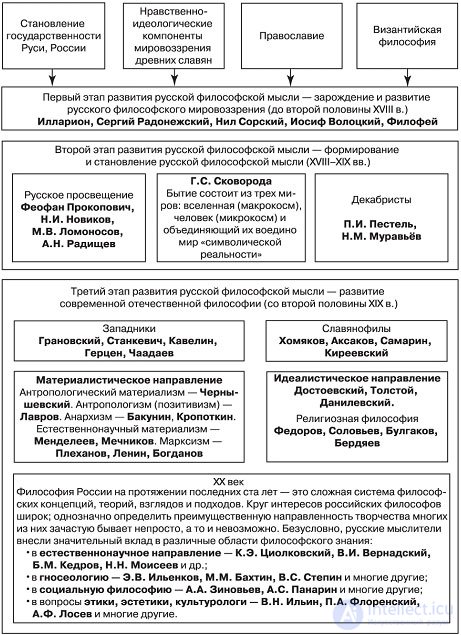
Fig. Stages in the development of Russian philosophy.
From the second half of the 19th century, elaborate, complete philosophical systems appear in Russian philosophy. The dynamic development of domestic and foreign science, the rapid growth in the prestige of Russian literature and art, and significant shifts in the social structure of society influenced every aspect of Russian life. Among other things, this contributed to a deepening of the philosophical understanding of being and led to a differentiation of philosophical knowledge.
At the end of the 19th century, among the educated stratum of Russia, above all the intelligentsia, a materialist understanding of the world began to establish itself and gain strength. In connection with this, the activity of representatives of Russian society defending idealist positions increased.
In philosophy this was expressed in the formation of two currents — the materialist and the idealist.
CONCLUSION
Soviet philosophy destalinization
Soviet philosophy is a multidimensional, ambiguous intellectual tradition possessing a fairly high degree of internal contradiction. As a self-aware system of ideas, theories, and hypotheses, as well as ideologically protective myths, it was formed as a result of:
a) the forcible expulsion of non-Marxist thinkers from Russian social and human studies;
b) the rise to dominant positions in the system of philosophical academic institutions and theoretical bodies in the USSR, in the 1930s, of the pro-Stalinist group led by Mitin and other philosophers;
c) attempts at a certain systematization and at lending respectability to this tradition on the basis of Stalin's work «On Dialectical and Historical Materialism».
The range of possible discussions in Soviet philosophy was defined and sanctioned only after the Second World War. Alongside ideologically engaged theorizing, which undoubtedly dominated in the 1940s–1980s, the research of a number of thinkers in the USSR not only creatively developed the mainstream, avant-garde problems of 20th-century philosophy but also formed new scholarly directions relevant to international philosophical knowledge. Thanks to the efforts of Bakhtin, Lotman, Losev, Averintsev, Stepin, and others, authoritative philosophical schools, both metropolitan and regional, were created in the USSR, and a generation of professional cadres was trained that, on the whole, met the «standard» of philosophy for the third millennium.
Thus, despite the complex political and ideological conditions, dialectical-materialist philosophy in the USSR largely retained its methodological significance and acquired the beginnings of fruitful ideas from the works of well-known Soviet scholars: social scientists and natural scientists, historians of philosophy, ethicists, and aestheticians. National and regional philosophical communities took shape, each with its own problem areas and research programs. At the same time, there was intensive interaction among these communities.
Today in Russia philosophers continue to work and to create. Having freed themselves from the rigid framework of official Marxism, they seek new paths in theory, discovering for themselves and others previously unknown strata of being, experience, and thought.
Philosophical problems were intensively developed during these years. A large field arose with a diverse and ramified range of topics: the problem of causality in contemporary science, the correspondence principle, the complementarity principle, the observability principle, the reduction principle, the problem of global evolutionism, and others. Major scholars of various specialties took an active part in developing the philosophical problems of natural science
In the 1960s–1970s works appear that may fully be regarded as belonging to the emerging field of philosophical anthropology. During these years a number of philosophers came to the view that the problems of the theory of consciousness could not be investigated outside the framework of a holistic philosophical-anthropological conception. Research on the theory and history of aesthetics, on the structure of aesthetic categories (the sublime, the beautiful, the tragic, the comic), on the relationship between mass and elite art, and on the critical analysis of contemporary European aesthetics developed extensively.
A rise begins in the study of the history of Western philosophy. Methodological problems of historico-philosophical research were developed. Historico-philosophical scholarship was enriched by works on ancient, medieval, and Renaissance philosophy, and on the philosophy of the modern and most recent eras. Various currents of contemporary Western philosophy were investigated – phenomenology, existentialism, neo-Thomism, philosophical anthropology, critical rationalism, pragmatism, neopositivism, hermeneutics, and structuralism. Serious studies of the formation and development of K. Marx's views appeared.
Research into the history of Russian philosophy was conducted one-sidedly. The history of Russian idealism was practically not studied. And yet serious studies did appear in this field as well. These were works on the history of Russian «lovers of wisdom» (lyubomudrie) of the 1920s–1930s. The study of the history of philosophy in the countries of the East – China, India, Japan, Iran, and the Arab countries – developed into an independent field.
By the early 1970s, national and regional philosophical communities with their own problem areas and research programs had taken shape in the USSR. At the same time, there was intensive interaction among these communities. As a result, interesting research findings became the property of all Soviet philosophers. Thus, for example, the research of Leningrad philosophers was oriented primarily toward ontological problems and the philosophical questions of natural science. In Rostov-on-Don a team of researchers in the philosophy of culture took shape. In Novosibirsk, besides the activity of M.A. Rozov's school, research was conducted on the philosophy of science and the study of intellectual systems. In Sverdlovsk, problems of social philosophy, philosophical anthropology, and epistemology were developed. In Tomsk a group of philosophers dealt with the methodology of science. In Voronezh the probabilistic picture of the world was investigated
In the republics of the USSR, philosophical communities also had their own research programs. In Ukraine the school of logic and methodology of science and the school of philosophical anthropology worked successfully. In Belarus interesting results in the philosophy of science were obtained within V.S. Stepin's school. The works of Kazakh philosophers on the theory of dialectics, inspired by the ideas of E.V. Ilyenkov, gained renown. In Tajikistan philosophical questions of cosmology and the history of philosophy were fruitfully pursued. In Kyrgyzstan research was carried out on problems of communication and understanding. In Georgia research was conducted on the history of the most recent philosophy, on aesthetics, and on contemporary problems of logic. Armenian philosophers intensively developed problems of semiotics and the philosophy of culture. The Tartu school of semiotics (headed by Yu.M. Lotman) achieved worldwide fame. In Estonia problems of epistemology and the methodology of science were also studied successfully. In Lithuania philosophical problems of contemporary formal logic and ethics were investigated.
Thus, although in these years Soviet philosophers could not fail to declare their adherence to the ideas of Marxism, in essence, within this framework, various philosophical schools developed fruitfully, arguing with and enriching one another. All of them opposed the philosophical dogmatism imposed by the ideological leadership, which manifested itself above all in the teaching of philosophy. At the same time, the various schools also differed from one another in their attitude toward the Marxist heritage. While some of them tried to develop, under contemporary conditions, the ideas contained in Marx's works, others used Marxist terminology to develop ideas close to neopositivism, existentialism, or phenomenology. Some philosophers, who had earlier been zealous adherents of the ideas of the young Marx, subsequently began to combine his ideas with the ideas of phenomenology, existentialism, and other currents of contemporary philosophy
The publication in 1960–1970 of the five-volume «Philosophical Encyclopedia» had a significant influence on the development of philosophical research in the USSR. This encyclopedia introduced many problems and concepts that were new for that time.
A very important role in Soviet philosophy of these years was played by the journal «Voprosy Filosofii» (Problems of Philosophy), especially in the second half of the 1960s and the 1970s, when its editor-in-chief was I.T. Frolov, and his deputy was M.K. Mamardashvili. During these years the journal became something of a distinctive gathering place for many of our intellectuals. It discussed problems of the philosophy of science, culture, education, and history, which were connected with the principal worldview quests of the time. The regular publication of the journal «Filosofskie Nauki» (Philosophical Sciences) was also significant for the development of philosophy, as it discussed not only theoretical problems of philosophy but also questions of teaching philosophy.
At the same time, the development of philosophy in these years took place under difficult conditions. Whereas in the field of epistemology, the philosophy and methodology of science, logic, and in a number of areas of philosophical anthropology, ethics, aesthetics, philosophy of culture, and history of philosophy it was possible not only to put forward new ideas but also to create actively working scholarly schools, in the field of social philosophy this was far more difficult. Nevertheless, such attempts were made. These included the development of an authentic Marxian understanding of the socio-economic formation and the demonstration of its contemporary significance; the study of methodological problems of historical science; and the investigation of particular questions of social philosophy. At this time thorough research into the philosophy of religion also began.
Certain areas of philosophical knowledge, such as political philosophy, for example, could not exist at all during those years. Russian religious philosophy, an integral part of Russian culture, was practically under prohibition. Although the first studies of this kind did appear in the «Philosophical Encyclopedia», further work in this direction was halted. At that time, Russian philosophical thought found it difficult to find paths for dialogue with the various currents of world philosophy. But a number of steps were taken: works by contemporary Western authors were translated, especially on problems of logic and the methodology of science, and Soviet philosophers began to participate regularly in World Congresses of Philosophy and congresses on logic, philosophy, and the methodology of science. However, there was no ongoing working interaction with Western colleagues, especially those who were developing fundamental problems of metaphysics, philosophical anthropology, and social and political philosophy.
The authorities continued to demand of philosophers ideological support for party policy, in the form of developing questions of scientific communism, philosophical commentary and propaganda for current party decisions, and preparation of textbooks that set out the official version of philosophy. The public judged Soviet philosophy chiefly by these works, which discouraged a taste for genuine philosophical thought in those who read them. Our greatest philosophers were known only in narrow circles of the intelligentsia.
In the 1990s and at the beginning of the 21st century, philosophy began to develop in an entirely new ideological and cultural situation, amid the disappearance of the official ideology and the emergence of the possibility of developing various philosophical conceptions. The situation that arose at the start of the 1990s was so new that some philosophers were tempted to begin working in culture and in philosophy (as part of it) as if from scratch. And if it is truly impossible to start entirely from scratch — since no creative endeavor is possible without traditions — then at least, some thought, one could as it were «skip over», simply not notice, everything that had been done in our culture during the grim decades of ideological dictatorship. To try to sort out in detail what had been done then, to try to separate the bad from the good, is pointless, some of our philosophers began to think. For even what was then considered good, «progressive» (and it may indeed have been so under those difficult conditions), can hardly serve as a foundation for philosophizing today. After all, today we can already clearly see that even the best representatives of our philosophy of that time suffered the deadening influence of moribund dogmas. It could not have been otherwise for those who were born, grew up, and lived at that time. Therefore, the development of contemporary Russian philosophy must rely on other traditions. Some, in this connection, proposed continuing what had been done in Russian religious philosophy, drawing on that source of ideas connected with Orthodoxy and the culture of the Silver Age. In this connection, special significance was attached to the philosophical ideas of A.F. Losev, who lived, worked, and published in the USSR, but in essence developed, under the new conditions, the ideas of Russian religious philosophy from the beginning of the century. Others saw a possible source of new philosophical creativity in the assimilation of the ideas of contemporary Western philosophy, in particular phenomenology and postmodernism.
New opportunities for philosophy have now arisen in our country. The works of the classics of Russian religious philosophy are being republished.
And yet the view that philosophy in Russia can develop only from these two sources — the assimilation of the heritage of Russian religious philosophy and contemporary Western philosophy — is mistaken. The fact is that, for all the importance of assimilating the heritage of Russian religious philosophy, this assimilation cannot replace the need for independent philosophical creativity and for solving problems that did not exist for that philosophy. It is impossible to claim simply to restore the line of development of Russian philosophical thought that was interrupted by the revolution of 1917, for our country is now a completely different one, and the world in which we live has also moved far from what it was in the first decades of our century. As for the assimilation of Western philosophical classics of the 20th century and contemporary Western philosophical thought, this too is necessary and important. But the fact is that the human meaning of philosophy, its social and cultural role, is connected with helping us understand how universal and «eternal» problems are connected with a concrete, unique cultural and historical situation specific to a given culture and a given time. Our Russian culture, in its past, present, and future, needs self-awareness (such self-awareness is in general a necessary condition for the development of any culture). It is domestic philosophy that is called upon to engage in this. Contemporary Western thought, like the heritage of domestic philosophy, can substantially help in this, but cannot replace independent thinking. One might even say that if Russian culture has a future, an original philosophical thought cannot fail to exist in our country. Moreover, one can learn to philosophize in only one way: by independently solving philosophical problems. Assimilation of a heritage (one's own and others') is necessary but not sufficient, and imitation of someone else's activity is not very fruitful.
CONCLUSION
Soviet philosophy, destalinization
Soviet philosophy is a multidimensional, ambiguous intellectual tradition possessing a fairly high degree of internal contradictoriness. As a self-aware system of ideas, theories, hypotheses, and also ideologically protective myths, it was formed as a result of:
a) the forcible severance of non-Marxist thinkers from Russian social science and the study of humankind;
b) the ascent to dominant positions in the system of philosophical academic structures and theoretical bodies in the USSR in the 1930s of the pro-Stalinist group of Mitin and other philosophers;
c) attempts at a certain systematization and imparting of respectability to this tradition on the basis of Stalin's work «On Dialectical and Historical Materialism».
The range of possible discussions in Soviet philosophy was delineated and sanctioned only after the Second World War. Alongside the ideologically committed theorizing that undoubtedly dominated in the 1940s–1980s, the research of a number of Soviet thinkers not only creatively developed the mainstream, avant-garde problems of 20th-century philosophy, but also gave rise to new scholarly directions relevant to international philosophical knowledge. Thanks to the efforts of Bakhtin, Lotman, Losev, Averintsev, Stepin, and others, the USSR not only produced authoritative philosophical schools in the capital and the provinces, but also trained a generation of professional cadres that, on the whole, met the «standard» of philosophy for the third millennium.
Thus, despite complex political and ideological conditions, dialectical-materialist philosophy in the USSR largely preserved its methodological significance and acquired the beginnings of fruitful ideas from the works of well-known Soviet scholars: social scientists and natural scientists, historians of philosophy, ethicists, and aestheticians. National and regional philosophical communities took shape, each with its own problematics and research programs. At the same time, there was intensive interaction among these communities.
Today, philosophers in Russia continue to work and to create. Having freed themselves from the rigid confines of official Marxism, they are seeking new paths in theory, discovering for themselves and for others previously unknown strata of being, experience, and thought.

Comments