
Lecture
The philosophy of history (historiosophy) — is a branch of philosophy called upon to answer questions about the objective regularities and the spiritual-moral meaning of the historical process, about the ways of realizing human essential powers in history, and about the possibilities of attaining universal human unity .
The philosophy of history studies the immanent logic of the development of human society, the unity and multidimensionality of the historical process, the problems of social determinism, and establishes the truth or reliability of historical facts and events. Also belonging to the philosophy of history are questions about the possibility, essence, and limits of historical knowledge and of historical science in particular.
Although the term «philosophy of history» itself belongs to the French Enlightenment thinker Voltaire, the question of the existence of general laws of historical development, directly connected with the subject of the philosophy of history in its modern understanding, was posed by the German Enlightenment thinker Johann Gottfried Herder in his work «Ideas for a Philosophy of the History of Mankind» (1784).
The main questions considered in the philosophy of history include:
The aim and direction of history: The philosophy of history is concerned with the question of the meaning and purpose of the historical process. It examines whether history has a certain final outcome or observable tendencies.
The role of man in history: The philosophy of history studies the influence of man on the course of historical development. It raises questions about free will, and about the role of individual actors and collective forces in shaping historical events.
Progress and regress: The philosophy of history is concerned with the question of progress and regress in history. It examines whether there are general tendencies toward the improvement or worsening of living conditions and the development of humanity over time.
The interaction of cultures and civilizations: The philosophy of history considers questions about the interaction of various cultures and civilizations in a historical context. It studies the influence of cultural exchange, conflicts, and assimilation on historical development.
The philosophy of history constitutes a complex and multifaceted field of philosophy, encompassing various approaches and theories. Different philosophers and thinkers have proposed their own conceptions and interpretations of the philosophy of history, and this field continues to be the subject of active debate and research in contemporary philosophy.


Already in the minds of thinkers of antiquity there arose a striving to order historical knowledge, to periodize history, and to grasp its direction.
Regarding the origin of the philosophy of history as an independent field of scholarly activity, and its first authors in this sphere, various points of view exist. Thus the French philosopher Joseph Ernest Renan (1823—1892) gives the palm of primacy to the prophet Daniel, author of a large-scale description of the succession of four monarchies, which for a long time served as a source of inspiration for many Christian writers and as the basis of the history of the European peoples of the Middle Ages. Others consider Aristotle to be the «father» of the philosophy of history, taking into account his «Politics» . Hesiod, in the poem «Works and Days», made the first attempt at a regressive periodization of history (naturally, from the standpoint of the mythological worldview that dominated in antiquity). The vector of the direction of history in the work of the ancient Greek poet runs from cosmos to chaos through five successive ages: the golden age , the age of silver, the age of bronze, the age of heroes, and the age of iron. The potential possibility of a return to the «golden age» through purification from the sins of the past illustrates a cyclical movement, a recurring cycle.
Contrary to Professor Losev's widely disseminated assertion about the cyclical basis of ancient historicism[10], not all contemporary researchers agree with it: thus the Soviet and Russian historian Yu. I. Semyonov refutes this opinion, asserting that «the idea of cyclism was present in ancient thought. But it, as a rule, referred to the world as a whole, to the cosmos. It was almost never applied to history, although there were grounds for this: before the eyes of historians, states arose, flourished, and perished.»[11] In his opinion, the idea of the cyclical recurrence of history arises only in the period of late antiquity, in Polybius, in his scheme of the evolution of forms of government. In the sixth book of his «Histories» a picture is drawn of the cyclical repetition of forms of government: the original kingship gives way to tyranny, which in turn is replaced by aristocracy. The latter degenerates into oligarchy, which collapses as a result of an uprising of the people, establishing democracy. Democracy degenerates into ochlocracy (mob rule), which makes the establishment of one-man rule inevitable. And then everything goes around a new circle.
Already in antiquity progressivist views arose, according to which humanity moved from a bestial way of life to a civilized one. In particular, such an idea can be traced in Democritus and Dicaearchus. But such "natural-scientific" demythologizing anticipations were, needless to say, marginal for their time, and proved useful only much later, to the materialism of the late Enlightenment, in the creation of the theory of progress.
A similar idea can also be traced in the poem of the Roman philosopher Titus Lucretius Carus, «On the Nature of Things», where it speaks both of the original bestial condition of humanity and of how people emerged from it. The striking pictures painted by Lucretius exerted an influence, for example, on Vico's grand philosophy of history.
The first truly historiosophical idea was proposed by Christianity. It was Christianity that first introduced the notions of the equality of all people before God and, thereby, of the common destiny of all the peoples of the world. «A Christian historian, like St. Augustine, was not interested in the concrete history of the Greeks or the Jews as such; what mattered to him was the redemption of man as man, an event establishing the action of God's will on Earth. All nations are merely branches of a single humanity, and its destiny can be understood in terms of God's plan for man. Moreover, Christianity introduced the notion of a history bounded in time, beginning with God's creation of man and ending with his final salvation.»[12] A concrete historical event can acquire significance only in relation to some greater event or goal, the attainment of which necessarily entails the cessation of the historical process. Such an event, in the Christian tradition, is the Day of Judgment, which is the final end of human history — it is precisely this that lends potential meaning to all particular events.
However, Christian eschatology denied any value to the secular history of peoples, and so a genuine philosophy of history encompassing the whole of the material never existed here — there was only dogmatics and church history. Thinking was based on the interweaving of ancient universal history with biblical-church history, as it had been created by Julius Africanus, Eusebius, Jerome, and Augustine. Into this same framework the Middle Ages introduced its own chronicles, as, for example, Otto of Freising did.
The disintegration of theological rationalism (scholasticism) gave rise to a secularized rationalism, which transformed ancient ontology into a natural-scientific-mathematical metaphysics of the laws of nature. Historians, freed from the power of church dogma, either destroyed Catholic dogmas or sang panegyrics to princes. Only the philology of the Maurists gave a history free of self-interest and based on sources, as the fruit of a true monastic asceticism.
Philosophers granted history and the doctrine of society a place in their systems only in appendices, where personal views on life were expressed, as Descartes did, or they subordinated these sciences to rationalism and mechanistic views, as Hobbes and Spinoza did. Out of this, through the transformation of ancient and Christian natural law, arises a surrogate preceding the philosophy of history — the modern secular natural law, which continued to operate up to Kant and Fichte, Bentham and Comte, and which exerted considerable influence after them as well.
As a result of geographical discoveries and colonization, "savages" — native peoples with their, as was then thought, "primitive" way of life — came within the field of vision of European education, which prompted comparisons with the ancient Germans described by Tacitus, the Scythians of Herodotus, and even with the ancient Greeks themselves. Out of this extensive program of comparison grew the Enlightenment philosophy of history (above all in Voltaire and Montesquieu), which later set world history the goal of the idea of the progress of humanity.
Parallel to this movement, and partly contrary to it, appeared Vico's «New Science», which grounded a theory of the self-understanding of the generative historical spirit.
Against the Enlightenment's apology for civilization, and especially against the theory of progress, Rousseau came out, denying any value to history. His wavering between the ideal of a primitive initial stage, which annihilated history, and full democracy, which completes history, gave a most powerful impetus to the development of the philosophy of history in the 19th century, in its two main directions — the Anglo-French positivist and the German speculative — an impetus further reinforced by the French Revolution, which was in many ways based on Rousseau's ideas and, having opened a new world epoch, compelled an even greater reflection on history. Out of opposition to the ideas of the French Revolution, the philosophy of history as such emerged.
The philosophy of history of Herzen — its most important features are the rejection of a teleological view of history and the critique of historical fatalism, a view of historical development as proceeding (like development in nature) not along a straight line but in various directions, as a multivariant development, representing a process of the realization of one or another possibility that arose as a result of the circumstances that had taken shape[13].
Among the main approaches to the development of the philosophy of history the following may be included:
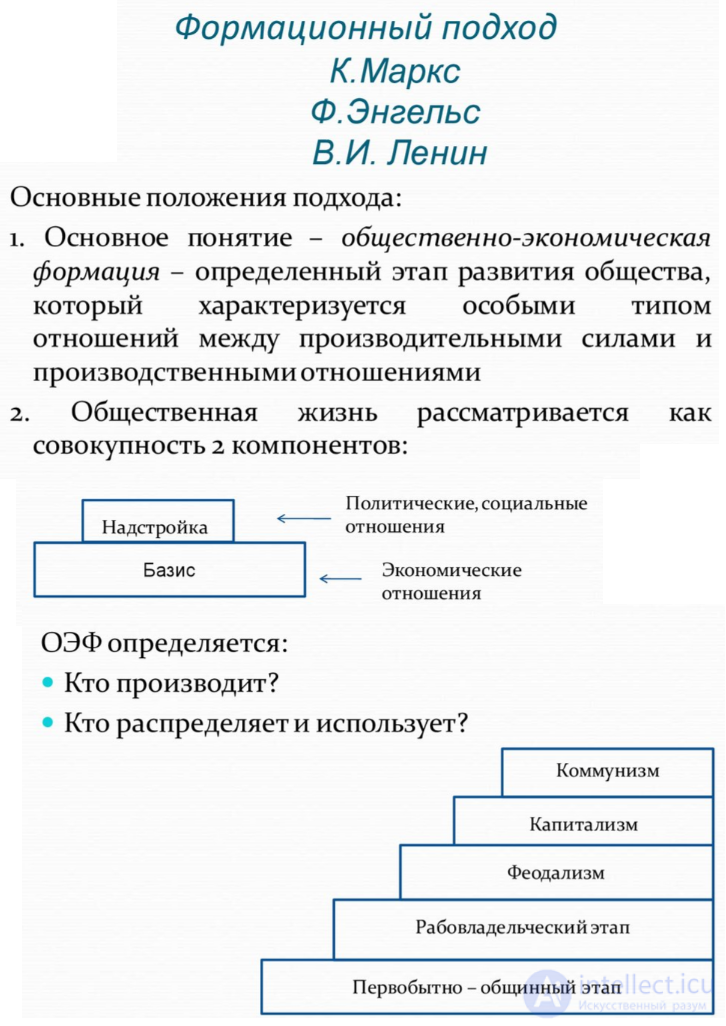
K. Marx worked out the formational approach to history, synthesizing the rationalist logic of Hegel's philosophy of history with naturalistic conceptions of history. He saw in the historical process the evolution of the types of interaction between man and nature in labor activity. In primitive society all members of the community are equal. But as soon as the process of labor and production begins to improve, surpluses of goods appear, and along with them — a struggle for their appropriation — class struggle.
In Soviet historical materialism it was asserted that Marx distinguished several stages in the development of society, and, correspondingly, several types of society, from the least developed to the most perfect — several socio-economic formations:
At the same time, a study of Marx's texts shows that he himself nowhere proposed the above-described scheme of five formations (the so-called «five-stage scheme»). Contemporary Russian scholars who have studied the problem (A. B. Gofman, V. L. Inozemtsev, Yu. K. Pletnikov) have come to the conclusion that Marx and Engels have no concept of «socio-economic formation». It can be considered established that in Marx's texts there are three social formations: the primary, or archaic; the secondary, or economic; and the tertiary, or communist .
As V. L. Inozemtsev writes, the «socio-economic formations» of Soviet Marxism go back to an error of V. I. Lenin, who, striving to simplify the terminology, turned the «economic social formation» (in the singular) from Marx's work «A Contribution to the Critique of Political Economy» into several «socio-economic formations» in the Russian translation , which was fixed as a term in Ostrovityanov's textbook in 1952.
Marx regarded labor as the substance of human history , which he understood as the objectification of an animal's needs, which makes the alienation of labor the ultimate criterion for the periodization of the social-historical process.



The philosophy of history is called upon to reveal the content and essence of the historical process, its regularities, direction, driving forces, and so on.
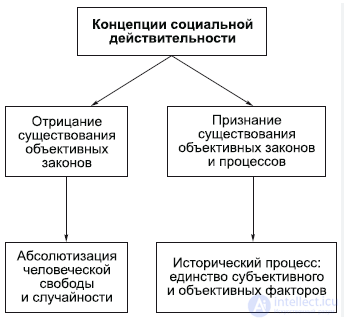
Many thinkers of the past, comparing the phenomena of nature with social phenomena, saw the difference between them in the fact that the history of society is made by people, whereas in nature phenomena occur by themselves as a result of the interaction of blind, elemental forces. People do not commit a single act unless prompted to it by some thought, desire, or motive. And since the whole of life consists of people's acts, then in society everything is determined by people's consciousness. And if it is granted that people make history as they see fit, then what objective laws in society can we speak of?
The conception denying the existence of objective laws of social reality is fairly widespread even today. In addition to what has been said above, the following arguments are also cited in its favor.
• It is asserted that social reality, unlike natural reality, is composed of unrepeatable, absolutely individual events, which cannot be subsumed under a general law (W. Windelband (1848–1915), H. Rickert (1863–1936), et al.).
• It is asserted that there is no necessity in historical development, only possibilities, the realization of which depends on various circumstances. It turns out that chance reigns in history. Here one may recall the old joke that if Cleopatra's nose had been shorter, history would have taken a different shape. And B. Russell, in the same vein, said that if Genoa had not ceded Corsica to France in 1768, Napoleon, who was born the following year, would have been an Italian, and the history of France would have been different.
In the course of history there are various possibilities, and the realization of one or another of them is determined by the course of the struggle of various social forces. At the same time, if we speak not of the subjective assumptions and projects of political figures but of real possibilities, then they are determined by the objective conditions of the development of society. Chance events, of course, exert an influence on the course of events, but they do not determine its general direction.
Although the life of society consists of the actions of people, it by no means follows from this that all the processes occurring in society are fully controlled by people's consciousness and subordinate to their actions. There exist objective circumstances, which limit the possibilities of realizing human wishes and intentions – both for a single individual and for social communities.
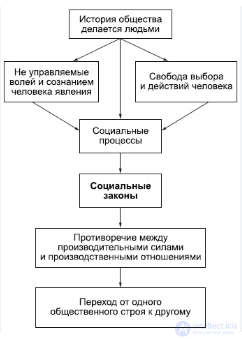
People themselves make history; they are at once the authors and the actors of their own drama. In society there exist and operate objective laws. The historical process is the result of people's activity, and at the same time – it is objectively lawful.
This situation put many sociologists at a loss: they either acknowledged the existence of laws independent of people (in religious-idealist philosophy these appeared as fate, doom, destiny), while considering that people's activity is incapable of influencing the course of historical development (fatalism), or they asserted the existence of an activity of people free from any laws whatsoever (voluntarism).
In society there is no rigid predetermination, no unambiguous determination of people's behavior. A person has a certain freedom of action, and the choice of one act or another is motivated by their subjective impulses.
Each generation, entering into life, becomes involved in certain objective conditions that took shape before its appearance in the world and, consequently, independently of it (a given state of production, everyday objects, traditions and customs, social institutions). These circumstances broadly determine the way of life and the way of thinking of the social groups in which people live. "People make their own history," wrote Marx, "but they do not make it as they please, under circumstances they have not chosen, but which are directly given and inherited from the past"[24].
A new generation can, through its activity, change reality, but it can do so only if that reality contains the objective conditions and means for such activity. Every given state of society determines the possibilities for its transformation and the main features of the new state that will emerge as the outcome of that transformation. Thus, the transition from one social order to another proves objectively possible owing to the emergence of new productive forces, which come into contradiction with the old relations of production. The necessity of such a transition is sooner or later recognized by the progressive forces of society, whose interests clash with those of the outdated forces striving to preserve the old order.
As a result, the process of social development unfolds in a lawlike manner, and the conscious activity of people ultimately proves to be a necessary element of this lawlike process. People make their own history, but they make it in accordance with the possibilities determined by objective laws that do not depend on human will and consciousness.
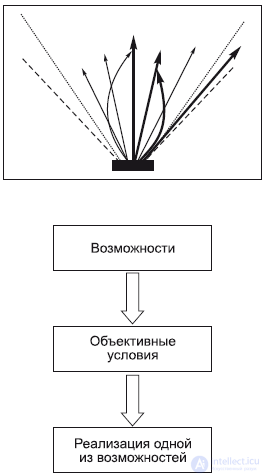
The laws of history give rise to a "fan of possibilities" that may be realized, and in different ways, or may not be realized at all. Which of the possibilities is realized, and how, and which remain unrealized, depends on people's subjective intentions and actions. Moreover, changes in people's consciousness themselves become a factor that alters social reality and, thereby, the conditions under which historical laws operate. The "fan of possibilities" therefore has no fixed, unchanging boundaries: new ideas and projects of social reorganization, born in the minds of theorists and gaining recognition in society, can give rise to new possibilities and widen their "fan." The laws of history thus allow room for historical creativity.
The arrows in the figure represent the "fan of possibilities." The dotted lines depict its boundaries, and the double-dotted lines the boundaries pushed outward by historical creativity. The bold arrows denote the most probable possibilities. But any possibility within the boundaries of the given fan may be realized. This, again, means that the laws of history, as already noted, do not possess the unambiguity, necessity, and inevitability characteristic of the laws of nature. The dependence of the outcomes of historical laws on the consciousness and will of the actors involved means that these laws indicate only a general tendency in the development of social processes in a certain direction, or, one might say, an "angle of scatter" of the vectors of social development (whose spread, moreover, itself changes). Relying on these laws, one can foresee the future only in certain general outlines, but not in concrete detail. Bearing in mind this feature of the laws of history, they are called "trend-laws" - as distinct from laws that make it possible to calculate precisely what will happen under given conditions.
At any given historical moment there exists a certain spectrum of possibilities for the further course of events. Laws determine the boundaries of this range but do not determine which of the possibilities will be realized. Social laws are "trend-laws," which do not unambiguously determine each individual event but express the general direction of historical development, the tendencies of a multitude of mass events. Laws determine, in general outline, the tendency of society's development, while the concrete course of historical events is the result of the interaction of many factors.
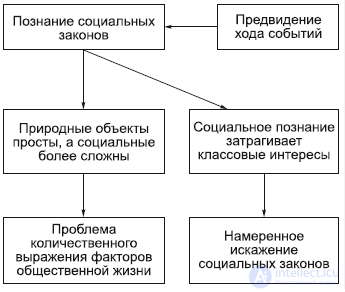
The cognition of social laws encounters a number of difficulties.
First, one must take into account that natural objects are relatively simple, relatively stable, and exist in a developed form even before their cognition begins. Social objects are considerably more complex, more dynamic. The cognition of the laws of social development depends on the degree of development of social relations, and therefore their discovery becomes possible only under certain historical conditions, at a certain level of social development. Thus, before capitalism, class division in society was masked by estate-based, caste, and religious divisions, and this hindered the cognition of the law of class struggle. Only under capitalism did class relations become more pronounced and were recognized as such.
Second, social groups and classes relate differently to the cognition and operation of laws. The subject matter of natural science, as a rule, does not directly affect social interests. Of course, the history of natural science also knows of concepts around which struggles took place (for example, the concepts of Copernicus, Giordano Bruno, Darwin). Natural science does not directly affect class interests. But in the social sciences, the very subject of study - society with its economic, social, political, and ideological subsystems - is closely bound up with class interests. It is no accident that there are situations in which the ruling classes have no interest in the cognition of the objective laws of social development, and try to conceal or distort them in their own interests.
The value of a scientific theory is measured to a considerable extent by its ability to foresee the course of events. And foresight can be effective if it relies on knowledge of laws.
Foresight in social life differs from foresight of natural processes. In astronomy, for example, one can predict decades in advance the appearance of a comet, solar and lunar eclipses, and so forth. In society matters are more complicated. Many factors of social life do not lend themselves to quantitative expression. How, for example, can one account for moral factors in human activity; after all, these are not phenomena of the same kind as the coordinates and momentum of a comet.
The laws of social phenomena still have a qualitative character. We do not know the speed of social processes; so far we know only their direction. Thus, we know the law of the interconnection between productive forces and relations of production, and we know that a mismatch between the character of production relations and the level of development of productive forces will lead to a qualitative change in the given society, but we cannot indicate the timing of this change or its concrete forms.
Features of the Laws of Social Development
Unlike the laws of nature, the laws of social development have existed for a comparatively short time.
Unlike the laws of nature, which will operate forever, the laws of social development will disappear together with society.
The laws of nature are objective in their content, while the laws of social development depend on the activity of specific people.
The laws of nature operate identically at any point in the universe.
Social laws operate within a specific society.
The laws of social development are determined only by the events that have actually occurred in history and do not take into account missed possibilities.
Freedom is a person's ability to perform acts in accordance with their own interests, needs, and goals. Freedom is usually contrasted with necessity. In the strict sense, freedom should be contrasted not with necessity but with coercion. If freedom consists in acting in accordance with one's inner convictions, goals, and interests, then coercion is a person's action under the influence of some external force, contrary to their inner convictions. And coercion, understood in this way, is not identical to necessity.
We have already discussed two approaches to the problem of social laws. Here two variants arose. In the first case, from the recognition of the existence of objective laws in the world in general, and in society in particular, the conclusion was drawn that humans have no free will and that free activity is nothing more than an illusion. In the other variant, the denial of the existence of objective laws thereby leads to an absolutization of freedom. Both variants are extremes that fail to take into account the dialectic of necessity and chance and the specific nature of the laws of society.
The most important feature of freedom is choice among a multitude of possible lines of human behavior. Freedom exists wherever there is a choice of the goal of activity, a choice of means leading to the achievement of that goal, a choice of acts in a given life situation. But the objective basis of a situation of choice is the objective existence of a spectrum of possibilities determined by the operation of objective laws.
Within the bounds permitted by the laws, in the realm of the possible, a person possesses freedom of choice, and what will happen depends on that choice. When these bounds are not recognized, an illusion may arise of the absence of social laws and of the complete dependence of social processes on human will (this occurs when the will does not go beyond the bounds of the possible). If, on the other hand, a person's desires and goals run up against the bounds of the possible, against the restrictive action of laws, an illusion may arise of the fatal predetermination of social processes and of people's complete powerlessness to influence them.
A situation of choice is still only a precondition of freedom, of free action. The choice itself is determined by a number of factors: goal-setting, the character of practical activity, and knowledge. The role of knowledge in choice deserves particular emphasis. A person chooses the line of behavior that seems to them the most significant, useful, or valuable, and this can be determined only on the basis of knowledge.
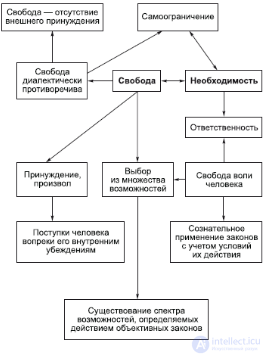
Freedom does not exist as the possibility for a person to make their own decisions and carry out actions independently of any external circumstances whatsoever. One must distinguish formal, "juridical" freedom from "actual," real freedom. Formal, "juridical" freedom consists in the fact that certain actions are permitted, while abstracting from whether there are real possibilities for performing them. If so, then, according to this point of view, abstracting from people's economic position, one could claim that the poor and the rich are equally free. But real life is not like that; as Leibniz said, "the one who has more means is more free to do what he wants."
Freedom is internally, dialectically self-contradictory. Freedom, on the one hand, is the absence of external coercion. But on the other hand, the freedom of one person ends where the freedom of another begins. Freedom is possible only where there is self-restraint. When this is absent, freedom turns into arbitrariness. And where there is arbitrariness, there begins unfreedom. Where there is arbitrariness, there is insecurity.
There is no such thing as absolute freedom, dependent on nothing. All of a person's actions, even those that at first glance seem inexplicable, are conditioned by that person's inner world or by external circumstances. Free will is expressed not in an imagined independence from the objective laws and conditions of social existence, but in consciously applying objective laws, taking into account the conditions of their operation.
The social nature of freedom is clearly revealed when it is set alongside responsibility. Freedom and responsibility are two sides of a single whole - conscious human activity. In making a decision, a person is capable of simultaneously forming within themselves a sense of responsibility for their actions - before society and before themselves.
A person can set themselves goals and objectives for changing social reality. Freedom is effective when it can be translated into action. One might recall the Stoics, who said that even a slave in chains can be free. But freedom in thought alone, so to speak, an inner freedom lacking any possibility of real expression, is an imaginary, illusory freedom. Real freedom can change social reality if a person's actions are permitted by natural and social laws. And then a paradoxical conclusion follows: freedom, acting in history, behaves as necessity. And historical necessity itself is composed of the free acts and actions of people as their integral result.
The philosophical and sociological literature offers several conceptions of the historical process. Already in the philosophy of the ancient world, conceptions of the linear and cyclical character of history took shape. The question was posed: what does history bring - an improvement in people's lives, or a multiplication of suffering and misfortune? This question was bound up with what was understood by happiness and misfortune, and with what one ought to strive for and resist in social life.
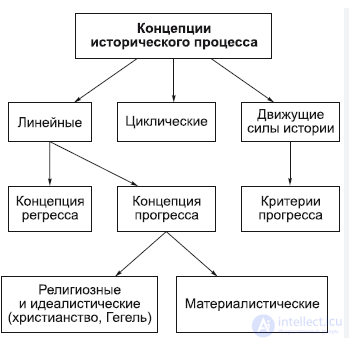
Living at the turn of the 8th-7th centuries BCE, the poet Hesiod lamented that history had passed through five ages. The first was the golden age; people were distinguished by high morals, were pious, and lived easily and carefree. Then came the silver age - things became worse in every respect, and so on. Finally came the worst age, the present, iron age. Everything is heading toward the worse; violence, evil, and injustice are growing. Worthy people are ruined, unworthy people grow rich, honest people are oppressed, and dishonest people hold the reins of power. Hesiod takes the standpoint of historical regress.
Alongside the conception of regress, the philosophy of the ancient world also contained a conception of the progressive development of society. In ancient philosophy it was held by Democritus, Plato, and Aristotle. A particular variant of this conception was the position of Christian philosophy, which understood history as the realization of a plan for the salvation of humankind predetermined by God (providentialism). Many philosophers of modern times and of our own day have spoken of the presence in history of a single trajectory of linear progress, linking this progress to the development of material production (K. Marx, A. Toffler, R. Aron, D. Bell, and others).
The conception of the linear direction of the historical process includes two variants - pessimistic and optimistic.
The idea of the cyclical recurrence of the world process was also proposed (for example, in the Vedas of Indian philosophy, among the Stoics in ancient philosophy, and in Ecclesiastes in the Bible). According to this conception, history moves along an ascending trajectory, then passes to a descending one, then again moves upward, and so on. This idea was often a consequence of the notion of the cyclical existence of the world.
One may also examine more closely the position of Christian philosophy of history. Here, on the one hand, a pessimism is expressed - regret over the irrevocable loss of paradise - while on the other, there is a view of history as movement toward a future salvation, toward the coming of the messiah. The conception of providentialism persists to this day. J. Maritain, for example, proceeds from the premise that the course of history realizes the Divine plan.
The idea of progress was the most popular and captivating idea in the nineteenth-century philosophy of history. Progress was understood as smooth, evolutionary development. This conception sometimes grew into fatalism, when people spoke of a "law of evolution" before which humans were powerless.
Alongside the conception of historical progress, irrationalist variants of philosophy have also put forward the idea of regress. Thus Nietzsche asserts: "It can be proved that everything leading up to us was decline; man, and precisely the wisest man, is the supreme error of nature and the expression of its self-contradiction (the most suffering creature): the path of nature that led to the present is a fall." Nietzsche is nevertheless inconsistent. He also speaks of the cyclicity of history, of "eternal recurrence."
Some sociologists, instead of the concepts of "development," "progress," and "evolution," use the concept of "change," which has an advantage over the former, since it does not indicate the direction in which the historical process is moving. Some historians, emphasizing the uniqueness of each epoch, consider it mistaken to speak of progress at all. Gaining in one respect, people lose in another; we have aviation, but no Shakespeare.
The resolution of the question of the direction of the historical process is often linked to the question of whether history has a meaning, a final goal, and to the question of the criteria of social progress.
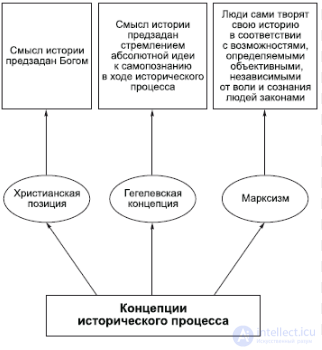
Various answers are proposed to the question of the meaning of history, of the historical process. From the Christian point of view, the meaning of history was predetermined by God. History appears as the trial of fallen humanity, moving from punishment to forgiveness in a future otherworldly life. In Hegel's conception, the meaning of history is predetermined by the striving of the absolute idea toward self-knowledge in the course of the historical process. From the point of view of Marxism, it makes no sense to speak of social progress apart from and outside of human activity, of some automatic progress that of itself leads humanity toward some goal set from time immemorial. Let us formulate once more the position of Marxism. People make their own history, but they make it in accordance with the possibilities determined by objective laws that are independent of people's will and consciousness. Social laws determine, in general terms, the tendencies of society's development, while the concrete course of historical events is the result of the interaction of many factors.
Social progress is not some unambiguous trajectory of society's development. Within the general direction of the course of history one can also see eras of reaction and catastrophes leading to the decline and even the death of peoples and civilizations. But this does not contradict the idea of progress.
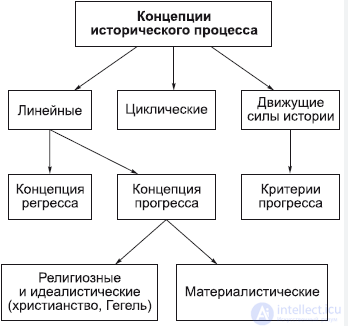
Sociology has proposed many criteria of progress. Among them are labor productivity, abundance of material goods, personal freedom, the development of morality, and so on.
In characterizing the criteria of social progress, one must take into account that society consists of a number of spheres, and it is therefore reasonable to raise the question of criteria of progress within each of these spheres. And within each of these spheres there are its own subsystems, which have their own criteria of progress.
If one approaches the problem of the criteria of social progress from the standpoint of the materialist understanding of history, then the basic criterion must be sought where the basic factors are located – in the sphere of material production, the economic sphere. This concerns the development of the productive forces and the degree to which relations of production correspond to the level of development of the productive forces. The development of material production leads to an increase in the quantity of the product produced in order to expand human needs and change the ways of satisfying them. And the growth in the level of needs is the next important criterion of social progress.
But this is not enough. Social progress is truly progress when it is connected with the progress of the human being. Social progress consists in making the maximum number of people as free as possible, so that they can live and develop, and can fully realize their spiritual potential. It is for precisely this purpose that the development of production, the growth of the production of material goods, is necessary. If production is not conducted for this purpose, then its development in itself cannot be a criterion of progress. Social progress is connected with the development of human freedom; it is not for nothing that it is said that the measure of freedom is the measure of progress. Social progress is also connected with the development of political freedom, democracy, humanistic principles, and so on.
Social progress is characterized by a complex of criteria. Each individual criterion is necessary but insufficient. Only the entire complex of these criteria allows one to adequately assess the character of society's evolution.
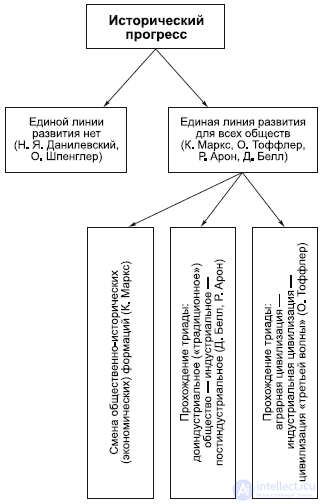
In every society, in every historical epoch, progressive or regressive tendencies may predominate. But is there some general line of development running through the whole of humanity? Is there a «world history»?
One can note the main points of view. According to one of them (N. Ya. Danilevsky, O. Spengler), there is no single history, but rather various, unrepeatable, closed, independently developing cultures, each of which may attain a high level of culture, of civilization. But one cannot consider that they are all simultaneously at the same level of development. Today there are cultures that are at a low level of development, for example, in the jungle, on certain islands; the tribes inhabiting them are at the level of a primitive communal system.
According to another point of view, all societies pass through one main line of development. This line is interpreted either as a succession of socio-historical (economic) formations (Marx), or as passage through a triad: pre-industrial («traditional») society – industrial – post-industrial (D. Bell); or the triad: agrarian civilization – industrial civilization – the civilization of the «third wave» (A. Toffler). The latter is supposed to be ecological, democratic, and based on «soft technologies».

classification of civilizations according to A. Toynbee
In the history of society there is a combination of the general and the particular, the specific. On the one hand, we see the concrete process of development of individual countries and peoples. The specifics of their development depend on natural forces, features of their way of life, the state of spiritual culture, the character of their leaders, and so on. On the other hand, there are general tendencies, directions of development.
But why does something general exist in the historical process? This can be explained by the fact that the historical process is the history of people, of rational beings who live by their own labor and are connected by a system of social relations. People may not know one another, may be separated by oceans or vast expanses of continents, but if they obtain their means of life through their own labor, strive to use natural resources, and develop and satisfy their needs, then their life activity forms a single historical process.
The historical process is both unidirectional (if we speak of its general tendency) and multivariant (if we are speaking of a concrete country or people). But this multivariance is not unlimited; it is contained within the framework of the general tendency of history.
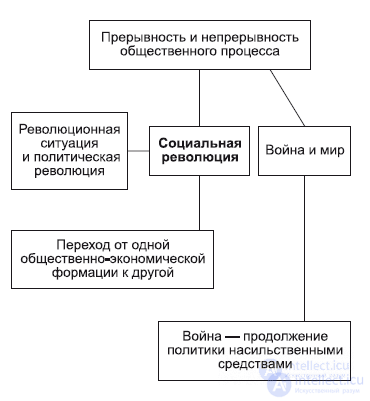
The social process includes both continuity and discontinuity, evolutionary and revolutionary changes, states of war and peace.
A social revolution, from the point of view of Marxism, is a transition from one socio-economic formation to another. This transition includes qualitative transformations in all spheres of social life – economic, social, political, and spiritual.

A social revolution occurs only when certain objective conditions are present. The main one of these is the operation of the law of correspondence of relations of production to the level and character of the productive forces. When developing productive forces come into contradiction with existing relations of production, a period of social revolution then arrives. Social revolution is a regularity in the development of society, since the productive forces, in their development, inevitably outgrow the existing relations of production, and the latter must be brought into correspondence with the grown productive forces. Therefore one should not consider social revolution a violation of the «normal» course of society's development.
Social revolution as a whole should not be identified with political revolution. History shows that a social revolution can include several political revolutions (thus, the French bourgeois revolution included the political revolutions of 1789, 1830, and 1848), as well as counter-revolutions.
For a political revolution to occur, a revolutionary situation is necessary. V. I. Lenin characterizes its signs as follows:
History knows examples of such revolutionary situations that did not develop into a revolution (for example, in Russia in 1859–1861). A revolutionary situation is a necessary but insufficient factor. For a revolutionary situation to develop into a revolution, subjective factors are necessary – the energy of the revolutionary class, the organization of the popular masses.
Who drives history – outstanding individuals? An elite? The masses? Historical science, as the memory of humanity, has preserved the names of historical figures, rulers, and military commanders with whom the most important historical events of the past are associated. From this it was often concluded that these outstanding historical figures were the authors and main actors of history.
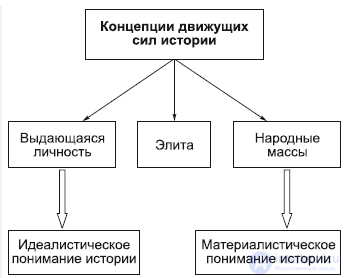
Representatives of this point of view said that the masses are incapable of creativity, that they can never be raised to the level of the individual, that the mass is hostile to individuality. F. Nietzsche asserted that the people are «formless material out of which one creates, mere stone that needs a sculptor». From this followed the conclusion about the necessity of a leader, a superman with a strong will to power. It was further said that society and the individual are hostile to one another, that a conflict between social and personal interests is always inevitable, since the whole strives to subordinate the parts to itself, while the individual wants to preserve their individuality. But only «strong individuals» can withstand the struggle with society. The idealist understanding of history inevitably entailed the recognition of the leading role of individual persons in the historical process.
Related to this conception is the theory of the elite. This theory sees in the people, the mass, only a passive and even destructive force. The bearer of the creative principle is the elite, consisting of the most gifted part of a given people, the most educated, strong-willed, and energetic, and therefore also the people who possess real power. A distinctive modification of this conception is the theory of the technocratic elite. Thus, J. Burnham, in the book «The Managerial Revolution», asserted that as a result of the scientific-technological revolution, power would pass to the scientific-technical intelligentsia managing enterprises, concerns, and banks.
Marxism asserts the role of the popular masses as the driving forces of history. The people are the main creator, the subject of history. The people make history by producing, through their labor, the values of culture. The driving force of history is the class struggle. The class struggle is the struggle of the oppressed, exploited popular masses against their oppressors.
The people are the decisive, but not the determining, force of historical development. The direction and character of the people's activity is determined by the objective laws of social development. These laws are realized through people's activity. Certain historical conditions, especially in transitional epochs, create the possibility for the emergence of outstanding individuals. Outstanding individuals arise in response to a historical need for them.
A distinctive feature of the contemporary era is the emergence of global problems. Until recently it was believed that neither the forces of nature nor human beings themselves were capable of ending the existence of humanity, or at least of substantially affecting its existence. Today humanity faces the Hamletian question: to be or not to be? The situation confronting society is the result of the development of society itself, above all of scientific-technological progress.
Global problems are those that satisfy the following conditions:
The solution of global problems can be grouped into problems:
1) connected with relations between states;
2) connected with the relations of «human–nature»;
3) connected with the relations of «human–society».
The first group of problems includes the problems of preserving peace and equalizing the levels of economic and social development of all countries; the second includes problems of resources, energy, food, and so on; the third includes problems of education, healthcare, culture, and so on.
Awareness of global problems led to the formation of so-called global studies – a complex of conceptions about the causes of and ways of solving global problems.
First among the global problems is the problem of human survival. Universal human expenditures on armaments exceed all types of expenditure on food production in the world. The buildup of armaments, given the existence of nuclear weapons, is becoming senseless. No country today can ensure its security alone. Security can only be universal.
Second among the global problems is the ecological problem. Nature is ceasing to withstand anthropogenic impacts.
Important is the energy problem. It is necessary to develop new methods of obtaining energy, reducing the use of fossil fuel. One must strive for waste-free production.
The question is raised of the need to reduce the rate of population growth and stabilize its numbers; a population of about 8–9 billion people is considered optimal for the Earth. Many representatives of global studies, while considering scientific-technological progress to be the main cause of global problems, believe that it will also make it possible to solve these problems. Technology based on science will make it possible to resolve the contradictions that have arisen and bring society to an optimal state.

Global studies offers many recommendations. But how are they to be implemented? It is clear that the resolution of global problems requires new political thinking, a new organization of international relations, and the organization of the world community. But all this encounters considerable difficulties.
Closely connected with global studies is futurology, whose task is to foresee the future of human society. Futurology and science-fiction writers paint diverse pictures of the future – from pessimistic ones (atomic catastrophe, the degeneration of humanity, and so on) to optimistic ones (communism, extraterrestrial civilizations, and so on).
At the center of futurology's attention are the prospects of the technological revolution (or scientific-technological progress). The development of information technology sharply increases labor productivity, reduces the need for unskilled workers, and brings to the fore the «gold collars» (designers, engineers, programmers, and the like). Information technology changes the structure of management and leads to changes in social life in all spheres, from the economic to the spiritual.
Advanced countries have entered a stage called the «information society» or the «service society». The «information society» is replacing both capitalism and socialism, in that class contradictions are abolished in this society, and in the new society the leading role is played by the «cognitariat» (A. Toffler).
People are inclined to dream of a better life. These dreams run through the whole history of society. The utopian socialists said that a golden age lies ahead of us (Saint-Simon), that «centuries of happiness will last seven times longer than centuries of unhappiness» (Fourier). Marx and Engels gave, in general terms, a characterization of communism, which would come to replace capitalism. Practice is the criterion of truth. The practice of socialist construction in a number of countries revealed, in essence, the utopian nature of the proposed conception of communism. The socio-historical process turned out to be more complex than it was represented to be in Marxism.
Today there is in fact no sufficiently substantiated conception of the future in the philosophy of history comparable to the model of communism. One often speaks of movement toward a humane, democratic society with a fully developed personality, and so on. All this is rather abstract. But is it worth creating some concretely detailed images of the future? One could see that concrete models of the future are most likely to prove mistaken. Let us confine ourselves to the general thesis about the progressive character of society's development.

Comments