
Lecture
The 19th – 20th centuries were a time of serious changes in the development of humanity, which was overwhelmed by an avalanche of social problems: wars, revolutions, modernization and transformation processes, globalization on an ever-increasing scale, the emergence of «world problems,» including the problem of humanity's survival. The most destructive crisis of all – the crisis of spirituality, culture, the crisis of the human being – is growing at a rapid pace. It has become clearer than ever that it is precisely this crisis that underlies all others. Even from a purely pragmatic point of view, one can see that the crisis of culture is also a central problem of political and economic life.
In the 20th century, Nietzsche's terrifying prophecy came true: "the time will come when a struggle for world domination will be waged – it will be waged in the name of the founders of philosophical doctrines." Here is what another philosopher, K. Jaspers, foresaw: "We live in a situation incomparably richer in possibilities and dangers spiritually, yet if it is not given satisfaction, it will inevitably turn into the most wretched time for a person who has proved incapable." No less poetically, and just as perceptively, Teilhard de Chardin envisioned the end of the 20th century, saying that, having entered the phase of evolution at the level of culture, we hold evolution in our own hands – gaining the ability to identify and realize those combinations that remained unrealized by nature in the play of accident and chance.
. Our question is what the value, calling, and fate of philosophy are. As always in a turning-point era, the question of why and in what capacity philosophy is needed in today's world – where people occupied with serious matters at best only graciously permit its existence – becomes especially acute. J. Habermas once aptly observed that philosophy has been scolded and rejected for all two and a half thousand years of its existence, and yet it still exists. It is evident that it is needed not only by eccentric philosophers – otherwise how could they have defended and preserved it among people who "know the price of everything but the value of nothing"?
Questions about the meaning and significance of philosophy, which arise especially acutely at turning points of civilization, are rethought each time and demand a new answer – what philosophy is for society, and what society is for the philosopher.
The philosopher is a person whose hearing is always open to the "silent call of being" (M. Heidegger), and the philosopher's hearing is such that at decisive moments, when being is fractured or undergoing a break, this call becomes for him painfully wrenching.
Philosophy is the only realm of the spirit that constitutes a reflection on the whole of culture and its tendencies, and therefore the problems to which the philosopher's ear responds, and to which he draws the attention of others, are naturally sensed by him rather than selected for any special – even the loftiest – considerations. Like the artist, the philosopher's first responsibility is to himself, and if he is truly a philosopher, he literally suffers and lives these problems. At the same time, in philosophical consciousness the "call of being" is refracted in such a way that, having become the subject of professional philosophical reflection and constructive analysis, the questions (and answers) discerned by philosophy reach the ears of contemporaries and become natural to the consciousness of the era. Such has been philosophy's contact with life throughout all 25 centuries of its history. ".
The specificity of philosophical thinking is such that it simultaneously forecasts and projects new approaches, new methods, new understanding. Philosophy is the watchman of culture. Nurturing and preserving existing values, it does more than any other realm of the spirit to form and justify those values that are adequate to a new mode of being.
The meaning of philosophical inquiry has always consisted not only in clarifying the worldview structures that determine the image of the world and the way of life of people in a given historical era, but also, by reflecting on these (deep) structures, in proposing possible variants of new life meanings and new values,
The 19th century became, for European philosophy, the century in which classical philosophy was completed – whose culmination was the grandiose system of Hegel – and the century of the formation of a new, so-called non-classical philosophy. The main claim of classical philosophy was a claim to systematicity, monism, and confidence in the existence of a natural order of the world and in the possibility of its rational comprehension. The main claim of non-classical philosophy is to overcome the intellectual culture that had taken shape in Europe over three centuries and to create a «new philosophy» corresponding to the modern era. It is characterized by a demonstrative rejection of philosophical classics while retaining a hidden inner dependence on them. Hence its pointed polemical character, its tendency toward «disputing the classics,» toward overcoming them. However, in essence «new philosophy» represents the result of transferring classical habits of thought into a new era: the traditional theoretical-conceptual apparatus, with its characteristic means of rational conceptualization, is used to express new meanings and new sensibilities.
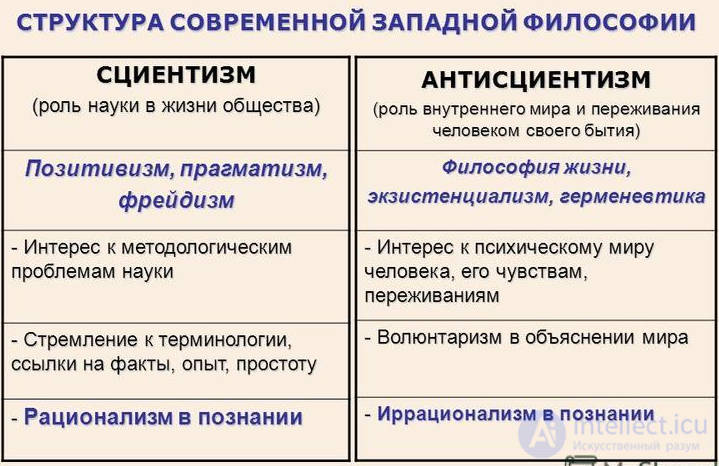
This is most characteristic of the philosophy of positivism, which became the basis for the final formation of scientism as a worldview, whose origins lie in the rational culture of the Enlightenment with its orientation toward science as a means of the progress of human society and the highest expression of humanity's creative possibilities.
At the same time, as an antithesis to scientism, movements arose oriented toward the human personality in the full richness of its experience of the elemental force of being, which cannot be understood or captured by the rational constructions of traditional philosophy: the «philosophy of life,» «existentialism,» and hermeneutics. Within the concepts of the representatives of these movements, awareness began to grow of the spiritual crisis of rational European culture, the loss of a living creative principle, without which the end – «The Decline of the West» – and the loss of personal life-meaning orientations become inevitable.
.
Positivism, which arose in the mid-19th century as an independent philosophical conception and later spread as a tradition, won enormous popularity among representatives of the natural sciences. At present, positivism (French positivisme, from Latin positivus – positive) is defined as a movement in the methodology of science that declares empirical research to be the sole source of true, actual knowledge and denies the cognitive value of philosophy as a form of inquiry. For Comte, the concept «positive» means the real, the factually given, the definitely asserted, the reliable – that which, in his view, distinguishes scientific knowledge from all other kinds of knowledge, religious and philosophical. Within positivism the first consistent model of scientific knowledge was created, which is why it is regarded as the beginning of the philosophy of science as a special sphere of philosophical inquiry.
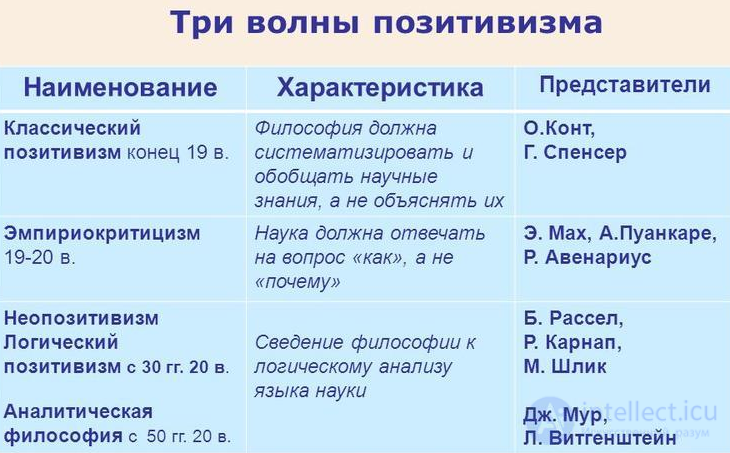
Positivism is based on the worldview ideas of the Enlightenment concerning the progressive development of humanity and the determining role of science in this process. In the course of its development, positivism took shape as a distinct tradition, whose basic principles are in one way or another connected with these ideas. Three historically successive stages are usually distinguished: the first, whose most significant figures include A. Comte, J.S. Mill, and H. Spencer; the second – Machism, or empirio-criticism (Mach, Avenarius); and neopositivism (analytic empiricism)
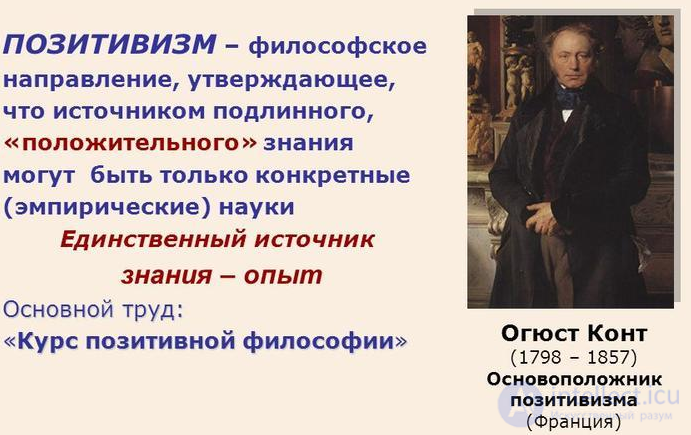
The founder of positivism, A. Comte (1798 – 1857), presents the history of humanity as the history of the development of the whole domain of spiritual culture, which, like an organism, passes successively through the stages of childhood, youth, and maturity. The stages are distinguished by the types of explanation used by people:
- the first – theological («fictitious»). At this stage of the state of the spirit, people invoke ideas about various supernatural forces to explain phenomena, worship fetishes, and invent gods as the first causes of things and phenomena (polytheism); then gradually the multitude of gods is replaced by One – a Single God, acting as the principal first cause (monotheism)
- the second, metaphysical (philosophical). People still strive to grasp the origin and first causes of things, but the place of supernatural factors is taken by abstract entities. The place of the Single God is taken by Nature, which Comte defines as a «vague equivalent of universal connection.»
- the third stage – the positive stage — in which scientific knowledge becomes the sole form of knowledge. «In the positive state, the human mind recognizes the impossibility of attaining absolute knowledge, renounces the investigation of the origin and purpose of the existing world and of the inner causes of phenomena, and strives, by correctly combining reasoning and observation, to know the actual laws of phenomena, that is, the invariable relations of succession and resemblance. The explanation of phenomena, reduced to its true objects, consists merely in establishing connections between individual phenomena and a few general facts, the number of which decreases more and more as science progresses.» (A. Comte, Course of Positive Philosophy. St. Petersburg, 1900, vol. 1, p. 4). Thus, science, unlike philosophy, does not explain phenomena but describes the connections among facts.
The main idea of the law of the three stages is that all preceding human development represents merely a prehistory of the present state, a preparatory period for the positive mode of reasoning.
Comte acknowledges that the stages can coexist, but the overall direction of development means that the more mature stage inevitably displaces the preceding one. Accordingly, having passed through the metaphysical stage, knowledge must inevitably free itself from the attitude peculiar to that stage – the search for «final causes» and speculative propositions – and move into the scientific stage; this transition is accomplished for each science depending on the simplicity of its subject matter.
Accordingly, Comte proposes his own classification of the sciences, dividing all sciences into theoretical (abstract or general, and particular, descriptive) and applied. Of greatest interest is the classification of the abstract sciences, which Comte arranges in a series by degree of simplicity: mathematics and mechanics – astronomy (celestial mechanics) – physics – chemistry – biology – sociology (social physics). This series reflects, according to Comte, the actual relations of subordination among the sciences within the overall system: each subsequent science presupposes the preceding one as its necessary premise, yet its content is not reducible to it. The last science – sociology – the most complex in the hierarchy of sciences, is based on the laws of biology but is not reducible to it, and must take into account the modification of these laws arising from the interaction of individuals. A. Comte introduced the very term «sociology» and laid the foundations of the method of scientific sociology in accordance with the general principles of the «positive method»: to study the laws of observed phenomena, to justify one's assertions by reference to facts, to seek connections among facts rather than engage in philosophical speculation in search of the meaning of history.
Comte's follower, and at the same time his opponent on a number of questions, H. Spencer (1820 – 1903) put forward the idea of progress as evolution – the gradual, continuous change of society.
What he shared with Comte was an understanding of the character of scientific knowledge: science should not concern itself with investigating first causes and first principles, since here we can know nothing, as this is not observable, either because it took place in the past or because it lies beyond our perception altogether. Such, for example, are questions relating to the origin of the universe and problems connected with the first causes of natural processes. In attempting to pose such questions, science differs little from religion, since it is unable to use the scientific method: the observation of phenomena and the establishment of observable connections between them. The «ultimate reality» lies beyond the reach of science, is inaccessible to rational cognition, and is therefore unknowable. Having established the boundaries and possibilities of science, Spencer holds that the task of philosophy is to generalize their results on the basis of a universal principle of evolution. He put forward this idea seven years before Darwin's theory, drawing on the works of Lamarck and K. E. von Baer. Evolution is understood by him as as «an integration of matter accompanied by a dissipation of motion, during which matter passes from an indefinite, incoherent homogeneity to a definite, coherent heterogeneity, and the retained motion of matter undergoes a corresponding transformation.» All things have a common origin, but through the inheritance of traits acquired in the process of adaptation to the environment, their differentiation occurs; when the process of adaptation is complete, a coherent, ordered universe arises. In the end every thing reaches a state of full adaptation to its environment, but such a state is unstable. Therefore the final stage of evolution is nothing other than the first stage in the process of «dissipation,» after which, once the cycle is complete, evolution follows once again.
Spencer's sociological conception achieves the greatest fame, in which he applies his theory of evolution to the development and functioning of society, regarded as a living organism.. Societies can organize and control their own processes of adaptation, in which case they develop in the direction of militaristic regimes; or they can allow free and flexible adaptation, in which case they turn into industrially developed states. The highest goal of the evolution of society and the main criterion of progress is the establishment of harmony between socio-economic development and the development of the individual. Many of Spencer's ideas were further developed in modern Western sociology, in particular in various models of the structural-functionalist approach.
The emergence of the second positivism is connected with the reaction to the formation of non-classical physics and the resulting recognition of the limitations of the mechanistic natural science based on Newton's classical mechanics. Representatives of this movement reproached the founders of positivism for insufficient consistency in insisting on the necessity of purging science of all elements of metaphysics. Experience, which is the sole reality that lends science reliability, needs to be «purified» on the basis of creating a theory of scientific knowledge that strengthens the empiricist tradition.
Avenarius (1843 – 1896), who called his philosophy empirio-criticism (a critique of experience), regarded the main task of philosophy – as distinct from the particular sciences, which continually accumulate experience – as being to purify experience of what is constantly mixed into it: value-laden and anthropomorphic elements. The latter are especially important, since within experience itself one can find assumptions that distort the picture of reality without being directly given sensations. To this end, the concepts of «cause» and «force» are examined, which are not given in immediate experience but serve merely as abbreviated expressions for designating corresponding sensations.
The most significant achievements of the second positivism are associated with the name of Mach (1843 – 1896). E. Mach's scientific work covers a wide range of topics – from experimental and theoretical physics to the physiology of the sense organs and psychology. Einstein wrote of Mach: «In his spiritual outlook, Mach was not a philosopher who chose the natural sciences as an object of his speculative constructions, but a natural scientist distinguished by the breadth of his interests and his persistence in work, to whom some particular question lying outside general attention could bring enormous satisfaction.» Mach himself always objected to being considered a philosopher; nevertheless, his conception of scientific knowledge has had, and continues to have, a significant influence on contemporary epistemology.
Mach resolves the task of consistently freeing experience from metaphysical speculation and the philosophical problems connected with it by means of the theory of «neutral elements.» The starting point of this theory is the proposition that sensations are the initial stage of our cognition. All external and internal experience is formed from these sensations, which form connections of various kinds. Just as the properties of things manifest themselves in their interaction (the solubility of sugar manifests itself in interaction with water, which is registered by our sensations), complexes of sensations register the interaction of elements that are «neutral» in themselves. Interaction with the brain produces the property «mental,» while the interaction of groups of elements with one another produces what we call «physical.» Thus «physical» and «mental» are co-ordinate properties, just as sugar possesses the properties of whiteness and solubility. It is meaningless to ask which of sugar's properties is primary, just as it is meaningless to ask what is primary – the «mental,» «spirit,» or the «physical,» matter. Such questions must be excluded from scientific knowledge as meaningless.
Continuing the tradition of understanding cognition as the fixation of connections among observed facts, «complexes of sensations,» Mach formulates the famous principle of the «economy of thought,» according to which the basis for accepting one or another conception is its simplicity, achieved by removing all elements that do not merely describe observations.
The third stage in the development of positivism begins in the 1920s in the form of logical empiricism, developed initially in the works of Russell, Carnap, and Wittgenstein, and continued thereafter by various movements within analytic philosophy.
Logical empiricism abandons the psychologism characteristic of the second positivism and concentrates its attention on the problem of the meaning of scientific statements, which must be empirically meaningful. From this point of view philosophy must be entirely eliminated from the system of substantive knowledge and can claim only the role of an activity of linguistic analysis aimed at constructing ideal logical models of meaningful reasoning and eliminating all pseudo-problems.
The process by which the truth and meaningfulness of a scientific statement is established is its verification, that is, its reduction to so-called protocol sentences, which form the empirical basis of science. It is assumed that this can be accomplished by means of the reduction of theoretical statements to empirical ones, which register the immediate results of experiment.
The conception of logical empiricism brought the basic ideas of positivism to a state of logical precision, laying bare all its inherent contradictions. Positivism is often characterized as an expression of the «common sense of science,» which explains its widespread diffusion among representatives of natural science in the late 19th and first half of the 20th centuries. In fact, within positivism the first model of scientific knowledge took shape, the so-called «standard conception of science,» according to which:
Natural phenomena really exist and are objective in character, that is, they do not depend on the will and desire of people.
The basis of science is the impartial observation of facts, which serve as the foundation for the formulation of laws of nature – statements generalizing facts. Theory is erected upon facts, and one theory can replace another. On the whole one can speak of a cumulation of knowledge.
The reliability of facts is guaranteed by rigorous criteria, whereby the influence of the subject can be entirely excluded.
The content of knowledge does not depend on social context. Science is entirely autonomous.
The external persuasiveness and simplicity of positivism, beginning with the law of the three stages, attracted the attention of researchers in the history of science. However, attempts to apply this model to the actual history of science, carried out over the course of nearly a century, revealed its inadequacy. Thus the famous historian of science P. Tannery (1843 – 1904) became convinced, on the basis of concrete historical material, that the development of science is influenced, besides the general spiritual condition of society, by other factors as well – economic, political. P. Duhem (1861 – 1916) showed that a scientific fact is not the fixation of a directly given observation, but a complex symbolic construction containing theoretical concepts within it.
The second stage in the development of the scientistic programs of the 20th century began with the work of Karl Popper, who from the very outset put forward ideas for revising the subject matter, reformulating the problems, and reworking the research program for the analysis of scientific knowledge. The principle of verification was subjected to criticism, and in its place Popper put forward the principle of falsification, that is, the criterion of genuine scientific knowledge now became the possibility of its being empirically refuted – scientists must acknowledge the fundamental fallibility of their constructions and understand that the recognition of one's own “error,” criticism, is the true engine of scientific progress.
Given this general picture, on which the new approach relied, it was precisely Popper and his students who came to recognize the role of the history of science, to acknowledge the fact that the philosophy (or methodology) of science must, in its inquiries, be correlated with what the history of science knows, since only the latter represents the processes of scientific change, the processes of the filiation of ideas and theories, and provides an empirical picture of how the succession of scientific theories has occurred (for example, the Ptolemaic picture was replaced by the Copernican, and Newtonian mechanics by the theory of relativity). The history of science is not itself capable of revealing the regularities and mechanisms of this dynamic process; however, philosophical-methodological constructions are precisely what help to bring them to light.
The necessity of an alliance among philosophy, methodology, and the history of science becomes a necessary element of the postpositivist worldview, within which a discussion unfolds between the followers of K. Popper (I. Lakatos, P. Feyerabend) and his critics (T. Kuhn)
I. Lakatos undertook an attempt to justify the possibility of a rational reconstruction of the process of the development of scientific knowledge, basing himself on the actual material of the history of science. The real facts of history show that «falsificationism,» as a necessary principle for the acceptance of a scientific theory, is not often applied in practice. In his view, the situation in which a scientist works is determined by the presence, in the arsenal of methodological means he uses, of a structure composed of elements of differing epistemological nature, which Lakatos called a scientific research programme. The main struggle between different conceptions takes place within the framework of a research programme, but in history entire programmes are also superseded. The progress of science is bound up with the acceptance of the programme that can explain or predict the greatest number of facts. Programmes can coexist with one another for quite a long time, and therefore scientific revolutions in science occur rather rarely and do not play a special role in the development of science.
The internal and external history of science relate to one another as rational reconstruction and the empirical identification of the rather fortuitous factors influencing the development of science in a given era. Here one can speak of a choice of normative methodological conception depending on how large a number of facts of the actual history of science a given conception explains. Thus one can speak of a historiographical criterion in the methodology of science. Lakatos even formulated the principle: «the history of science is the touchstone of methodological conceptions»; «history of science without philosophy of science is blind, philosophy of science without history of science is empty.»
Thomas Kuhn (1922 – 1989) continues the historical direction of postpositivism and, from the middle of the last century, becomes one of the most prominent figures in the philosophy of science
T. Kuhn's interest in the history of science manifested itself while he was still a graduate student specializing in theoretical physics. He was interested in the history of the formation of physical theories, and in this connection it turned out to be important to take up problems of a psychological character, which he began to work on. As a result, he prepared a course of lectures, «In Search of Physical Theory,» which he taught for 10 years at the Lowell Institute in Boston. Subsequently he became interested in questions connected with the sociological problems of communities of scientists of various specialties, which led to the central ideas of his famous work «The Structure of Scientific Revolutions,» published in 1962. This book was, in a certain sense, a turning point in the question of the relation between theory and the history of science, convincingly demonstrating the untenability of the positivist tradition in understanding the mechanisms of the development of science. The concepts of «paradigm,» «scientific community,» and «scientific revolution» became firmly established in the arsenal of contemporary research in science studies.
Unlike K. Popper, from T. Kuhn's point of view the history of science represents not a continuous revolution but a successive alternation of two periods: the period of «normal science» and the period of «scientific revolution,» which are much rarer.
The ability to function in the mode of «normal science» is provided by the «paradigm.» The paradigm (disciplinary matrix), in T. Kuhn's conception, is the unifying factor of the scientific community, setting the standards for the scientist's activity, that is, providing not only a unified conception of reality as a whole and of its fragments within the subject domain of a given science, but also definite methodological rules and guidelines for activity. The concept of «paradigm» is key to understanding the character of historical-scientific development. The starting point in the process of the development of science is the pre-paradigmatic period. At this stage discussion and research are carried out within a large number of schools and movements, differing in their views, their system of concepts, and their methods of investigating reality. The struggle among schools, as a rule, ends with the acceptance of one conception that has won out in the competitive struggle. Within T. Kuhn's historiographic conception, the process of the historical development of science represents a succession of paradigm shifts, which constitutes the essence of scientific revolutions. The history of science, thus, is not a sequential, «linear» accumulation of knowledge, as was asserted in the positivist tradition, but represents a combination of an evolutionary process («normal science») taking place within a paradigm, and a process of revolutions – a radical restructuring of concepts, methods, rules of research, and so on. At the same time, the acceptance of a new paradigm is not a process of rational choice but is conditioned by circumstances of a socio-psychological character. Science, in its historical development, consists of successive states between which it is impossible to establish correspondence. The idea of «incommensurability» is the most vulnerable point in T. Kuhn's position, and has provoked the sharpest debates.
Another significant concept of T. Kuhn's is the concept of «scientific community.» It reflects the feature, characteristic of science, of the collective nature of its activity, the conception of science as a system of the joint activity of scientists.
The concepts of «normal science» and «scientific revolution» are correlated with one another and reflect the overall course of scientific development. «Normal science» is a science in which a scientist working within a paradigm can always obtain a result accepted by the scientific community, since his activity as a whole is backed by standards. In effect, work during the period of normal science is work at solving puzzles, with a firm confidence in the presence of a guaranteed result. The period of scientific revolution matures within the depths of normal science and is recognized by scientists as the incapacity of the old theory to solve traditional problems. This is a time when new conceptions are formed that come into competition with the old ones, a time of choice, in which scientists must decide the question of accepting new conceptions and new rules of the «game.» The criteria for choice, from Kuhn's point of view, are sufficiently indeterminate, and therefore the period of scientific revolution, as the history of science shows, is the most dramatic in the functioning of the scientific community.
The main criticism of T. Kuhn's conception is connected with his notion of «normal science» and scientific revolutions, which can be applied only with difficulty to the analysis of the actual history of science.
Pragmatism also belongs to the influential scientistic movement; its representatives concentrate their attention on the justification of knowledge, with justification defined in terms of successful adaptation of one type or another. The impetus for the development of pragmatism was given by C. Darwin's conception, with its idea of adaptation to the environment.
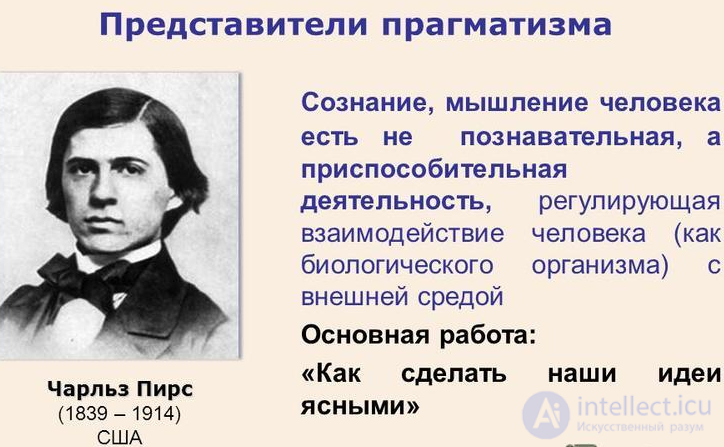
The first ideas of pragmatism were set forth by Peirce, who put forward the assumption that a complete conception of an object includes a conception of its application. All thought and cognition is carried out by means of signs, which effect the translation (interpretation) of one piece of knowledge into another, so that it is impossible to isolate the beginning of knowledge. In accordance with Peirce's understanding of C. Darwin's theory, thought is regarded as a form of adaptation to the environment. Accordingly, the goal of cognition is not the conceptual reflection of reality, but the regulation of the relation between the organism and the environment; cognitive activity should be considered not in relation to external (objective) reality, but in relation to internal psychological processes. A person, living and acting in the world, develops various types of actions, habits, that replace animal instincts for him. Awareness of them constitutes what we call belief, and in fact means a readiness to act in a calm, confident state of mind. The question of truth or falsity is thereby removed: true, correct, is everything that provides psychological confidence in a person's actions and thereby contributes to his adaptation to the environment.
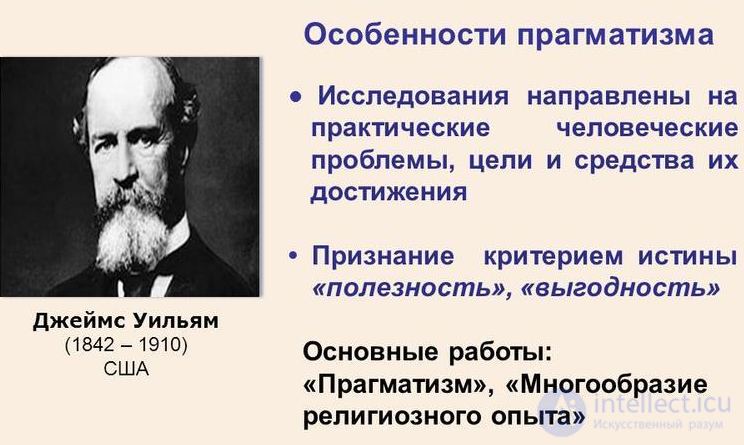
The development and popularization of the ideas of pragmatism were carried out by W. James, and subsequently by J. Dewey, who created the conception of instrumentalism. For Dewey the principal object of attention is scientific knowledge, and he criticizes epistemic theories that examine «the question of the relation of thought «in general» to reality «in general.»» An adequate approach to cognition requires examining any piece of knowledge in the context of the concrete inquiry in which it was obtained. Cognition is always the overcoming of dissatisfaction, and it cannot be understood as a comparison of spiritual and material (natural) entities. It is, rather, a transition, a transformation of different phases of one and the same situation. The general schema for obtaining knowledge contains several stages, among which the most important are the advancing of a supposition (a hypothesis) and its verification. Concepts, ideas, and theories function as intellectual instruments for solving a problem – hence the designation of this conception as «instrumentalism.» A judgment is true if it works in the corresponding situation, functioning as a tool for restructuring the situation, making it possible to eliminate certain difficulties.
A departure from the tradition of positivism also occurs in the sphere of social cognition. The founder of positivism and the «creator» of sociology, A. Comte, as is well known, includes it in the general series of natural sciences. The critique of such a positivistically oriented sociology is carried out within hermeneutics – a movement in the theory of knowledge that took shape at the end of the 19th century.
Of all contemporary philosophical conceptions, hermeneutics has the longest prehistory. Its name derives from that of the god Hermes, messenger of the gods and interpreter of their will. In Christian theology this was the name given to the art of interpreting Holy Scripture. The method of hermeneutics acquired special significance during the period of the Reformation, when the ability to understand and interpret the text of the Bible became a pressing necessity for every believing Protestant.
As an independent discipline of a secular character, hermeneutics takes shape in the works of Schleiermacher (1768 – 1834) and Dilthey (1833 – 1911). Schleiermacher regarded the hermeneutic method as a way of understanding and reproducing the act of authorial creation by analyzing a text. For Dilthey, hermeneutics becomes a means of resolving the most important theoretical-methodological problems of the social sciences and humanities (the «sciences of the spirit»). For him, hermeneutics is an attempt to give a consistent epistemological and methodological grounding to the «sciences of the spirit» as sciences of the understanding cycle, fundamentally different from natural science – something not taken into account in the conceptions of positivistically oriented sociology.
In his teaching on worldviews, that is, on the ways in which people relate to life and its manifestations in religion, art, and philosophy, Dilthey distinguished three types of worldview: naturalism, represented by Anglo-French positivism; the idealism of freedom – German romanticism; and objective idealism, embodied in classical German philosophy. His own worldview can be represented as an amalgam of everything most promising contained in them: from positivism, an intolerance of abstract constructions detached from experience; from romanticism, a heightened attentiveness to the personal principle; from German idealism, historicity. The pathos of positivism inspired him in his struggle against metaphysics; however, for him, unlike many of his contemporaries, positivism and scientificity were not synonymous. He saw the limitations of the positivist ideal and did not accept the positivist absolutization of the method of the natural sciences.
Dilthey's goal becomes, as one of his students wrote, «the resurrection of Hegel's great designs – to uncover the structure of the spiritual world as an autonomous reality in which socio-historical facts would find their place and, at the same time, their connection, allowing for their historical and systematic study.
Since spirit, according to Hegel's conception, is internally structured, it contains the possibility of cognition, which in this case turns out to be understanding. This understanding is a reading and interpretation of spirit in everything – in stone, , in the sounds of music, in legal institutions, gestures, words, texts of any kind. Understanding a text as an «objectification of life» of a particular creative individual is possible only on condition of understanding the spiritual world of the corresponding epoch, which in turn presupposes an understanding of the «objectifications of life» left behind by that epoch. Dilthey contrasts understanding, akin to an intuitive penetration into life, with the method of «explanation», applicable in the «natural sciences», which deals with external experience and is bound up with the constructive activity of the understanding faculty.
The establishment of rules of interpretation constitutes, for Dilthey, hermeneutics as the art of interpreting texts. The most important concept here turns out to be that of the hermeneutic circle. The hermeneutic circle characterizes the process of understanding, connected with its cyclical nature. The various modifications of the hermeneutic circle are connected with the recognition of the mutual conditioning of explanation and interpretation on the one hand, and understanding – on the other. In order to understand something, it is necessary to explain it, and vice versa.
In Dilthey's time, hermeneutics had not yet become widespread. It becomes an independent discipline with Gadamer (1900 - 1989), who gave it the significance not only of a philosophical method, but of philosophizing as such. The subject of the philosophy of hermeneutics is not only the humanities, but the entire body of human knowledge about the world and man's being in it. Understanding – is a mode of existence of the knowing, acting, and evaluating human being. Understanding as a universal way for man to appropriate the world is given concrete form by Gadamer as «experience» Reality is not only known (theoretically), but also «experienced» (in a vitally practical way) by man – «the experience of art», «the experience of history» The basic mechanisms of the formation of experience are laid down in language. Language sets the initial schemes of man's orientation in the world, anticipating his grasp of it in concepts. What matters most for Gadamer is to show the conditioning of the reflective-theoretical appropriation of the world by pre-predicative forms of acquaintance with it. As the principal such form, Gadamer singles out «prejudice» – a polemic with the philosophy of the Enlightenment, which proclaimed as its goal the purification of Reason from prejudice. Truth is not a characteristic of cognition, but a characteristic of being itself. Understanding a text appears as an existential event of human life (the point of departure – the ontological character of the hermeneutic circle); understanding is always «interpreting», and interpretation is «understanding»; understanding is possible only as «application» – the correlation of the content of a text with the cultural and intellectual experience of the present. The interpretation of a text thus consists not in recreating the original (authorial) meaning, but in creating meaning anew.
The linguistic nature of philosophy is revealed, according to Gadamer, above all in its dialogical character. However, dialogue is not limited to linguistic communication between two persons. A dialogical character is also acquired by the relationship between the researcher, or interpreter, and the object of research. The text being interpreted is regarded as an answer to some question, the reconstruction of which is necessary in order to be able to understand the text itself. «The logic of the human sciences is the logic of the question» – Gadamer asserts, and the entire world of our experience has a fundamentally linguistic character. It is precisely in the discovery of the «hermeneutic dimension» of the world that Gadamer himself sees his principal contribution.
Anthropologism of irrationalist orientation as a trend in contemporary Western philosophy.
Serious opposition to scientistic conceptions, oriented toward rationalist cognition and regarding science as the highest expression of social progress and the pinnacle of human creativity, is offered by a body of philosophical theories at the center of whose attention is man in the full fullness of his manifestations, above all the irrational and spontaneous ones.
Among these, «the philosophy of life» occupies a special place. At the foundation of the philosophy of life lies the idea that reason does not exhaust the entire content of human existence, that the basis for understanding the essence of man must be the fullness of the sensations of life. In essence – this is a reevaluation of the value of scientific knowledge and reason. The need for this reevaluation began to be recognized in connection with the awareness of the insufficiency of the mechanistic methodology of classical natural science at its foundation. The philosophy of life appears as the protest of life against the absolutization of the role of calculating reason, as a protest against the technization of the world, as a protest of the soul against the machine, against the de-souling of man.
Representatives of this trend turned to life as the primary reality, a whole, organic process preceding the division of matter and spirit, being and consciousness.
In all these conceptions, life represents a whole process of continuous creative development, opposed to mechanical, inorganic formations, to everything definite, frozen, «that has become». The process of life is not subject to the deadening, decomposing, analytical activity of reason. Anti-scientism follows from the assertion that reason, by its very nature, is detached from life, and grasps only the relations between things, not the things themselves. Rational cognition is oriented toward the satisfaction of practical interests, and acts out of considerations of utilitarian expediency.
The most adequate way of grasping the expression of life turns out to be art – poetry, music. Special attention is given to myth, as a manifestation of spontaneous creativity. The problems of time and history are considered as an aspect of creativity. In the foreground – is an interest in the methodology of the humanities, of historical research, of the «human sciences». History is removed from the power of objective regularities, which operate only in the world of nature. The understanding of cultures as absolutely distinctive and incomprehensible to one another turns into relativism, a denial of a single historical process of human development. Later, these ideas formed the basis of the conception of «mass society», «mass culture», in which creativity is absent and alienation reigns. The philosophy of life is succeeded by personalism and existentialism, which rest on its principles.
A. Schopenhauer (1786 - 1860) is considered the forerunner of the philosophy of life. The core of his conception is the notion of the World Will, a mighty creative principle determining the existence of all things and processes. The Will is directed toward the realization of its own power, so that in its manifestations it destroys itself, yet again and again continues its endless striving and struggle. Various forms of the process of self-realization of the World Will are, according to Schopenhauer, universal gravitation, magnetism and various other forces, chemical affinity, the will to live and the struggle for existence in the organic world, the instincts of animals, the affects of people, their vindictiveness and lust for power.
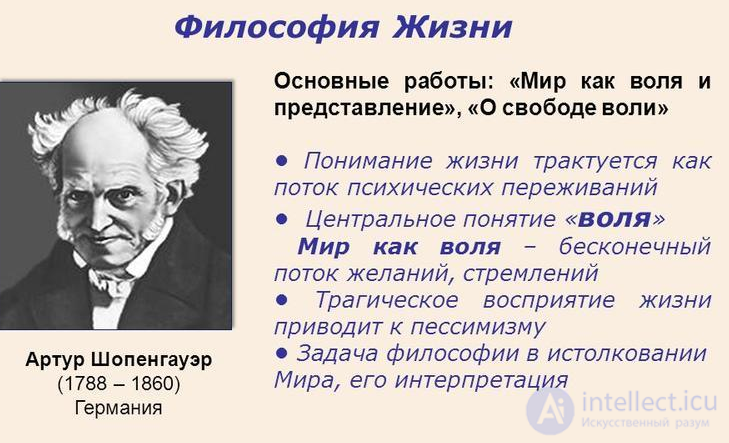
In the organic world, the world will integrates its striving as a striving for life, and in this the tragedy and contradiction of the being of life is revealed: its excess foredooms the majority to destruction. Man alone, of all living beings, is capable of setting a limit to this «killing striving» of the will, halting it through «disinterested» representation – cognition, as a result of which an understanding of the other and compassion for him become possible. Interest in Schopenhauer's philosophy grows toward the end of the 19th century in connection with the general situation of the crisis of European culture, a presentiment of which was reflected in it quite fully and expressively.
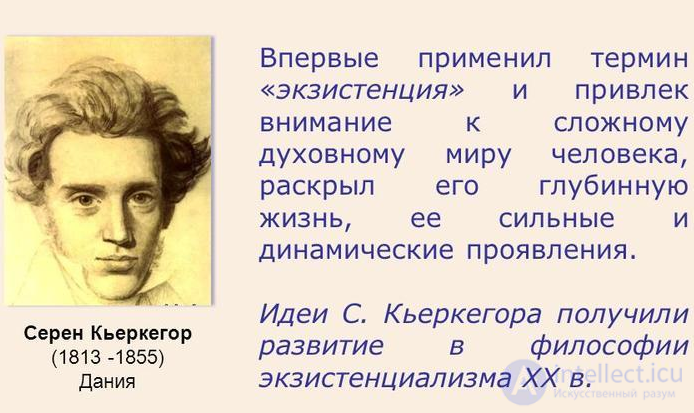
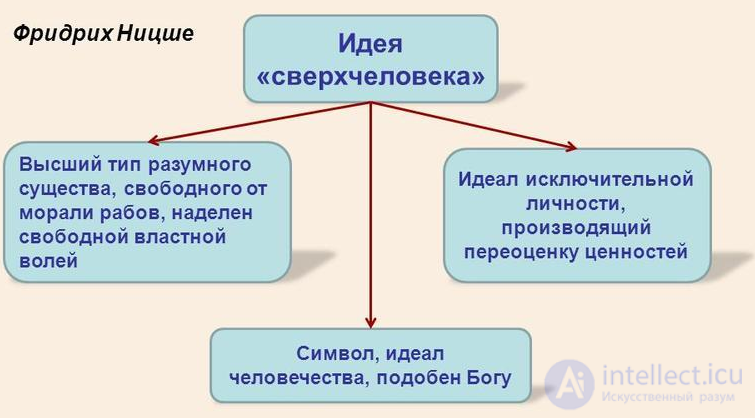
One of the most brilliant representatives of the philosophy of life is F. Nietzsche (1844 - 1900) – a figure in whom the situation of a transitional epoch – the turn of the 19th – 20th centuries – found its most dramatic expression. On the one hand, he is an heir of Western philosophical classics, since the problems he raises – a reconsideration of the ancient philosophical heritage, Christianity, the modern age. On the other – a call for a revaluation of values, a call to the elemental, to creative manifestation. Three stages can be distinguished in his work: the first is connected with questions of culture, its romanticization, and stands under the strong influence of Schopenhauer's philosophy. The second – the revaluation of values. The third – the conception of voluntarism and perspectivism («will to power», «superman», «eternal recurrence») The genesis of human society and culture is connected with the development, in place of physical strength, of intellect and imagination, which allow this physically weak «zoological species» to cope with the solving of practical tasks, allowing it to survive. The means of culture – language and logic, which inevitably distort reality, for they standardize the uniqueness of any situation. Gradually a substitution of «life» by «the existent» takes place, that is, by the regular, the repeating, that is, by that with which science is concerned. At the same time, there is also another important component of human culture – art. It stands much closer to «life» In the early stages, art played a more essential role in culture than science. Subsequently this relation changed in favor of science. Nietzsche sees the model of an ideal correlation of these two principles in ancient Greece. It is precisely here that the Dionysian principle (titanism, the free play of vital forces) is counterbalanced by the Apollonian (measure, formedness) European culture took the path of suppressing the Dionysian principle by the Apollonian – by «reason», truth, orderliness, the Christian God. The world is turned into an unbroken orderliness, in which the weak easily survive and mediocrity triumphs.
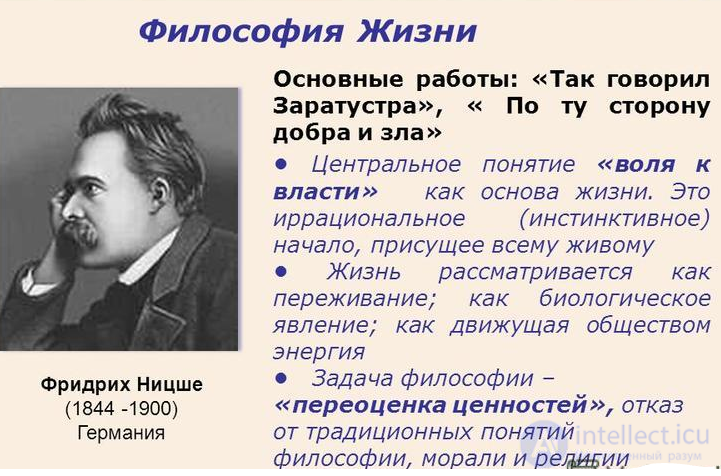
As a result, European consciousness gives rise to nihilism, as a denial of the customary goals and ideals of European culture, above all of the notions of purpose, unity and truth. In place of a single, true being, Nietzsche puts «life» as eternal movement, becoming, constant flux, devoid of the attributes of «being». Becoming, according to Nietzsche, has no purpose, no unity, and cannot be assessed as true or false, good or evil («Heracliteanism»). All processes appear as various modifications of the action of the will to power, to might. «Thing», «subject», «the unity of the I» – appear as products of the creativity, the activity of the thinking individual, heuristic simplifications for designating force. Under the influence of drives and needs, man interprets the world in a definite way, for every drive is a «certain kind of lust for power», striving to impose its own perspective as a norm on all other drives. Injustice, oppression, exploitation are not the prerogative of this or that social form of life. This is a deep characteristic of «life» as such. An appeal to reason and truth – is merely a substitute, for direct physical coercion, way for one will to influence another will (including a collective one). Rational argumentation and, in general, any reasoning, according to Nietzsche, are meaningful only insofar as they designate the perspective of some will striving to expand its power. In any philosophical discussion, the matter is not about the search for truth, but about the affirmation of life, the subjugation of another's will to one's own. Nietzsche links the critique of metaphysics with the critique of language. Thought is inseparable from language, but language necessarily distorts reality. By means of word-metaphors, people initially order the chaos of impressions given in experience. Then these chance metaphors «harden» and, through frequent use, turn into «concepts». The universal applicability of concepts – is the guarantee of the existence of a society whose members must be able to «come to an agreement». Regarding reality as an unordered stream of becoming, Nietzsche emphasizes the incommensurability of the image of the world created by the categorial scheme of language with the true state of affairs, the incapacity of language, and consequently of thought, to present knowledge independently of language and thought themselves. Nietzsche's conviction of the falsifying nature of language and rational thought lies at the basis of his assertion of the priority of action and will over all other properties and qualities. «Universal and necessary truths», though lacking cognitive value, are useful, within the general life process, belong to the «generic subject» and are a priori in relation to the individual subject. It is precisely for this reason that they «eternally recur» as inevitable forms of life and experience. «Nietzscheanism» as a political trend – is unrestrained activism, the triumph of irrational vitality, contempt for spiritual values, amoralism, political extremism.
No less brilliant a proponent of the philosophy of life was A. Bergson (1859 - 1941). The goal of philosophy, from the standpoint of his philosophy – is «to overcome the standpoint of reason». The point of departure of all philosophy, guaranteeing its reliability, is the individual's own existence, expressed in the continuous change of sensations, desires, that is, the change of psychic states. This is precisely «life», representing the genuine reality
Bergson continues the tradition of nineteenth-century French spiritualism, setting himself the task of creating a «positive metaphysics», one that overcomes the one-sidedness of both mechanistic, positivist methods of philosophical inquiry and the speculative, contemplative character of traditional rationalist metaphysics. The basic point of departure – is reliance on immediate experience, by means of which the absolute is grasped. In Bergson's metaphysics there are two central points: true concrete time (duration) and the non-intellectual intuition that grasps it, as the genuine philosophical method. Duration is understood as the basis of all psychic, conscious processes. Duration, unlike the abstract time of science, presupposes the constant creation of new forms, the interpenetration of past and present, the unpredictability of future states, freedom. Intuition, as a way of grasping duration, is opposed to intellectual methods of cognition, which are powerless before the phenomena of consciousness and life, subordinated to practical and social needs, and capable of yielding knowledge only of the relative, not of the absolute. Bodily functions, the perception connected with them, and the intellect based on perception are oriented toward adaptation to certain conditions, toward the realization of practical actions, and not toward the creation of representations of reality. The theory of knowledge is grounded by means of evolutionary teaching. In the work Creative Evolution, created under the influence of the philosophy of Plotinus, this teaching is opposed both to mechanistic and to teleological evolutionism, which saw in evolution the realization of a definite plan, a goal. According to Bergson, the goal of evolution lies not ahead, but behind, appearing in the form of an initial «explosion», which led to the unfolding of the vital process. The concept of life is constructed by analogy with the processes of consciousness; accordingly, life appears as a stream of creativity of continuous qualitative changes, inventions. Bergson represents intellect and intuition as objectively conditioned forms of life and cognition, originally united in the vital impulse (élan vital), but diverging in the process of evolution and acquiring, in the course of development, opposite characteristics. His socio-ethical and religious teaching considers the possibilities for the development of societies of different types: the «closed society», with a static morality and religion, is opposed to the «open society», consisting of chosen heroes. The former is a dead-end branch of evolution.
Sufficiently close to the philosophy of life in its orientation toward man is phenomenology. The specificity of phenomenology as a philosophical teaching consists in the rejection of any idealizations as a point of departure, and the acceptance of the single premise – the possibility of describing the spontaneous-meaningful life of consciousness (Husserl), or of interpreting the fundamental structures of human existence (Heidegger), a possibility rooted in consciousness and human being itself. From the standpoint of its social and cultural function, phenomenology lays claim to the discovery of a new type of intellectual activity, allowing a deep penetration into man's spiritual world, allowing one to understand and describe the deep structures of his consciousness in all the diverse forms of his existence. The point of departure here is a critique of naturalism, which sees the essence of consciousness in its connections with the world of objects.
Indifference to the existence of the object is conditionally methodological: consciousness here appears as «an interweaving of experiences in the unity of a stream,» fundamentally undeterminable through the object whose sense it establishes (constitutes). There is nothing in consciousness except meanings (senses) of real, imagined, or illusory objects. The goal of phenomenological reduction is to uncover in every individual consciousness a pure consciousness, a pure awareness as pure open-mindedness, which calls into question any already-given system of mediations between itself and the world. Pure consciousness is not consciousness purged of objects; on the contrary, it is here that consciousness first reveals its essence as a meaningful joining with the object. Pure consciousness is the self-purification of consciousness from schemes, dogmas, and stereotyped patterns of thought imposed on it, from attempts to find the basis of consciousness in something that is not consciousness. The phenomenological method is the identification and description of the field of the immediate meaningful conjugation of consciousness and object, a field whose horizons contain no hidden entities not manifested as meanings. The mutual irreducibility of consciousness and world is expressed in the difference among three kinds of connection: between things (objects and processes of the external world), between mental acts and states, and between meanings. The connection of meanings is ideal, not inductive or deductive-logical; it is given only in description, as a process of meaning-formation.
продолжение следует...
Часть 1 Contemporary Western Philosophy
Часть 2 The philosophy of the convergence of the positions of religion

Comments