Norms of morality (moral norms) — norms of human behaviour arising out of morality. Their fulfilment is a moral duty, and their violation is a source of moral guilt[ . This is one of the basic concepts of ethics.
Moral norms form a system that differs from other systems of norms (law, custom, etiquette). A number of authors recognize moral norms as having priority over other norms, and sometimes ascribe to them such properties as categoricalness, rigidity, universality, immutability . Others point out that absolutizing moral norms and treating them as universal and obligatory is a source of fanaticism.
Norms of morality are assessed by civil society in connection with its level of development.
Some authors distinguish between «norms of morality», which serve as a guiding principle of ethics, and the specific moral norms that follow from it. Examples of higher norms of morality are the norm authored by Thomas Aquinas: «Strive for good, avoid evil», the principle of striving for «the greatest benefit for the greatest number of people» of Jeremy Bentham, Kant's categorical imperative, or Albert Schweitzer's principle of «reverence for life»
Classification of moral norms
Maria Ossowska produced a classification of moral norms :
- norms concerning biological existence, in particular the prohibition of killing or the protection of animal life,
- norms of dignity, including the concept of honour,
- norms concerning independence, including basic personal freedoms,
- norms concerning privacy,
- norms concerning trust, including truthfulness and fidelity,
- norms of justice,
- norms concerning social conflicts,
- norms formulated as recommendations, various kinds of ethical virtues,
- norms about other moral norms, including:
- the principle according to which analogous cases should be treated in a similar manner,
- Kant's categorical imperative, according to which one should apply only those norms that we would want to become a universal law (so that they could be generalized),
- the principle according to which no one should be a judge in their own case.
Connection with culture
Psychologist Michele Gelfand points to the connection of moral norms with the culture of a given people (the theory of «cultural tightness-looseness»). According to Gelfand, «tight» cultures have stricter moral norms and stricter penalties for violating those norms; loose cultures have weaker social norms and greater tolerance for deviant behaviour.
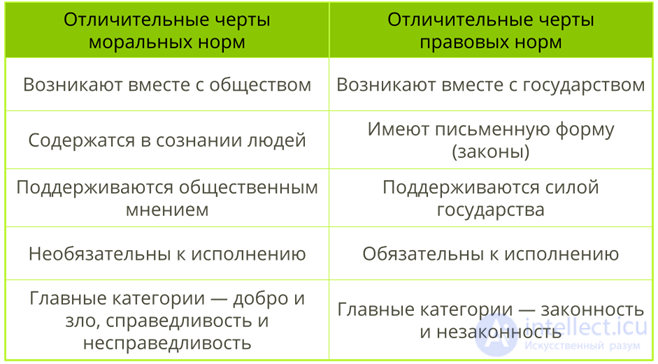
The difference between moral norms and legal norms
Functions of moral norms:
- Evaluative – thanks to the existence of moral norms, society has benchmarks for assessing particular deeds and particular actions of people.
- Regulative – moral norms regulate the behaviour of members of society, encouraging desirable behaviour and condemning undesirable behaviour. In this way, a balance of the interests of all members of society is achieved.
- Educational – moral norms are the basis for the formation in society of higher-order values, such as patriotism, dedication, self-sacrifice.
- Controlling – the very fact of the existence of moral norms, their universality and obligatory nature, includes mechanisms of control and self-control over their observance. Even those individuals who for some reason do not share existing moral norms are forced to reckon with them.
- Integrating – moral norms contribute to achieving inner harmony among members of society, to the coordination of deeds and beliefs, thoughts and actions, goals and the ways of achieving them.
Tests for reinforcement and self-check
1. Moral norms act as manifestations of:
- a) divine will
- b) human arbitrariness
- c) moral relations *
- d) the laws of the state
2. What does the concept of «spontaneity of morality» mean:
- Moral norms are created by each person separately
- Moral norms are formed directly in social life as an :expression of pressing needs *
- Moral norms are created by special bodies, spontaneously convened
3. Which elements are part of the system of morality:
- A) moral principles;
- B) moral norms; *
- C) moral prohibitions; *
- D) moral collisions;
- E) moral doctrines;
- F) moral relations.
4. Which elements are part of the structure of ethics?
- A) mores – custom – morality;
- B) history of ethics – theory of morality - applied ethics; *
- C) moral consciousness – moral behaviour – moral norms.
See also
- [[b5660]]
- [[b8530]]
- [[b5661]]
- [[b8109]]
- [[b310]]
- Overton window
See also


Comments