Scoring of the tests
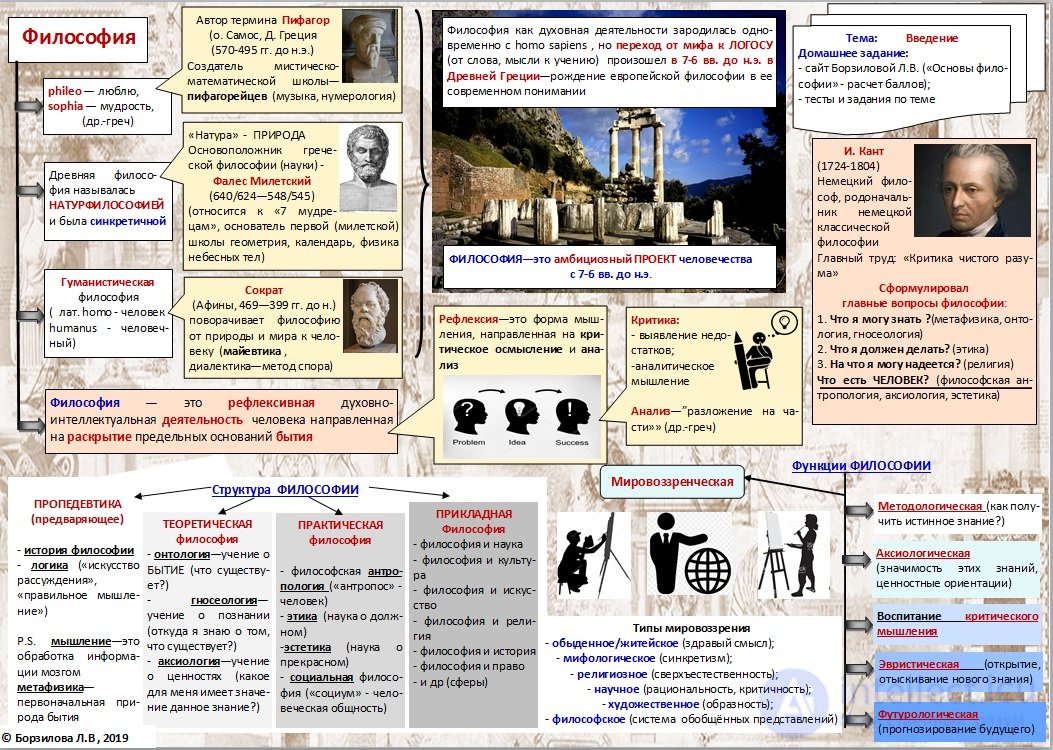
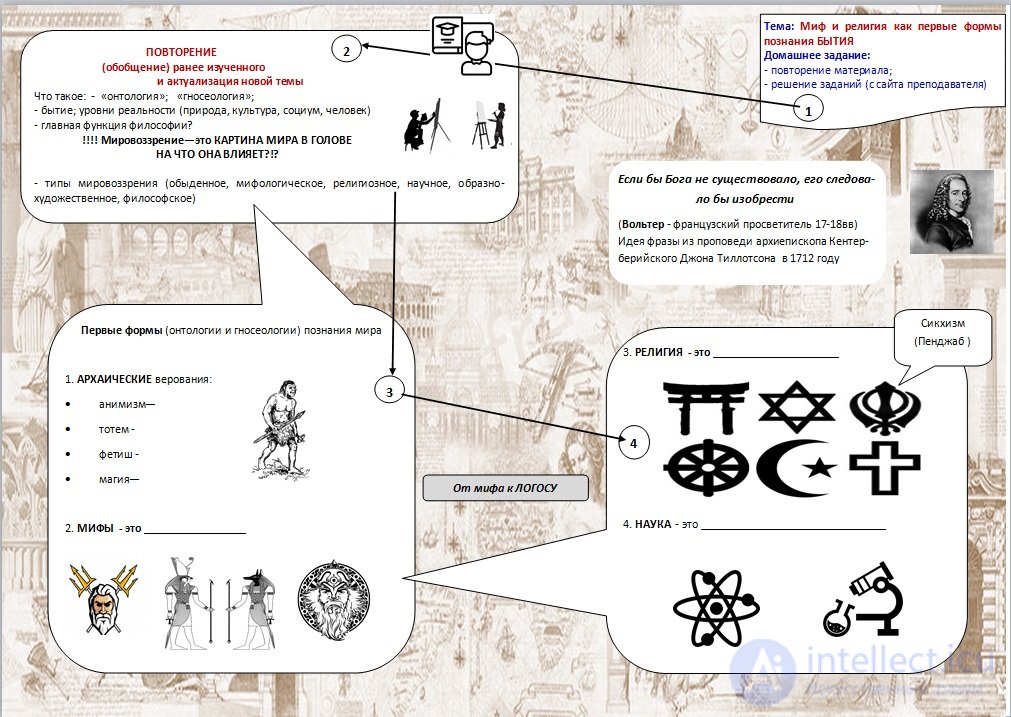
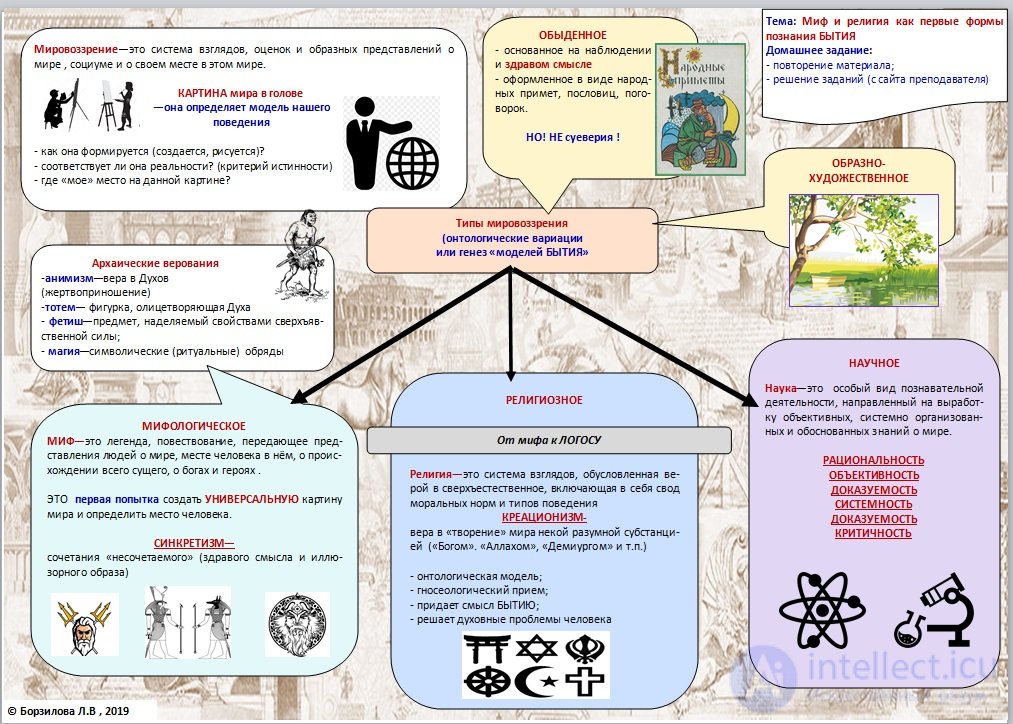
These online tests in philosophy will let you rehearse and delve deeper into material you have already studied, while the diagrams and infographics will help you generalize the knowledge you have acquired.
For the final test from a group of tasks including two levels of difficulty, a grade of «satisfactory» is given provided the student has solved at least 10 tasks (58% of all tasks), of which at least two are tasks of the second level of difficulty.
A grade of «good» is given if the student has correctly completed at least 13 tasks (75%), provided all tasks of the second level of difficulty have been solved.
A grade of «excellent» is given if the student has correctly completed at least 17 tasks (92%), provided all tasks of the second level of difficulty have been solved.
Philosophy and its role in the life of the individual and society.
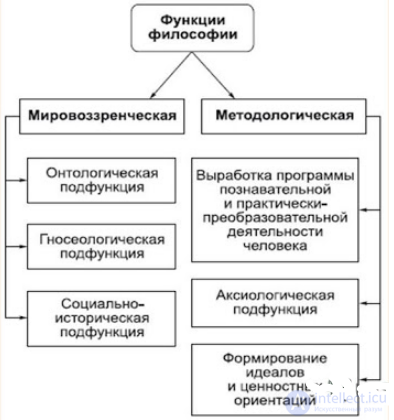
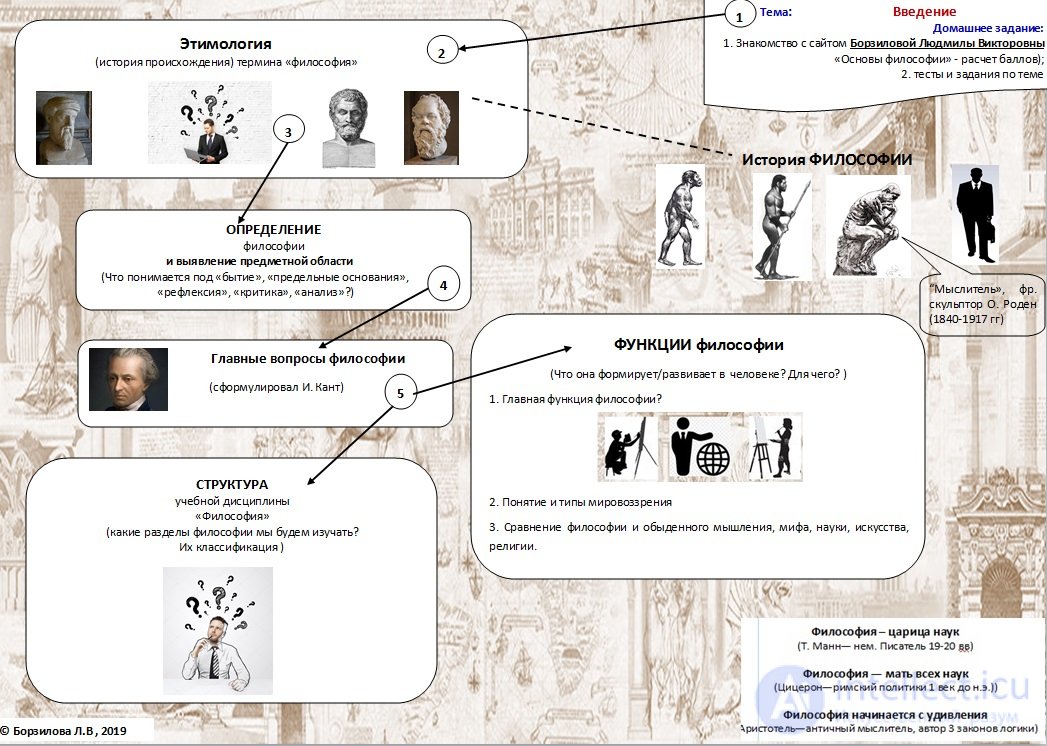
1. Philosophy is (indicate the most correct answer):
- *a) a dynamic process of questioning, of the search for the human lot;
- b) a collection of theories and conceptions of philosophers;
- c) the science that studies language;
- d) the doctrine of the knowability of the world;
- e) the doctrine of the structure of the world.
2. The term «philosophy» means:
- a) reasoning;
- b) a competent opinion;
- c) a professional activity;
- *d) love of wisdom;
- e) logic.
3. The subject of philosophy is (indicate the most correct answer):
- a) the structure of the world;
- b) the beauty of the world;
- c) human happiness;
- *d) the universal within the system «world-human being»;
- e) the search for an ideal society.
4. Philosophy possesses the following functions:
- a) worldview-forming and cognitive;
- b) methodological and prognostic;
- c) axiological and orientational;
- *d) all of these functions taken together.
5. Philosophy explains the world by means of:
- a) mythological images;
- b) revelation;
- c) intuitive insight;
- *d) rational argumentation;
- e) mathematics.
6. Philosophy is:
- *a) a worldview;
- b) a world-feeling;
- c) a world-sensing;
- d) a world-perception.
7. Answers to philosophical questions are sought in:
- a) religious beliefs;
- b) mythological representations;
- c) scientific research;
- *d) the arguments and inferences of reason;
- e) divine revelation.
8. The fundamental question of philosophy is (indicate the most correct answer):
- *a) the question of the relation of consciousness to being, of the ideal to the material;
- b) what are the criteria of truth?
- c) how did the world arise?
- d) what is good and evil?
- e) what is God?
9. The formulations of the fundamental question of philosophy include (indicate all correct options):
- a) who is to blame (Herzen)?
- *b) what is primary: the material or the ideal (Engels)?
- *c) is life worth living (Camus)?
- *d) how to be happy (Socrates)?
- e) what is to be done (Chernyshevsky)?
10. The eternal philosophical questions include (indicate all correct options):
- a) what are the exact dimensions of the universe?
- *b) what is the essence of the human being?
- c) of what elements does a living cell consist?
- *d) what is the meaning of life?
- e) what is the genealogy of the Slavs?
11. Philosophy is (indicate the most correct answer):
- *a) a rational understanding of the world;
- b) revelation;
- c) a true world-sensing;
- d) a specific world-perception.
12. A necessary characteristic of the philosophical worldview is:
- a) concreteness;
- b) visualizability;
- c) systematicity;
- *d) abstractness;
- e) experimentality.
13. A stable system of views on the world, of a person's convictions, representations, and beliefs, which determines the choice of a particular life stance and one's attitude toward the world and other people, — this is:
- a) world-perception;
- b) world-feeling;
- *c) worldview;
- d) world-sensing;
- e) world-vision.
14. Establish the sequence of the historical types of worldview:
- 3a) philosophy;
- 1b) mythology;
- 4c) science;
- 2d) religion.
15. In their origins, philosophy and science relied on:
- *a) mythology;
- b) technology;
- c) religion;
- d) magic;
- e) art.
16. In philosophy, myth is understood as (indicate the most correct answer):
- a) a worldview based on belief in the supernatural;
- b) a specific figurative, syncretic worldview;
- c) a fantastical tale, a legend;
- *d) primitive man's holistic, undifferentiated comprehension of the world and its phenomena, built on a «shape-shifting» logic;
- e) a fairy tale, an invention, a deliberate deception.
17. In this picture of the world, the «natural» and the «supernatural» are not distinguished from one another:
- a) in the scientific;
- b) in the religious;
- *c) in the mythological;
- d) in the philosophical;
- e) in the ordinary.
18. The relationship between philosophy and science consists in the fact that:
- a) philosophy is a part of science;
- b) science is a part of philosophy;
- *c) philosophy and science partially overlap with one another;
- d) philosophy and science exclude one another;
- e) philosophy and science bear no relation to one another whatsoever.
19. The main branches of philosophy (indicate all correct options):
- *a) ontology;
- b) phraseology;
- c) political science;
- *d) axiology;
- e) sociology;
- *f) anthropology;
- *g) epistemology.
20. The doctrine of being as such. The branch of philosophy that studies the fundamental principles of being:
- a) ethics;
- b) axiology;
- c) eschatology;
- *d) ontology;
- e) anthropology.
21. The philosophical doctrine of the universal laws of cognition is:
- *a) epistemology;
- b) ontology;
- c) aesthetics;
- d) ethics;
- e) anthropology.
22. The central problem of ontology is:
- a) the meaning of human life;
- b) whether the world around us is knowable;
- *c) the relationship of being and consciousness, of the material and the ideal;
- d) the study of the laws of thought;
- e) death and the immortality of the human being.
23. Axiology — is the doctrine:
- *a) of values, of their origin and essence;
- b) of beauty;
- c) of the principles of cognition;
- d) of the spiritual culture of society;
- e) of the essence of human history.
24. Materialist trends accept the following propositions (indicate all correct options):
- *a) the world consists of material bodies, each body of the smallest particles;
- b) the world was created by God, and everything in it happens by the will of the Almighty;
- *c) matter – is objective reality;
- *d) motion is an attribute of matter;
- e) space and time are forms of living perception.
tests Philosophy of the Ancient East
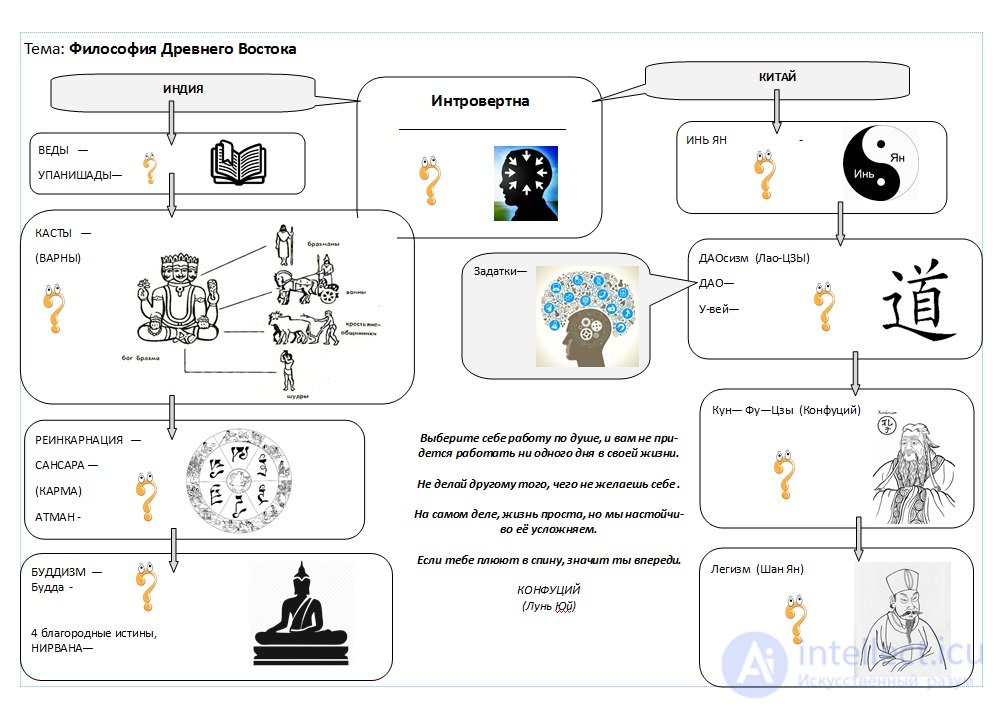
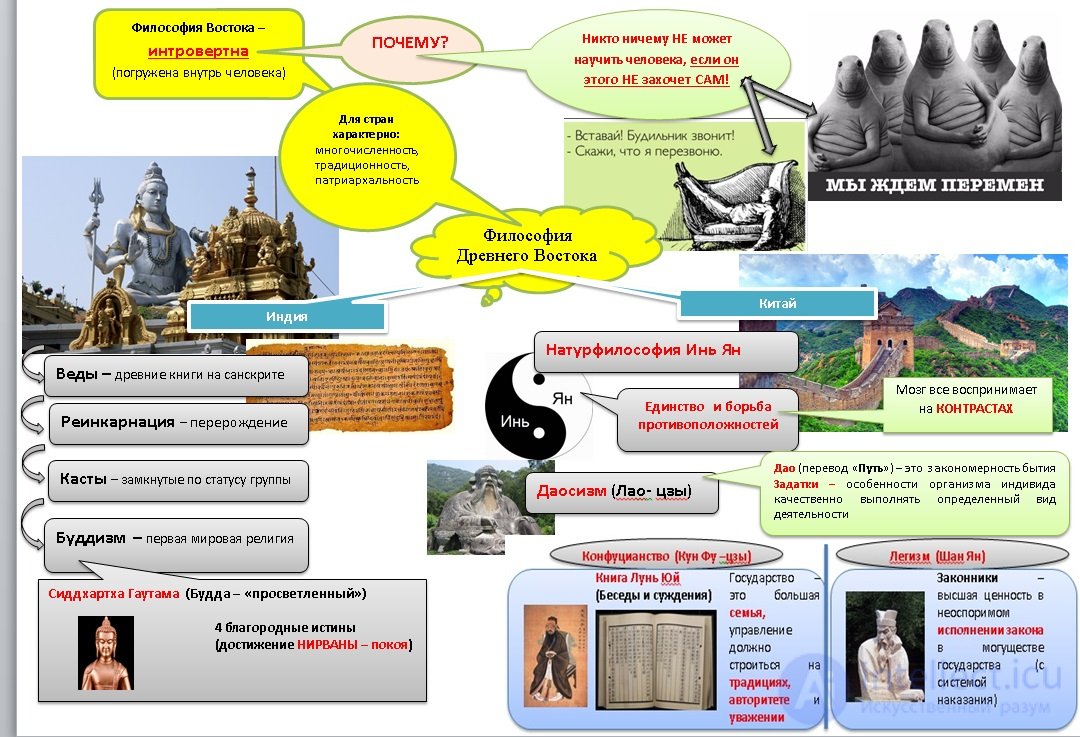
Match the following pairs
| Vedas |
a closed social group |
| Shang Yang |
Shang Yang |
| introversion |
«The Analects» |
| Daoism |
reincarnation |
| Lunyu |
unity in the struggle of opposites |
| Reincarnation |
«The Analects» |
| legalism |
immersion in oneself |
| Yin Yang |
Laozi |
| Caste |
legalism |
| Buddhism |
Ancient books |
| |
Siddhartha Gautama |
tests on the topic of Ancient Philosophy
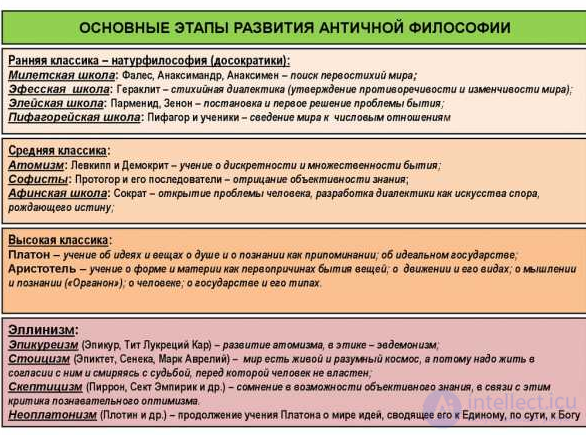
Infographic
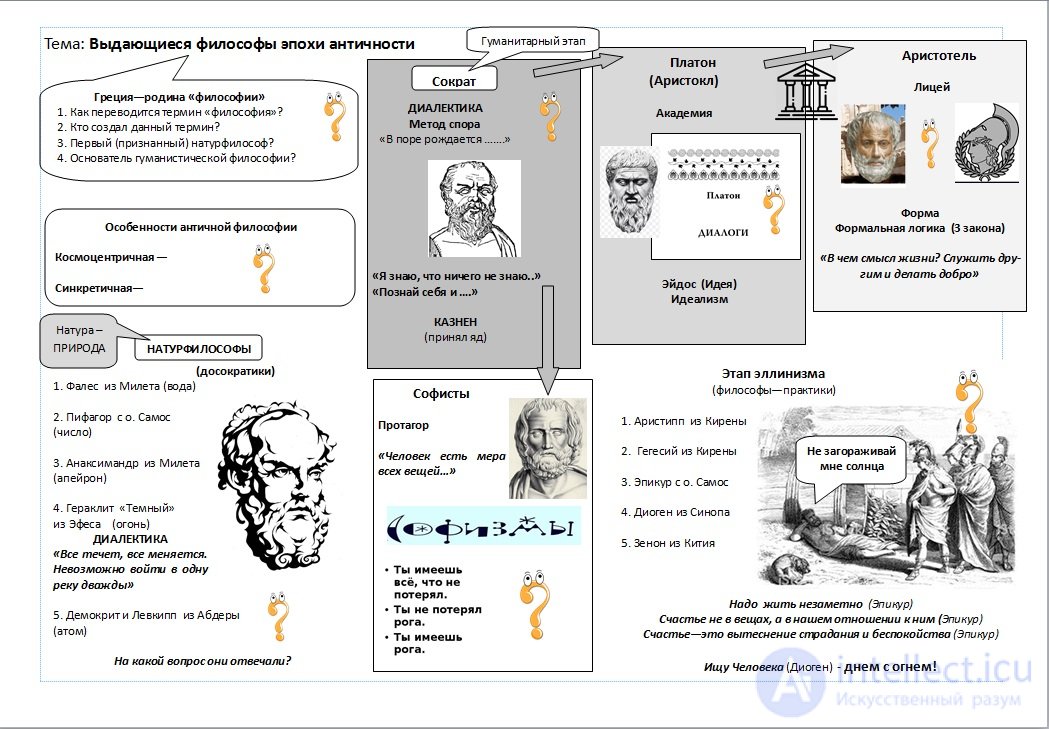
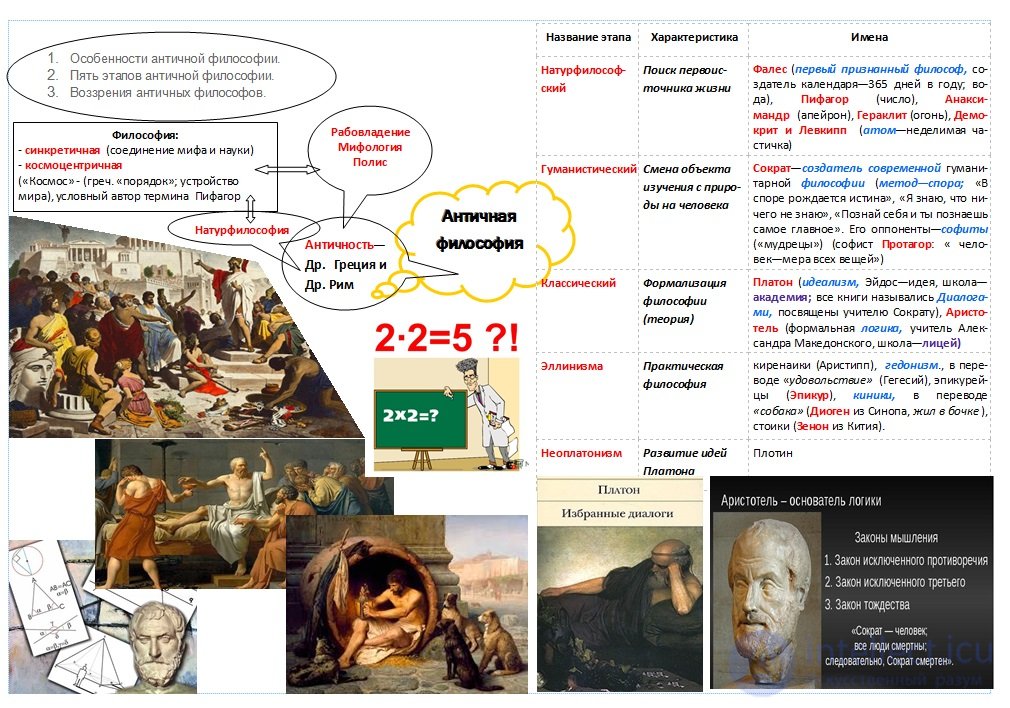
1. A later author wrote of this philosopher: «Everything is from water, he said, and into water everything decomposes».
- a) Anaximenes;
- b) Empedocles;
- *c) Thales;
- d) Plato;
- e) Aristotle.
2. To which form of materialism can the doctrine of Thales of Miletus be attributed:
- a) dialectical materialism;
- b) mechanistic materialism;
- c) anthropological materialism;
- *d) spontaneous (naive) materialism.
3. Representatives of the Milesian school are called spontaneous materialists because they:
- *a) took material elements as the first principle of the world;
- b) openly asserted the primacy of matter over spirit;
- c) denied the existence of the material;
- d) formulated the atomistic conception;
- e) denied the possibility of knowing the world.
4. Of this philosopher's teaching a later author wrote: «This cosmos, the same for all things, was created by no god and no man, but always was, is, and will eternally be a living fire, kindling in measures and going out in measures».
- a) Plato;
- b) Aristotle;
- c) Democritus;
- d) Parmenides;
- *e) Heraclitus.
5. The fragment «Everything flows, everything changes» expresses the essence of:
- *a) Heraclitus's dialectical thought;
- b) Parmenides's metaphysical conception;
- c) the relativism of the sophists;
- d) Aristotle's logic;
- e) the critical stance of the skeptics.
6. The category of «Logos» in ancient philosophy was first introduced by:
- a) Parmenides;
- b) Thales;
- c) Democritus;
- *d) Heraclitus;
- e) Anaximenes.
7. This ancient thinker was the first to formulate the concept of «philosophy»:
- *a) Pythagoras;
- b) Plato;
- c) Socrates;
- d) Aristotle;
- e) Democritus.
8. Number, in the Pythagorean school, is:
- a) an abstraction;
- *b) the first principle of the world, identical with the thing itself;
- c) a creation of reason;
- d) a creation of God;
- e) a psychic illusion.
9. According to Parmenides, we fall into error when we think:
- *a) non-being;
- b) the first principle;
- c) being;
- d) divinity;
- e) matter.
10. The founder of ancient atomism is:
- a) Socrates;
- *b) Democritus-Leucippus;
- c) Plato;
- d) Aristotle;
- e) Heraclitus.
11. Democritus's ontology is built on the principle that:
- *a) the world consists of invisible, indivisible particles — atoms;
- b) the first element of the world is the apeiron;
- c) any thing in the world is a union of matter and form;
- d) the first element of the world is number;
- e) knowledge of the world is impossible.
12. This ancient thinker held that «man is the measure of all things»:
- *a) Protagoras;
- b) Socrates;
- c) Xenophanes;
- d) Epicurus;
- e) Democritus.
13. Socrates said: «I know that I know nothing, but...»
- a) it is impossible to know everything;
- b) knowledge increases sorrow;
- c) there is no need to know anything at all;
- d) I will try to find out;
- *e) others do not even know that.
14. Maieutics is:
- a) ironic mockery;
- b) a form of admonition;
- c) light conversation «about nothing»;
- d) an experiment;
- *e) conversing with an interlocutor with the aim of helping them attain the truth.
15. According to Plato, an idea is:
- a) material and intelligible;
- *b) immaterial, but intelligible;
- c) material, but not intelligible;
- d) immaterial and not intelligible;
- e) a construct of consciousness.
16. True cognition, according to Plato, is:
- a) logically rigorous, rational cognition;
- b) mystical experience;
- *c) the soul's recollection of the ideas it beheld in another world;
- d) knowledge based on experiment;
- e) true cognition is impossible.
17. This ancient philosopher wrote: «Since the soul is immortal, there is nothing it has not already learned; so it is no wonder that it is able to recall what it once knew. And since everything in nature is akin to everything else, and the soul has learned all things, nothing prevents one who has recalled a single thing from finding out all the rest for oneself: for to seek and to learn is, in fact, nothing but recollection».
- a) Aristotle;
- b) Democritus;
- *c) Plato;
- d) Protagoras;
- e) Pythagoras.
18. Plato's "Republic" was:
- a) a democratic state of equal opportunity;
- b) a religious state;
- *c) a state of a caste type, with a clear division into estates;
- d) an absolute monarchy;
- e) a despotism of the Eastern type.
19. In his «Republic», Plato divided society into three estates:
- a) the poor, the well-off, the rich;
- b) peasants, artisans, townsfolk;
- c) nobles, priests, peasants;
- *d) philosophers, warriors, artisans;
- e) peasants, workers, the intelligentsia.
20. In Aristotle's view, every thing is:
- a) a complex union of the smallest particles – atoms;
- b) the sensory image of an idea;
- *c) a union of matter and form;
- d) created from water;
- e) a construct of consciousness.
21. This ancient philosopher wrote: «...The state is a product of natural development, and man is by nature a political being. Whoever, by virtue of their own nature and not by mere accident, lives outside the state, is either a superhuman being or a being underdeveloped in moral respects...»
- *a) Aristotle;
- b) Plato;
- c) Plotinus;
- d) Democritus;
- e) Seneca.
22. In their ethical conception the Stoics put forward:
- *a) the ideal of the sage, who bears the blows of fate dispassionately;
- b) anarchic principles of social life;
- c) the ideal of the believer, meekly enduring the blows of fate in hope of the afterlife;
- d) the ideal of the hero, standing against the whole world;
- e) the ideal of the «suffering god».
23. Determine to which philosopher's teaching the following first principles belong:
First cause of being Philosopher
- d1. water; a) Democritus;
- b2. apeiron; b) Anaximander;
- e3. fire; c) Pythagoras;
- c4. number; d) Thales;
- a5. atoms; e) Heraclitus.
24. Determine in the conceptions of which ancient philosophers the following categories play the dominant role:
- Philosopher Basic categories
- b1. Plato; a) logos;
- a2. Heraclitus; b) idea;
- d3. Aristotle; d) form;
- e4. Democritus; e) atom;
- f g5. Empedocles; f) love;
- g) strife.
25. Establish the correspondence between the philosopher and their school:
- b1. Parmenides; a) atomists;
- a2. Democritus; b) the Eleatic school;
- c3. Anaximander; c) the Milesian school;
- d4. Plotinus; d) neoplatonism;
- e5. Pyrrho; e) skeptics.
26. Establish the correspondence between the philosopher and the philosophical trend:
- b d 1. materialism; a) Parmenides;
- a c e2. idealism; b) Democritus;
- c) Aristotle;
- d) Epicurus;
- e) Plato.
27. Establish the correspondence between the teacher and the pupil:
- Teacher Pupil:
- b1. Plato; a) Anaximander;
- d2. Socrates; b) Aristotle;
- c3. Aristotle; c) Alexander the Great;
- a4. Thales; d) Plato.
28. Establish the sequence of the philosophical doctrines of antiquity:
- 3a) «the world of ideas»;
- 1b) «everything from water»;
- 2c) «number lies at the foundation of everything»;
- 4d) «suspension of judgment».
29. Establish the sequence of the philosophical schools of antiquity:
- 2a) the Pythagoreans;
- 1b) the Milesian school;
- 4c) the Lyceum;
- 3d) the Academy;
- 5e) the neoplatonists.
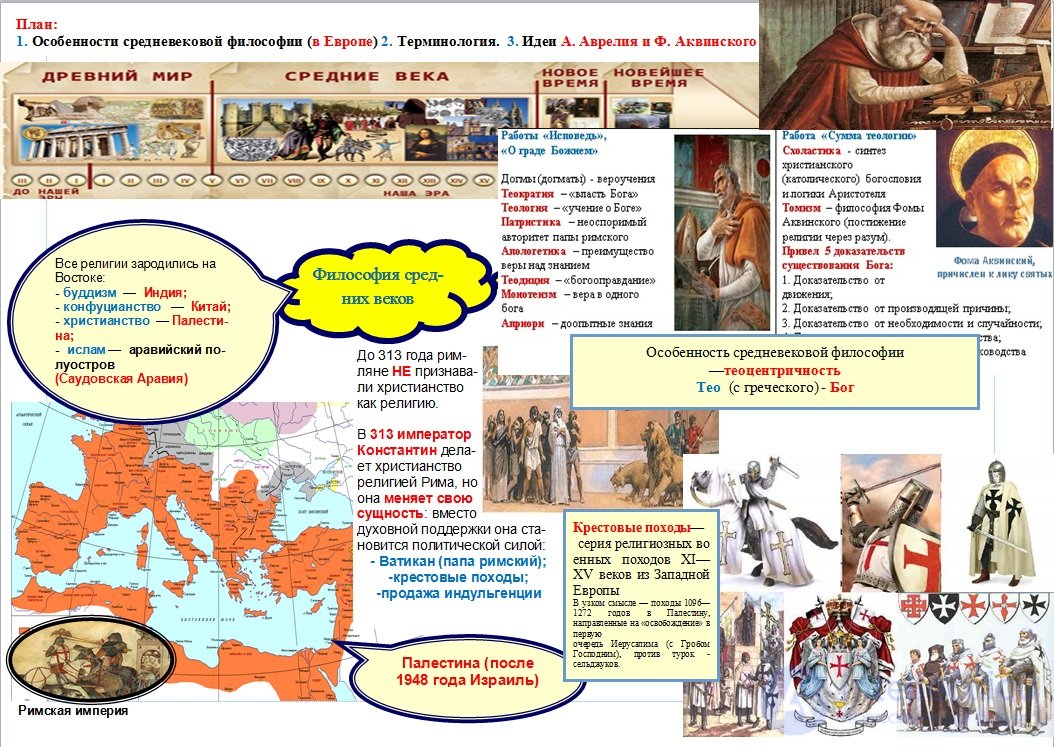
Tests in Philosophy: Medieval Philosophy
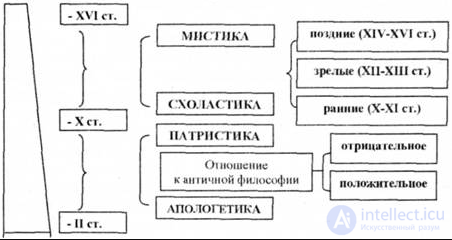
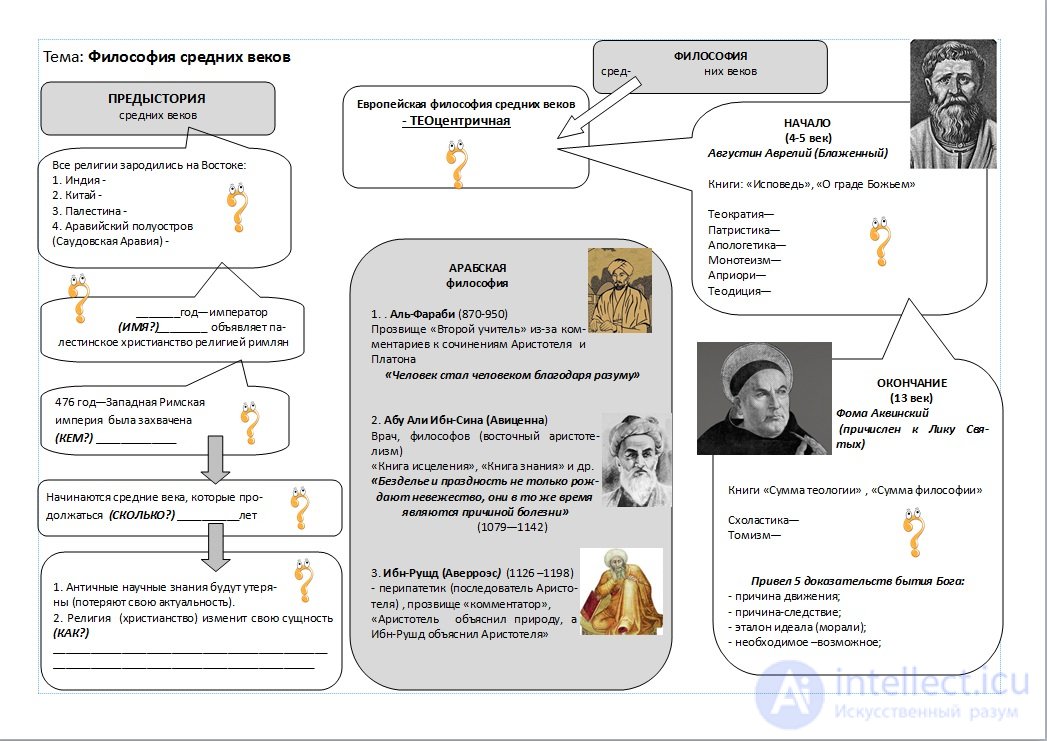
1. The fundamental ideas of the Bible include (indicate all correct options):
- *a) the creation of the world out of nothing;
- b) the world consists of the smallest indivisible particles;
- c) there are many gods, but the supreme one is Zeus;
- d) the concept of reincarnation (the transmigration of souls);
- *e) man is created in the image and likeness of God.
2. The basic dogma of the Christian doctrine concerning God states:
- a) there is no god but Allah;
- b) God is the One;
- *c) God, being one and unique, exists in three hypostases;
- d) God is All and All is God;
- e) God is an impersonal spiritual reality.
3. The basic dogma of Christianity:
- a) dualism;
- *b) the Trinity (triune unity);
- c) deism;
- d) pantheism;
- e) skepticism.
4. The religious-Christian understanding of the human being asserts that:
- a) man — one being equal to other beings created by God;
- b) man — the worst of God's creations;
- c) man — an accident, worth nothing;
- *d) man – the «crown of creation» and lord of all that God created for him;
- e) man – a «thinking machine».
5. At the center of the reflections of medieval philosophers stands:
- a) nature;
- b) personality;
- *c) God;
- d) the ideal world;
- e) the process of cognition.
6. The most important branch of knowledge in the Middle Ages:
- a) philosophy;
- *b) theology;
- c) science;
- d) logic;
- e) mathematics.
7. At the foundation of medieval gnoseology lies the idea of:
- a) creation;
- b) predestination;
- *c) revelation;
- d) the Fall;
- e) salvation.
8. The theory justifying God with respect to the evil he permits in the world is called:
- a) tendency;
- b) theocracy;
- c) theogony;
- *d) theodicy;
- e) theism.
9. Medieval philosophical thought:
- a) completely rejected ancient philosophy;
- b) continued the traditions of the ancient philosophers;
- *c) used the ideas of individual philosophers, reworking them in accordance with its own needs;
- d) used motifs of ancient mythology;
- e) did not know ancient philosophy.
10. The Christian-religious understanding of history means that:
- *a) history is a rectilinear movement from the Fall to the Day of Judgment;
- b) history — is a movement from primitiveness to an ideal, perfect society;
- c) history is the progress of science and technology;
- d) history is cyclical: it is a birth out of chaos and a return into it;
- e) history is the unfolding of the class struggle.
11. The Apologists of the 2nd century AD:
- a) were followers of Julian the Apostate;
- *b) defended and justified the Christian doctrine;
- c) were the first to reveal the striving of the soul toward the primordial unity;
- d) considered the opposition of spirit and matter;
- e) were followers of atomism.
12. The new quality of the human being discovered by medieval patristics:
- *a) spirit;
- b) soul;
- c) reason;
- d) body;
- e) will.
13. Augustine makes the central object of philosophical reflection:
- a) man;
- *b) God;
- c) nature;
- d) logic;
- e) mathematics.
14. The foundation of spiritual life in Augustine's conception is:
- a) reason;
- b) will;
- c) experience;
- *d) faith;
- e) passion.
15. The highest criterion of truth in Augustine's conception:
- a) experience;
- b) reason;
- *c) revelation;
- d) experiment;
- e) there is no such criterion.
16. The task of medieval philosophy, from the standpoint of the Scholastics, consisted in:
- a) investigating social reality;
- b) investigating nature;
- *c) finding rational proofs of faith;
- d) formulating a theory of knowledge;
- e) grounding the scientific method.
17. In scholasticism a distinction was proclaimed between:
- *a) faith and reason;
- b) feeling and thought;
- c) the conscious and the unconscious;
- d) reason and intuition.
18. The subject of the dispute over universals was:
- a) the triune nature of God;
- b) methods of salvation;
- *c) the real existence of general concepts;
- d) the place of God in the world;
- e) the first principle of being.
19. In the dispute over universals, the realists:
- *a) attributed existence to the universal;
- b) did not admit the real existence of universals;
- c) denied the reality of the universal in things, but acknowledged it as a thought, concept, name;
- d) held that universals are a priori constructs of cognition;
- e) held that universals are a psychic illusion.
20. Nominalism, in its attack on the strict rationalization of religious dogmas, thereby:
- a) strengthened Christian theology;
- *b) prepared the ground for the separation of theology from philosophy;
- c) placed the authoritarian position of the church on a new foundation;
- d) hindered the formation of the science of the Modern Age;
- e) gave impetus to the development of mysticism.
21. On the question of the relation between philosophy and religion, Thomas Aquinas put forward the thesis that:
- a) religion and philosophy are incompatible;
- b) all religious dogmas must be proven by reason;
- *c) religion is neither outside nor against reason, it is above reason;
- d) philosophy must be abolished;
- e) religion must be abolished.
22. Thomas Aquinas adhered to the conception:
- a) of the incompatibility of faith and knowledge;
- b) of the superiority of knowledge over faith;
- c) of the harmony of faith and knowledge;
- *d) of the superiority of faith over knowledge.
23. The teaching of Thomas Aquinas and the whole religious-philosophical direction he created is called:
- a) atomism;
- *b) Thomism;
- c) Augustinianism;
- d) papism;
- e) Protestantism.
24. In his reasoning about God, Thomas Aquinas:
- a) unconditionally defended the idea of a personal God;
- *b) recognized God as fully transcendent, unknowable;
- c) held that the cognition of God is mediated by his influence in nature;
- d) supposed that God — is nature itself;
- e) held that God – is the prime mover.
25. In investigating the problems of the human soul, Thomas Aquinas proceeded from the position that:
- *a) the soul is pure form without matter, it is incorporeal;
- b) the soul is a part of the body, acting as its formative principle;
- c) the soul consists of a special subtle matter, distinct from the corporeal, and is therefore not destroyed together with the body;
- d) the soul is a manifestation of a supra-individual spirit, and is therefore indestructible.
26. To this medieval thinker belong the five most complete proofs of the existence of God:
- a) Augustine the Blessed;
- *b) Thomas Aquinas;
- c) Anselm of Canterbury;
- d) Albert the Great;
- e) Tertullian.
27. Match the philosopher to the philosophical direction:
- b c1. realism; a) William of Ockham;
- c a2. nominalism; b) Anselm of Canterbury;
- c) John Roscelin;
- d) Thomas Aquinas.
28. Establish the sequence of the medieval philosophers:
- 4a) Thomas Aquinas;
- 3b) Augustine the Blessed;
- 1c) Philo of Alexandria;
- 2d) Tertullian.
29. Establish the sequence in which the philosophical works arose:
- 2a) «The City of God» by Augustine the Blessed;
- 4b) «Summa Theologiae» by Thomas Aquinas;
- 3c) «On the Divine Names» by Dionysius the Areopagite;
- 1d) «On First Principles» by Origen.
30. Match the philosophical treatise to the corresponding philosopher:
- b1. «The City of God»; a) Dionysius the Areopagite;
- d2. «Summa Theologiae»; b) Augustine the Blessed;
- a3. «On the Divine Names»; c) Origen;
- c4. «On First Principles»; d) Thomas Aquinas.
Tests on the Philosophy of the Renaissance and the Modern Age
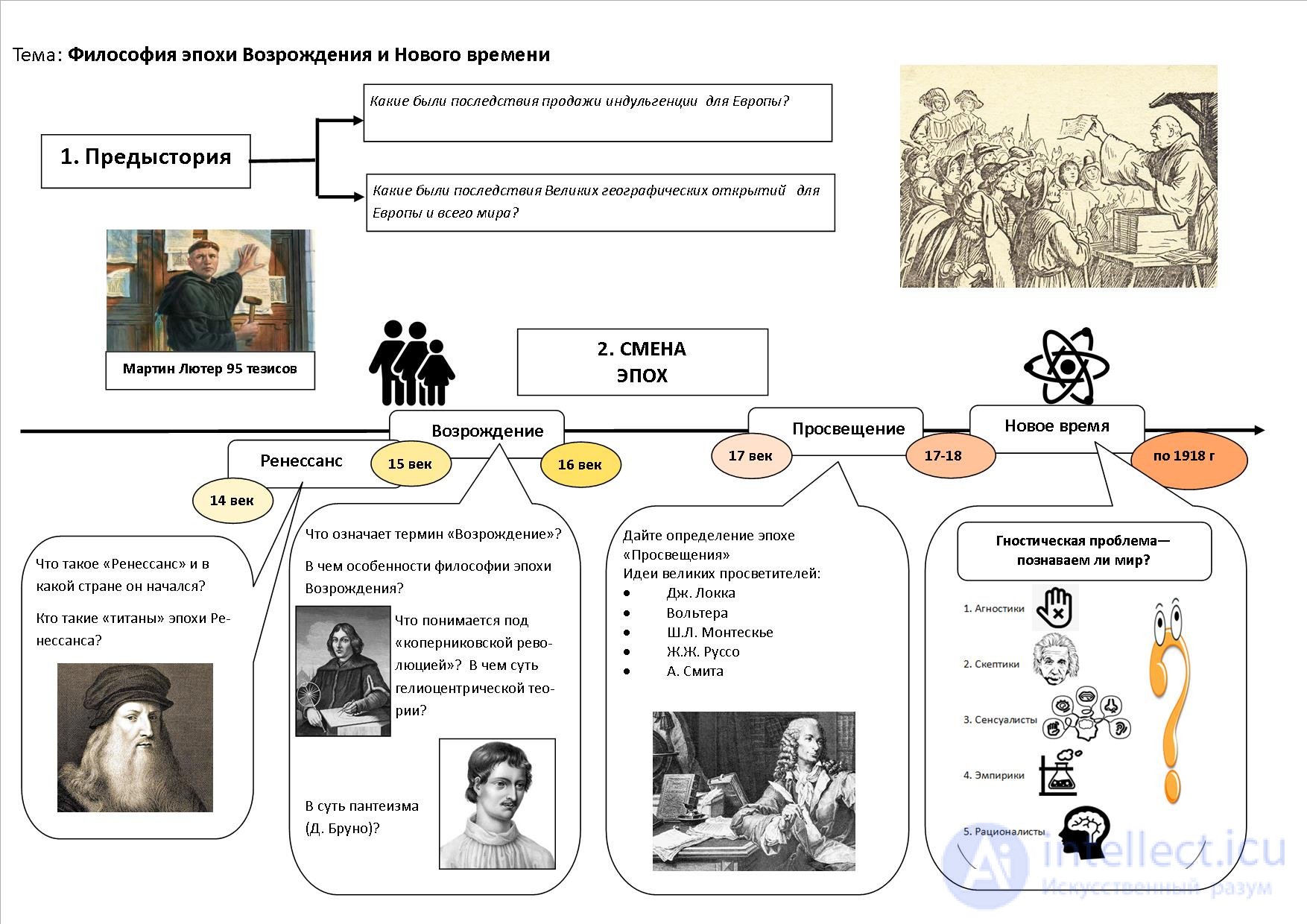
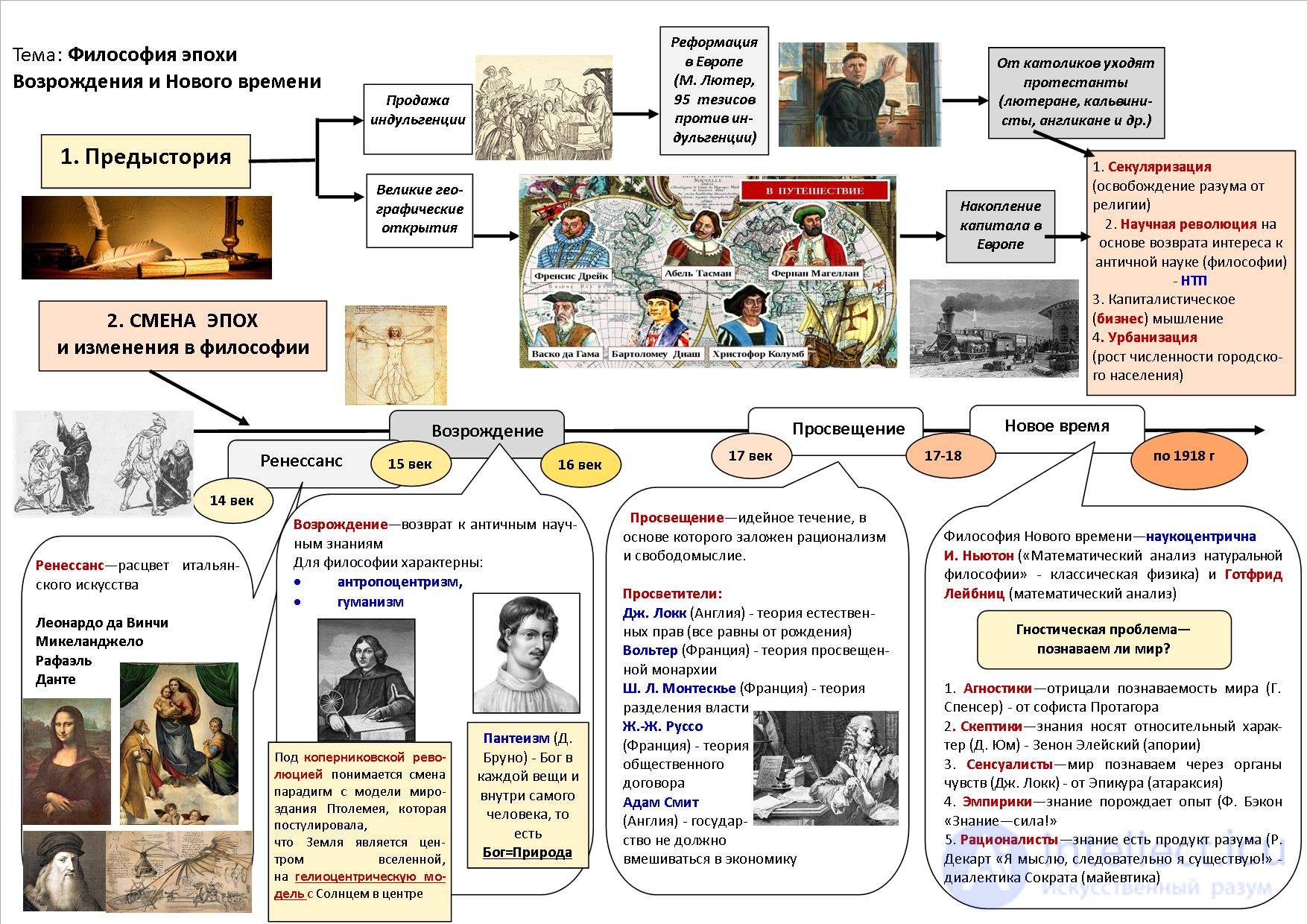
1. The best-known work of Nicholas of Cusa bears the title:
- a) «On Cause, Principle and the One»;
- b) «On the Dignity and Advancement of Learning»;
- *c) «On Learned Ignorance»;
- d) «On the Infinite Universe and Worlds»;
- e) «On the Greatness of the Soul».
2. In his theory of knowledge, F. Bacon adhered to the conception of:
- a) absolute truth;
- b) relative truth;
- c) unattainable truth;
- d) conventional truth;
- *e) double truth.
3. According to the majority of historians of philosophy, F. Bacon was the founder of European:
- a) idealism and stoicism;
- b) objectivism and skepticism;
- *c) empiricism and materialism;
- d) rationalism;
- e) panmathematism.
4. The basic working method of F. Bacon – is:
- a) analysis;
- b) synthesis;
- c) deduction;
- *d) induction;
- e) dialectics.
5. Bacon assigned generally accepted systems of thought (syllogistics and scholasticism) to the idols (phantoms):
- a) of the tribe;
- b) of the cave;
- c) of the marketplace;
- *d) of the theater.
6. The starting principle of Descartes's philosophizing:
- *a) doubt;
- b) dialectics;
- c) intuition;
- d) illumination;
- e) logic.
7. Before declaring: «I think, therefore I am», Descartes asserted:
- a) «I believe because it is absurd»;
- *b) «one must doubt everything»;
- c) «love that moves the sun and the other stars»;
- d) «knowledge — is power»;
- e) «know thyself».
8. According to Descartes's thought, extended substance and thinking substance:
- a) are in close interconnection;
- *b) exist independently of one another;
- c) are opposites and constantly struggle with one another;
- d) exist separately, and the existence of one excludes the simultaneous existence of the other;
- e) are an illusion of the psyche.
9. Descartes acknowledged the existence of:
- a) one substance — matter;
- b) one substance with two attributes: time and space;
- c) one substance with two attributes: thought and extension;
- *d) two independent substances — thought and extension;
- e) only facts of sensory perception.
10. The chief attribute of matter, according to Descartes, is:
- a) divisibility;
- *b) extension (extendedness);
- c) eternity;
- d) changeability;
- e) energy.
11. Descartes considered the main method for obtaining true and practically useful facts to be:
- a) contemplative analysis;
- b) empirical induction;
- *c) rational deduction;
- d) speculative synthesis;
- e) the dialectical method.
12. A whole series of philosophical directions developing Descartes's ideas is called, in the history of philosophy:
- *a) Cartesianism;
- b) sensualism;
- c) realism;
- d) deism;
- e) pragmatism.
13. Spinoza applied, in his «Ethics», an unusual method of exposition:
- a) logical;
- b) empirical;
- *c) geometrical;
- d) semantic;
- e) dialectical.
14. The attributes of substance (nature), according to Spinoza, are:
- a) an external cause;
- b) a multitude of finite things;
- *c) thought and extension;
- d) influence and connection;
- e) energy and information.
15. On the basis of his conception of the physical unity of the universe, G. Bruno expressed the idea that:
- a) the cosmos – is infinity, as eternal uncreated being (god);
- b) the infinity of the cosmos — is a divine attribute, since the world was created by an infinite god;
- *c) the cosmos is infinite, but surrounded by empty space (god);
- d) the cosmos – is empty space, surrounding god as its core;
- e) the cosmos was created by god and is finite, while god himself is infinite and constantly creates new worlds.
16. The philosophy of nature of G. Bruno— is:
- a) deism;
- b) creationism;
- *c) pantheism;
- d) dualism;
- e) materialism.
17. As Leviathan, the state was regarded by:
- a) Spinoza;
- *b) Hobbes;
- c) Descartes;
- d) Bacon;
- e) Nicholas of Cusa.
18. According to Locke, the foundation of all cognition is:
- *a) sensation;
- b) idea;
- c) thought;
- d) word;
- e) intuition.
19. This philosopher first divided power into three kinds (judicial, legislative and executive):
- a) Spinoza;
- *b) Locke;
- c) Descartes;
- d) Bacon;
- e) Nicholas of Cusa.
20. The philosophy of the Enlightenment as a whole is characterized by:
- *a) faith in human reason, knowledge and social progress;
- b) exceptional religiosity;
- c) theocentrism;
- d) an exceptional interest in the problems of cognition.
21. This philosopher directly identified man with a machine:
- a) Spinoza;
- b) Locke;
- *c) La Mettrie;
- d) Bacon;
- e) Nicholas of Cusa.
22. Voltaire held that religion arose when there met:
- a) man and god;
- b) god and the devil;
- c) god and a prophet;
- *d) a swindler and a fool.
23. The ideological leader, organizer and compiler of the first «Encyclopedia» was:
- a) Spinoza;
- *b) Diderot;
- c) La Mettrie;
- d) Bacon;
- e) Nicholas of Cusa.
24. Rousseau held that the development of culture forms in man needs that are:
- a) natural;
- *b) artificial;
- c) material;
- d) spiritual;
- e) social.
25. Match the philosopher to the philosophical direction:
- a c d1. empiricism; a) Bacon;
- b e2. rationalism; b) Descartes;
- c) Locke;
- d) Hobbes;
- e) Spinoza.
26. Establish the sequence in which the philosophical works arose:
- +1a) «On Learned Ignorance» by Nicholas of Cusa;
- 5b) «The Social Contract» by Rousseau;
- 2c) «On the Infinite Universe and Worlds» by Bruno;
- 4d) «Ethics» by Spinoza;
- 3e) «New Atlantis» by Bacon.
27. Match the philosophical treatise to the corresponding philosopher:
- c1. «On Learned Ignorance»; a) Bacon;
- e2. «The Social Contract»; b) Descartes;
- b3. «Discourse on Method»; c) Nicholas of Cusa;
- d4. «Leviathan»; d) Hobbes;
- a5. «New Atlantis»; e) Rousseau.
Topic: German Classical Philosophy.
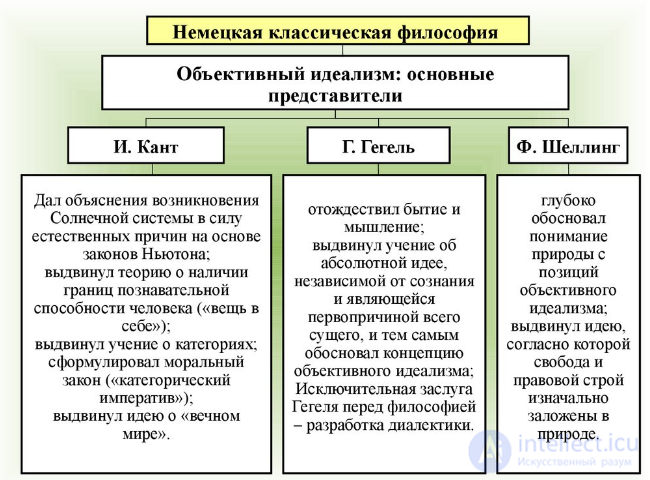
1. In the philosophical work of I. Kant the following periods are distinguished:
- *a) precritical and critical;
- b) materialist and dialectical;
- c) logical and ontological;
- d) rational and irrational;
- e) metaphysical and dialectical.
2. The philosophical treatise «Critique of Pure Reason» was written by:
- a) Hegel;
- b) Descartes;
- *c) Kant;
- d) Nietzsche;
- e) Bacon.
3. The transcendent, according to Kant – is:
- a) that which is known through experience;
- b) that which is known empirically and rationally;
- c) that which is known by means of theoretical reason;
- d) that which is known by means of practical reason;
- *e) that which is absolutely unknowable.
4. According to Kant, the «thing in itself» – is:
- a) God;
- b) the real existence of a potential world;
- *c) an existing world which is completely inaccessible to us and can never become an object of our cognition;
- d) the same as phenomenal subjective being;
- e) the totality of transcendent subjects, the same as what Plato called the «world of ideas».
5. Besides appearances, Kant distinguishes:
- *a) the world of things in themselves;
- b) the world of consciousness in itself;
- c) the world of feelings in itself;
- d) the world of ideas in itself;
- e) god in himself.
6. According to Kant, an object and appearance in the world, given in perception, is for the cognizing subject:
- a) a thing in itself;
- *b) a phenomenon;
- c) a noumenon;
- d) an illusion;
- e) intuitive apprehension.
7. The a priori forms of sensory intuition, according to Kant:
- *a) space and time;
- b) space and thought;
- c) being and time;
- d) sensation and representation;
- e) being and consciousness.
8. According to Kant's theory, time and space:
- a) are eternal real attributes of substance;
- *b) do not exist in reality, but necessarily precede sensory experience;
- c) arise situationally, as the cognition of the world is perfected;
- d) are inherent properties of individual things;
- e) are primary in relation to matter.
9. Kant grounds the moral law, according to which man is an «end in himself», because:
- a) the connection between sensory stimulus and behavior has the character of direct necessity;
- *b) man — is a being capable of absolutely free autonomous motivation of behavior;
- c) man must reconcile his autonomous motivation with the motivation of other people, regarding them as a means to achieving his own ends;
- d) man must reconcile his autonomous motivation with the motivation of other people, regarding them as an end in themselves;
- e) man was created in the image and likeness of God.
10. Kant's formulation of the categorical imperative states: «Act so that the maxim of your conduct, on the basis of your will, could become...»:
- a) a habitual form of your conduct;
- b) a principle of the instinct of self-preservation;
- *c) a universal law;
- d) an example for others to imitate;
- e) a legal law.
11. According to Kant, the categorical imperative is:
- a) a law of the relation of the masses of the planets that he derived;
- b) a Christian dogma that he criticized;
- c) a civic position he held;
- d) proof of the untenability of any moral precepts;
- *e) an unconditional moral requirement, a moral law.
12. According to Kant, the moral worth of an act is the higher, the more it:
- *a) conforms to the operative law;
- b) provides personal satisfaction;
- c) is subordinated to an abstract sense of duty;
- d) is subordinated to the will of God;
- e) is connected with humane or friendly feelings.
13. In his theory of aesthetic judgment, Kant was the first to characterize the aesthetically pleasing from the standpoint of:
- a) need;
- b) creative capacity;
- c) practice;
- *d) disinterestedness;
- e) pleasure.
14. Hegel's philosophy is:
- a) realism;
- *b) absolute objective idealism;
- c) materialism;
- d) empiricism;
- e) transcendental idealism.
15. Dialectics in Hegel's philosophical system is:
- *a) speculative-idealist;
- b) existential;
- c) materialist;
- d) negative;
- e) metaphorical.
16. According to Hegel, the first principle of all that exists is:
- a) matter;
- b) consciousness;
- *c) the absolute idea (the world spirit);
- d) God;
- e) what exists has no first principle; everything is groundless and transient.
17. In Hegel's system, world development is:
- *a) the development of spirit (the absolute idea);
- b) the process of the lawlike succession of socioeconomic formations;
- c) the embodiment of the Divine plan;
- d) the process of the self-organization of matter;
- e) Hegel denied development.
18. In the "Science of Logic," Hegel substantiates the thesis:
- a) everything that exists is rational;
- b) everything that exists is actual;
- c) everything that is rational exists;
- *d) everything that is rational is actual.
19. Hegel, in his work "Philosophy of History," regarded history as:
- a) the progressive development of science;
- b) the self-purposed becoming of God;
- *c) the development of the world spirit in time;
- d) the development of the world spirit in space;
- e) moral progress.
20. The philosophy of L. Feuerbach is:
- *a) materialism;
- b) idealism;
- c) rationalism;
- d) naturalism;
- e) empiricism.
21. L. Feuerbach's materialist conception is known as:
- a) spontaneous materialism;
- b) naive materialism;
- c) mechanistic materialism;
- d) dialectical materialism;
- *e) anthropological materialism.
22. Feuerbach considered the main object of cognition to be:
- a) nature;
- b) God;
- *c) the human being;
- d) cognition;
- e) society.
23. Feuerbach regarded religion as:
- a) an absurd superstition;
- b) the absolutization of the subjective side of consciousness;
- *c) the ascription to God of human attributes;
- d) the realization of freedom;
- e) an atavism of consciousness, connected with people's fear of the forces of nature.
24. The "new ethics and religion of humanity" that Feuerbach called for is a religion and ethics of:
- a) law;
- b) the state;
- c) the absolute;
- *d) love;
- e) God.
25. Match the philosopher to the philosophical doctrine:
- b1. transcendental idealism; a) Hegel;
- d2. anthropological materialism; b) Kant;
- a3. absolute idealism; c) Schelling;
- c4. philosophy of identity; d) Feuerbach.
26. Match the philosophical treatise to the corresponding philosopher:
- b1. «Critique of Pure Reason»; a) Hegel;
- d2. «The Essence of Christianity»; b) Kant;
- a3. «Science of Logic»; c) Schelling;
- c4. «System of Transcendental Idealism»; d) Feuerbach.
Philosophy tests: Western European philosophy of the 19th-20th centuries
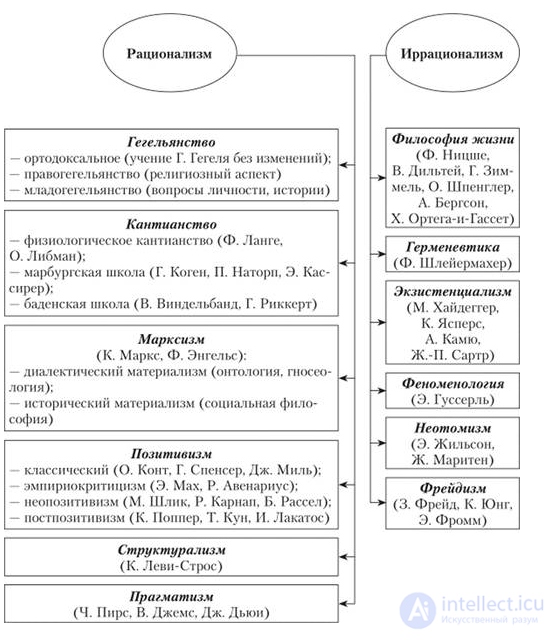
1. The philosophy of K. Marx bears the name:
- *a) dialectical materialism;
- b) phenomenology;
- c) historiosophy;
- d) critical realism;
- e) empiricism.
2. According to Marx, the development of society is based on the development of:
- a) consciousness;
- *b) the productive forces;
- c) the world spirit;
- d) the interaction of God and nature;
- e) the interaction of God and man.
3. The founding formula of Marxist philosophy for the analysis of social life means:
- a) consciousness determines being;
- *b) being determines consciousness;
- c) social being determines consciousness;
- d) social consciousness determines being;
- e) being is consciousness.
4. One of the stages in the development of positivism was:
- a) neo-Thomism;
- b) Berkeleianism;
- c) transcendentalism;
- *d) empirio-criticism;
- e) existentialism.
5. The outstanding figures of the so-called "first positivism" were:
- a) R. Avenarius;
- *b) A. Comte;
- *c) H. Spencer;
- d) H. Bergson;
- e) K. Marx.
6. A. Comte was convinced that in science one must strive to replace the word "why" with the word:
- a) what;
- b) what for;
- c) how much;
- *d) how.
7. According to A. Comte's teaching, the development of human society passes successively through three stages:
- a) mythological — philosophical — positive;
- *b) theological — metaphysical — positive;
- c) religious — positive — naturalistic;
- d) philosophical — positive — religious.
8. A. Comte hoped to replace all the sciences of society with:
- a) management;
- b) synergetics;
- *c) sociology;
- d) epistemology.
9. According to H. Spencer, throughout the Universe there is manifested a primordial, all-encompassing, and incomprehensible:
- a) Will;
- b) Matter;
- *c) Force;
- d) Soul.
10. H. Spencer formulated his fundamental law that the continuous redistribution of existing bodily particles and their motions is:
- *a) evolution;
- b) revolution;
- c) stagnation;
- d) transformation.
11. In his sociology, H. Spencer regarded society as a kind of "organism" that strives toward a state of:
- a) constant development;
- b) inevitable disintegration;
- *c) equilibrium;
- d) transformation.
12. A well-known assertion of pragmatism:
- a) truth is what has been proven;
- *b) truth is what is useful;
- c) truth is what is habitual;
- d) truth is what is incomprehensible;
- e) truth is revelation.
13. A representative of "philosophy of life" is:
- *a) Nietzsche;
- b) Kant;
- c) Schelling;
- d) Hegel;
- e) Fichte.
14. One of the main categories of "philosophy of life" is:
- a) reason;
- b) thought;
- c) consciousness;
- d) God;
- *e) will.
15. In Schopenhauer's teaching, the world surrounding us is merely a set of representations, which are most closely associated with the concept of:
- a) the thing in itself;
- b) eidos;
- *c) maya;
- d) monad;
- e) logos.
16. Gravity, magnetism, animal instincts, human behavior — all of this, according to Schopenhauer, is a manifestation of:
- a) nature;
- b) God;
- *c) will;
- d) reason.
17. According to Schopenhauer, the world Will is a force that is (indicate all correct answers):
- a) rational and purposeful;
- *b) unconscious, blind, and wild;
- c) luminous and divine;
- d) limited and weak;
- *e) singular and groundless.
18. In Schopenhauer's opinion, human life as a whole is:
- a) happiness;
- b) enjoyment;
- *c) suffering;
- d) service to God;
- e) love.
19. In Schopenhauer's opinion, salvation from eternal suffering can be attained if one:
- a) leads a rational, moderate life;
- b) prays;
- c) serves society;
- *d) overcomes desire, passion;
- e) strives for pleasure.
20. According to Schopenhauer, human history is:
- a) a progressive movement toward a society of universal prosperity;
- b) the inevitable approach of the Last Judgment;
- *c) a meaningless tangle of events;
- d) the triumph of freedom.
21. The greatest influence on Schopenhauer's philosophy was exerted by (indicate all correct answers):
- *a) the teaching of Kant;
- b) the teaching of Hegel;
- c) the teaching of Schelling;
- *d) the teaching of the Buddha;
- e) the teaching of Rousseau.
22. Schopenhauer's philosophy is:
- a) an optimistic teaching;
- *b) a pessimistic teaching;
- c) a hedonistic teaching;
- d) a rationalist teaching;
- e) a eudaimonistic teaching.
23. The psychological concept that largely determined S. Kierkegaard's philosophical anthropology:
- a) love;
- *b) fear;
- c) envy;
- d) joy.
24. The central idea of S. Kierkegaard's philosophy:
- a) a human being is a unique individuality. And the more he perfects himself, the more benefit he brings to society and improves it;
- b) the basic anthropological unit is the people. It manifests its capacities, talents, and active abilities in individuals;
- *c) the spiritual individual, the single human being, stands opposed to the social environment and perfects himself in spite of it and its laws;
- d) only universal phenomena really exist — the race, class, state, society. Individuals are faceless, anonymous, and untrue.
25. S. Kierkegaard considered there to be three stages of existence of the human spirit:
- a) epistemological — ethical — aesthetic;
- b) epistemological — aesthetic — religious;
- *c) aesthetic — ethical — religious;
- d) aesthetic — ethical — epistemological.
26. The fundamental concept in the philosophy of F. Nietzsche is:
- a) the will to life;
- *b) the will to power;
- c) the will to wealth;
- d) the will to God;
- e) the will to humanity.
27. F. Nietzsche substantiated the idea of:
- a) the economic progress of humanity;
- b) the moral progress of humanity;
- *c) eternal recurrence;
- d) the inevitability of the victory of socialism;
- e) scientific and technological progress.
28. In the sphere of scientific cognition, according to Nietzsche's thought, truth is:
- a) the goal of scientific cognition;
- b) an objective reflection of reality;
- c) a current opinion;
- *d) a useful error.
29. The ideal human being of the future, according to Nietzsche, is:
- a) the collectivist human being;
- b) the mass human being;
- c) the marginal human being;
- d) the machine human being;
- *e) the overman.
30. In the philosophy of H. Bergson, life is understood as:
- *a) a changeable, creative flow of consciousness;
- b) a process of rational, logical cognition;
- c) a system of sensations and feelings;
- d) a totality of animal and plant forms;
- e) a form of the state of protein.
31. The treatise belonging to Bergson's pen is:
- a) "The Evolution of Species";
- b) "Cosmogony";
- c) "On the Celestial Hierarchy";
- *d) "Creative Evolution";
- e) "The Creativity of Man".
32. According to H. Bergson, the foundation of cognition is:
- a) experience;
- b) reason;
- c) logic;
- d) experiment;
- *e) intuition.
33. According to S. Freud's teaching, life as a whole and most of a person's specific actions are determined by:
- a) thinking;
- *b) the unconscious;
- c) reason;
- d) the intellect;
- e) experience.
34. According to psychoanalysis, human culture is built on:
- a) the striving to satisfy primary drives and instincts directly and immediately;
- b) the reduction of a person's sense of guilt;
- c) the reduction of the individual's anxiety;
- *d) the sublimation of primary complexes;
- e) the striving toward labor.
35. The archetype, according to C. Jung, is:
- a) the initial moments of all scientific cognition;
- b) the image of a leader, a chieftain;
- c) the original constituents of the human psyche;
- *d) collective forms and images arising from mythological consciousness and way of life;
- e) a paradigm of cognition.
36. The basic premise of existentialism means:
- a) being determines consciousness;
- b) the denial of the reality of the world;
- c) essence precedes existence;
- *d) existence precedes essence;
- e) essence and existence are identical.
37. A fundamental characteristic of human existence in existentialism is:
- a) love;
- *b) freedom;
- c) duty;
- d) conscience;
- e) reason.
38. In existentialism, existential time is bound up with such concepts as (indicate all correct answers):
- a) infinity;
- b) structure;
- *c) resoluteness;
- *d)
продолжение следует...
Продолжение:
Часть 1 1000 Online Philosophy Tests with Answers, Diagrams, and Infographics
Часть 2 - 1000 Online Philosophy Tests with Answers, Diagrams, and Infographics
Часть 3 tests on the topic Society and History - 1000 Online
Часть 4 Topic 1 Philosophy and the scientific picture of the world


Comments