
Lecture
Determinism (from Latin determinare — «to limit, delineate, define») — the doctrine of the interconnection and mutual determination of all phenomena and processes , the doctrine of universal causality.
Determinism is the philosophical doctrine of the objective, lawlike interconnection and mutual conditioning of things, processes, and phenomena.
The main points:

A cause-and-effect relationship is a genetic connection between phenomena in which one phenomenon, called the cause, given certain conditions, necessarily generates, calls into being, another phenomenon, called the effect.
According to determinism, everything that occurs in the world, including the course of history and of human life, is predetermined either by fate, or by the gods or God (the doctrine of predestination, theological determinism), or by nature (cosmological determinism), or by human will (anthropological-ethical determinism), or by the development of society (social determinism).

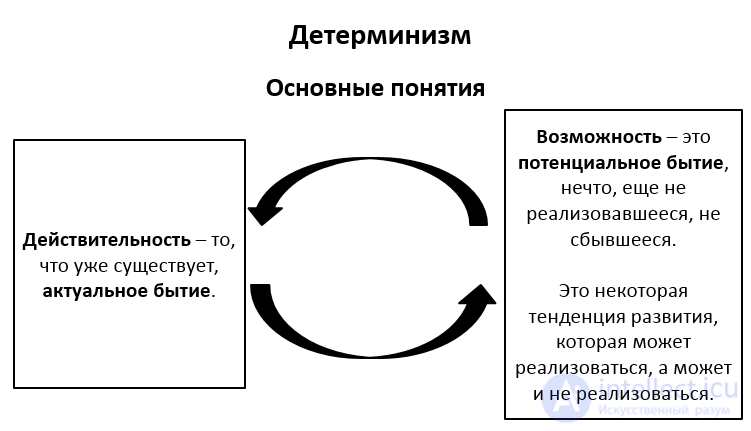

On this basis, the understanding of freedom is determined, including the conclusion according to which there is, in essence, no room for choice, and accordingly for personal responsibility, on the part of human beings.
In this form, determinism can be defined as the assertion that there is only one, precisely fixed, possible future.
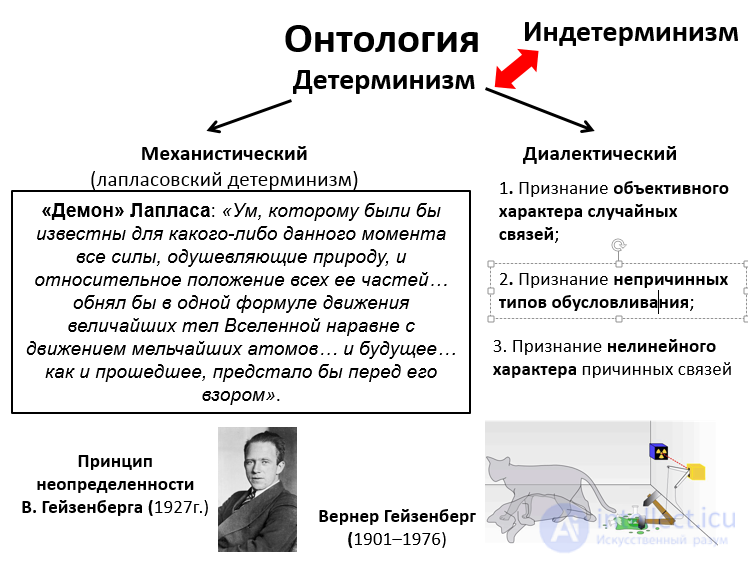
Determinism can also be understood as fatalism. The opposite of determinism is indeterminism .
An adherent of absolute determinism was Pierre-Simon Laplace. He postulated that if some intelligent being could know the position and velocity of all particles in the world, it could predict all events of the universe with complete precision. Such a hypothetical being was subsequently named Laplace's demon.
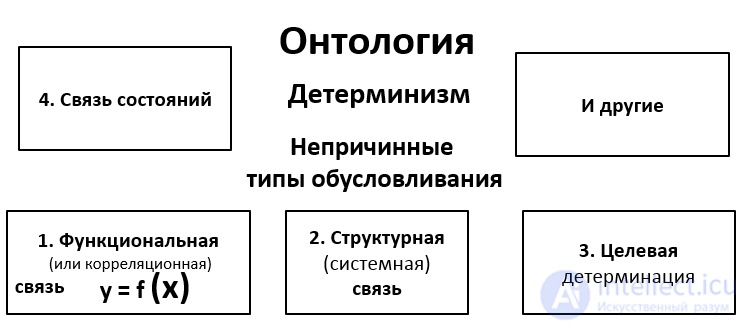
Determinism, as a conception of the interconnection of all phenomena and processes, is an essential component of scientific methodology, directing researchers toward identifying causality and lawful regularities in nature, society, and thought .
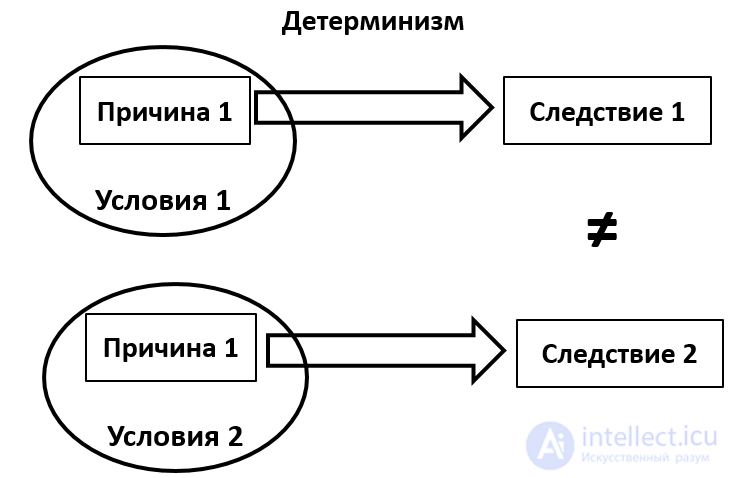
Classical physics is built on the principle of determinism. Thermodynamics and molecular physics represent a special question in this connection. Determinism does not imply the reversibility of time, proceeding from the assumption that a particle will not necessarily return to its initial state when time is reversed, meaning that a trajectory will not always be uniquely determined by the final conditions
The uncertainty principle, in Einstein's version, played a very useful role, since it showed that in the world of fundamental particles the law of conservation of energy could be violated…
…with its help it also proved possible to explain some unusual phenomena in the world of subatomic particles, proceeding from the fact that under conditions where the conservation law is violated, particles may appear out of nothing that disappear before they can be detected, and which are therefore called virtual particles…
…the uncertainty principle strongly influenced the development of modern physics and philosophy. It is directly connected with the philosophical problem of causality (that is, the cause-and-effect relationship). However, in science the fate of this idea turned out to be different from what was expected. One can often read that the uncertainty principle demonstrates the fundamental impossibility of obtaining precise scientific answers about what actually happens in the surrounding world, and that all human knowledge is obtained only thanks to the unpredictable caprices of the universe, where the effect is not determined by the cause .
— Isaac Asimov, Guide to Science for the Intelligent Person
Between determinism and indeterminism there are transitional doctrines, for example in Luther, Zwingli, and Kant: thus, if determinism applies fully to the empirically given «natural» nature of the human being, then their moral nature is, in this case, regarded as a form of indeterminism.
In quantum mechanics, superdeterminism is a loophole in Bell's theorem that allows it to be circumvented by assuming that all measured systems are causally correlated with the choice of which measurements are made on them. It is entirely possible that someone could use this loophole to construct a local hidden-variable theory reproducing the predictions of quantum mechanics. Superdeterminists do not accept the existence of genuine chances or possibilities anywhere in the cosmos.
Bell's theorem assumes that the measurements performed at each detector can be chosen independently of one another and of the hidden variable being measured. But in a superdeterministic theory this is not true; they are necessarily correlated. Since the choice of measurements and the hidden variable are predetermined, the results at one detector can depend on which measurement is performed at the other, without any need to transmit information at a speed exceeding the speed of light.
Thus, one may suppose that freedom of choice was constrained from the beginning of the universe at the Big Bang, with each future measurement predetermined by correlations established at the Big Bang [ edit ]. This would make superdeterminism untestable [ citation needed ], since experimenters could never eliminate the correlations that were created at the beginning of the universe: the free-choice loophole can never be completely closed.
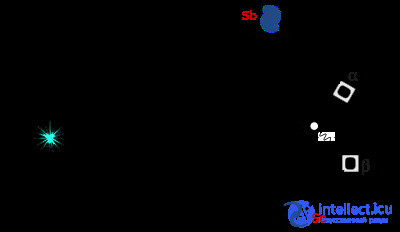
In the 1980s, John Bell discussed superdeterminism in a BBC interview:
There is a way to avoid the assumptions of superluminal speeds and spooky action at a distance. But this presupposes absolute determinism in the universe, a complete absence of free will.. Suppose the world is superdeterministic, with not only inanimate nature running on behind-the-scenes clockwork, but also our behavior, including our belief that we are free to choose to do one experiment rather than another, absolutely predetermined, including the "decision" of the experimenter to carry out one set of measurements rather than another, then the difficulty disappears. There is no need for a signal traveling faster than light to tell particle A what measurement has been carried out on particle B, because the universe, including particle A, already «knows» what that measurement will be and what its outcome will be.
Although he acknowledged the existence of the loophole, he also maintained that it was implausible. Even if the measurements performed are chosen by deterministic random-number generators, one can suppose that the choice is «effectively free for the purpose at hand», because the machine's choice is altered by a large number of very small effects. It is unlikely that the hidden variable would be sensitive to all the same small influences as the random-number generator.
Nobel laureate Gerard 't Hooft discussed this loophole with John Bell in the early 1980s. «I raised the question: suppose that Alice's and Bob's decisions should also be regarded as arising not from free will, but as determined by everything in the theory. John said: well, you know, that's something I have to rule out. perhaps what I said doesn't apply. I said, Alice and Bob make their decision based on a cause. The cause lies in their past and must be included in the picture".
According to the physicist Anton Zeilinger, if superdeterminism is true, some of its consequences would call into question the very value of science, by undermining falsifiability:
[We] always implicitly assume the freedom of the experimenter ... This fundamental assumption is necessary for engaging in science. If this were not true, then, I believe, it would make no sense at all to pose questions to nature in an experiment, since nature could then determine our questions, and this could guide our questions in such a way that we would arrive at a false picture of nature. [7

Comments