
Lecture
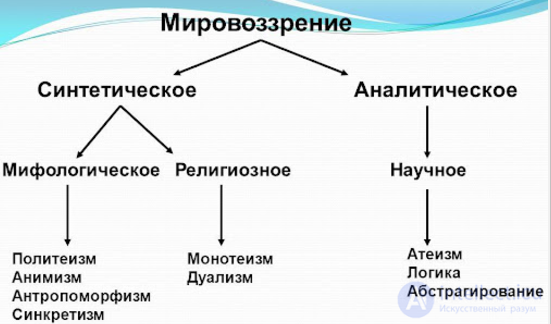
Anthropomorphism (Fr. anthropomorphisme, from Anc. Greek ἄνθρωπος — «man», μορφή — «form, image, shape») — the attribution of human form and its properties to inanimate objects, animals, plants, natural phenomena, supernatural beings, abstract concepts, and so on. Personification is the related attribution of human form and characteristics to abstract concepts such as nations, emotions, and natural forces such as the seasons and weather. Both have ancient roots as storytelling and artistic devices, and most cultures have traditional fables with anthropomorphized animals as characters. People have also commonly attributed human emotions and behavioral traits to both wild and domesticated animals.
This is a worldview concept expressed through the nominative means of language, the visual arts, and so on. According to this principle, inanimate objects, living beings, and fictional entities that lack human nature can be endowed with human qualities, both physical and emotional. The objects in question are, in particular, capable of feeling, experiencing emotions, speaking, thinking, and performing meaningful human actions.
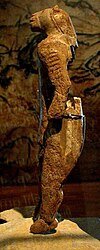
The Löwenmensch figurine, 35,000–40,000 years old
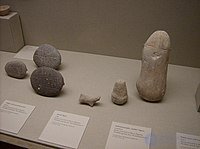
Anthropomorphic «pebble» figures from the 7th millennium BC
Since the beginning of behaviorally modern human activity in the Upper Paleolithic, around 40,000 years ago, examples of zoomorphic (animal-shaped) works of art appear, which may represent the earliest known evidence of anthropomorphism. One of the oldest known examples is an ivory sculpture, the Löwenmensch figurine from Germany, a human-shaped figure with the head of a lioness or lion, estimated to be about 32,000 years old.
It is impossible to say what these prehistoric works of art represent. A later example is the «Sorcerer,» an enigmatic cave painting from the Trois-Frères cave, Ariège, France: the meaning of the figure is unknown, but it is usually interpreted as some great spirit or master of animals. In any case, an element of anthropomorphism is present.
Archaeologist Steven Mithen links this anthropomorphic art to the emergence of more systematic hunting practices in the Upper Paleolithic. He suggests that this is the result of a change in the architecture of the human mind, an increasing fluidity between natural history and social intelligence, in which anthropomorphism allowed hunters to empathically identify with the animals they pursued and better predict their movements.
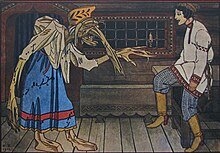
Baba Yaga, an anthropomorphic character of Russian folk tales
Anthropomorphism is characteristic of both early and later religions and is inherent in the myths of all peoples and times. Francis Bacon classed anthropomorphism among the «idols of the tribe,» in which, in his view, is expressed «the tendency to explain the actions of nature by analogy with human actions and deeds, that is, the conviction that nature does the same as man.» Voltaire wrote: «If God created us in His own image, we have returned the compliment.» Animism is characterized by an anthropomorphic attitude toward the forces of nature, plants, and animals. In polytheism, gods are humanized and endowed with human psychological traits. In monotheistic religions, anthropomorphism is generally regarded as a «primitive» conception of God, yet it remains widespread even within them. Anthropomorphism is inherent in descriptions of the external manifestations of God (His countenance, eye, hand, foot are mentioned), His actions (He sits in the heavens, sees, speaks, and hears), and His feelings (anger, satisfaction, laughter). However, such statements can be interpreted both literally and as a metaphor — an attempt to convey human sensations in this way.

A Celtic sword with an anthropomorphic hilt, Latenïum Museum, Neuchâtel, Switzerland
Linguistic reconstructions and other evidence indicate that anthropomorphism was the dominant principle of cognition and explanation of incomprehensible natural phenomena and patterns of world order at early stages of societal development (a storm is coming, the sky is frowning, the foliage «whispers,» and so on). Anthropomorphism was characteristic of most religious systems and was expressed in the transfer of human physical properties and psychological qualities onto objects of worship: inanimate objects (stone, cliff, sun), living beings (tree, crocodile, lion), and also beings of the earthly or middle realm (wood spirits, house spirits), the upper realm (gods, angels), and the lower realm (demons, devils). Alongside features of resemblance to humans, the inhabitants of the upper and lower realms typically also possess features that distinguish them from people. These usually include gigantic or dwarfish stature, immense strength, the presence of a tail or wings, excessive hairiness, and so on.
Some religions, scientists, and philosophers have objected to anthropomorphic deities. The earliest known criticism was voiced by the Greek philosopher Xenophanes (570–480 BC), who observed that people model their gods after themselves. He opposed the concept of deities as fundamentally anthropomorphic:
But if cattle and horses and lions had hands
or could paint with their hands and create works as men do, then
horses would draw the forms of gods like horses, and cattle like cattle,
and they would make their bodies
in the likeness of their own.
...
The Ethiopians say their gods are snub-nosed [ σιμούς ] and black,
while the Thracians say theirs are pale and red-haired.
Xenophanes said that the «greatest god» resembles man neither «in form nor in mind.»
Judaism and Islam reject an anthropomorphic deity, holding that God lies beyond human comprehension. Judaism's rejection of an anthropomorphic deity began with the prophets, who explicitly rejected any resemblance of God to human beings. This rejection was further strengthened after the Islamic Golden Age in the tenth century, which Maimonides systematized in the twelfth century in his thirteen principles of Jewish faith.
In the Ismaili interpretation of Islam, both attributing qualities to God and denying any qualities of God ( via negativa ) qualify as anthropomorphism and are rejected, since God cannot be understood by attributing qualities to Him or by stripping Him of them. The tenth-century Ismaili philosopher Abu Yaqub al-Sijistani proposed a method of double negation; for example: «God does not exist,» followed by «God does not not exist.» This exalts God beyond any understanding or human comprehension.
In secular thought, one of the most notable critiques began in 1600 with Francis Bacon, who opposed Aristotle's teleology, which held that everything behaves as it does in order to achieve some purpose, to realize itself. Bacon pointed out that the pursuit of goals is a human activity, and attributing it to nature amounts to misconstruing nature as human. [ 19 ] Modern criticism followed Bacon's ideas, such as the critiques of Baruch Spinoza and David Hume. Hume, for example, incorporated his arguments into his broader critique of human religions and specifically demonstrated what he called their «inconsistency,» whereby, on the one hand, the Deity is painted in the most exalted terms, while, on the other hand, He is degraded almost to the human level, endowed with human infirmities, passions, and prejudices. In The Faces in the Clouds, anthropologist Stewart Guthrie suggests that all religions are anthropomorphisms arising from the brain's tendency to detect the presence or traces of other people in natural phenomena.
Some scholars argue that anthropomorphism overestimates the similarities between humans and non-humans and therefore cannot yield accurate data.
Various examples of personification occur both in the Hebrew Bible and in the Christian New Testament, as well as in the texts of some other religions.
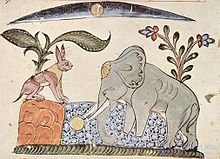
From the Panchatantra: a rabbit deceives an elephant by showing it the reflection of the moon.
Anthropomorphism, also called personification, is a long-established literary device dating from ancient times. The story of «The Hawk and the Nightingale» in Hesiod's Works and Days predates Aesop's fables by centuries. Collections of related fables from India, the Jataka and the Panchatantra, likewise use anthropomorphized animals to illustrate principles of life. Many of the animal stereotypes recognized today, such as the cunning fox and the proud lion, can be found in these collections. Aesop's anthropomorphisms were so well known by the first century AD that they colored the thinking of at least one philosopher:
And there is another charm about him, namely, that he puts animals in a pleasant light and makes them interesting to mankind. For, being brought up from childhood with these stories and being, as it were, nursed by them from infancy, we acquire certain opinions about various animals and think of some as royal animals, of others as foolish, of others as witty, and of others as innocent.
— Apollonius of Tyana
Apollonius noted that the fable was created to teach wisdom through fictions that are meant to be understood as fictions, contrasting favorably with the stories poets tell about deities, which are sometimes taken literally. Aesop, «by announcing a story that everyone knows is not true, told the truth by the very fact that he did not claim to be recounting real events.» The same awareness of the fable as fiction can be found in other examples around the world; one such is the traditional Ashanti way of beginning stories about the anthropomorphic trickster spider Anansi: «We do not really mean, we do not really mean, that what we are about to say is true. A story, a story; let it come, let it go.»
Anthropomorphic motifs have been common in fairy tales from the earliest ancient examples set in a mythological context to the great collections of the Brothers Grimm and Perrault. The Tale of Two Brothers (Egypt, 13th century BC) features several talking cows, and in Cupid and Psyche (Rome, 2nd century AD) Zephyr, the west wind, carries Psyche away. Later an ant takes pity on her and helps her in her quest.
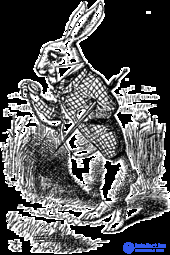
This depiction of an anthropomorphic rabbit, created by John Tenniel, was featured in the first chapter of Lewis Carroll's Alice's Adventures in Wonderland.
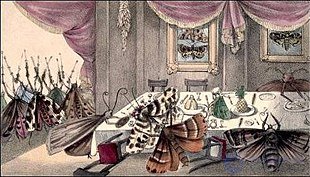
From The Emperor's Defeat (1831)
Building on the popularity of fables and fairy tales, children's literature began to emerge in the nineteenth century with works such as Lewis Carroll's Alice's Adventures in Wonderland (1865), Carlo Collodi's The Adventures of Pinocchio (1883), and Rudyard Kipling's The Jungle Book (1894), all of which used anthropomorphic elements. This continued into the twentieth century, when many of the most popular titles featured anthropomorphic characters, examples being Beatrix Potter's The Tale of Peter Rabbit (1901) and her later books; Kenneth Grahame's The Wind in the Willows (1908); A. A. Milne's Winnie-the-Pooh (1926) and The House at Pooh Corner (1928); and C. S. Lewis's The Lion, the Witch and the Wardrobe (1950) and the subsequent books of the Chronicles of Narnia series.
In many of these stories, the animals can be seen as representing facets of human personality and character. As John Rowe Townsend observes in discussing The Jungle Book, in which the boy Mowgli must rely on his new friends, the bear Baloo and the black panther Bagheera, «the jungle world is really both itself and our world.» A notable work aimed at an adult audience is George Orwell's Animal Farm, in which all the main characters are anthropomorphic animals. Examples not involving animals include the Reverend W. Awdry's stories of the Railway Series featuring the steam engine Thomas and other anthropomorphic locomotives.
The fantasy genre developed out of mythological, fairy-tale, and romantic motifs and sometimes features anthropomorphic animals as characters. The best-selling examples of the genre are The Hobbit (1937) and The Lord of the Rings (1954–1955), both written by J. R. R. Tolkien, books populated with talking creatures such as ravens, spiders, and the dragon Smaug, as well as a host of anthropomorphic goblins and elves. John D. Rateliff calls this the «Doctor Dolittle Theme» in his book The History of the Hobbit, and Tolkien believed that this anthropomorphism was closely tied to the emergence of human language and myth: «...The first men who spoke of «trees and stars» saw things quite differently. For them, the world was full of mythological beings... For them, all creation was «myth-woven and elvish.»» .
Richard Adams developed a distinctive approach to anthropomorphic writing in the 1970s: his debut novel, Watership Down (1972), featured rabbits that could speak — in their own language (Lapine) and mythology — and included a police force, Efrafa. Nevertheless, Adams tried to make his characters' behavior reflect that of wild rabbits, engaging in fighting, mating, and defecating, drawing on Ronald Lockley's study The Private Life of the Rabbit as research. Adams returned to anthropomorphic storytelling in his later novels The Plague Dogs (1977) and Traveller (1988).
By the twenty-first century, the market for children's picture books had expanded significantly. Perhaps most picture books contain some degree of anthropomorphism, popular examples being Eric Carle's The Very Hungry Caterpillar (1969) and Julia Donaldson's The Gruffalo (1999).
Anthropomorphism in literature and other media has given rise to a subculture known as the furry fandom, which promotes and creates stories and artwork featuring anthropomorphic animals, as well as the study and interpretation of humanity through anthropomorphism. This is often shortened in search to «anthro,» which some use as an alternative term for «furry.»
Anthropomorphic characters have also been a mainstay of the comics genre. Foremost among them was Neil Gaiman's The Sandman, which had an enormous influence on how characters that are physical embodiments are portrayed in the fantasy genre. [ 38 ] [ 39 ] Other examples include the mature Hellblazer (a personification of political and moral ideas), Fables and its spin-off series Jack of Fables, which was unique in featuring an anthropomorphic representation of literary devices and genres. Various Japanese manga and anime have used anthropomorphism as the basis of their stories. Examples include Squid Girl (an anthropomorphic squid), Hetalia: Axis Powers (personified countries), Upotte!! (personified guns), Arpeggio of Blue Steel, and Kancolle (personified ships).
Big Buck Bunny is a free short animated film featuring anthropomorphic characters.
The most prominent examples are the Walt Disney characters: the magic carpet from the Disney «Aladdin» franchise, Mickey Mouse, Donald Duck, Goofy, and Oswald the Lucky Rabbit; the Looney Tunes characters Bugs Bunny, Daffy Duck, and Porky Pig; and a whole host of others from the 1920s to the present day.
In the Disney/Pixar franchises Cars and Planes, all the characters are anthropomorphic vehicles, while in Toy Story they are anthropomorphic toys. Other Pixar franchises, such as Monsters, Inc., feature anthropomorphic monsters, while Finding Nemo features anthropomorphic sea creatures (such as fish, sharks, and whales). Discussing the anthropomorphic animals of the DreamWorks Madagascar franchise, Timothy Laurie suggests that « social differences rooted in conflict and contradiction are naturalized and rendered less «contentious» through a classificatory matrix of human and non-human relations [ clarification needed ] ». Other DreamWorks franchises, such as Shrek, feature fairy-tale characters, while the Blue Sky Studios of 20th Century Fox franchises, such as Ice Age, feature anthropomorphic extinct animals. Other characters from the animated series SpongeBob SquarePants likewise represent anthropomorphic marine creatures (such as sea sponges, starfish, octopuses, crabs, whales, dogfish, lobsters, and zooplankton).
All the characters of the animated film « Zootopia » (2016) by Walt Disney Animation Studios — are anthropomorphic animals, that is, representatives of an entirely non-human civilization.
The live-action/animated series «Alvin and the Chipmunks» from 20th Century Fox revolves around anthropomorphic, talkative, singing chipmunks . The female singing chipmunks, called The Chipettes, are also central characters in some of the franchise's films.
Since the 1960s, anthropomorphism has also been featured in various animated television shows, such as «Biker Mice from Mars» (1993–1996) and «SWAT Kats: The Radical Squadron» (1993–1995). «Teenage Mutant Ninja Turtles» , first aired in 1987, features four pizza-loving anthropomorphic turtles with extensive knowledge of ninjutsu, led by their anthropomorphic rat sensei, Master Splinter. Nickelodeon's longest-running animated series, « SpongeBob SquarePants» (from 1999 to the present), revolves around SpongeBob, a yellow sea sponge, living in the underwater city of Bikini Bottom with his anthropomorphic sea friends. Cartoon Network's animated series «The Amazing World of Gumball» (2011–2019) is devoted to anthropomorphic animals and inanimate objects. All the characters of Hasbro's series «My Little Pony: Friendship Is Magic» (2010–2019) are anthropomorphic fantastical creatures, most of whom are ponies living in the pony-inhabited land of Equestria . The original Netflix series «Centaurworld» tells the story of a war horse who is transported to a world similar to that of Dr. Seuss, full of centaurs who have the lower half of any animal, unlike the traditional horse .
In the American animated series Family Guy, one of the show's main characters, Brian, is a dog. Brian displays many human traits — he walks upright, talks, smokes, and drinks martinis — but also behaves like an ordinary dog in other respects; for example, he cannot help chasing a ball and barks at the mailman, regarding him as a threat. In a similar case, BoJack Horseman, an American adult animated black comedy series on Netflix, takes place in an alternate world where humans and anthropomorphic animals live side by side, and centers on the life of BoJack Horseman; a humanlike horse who was a one-hit wonder in the popular 1990s sitcom Horsin' Around, living off the remnants of the show in the present day. Several of the series' main characters are other animals who possess a human body form and other humanlike traits and identity; Mr. Peanutbutter, a humanoid dog, lives a mostly human life: he speaks American English, walks upright, owns a home, drives a car, is in a romantic relationship with a human woman (in this series, since animals and humans are treated as equals, such relationships are not regarded as bestiality but as ordinary human sexuality), Diane, and has a successful career in television, yet also displays canine traits: he sleeps in a human-sized dog bed, is arrested for participating in drag racing with the mailman, and is once made to wear a dog cone after getting stitches on his arm.
The PBS Kids animated series Let's Go Luna! is devoted to an anthropomorphic moon-woman who talks, sings, and dances. She descends from the sky to become an international-culture mentor to three main characters: a frog boy, a wombat, and a butterfly girl, who are meant to be preschoolers traveling the world, which is inhabited by anthropomorphic animals, with a circus run by their parents.
The Franco-Belgian animated series « Mush-Mush & the Mushables» takes place in a world inhabited by the Mushables, who are anthropomorphic mushrooms, as well as other creatures such as beetles, snails, and frogs .
In «Armello», anthropomorphic animals fight for control of the animal kingdom.
Sonic the Hedgehog, a video game franchise that debuted in 1991, features a fast blue hedgehog as its protagonist. The characters in this series are almost all anthropomorphic animals, such as foxes, cats, and other hedgehogs, who can talk and walk on their hind legs like ordinary humans. As with most animal anthropomorphism, clothing is not of great importance; some characters may be fully dressed, while others wear only shoes and gloves.
Another popular example in video games is the Super Mario series, which debuted in 1985 with Super Mario Bros., in which the main antagonist is a fictional species of anthropomorphic turtle-like creatures known as Koopas . Other games in the series, as well as others in its larger Mario franchise, have produced similar characters, such as Yoshi, Donkey Kong, and many others.
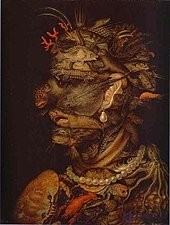
Anthropomorphic pareidolia by Giuseppe Arcimboldo
Claes Oldenburg's soft sculptures are usually described as anthropomorphic. Depicting ordinary household objects, Oldenburg's sculptures were considered pop art . Reproducing these objects, often at a larger size than the original, Oldenburg created his sculptures from soft materials. The anthropomorphic qualities of the sculptures lay mainly in their sagging, pliable appearance, which reflected less-than-idealistic forms of the human body. In «Soft Light Switches», Oldenburg creates a household light switch out of vinyl. Two identical switches, in a dull orange color, allude to nipples. The soft vinyl evokes the aging process, as the sculpture wrinkles and sags over time.
In the essay «Art and Objecthood», Michael Fried argues that «literalist art» (minimalism) becomes theatrical through anthropomorphism. The viewer engages with a minimalist work not as with an autonomous art object, but as in a theatrical interaction. Fried refers to a conversation in which Tony Smith answers questions about his six-foot cube «Die».
Q: Why didn't you make it bigger so that it would loom over the observer?
A: I was not making a monument.
Q: Then why didn't you make it smaller so that the observer could see over the top?
A: I was not making an object.
Fried implies an anthropomorphic connection through «a surrogate person – that is, a kind of statue».
The minimalists' solution of «hollowness» in many of their works was also considered by Fried to be «explicitly anthropomorphic». This «hollowness» suggests the idea of a separate inner world; an idea reflected in the human form. Fried considers the «hollowness» of literalist art to be «biomorphic», since it evokes a living organism.
Curator Lucy Lippard's 1966 exhibition «Eccentric Abstraction» represents, in Briony Fer's writing, an instance of post-minimalist anthropomorphism. Responding to Fried's interpretation of «the imminent presence of objects that appear as actors might appear on stage», Fer interprets the artists in «Eccentric Abstraction» as a new form of anthropomorphism. She draws on the ideas of the surrealist writer Roger Caillois, who speaks of «the spatial pull of the subject, of how the subject can inhabit its surroundings». Caillois gives the example of an insect that «through camouflage does this in order to become invisible... and loses its distinctness». For Fer, the anthropomorphic qualities of imitation found in the erotic, organic sculptures of artists Eva Hesse and Louise Bourgeois are not necessarily intended for strictly «mimetic» purposes. Instead, like the insect, the work is meant to arise within a «scopic field... which we cannot observe from outside».
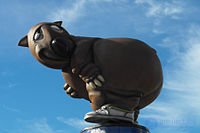
Fatso the fat wombat, a popular symbol of the 2000 Summer Olympics in Sydney, created as a parody of official commercial mascots
For branding, merchandising, and representation, figures known as mascots are now often used to personify sports teams, corporations, and major events such as World's Fairs and the Olympic Games . These personifications may be simple figures of people or animals, such as Ronald McDonald or the donkey representing the United States Democratic Party . In other cases these are anthropomorphic objects, such as « Clippy » or the « Michelin Man ». Most often these are anthropomorphic animals, such as the Energizer Bunny or the San Diego Chicken .
This practice is especially widespread in Japan, where all cities, regions, and companies have mascots, known collectively as yuru-chara . The two most popular are Kumamon (a bear representing Kumamoto Prefecture) and Funassyi (a pear representing Funabashi, a suburb of Tokyo).
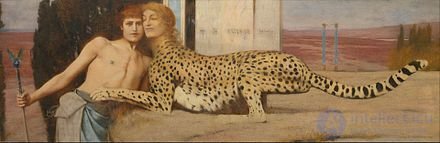
The Sphinx's weasel
Other examples of anthropomorphism include ascribing human traits to animals, especially pets, such as dogs and cats. Examples of this are the thought that a dog is smiling simply because it is baring its teeth, or that a cat is mourning its deceased owner. Anthropomorphism can be beneficial for animal welfare. A 2012 study by Butterfield et al. found that the use of anthropomorphic language when describing dogs creates greater willingness to help them in situations of distress. Earlier studies showed that people who ascribe human characteristics to animals are less inclined to eat them, and that the degree to which people perceive the minds of other animals predicts the moral concern extended to them. It is possible that anthropomorphism makes people love non-humans more when they have obvious human qualities, since perceived similarity has been shown to enhance prosocial behavior toward other people. A study of how animal behavior was discussed in the television series «Life» found that the script very often used anthropomorphisms.
In science, the use of anthropomorphic language implying that animals have intentions and emotions has traditionally been condemned as indicating a lack of objectivity . Biologists have been warned to avoid assuming that animals share any of the same mental, social, and emotional capacities as humans, and instead to rely on strictly observable evidence. In 1927, Ivan Pavlov wrote that animals should be regarded «without any need to resort to fanciful assumptions about the existence of any possible subjective states». More recently, the Oxford Companion to Animal Behaviour (1987) recommended that «it is better to study behaviour than to try to get at some hidden emotion». ] Some scientists, such as William M. Wheeler (writing apologetically in 1911 about his own use of anthropomorphism), used anthropomorphic language in metaphors to make subjects more understandable or memorable for people.
Despite the influence of Charles Darwin's ideas in his work «The Expression of the Emotions in Man and Animals» (Konrad Lorenz in 1965 called him the « patron saint » of ethology) , ethology as a whole focused on behavior rather than on emotions in animals .
Even insects play together, as described by that inimitable observer, M. Huber, who watched ants chasing each other and pretending to bite each other, just like puppies.
— Charles Darwin, The Descent of Man
The study of great apes in their own habitat and in captivity changed attitudes toward anthropomorphism. In the 1960s, three so-called « Leakey's angels » — Jane Goodall, studying chimpanzees, Dian Fossey, studying gorillas, and Birutè Galdikas, studying orangutans — were accused of «the worst of ethological sins — anthropomorphism». The accusation was prompted by their descriptions of great apes in the field; it is now more widely recognized that empathy plays an important role in research.
De Waal wrote: Alongside this came a growing understanding of the linguistic abilities of great apes and recognition that they make tools and possess individuality and culture.
In 1992, veterinarian Bruce Fogle, describing cats, points to the fact that «both humans and cats have identical neurochemicals and brain regions responsible for emotions», as evidence that «it is not anthropomorphic to attribute emotions such as jealousy to cats».
In science fiction, the artificial intelligence of a computer or robot, even if it was not programmed for human emotions, often spontaneously experiences these emotions anyway: for example, Agent Smith in The Matrix was influenced by «disgust» toward humanity. This is an example of anthropomorphism: in reality, although artificial intelligence may perhaps be intentionally programmed with human emotions, or may develop something resembling an emotion as a means to an end, if that proves useful, it will not spontaneously develop human emotions without any purpose, as depicted in fiction.
One example of anthropomorphism might be the belief that a person's computer is angry at them because they insulted it; another example might be the belief that an intelligent robot naturally finds a woman attractive and seeks to mate with her. Scientists sometimes disagree with one another as to whether a particular prediction about the behavior of artificial intelligence is logical or whether the prediction represents illogical anthropomorphism. [ 68 ] An example that might initially be regarded as anthropomorphism but is in fact a logical statement about the behavior of artificial intelligence can be found in Dario Floreano's experiments, in which some robots spontaneously developed a crude capacity for «deception» and tricked other robots into eating «poison» and dying: here the trait, «deception», ordinarily associated with humans rather than machines, spontaneously develops as a form of convergent evolution .
The conscious use of anthropomorphic metaphor is not inherently unreasonable; attributing mental processes to a computer under appropriate circumstances can serve the same purpose as attributing them to other people: it can help people understand what the computer will do, how their actions will affect the computer, how to compare computers to people, and, presumably, how to design computer programs. However, inappropriate use of anthropomorphic metaphors can lead to false beliefs about the behavior of computers, for example, causing people to overestimate how «flexible» computers are. According to Paul R. Cohen and Edward Feigenbaum, in order to distinguish between anthropomorphizing and logical prediction of AI behavior, «the trick is to know enough about how people and computers think to say exactly what they have in common, and, when we lack that knowledge, to use the comparison to suggest theories of human thinking or of computer thinking».
Computers invert the childhood hierarchical taxonomy of «rocks (non-living) → plants (living) → animals (conscious) → humans (rational)», introducing a non-human «actor» that appears to behave rationally on a regular basis. Much computer terminology derives from anthropomorphic metaphors: computers can «read», «write», or «catch a virus». Information technology has no clear correspondence to any other entities in the world except humans; the options are either to use an emotional, imprecise human metaphor, or to abandon the imprecise metaphor and use more precise, domain-specific technical terms.
People often assign computers an unnecessary social role during interaction. The reasons for this are debated; Youngme Moon and Clifford Nass suggest that people are emotionally, intellectually, and physiologically predisposed toward social activity, and so, when presented with even the tiniest social cues, deeply ingrained social responses are triggered automatically. This may allow anthropomorphic traits to be built into computers/robots in order to provide more familiar «social» interactions, which makes them easier to use.
Purported examples of anthropomorphism with respect to AI include: the widely mocked claim in 2022 by Google engineer Blake Lemoine that the Google chatbot LaMDA was sentient; Saudi Arabia's granting of honorary citizenship to the robot Sophia in 2017; and the reaction to the ELIZA chatbot in the 1960s.
In psychology, the first empirical study of anthropomorphism was conducted in 1944 by Fritz Heider and Marianne Simmel. In the first part of this experiment, the researchers showed a 2.5-minute animation in which several shapes moved across the screen in different directions at different speeds. When subjects were asked to describe what they saw, they gave detailed descriptions of the intentions and characters of the shapes. For example, a large triangle was described as a bully chasing two other shapes until they managed to trick it and escape. The researchers concluded that when people see objects making movements for which there is no obvious cause, they regard those objects as intentional agents (people who consciously make choices to achieve goals).
Modern psychologists generally characterize anthropomorphism as a cognitive bias. That is, anthropomorphism is a cognitive process whereby people use their schemas about other people as a basis for inferring the properties of non-human entities in order to make effective judgments about their environment, even though these inferences are not always accurate. Schemas about people are used as the basis because this knowledge is acquired at an early age, is more detailed than knowledge about non-human entities, and is more readily accessible in memory. Anthropomorphism can also function as a strategy for coping with loneliness when other human connections are unavailable.
Because drawing inferences requires cognitive effort, anthropomorphism is most likely to be triggered only when certain aspects of the person and their environment hold true. Psychologist Adam Waytz and his colleagues developed a three-factor theory of anthropomorphism to describe these aspects and predict when people are most inclined to anthropomorphize. These three factors are:
When elicited agent knowledge is low, and effectance and sociality are high, people are more inclined to anthropomorphize. Various dispositional, situational, developmental, and cultural variables can influence these three factors, such as need for cognition, social disconnection, cultural ideologies, uncertainty avoidance, and so on.
Children appear to anthropomorphize and use egocentric thinking from an early age, and do so more often than adults. Examples of this include describing a thundercloud as «angry» or drawing flowers with faces. This tendency toward anthropomorphism is likely related to the fact that children have acquired a great deal of socialization but not as much experience with specific non-human entities, so they have less-developed alternative schemas for their surroundings. By contrast, autistic children may tend to describe anthropomorphized objects in purely mechanical terms (that is, in terms of what they do), since, according to past research, they have difficulties with theory of mind (ToM). A 2018 study found that autistic individuals are more inclined toward personifying objects, suggesting that autistic empathy and ToM may be not only more complex but also more far-reaching. The double empathy problem calls into question the notion that autistic people have difficulties with ToM.
Anthropomorphism can be used to assist learning. In particular, anthropomorphized words and the description of scientific concepts with intentionality can improve subsequent recall of those concepts.
For people with depression, social anxiety, or other mental illnesses, emotional support animals are a useful component of treatment, in part because the anthropomorphism of these animals can meet patients' need for social connection.
The anthropomorphism of inanimate objects can influence consumer behavior. When products resemble a human schema — for example, when the front of a car resembles a face — potential buyers rate the product more positively than if they had not anthropomorphized the object.
People are also more inclined to trust robots with more complex tasks, such as driving a car or caring for children, if the robot resembles a human in ways such as having a face, voice, and name; imitating human movements; expressing emotions; and exhibiting some variability in behavior.
At present, anthropomorphism as a worldview principle persists within religious systems, especially the most archaic of them. It is also characteristic of an early stage of child development. Preschool children explain any causal relationships in the surrounding natural world by analogy with the relationships that exist between people, for example: «The moon is not in the sky because it has gone visiting.»
Anthropomorphism is one of the approaches in animal psychology, according to which mental phenomena in animals are declared similar to those in humans. The reason for this approach is that humans seek similarities between themselves and the object being studied, determine the correspondence of something to human qualities, and only then move on to studying the differences. Anthropomorphism with respect to the animal psyche was sharply criticized by behaviorists, reflexologists, and the followers of I. P. Pavlov. However, the representatives of these schools were in turn criticized for zoomorphism with respect to humans.
In aesthetic anthropomorphism, the artist consciously likens natural or fantastical objects to humans. Anthropomorphism is one of the main elements, for example, in fables.

Comments