
Lecture
The birth of theoretical philosophical thought occurred in the most ancient centers of human civilization with a high level of culture, such as Ancient Egypt, Ancient India, Ancient China, and Ancient Greece, at approximately the same time, in the middle of the 1st millennium B.C. At its basis lie reflections on the world and the purpose of human existence, which already appear among primitive man in connection with his immediate practical interests of survival. With the growth of culture and the expansion of contacts between people, in the pre-philosophical period this reflection rises to the concept of the world as a whole. The awakening of this concept was promoted by curiosity, or the intellectual factor, and the striving for a happy life, or the ethical factor. The result of these spiritual strivings was myth. Fantastically, though in a sensuous-speculative form, it reflects the everyday experience of primitive man, his conceptions of the connection of things in the world as a whole. From the original images, mythological gods gradually turn into anthropomorphic, human-like prototypes of the good and evil deeds of man, of ethical principles. With the growth of moral consciousness these prototypes become avengers of transgressions, rewarders of good, as well as the driving forces of nature and guardians of the natural, that is, of the eternal world order. Finally, from the moment when, instead of this fantastic form of mythological worldview, an attempt is made to depict the natural world in concepts, knowledge, or philosophy in the broad sense of the word, steps onto the stage of history. This transition occurred differently in different cultural centers, i.e. in Ancient Egypt, Ancient India, Ancient China, and Ancient Greece and Rome, and the manner of this transition is of decisive significance for understanding the future spiritual culture of East and West. Thus, for example, Indian philosophy is similar in origin to European philosophy, but it owes its specific character to the fact that in India the process of differentiation of mythology, religion, and science remained internal. Since the concern for science here lay above all with the priests, the further formation of theological and philosophical views was continually made to conform with ancient traditions.
Despite the outstanding cultural significance of Egyptian civilization, over time it acquired an increasingly stereotyped character, and the progress of philosophy became impossible owing to religious conservatism. The Egyptians thought more about death; they believed that the souls of the dead descend into the underworld, where the judgment of Osiris awaits them, its verdict determined by their way of life on earth. They believed that in the end the soul was destined to return to the body.
Therefore Indian philosophical thought is the oldest in the world. Its history begins with the Vedas, which arose, presumably, as early as the 2nd millennium B.C. The main periods of the development of Indian philosophy are the Vedic, the epic, and the systematic. The main source of information about the Vedic period is the body of literary monuments united under the general name Vedas (literally, «knowledge»), written in the ancient Indian language – Sanskrit (the so-called Vedic Sanskrit). The Vedas consist of four collections of hymns, chants, magical incantations, prayers, and the like: the Rigveda, the Samaveda, the Yajurveda, and the Atharvaveda. Each of these collections, usually known as the Vedas proper, over time acquired various commentaries and additions of a ritual (Brahmanas), magical (Aranyakas), and proto-philosophical and philosophical (Upanishads) character.
The properly philosophical views of Ancient India received their fullest expression in the Upanishads, though the first proto-philosophical approaches to reality can already be traced in the oldest of the collections of Vedic hymns – the Rigveda.
The main content of the Rigveda consists of solemn chants, incantations, and prayers, the authorship of which is attributed to ancient Indian poets and sages – the rishis. These chants, incantations, and prayers are addressed to the numerous deities of the Vedic pantheon, who personified for the ancient Indian above all various phenomena and processes of nature. At the same time, the Rigveda also reflects a dissatisfaction with the naively mythological interpretation of reality. The most important mythological names and concepts of the Rigveda for the subsequent development of theology and philosophy became Indra – the god of thunder, lightning, and storm; Mitra – the god of the Sun; Varuna – the god of the sky; Agni – the god of fire; Rita – the cosmic world order, law, custom; Yama – the god of death; Tapas – heat as the world-creating principle, asceticism, mortification of the flesh; Purusha – the «universal» man, spirit, soul.
The Upanishads (literally: «to sit at the feet of the teacher, receiving instruction», sometimes interpreted as «secret, hidden teaching») usually take the form of a dialogue between a sage-teacher and a pupil, or else with a person seeking truth and becoming his pupil. The creation of the Upanishads, of which there are more than a hundred, is usually dated to the 9th–6th centuries B.C.
In the Upanishads the religious-mythological worldview already loses its dominant position. Thus, in a number of places mention is made of the existence of several kinds of independent knowledge (sciences – vidya). Among them, besides the Vedas, chronology, logic, rhetoric, etymology, grammar, the science of numbers, astronomy, and military science are mentioned. Philosophy, too, takes shape as a separate domain, although no independent term for it is yet used in the Upanishads; but its existence is attested by the very fact that many purely philosophical problems are discussed, such as the place and purpose of man in the system of surrounding being, the nature of the external world and of man, the character of his life and psyche, the limits and possibilities of his cognitive faculties, and the norms of his conduct.
The dominant place in the Upanishads is occupied by the teaching that posits as the first cause and first foundation of being a spiritual principle, under the names Brahman or Atman, more rarely Purusha. Brahman and Atman are usually used synonymously, though Brahman more often serves to express the objective aspect of the ultimate reality (god, the omnipresent spirit), while Atman expresses its subjective aspect (the soul). Beginning with the Upanishads, Brahman and Atman become central concepts of the whole of Indian philosophy, especially of its idealist doctrines, above all Vedanta.
The central idea of the Upanishads is the identity of Brahman-Atman as the spiritual essence in man and in nature. This identity of subject and object is most concisely expressed in the famous saying of the Upanishads – «Thou art That», or «Thou art one with That». The central question in the theory of knowledge of the Upanishads is the division of knowledge into two kinds: lower and higher. Lower knowledge is knowledge of empirical reality, which is considered fragmentary, disjointed, and therefore untrue. Higher knowledge is knowledge of the spiritual absolute, which is regarded as the perception of being in its wholeness, and whose main means of acquisition is mystical intuition. Here great importance is usually attached to yogic practice. It is precisely this knowledge that gives power over the world.
In the sphere of ethics, the Upanishads are dominated by the preaching of a passive, contemplative attitude toward the world; the highest happiness is proclaimed to be the liberation of the soul from all worldly attachments (moksha, mukti).
For the first time in the Upanishads, the conception of the transmigration of souls (samsara) and of retribution for past actions (karma) begins to play a large role. Human conduct is determined by the moral law of dharma, which prescribes the observance of the duties established for each varna and each stage of life.
The main point in the sociology of the Upanishads is the recognition of the inviolability of the varna (caste) division of people.
The Upanishads played an enormous role in the entire history of Indian philosophy – from antiquity to the present day. The Upanishads became, as it were, the common foundation of all subsequent teachings: most of them considered themselves continuers of their legacy.
The main source of philosophical thought of the epic period is the vast epic poem «Mahabharata», which consists of 18 books recounting the struggle for power between two closely related clans – the Pandavas and the Kauravas. Alongside the narrative of this struggle, various books of the «Mahabharata» contain texts of philosophical content as well, such as the Bhagavad Gita, the Mokshadharma, the Anugita, and some others.
The philosophy of the epic period, like that of the preceding period, remains still strongly dependent on religious-mythological conceptions. In content and orientation, most of the philosophical ideas of the «Mahabharata» represent a continuation and development of the views dominant in the «Upanishads» concerning Brahman-Atman or Purusha as the spiritual absolute and its comprehension as a means of salvation and deliverance from the fetters of karma and samsara. However, unlike the «Upanishads», where philosophy is presented mainly in the form of separate statements and propositions with an unsettled, at times amorphous terminology, in the «Mahabharata» there already appear fully developed and coherent philosophical conceptions, offering a more or less complete treatment of the basic problems of worldview and possessing a more strictly fixed and more unambiguous conceptual apparatus.
The chief significance among these conceptions is acquired by the teaching of Samkhya and the closely related Yoga, which were already occasionally mentioned in the «Upanishads». Their basis is the proposition of prakriti or pradhana (matter, nature) as the source of all present being, including the psyche and consciousness, and, independent of it and untouched by its modifications, pure spirit – purusha (also called Brahman, Atman). Samkhya appears in two basic variants: the theistic (seshvara, i.e. «with god»), or monistic-idealist, when spirit is proclaimed to stand above prakriti and to create it, and the dualistic (nirishvara, i.e. «without god»), or atheistic, when spirit exists in parallel with matter and exerts no influence on it. In the epic the theistic variant of Samkhya predominates, set forth with the greatest fullness and consistency in the «Bhagavad Gita».
The Bhagavad Gita (literally, «the Divine Song») begins with a description of how, before the start of the decisive battle between the Pandavas and the Kauravas, the leader of the army of the Pandavas – Arjuna (also called Pandava, Bharata) – is suddenly seized with doubts as to the expediency and permissibility of fratricidal slaughter. Arjuna's doubts and wavering are dispelled by the god Krishna (epithets: Shri Bhagavan, and also the spiritual absolute – Brahman, Atman, Purusha). The instructions and arguments of Krishna in fact constitute the main content of the «Bhagavad Gita».
The theoretical basis of Krishna's reasoning is the teaching of monistic theistic Samkhya, which is used to justify a definite system of ethical-social views – concerning the necessity for every person to perform his social (varna) functions and duties, to be indifferent and unconcerned with the fruits of his worldly activity, and to devote all his thoughts to god.
At the same time, in Krishna's teaching there is a contradiction between the striving to justify the necessity of social activity and the demand to devote oneself to god (i.e. between karma yoga, or the yoga of action, jnana yoga, or the yoga of knowledge, and bhakti yoga, or the yoga of devotion to god), yet on the whole the conception of the «Gita» is rather coherent and elaborated in detail. This work exerted an enormous influence on the whole subsequent social thought of India.
An event of world significance was the emergence, in the epic period, of Buddhism at the turn of the 6th–5th centuries B.C. The essence of early Buddhism lies in the teaching about «suffering», known as the four noble truths. Buddhism proclaims as suffering everything connected with practical, everyday life, life itself, from the moment of birth to death. By foregrounding those «sufferings» of life which, by their very biological nature, bear an inescapable character (illness, old age, death), and also by pointing to the social disorder of life, fraught with all manner of misfortunes and torments, Buddhism absolutizes them, extends them to everything that exists, and elevates them to the rank of a universal law of being. The cessation of suffering comes when a person is freed from blind attachment to earthly life, which draws him into its eternal stream of continuously following and mutually engendering events.
This state of the extinguishing, the dying down, the cooling of passions and desires is called in Buddhism nirvana. And the chief attention of Buddhism is devoted to the attainment of this state through a «righteous» life and the assimilation of the truth of the eternal changeability of being.
In this, Buddhism, properly speaking, differs little from the analogous principles proclaimed in the «Upanishads» and the «Bhagavad Gita». However, its distinctiveness consists in the fact that it denies the idea of the substantiality of being expressed in the concepts of god and soul – Brahman, Atman, Purusha. In their place Buddhism advances the position that the whole diversity of being rests not on an internal spiritual basis, but is connected by an unbroken chain of universal interdependence and mutual conditioning – the law of dependent origination, understood in its own way as the law of cause-and-effect connection. The denial of the substantiality of everything that exists and of the absoluteness of the being of its concrete forms leads Buddhism to the thought of their relativity, their unreality, to the thought that in themselves they are nothing, emptiness (shunya).
The Buddha himself was not concerned with the detailed elaboration of the philosophical-metaphysical foundations of his teaching, preferring, as tradition has it, to pass over these problems in silence, since, in his opinion, complex theorizing is useless for attaining the main goal – salvation. Therefore the teaching of early Buddhism bears a predominantly practical, moral-ethical character. The Buddha opposed two extremes: both the unrestrained pursuit of worldly pleasures and ascetic mortification of the flesh and self-torment. He condemned Vedic ritualism and reverence for all manner of authorities, believing that salvation is accessible to all people, to whatever varna they belong, calling for tolerance, forgiveness, non-violence, and restraint.
In the systematic period (IV–II centuries B.C. – 3rd–4th centuries A.D., i.e. in the early Middle Ages) the philosophical thought of India reaches a high stage of development. Philosophy is finally constituted as an independent discipline, whose most important purpose, as is stated in the outstanding monument of Indian socio-political thought – the «Arthashastra, or the Science of Politics» – consists in being a methodological guide in theoretical and practical spheres of activity, a function it fulfills by disclosing the contradictory nature of the phenomena under investigation.
The main form of the development of philosophy becomes philosophical schools or systems (darshanas). Their composition is not strictly fixed; various sources name different numbers of them. But it is precisely in this period that their basic core takes shape, which includes six orthodox Brahmanist systems (Nyaya, Vaisheshika, Samkhya, Yoga, Mimamsa, Vedanta), which recognize the authority of sacred scripture (the Vedas and Upanishads), and three heterodox ones (Charvaka, or Lokayata, Jainism, and Buddhism, consisting of four schools – Vaibhashika, Sautrantika, Madhyamika, and the school of the Yogacharins. It should be noted that history has not preserved the names of the founders of these systems, and they are usually attributed to semi-legendary figures: the teaching of the Charvakas – to Brihaspati, the system of Nyaya – to Gautama, the teaching of Vaisheshika – to Kanada, the system of Samkhya – to Kapila, the system of Yoga – to Patanjali, the teaching of Mimamsa – to Jaimini, and the system of Vedanta – to Badarayana.
Each of these schools strives to encompass the whole range of philosophical problems, but at the same time each of them is characterized by an emphasis on a particular aspect of this range of problems.
Thus the school of Charvaka-Lokayata is distinguished by its uncompromising materialist character. It categorically denies god and the soul, and considers the ultimate foundations of being to be four or five elements (bhuta): fire, air, water, and earth.
According to the teaching of the Charvakas, in the elements taken separately there is no consciousness, but it can nevertheless arise from them when they take the form of a body. Thus, for them there is no soul separable from the body and capable of attaining the heavenly world or liberation.
A distinctive feature of the Charvaka school is its concentration on developing an ethical conception. The Charvakas see in the notions of good and evil an illusion created by human imagination. According to the Charvakas, only the suffering and pleasure of sensory existence are real. Consistent hedonism (from the Greek hedone, pleasure), that is, the ethical position that affirms pleasure as the highest good and criterion of human conduct and reduces to it the whole diversity of moral requirements, makes this school a unique phenomenon in the history of Indian thought.
Although the Buddha himself was concerned not so much with problems of philosophy as with the practical questions of eliminating human suffering, he nevertheless could not avoid philosophical discussions. Thus, in the early literature the following theoretical positions of his teaching are found: 1. All things are conditioned; there is nothing that would exist by itself. 2. Therefore all things, owing to changes in the conditions on which they depend, are subject to change; there is nothing permanent. 3. Therefore there is no soul, no god, and no other permanent substance. 4. One present life flows continuously, generating, by the law of karma, another life, just as one tree, by its seeds, generates another tree, which continues to live while the first withers.
Therefore all schools of Buddhism reject the substantiality of what exists and emphasize its changeable, impermanent nature, reducing it to a complex, at times intricate system of groups of primary elements (skandhas, dharmas, etc.), which include both physical (rupa) and psychic, spiritual (vedana, vijnana, citta) elements, the combination of which forms an eternal stream of momentary states of being (kshanika) that generate and condition one another.
Jainism proclaims everything in the world to have a soul and accordingly demands observance of the principle of non-violence (ahimsa). It also recognizes in every thing or phenomenon a countless multitude of properties and definitions, which leads it, in epistemology, to a peculiar relativism: about any object one can make an affirmative judgment with just as much success as a negative one (syadvada)
The careful elaboration of the rules and outward forms of ascetic conduct and the demand for their strictest observance, in particular the principle of ahimsa – causing no harm whatsoever to the living – is a characteristic feature of the ethical system of Jainism.
.In the system of Vaisheshika the central doctrine is that of the atomistic structure of the world. According to the teaching of the Vaisheshika, everything that exists falls into six categories: substance, quality, action, generality, particularity (vishesha) and inherence. The basic category in the Vaisheshika system is substance, which expresses the essence of a thing. This category exists really and objectively. Substances possessing motion make up the objective world. In the Vaisheshika system nine substances are counted: earth, water, light, air, ether, time, space, soul, and mind. The first four of these are material, atomistic, and productive substances. The combination of the atoms of these substances forms the physical world. The atom (anu – from Sanskrit an – to breathe, to sound, meaning separate, particular, individual, subtle, minutest). In the Vaisheshika teaching the atom is the limit of the division of material bodies. Atoms receive their initial motion from an invisible force – adrishta.
The process of the world's creation and the disjoining of atoms occurs in accordance with definite, eternally recurring cycles. The world-soul governs the combination of atoms. But god is not the creator of the universe; he only governs it.
The universe thus created is one of countless worlds.
The school of Nyaya (Skt., literally – reasoning, logic) devotes its main attention to problems of logic and the theory of knowledge, accepting in the main the ontology of the Vaisheshika
Taking liberation (moksha) as the final goal of human life, Nyaya emphasizes the importance of thought (inference) for the knowledge of reality. The conditions and methods of true knowledge can be determined by means of logic and its laws. Nyaya recognizes four independent sources of knowledge: perception, inference, comparison, and testimony (proof). Sensory perception is direct knowledge of an object (sight, hearing); logical inference is knowledge of an object through the isolation of an accompanying attribute; comparison is the recognition of a new object on the basis of its prior description and its resemblance to an already known object; testimony is the verbal witness of an authority, i.e. knowledge communicated by a trustworthy person – a teacher – or else by sacred scripture – the Vedas.
As for god, for the Naiyayikas he is an infinite «I», creating, preserving, and destroying the world. The wisdom and all-goodness of god help man, who possesses free will and, consequently, the possibility of choosing between good and evil, to attain liberation through true knowledge of himself and the world.
The logical teaching of Nyaya belongs to the first teachings on the forms and methods of reasoning to arise in the countries of the ancient East.
In Samkhya the chief category is matter (prakriti, pradhana, avyakta) alongside which the existence of a multiplicity of souls independent of it (purusha) is also recognized. The special significance of Samkhya in the history of Indian thought is determined by its theory of evolution, which presupposes the derivability of the whole world from the interaction of two natural principles – prakriti and purusha.
The world arose out of primordial matter (prakriti). The world develops within the range from dead matter to consciousness. When dead matter is spiritualized or illumined by intellect, it becomes Buddhi, perceiving and perceived, and the separation of subject and object occurs. Buddhi is the substratum of all individual consciousnesses. From it arises ahamkara – the «I», which in turn engenders, on the one hand, 11 organs (indriyas) (5 organs of perception, 5 organs of action, and an 11th, connecting and governing organ – the mind, manas), and on the other hand, 5 subtle, imperceptible seeds of material elements (tanmatras). All this forms the material soul (linga) of the individual. The tanmatras generate from themselves 5 gross material elements (bhutas): ether or space (akasha), air, fire, water, earth, and from their various combinations the whole world of sensibly perceived objects is formed, both organic and inorganic. Thus in Samkhya there are 24 categories, which together encompass all really existing reality. The recognition of the principle of development of the world's first cause is a distinguishing feature of Samkhya.
Despite what has been said, Samkhya recognizes, alongside prakriti and independently of it, a spiritual principle – purusha, which is the 25th category in this system. Purusha plays a role only in the ethical sphere: having seen prakriti in all its modifications, purusha «becomes aware» of its complete non-involvement in them and attains its immanent state of absolute freedom (moksha).
Man is subject to sufferings of various kinds until he becomes aware of the nature of prakriti. This knowledge liberates man's spirit and puts an end to rebirth.
The philosophy of Samkhya is the most interesting example of the ancient Eastern metaphysical systems.
Yoga deals chiefly with psychological questions concerning the ways and means of «withdrawing» and «purifying» consciousness, the soul, from the world of objects, taking as its theoretical basis the system of categories of Samkhya, which is why some authors do not consider it an independent school but merely a theistic variety of Samkhya.
Mimamsa sets as its goal the justification and explanation of Vedic ritualism, but the system of physical views it develops in this connection bears an entirely rational character and itself has a rather remote relation to the Vedas.
Mimamsa is built on the recognition of the reality of the material world, as well as of souls and gods, of which man learns on the basis of perception or other sources of knowledge. The world is created from atoms, and the soul is understood as an eternal and infinite substance, connected with the body but not dying with it. Mimamsa teaches of a special potential energy that arises in the soul in the performance of ritual. The accumulation of this energy entails, as a result, in the future – enjoyment of the fruits of the performance of rituals. The theory of knowledge of Mimamsa exerted a significant influence on Vedanta.
Vedanta is known as the most influential system of monistic objective idealism. It continues the teaching of the Upanishads about Brahman-Atman as the spiritual source and basis of everything that exists, carrying it to the point of proclaiming the material world a false appearance, an illusion (maya), arising from ignorance (avidya) of the true nature of Brahman-Atman.
For true knowledge, besides the study of revelation, the following are required: first, discrimination between eternal and non-eternal being; second, renunciation of all external reward in this world and in the world to come; third, possession of six means (tranquility of spirit, moderation, detachment, patience, concentration, faith); fourth – the striving for deliverance. The highest goal of knowledge is truth, which consists in the fact that one who knows the truth sees the one in everything and recognizes his own spirit (atman) as identical with the supreme spirit.
Thus, to sum up, it may be stated that all six orthodox systems, despite their differences, have much in common, and, from the point of view of Western European philosophy, suffer from the absence of a correct method. All teach about the nature of the soul and its relation to God. All strive to provide means of knowing the nature of the highest being and thereby to open a path to bliss. All agree that there is suffering in the world, from which one must be freed. All belong to the period when faith in the gods of the Vedas had disappeared and was replaced by faith in a supreme deity or in Brahma. However, theoretical thought was not trained in the strict school of science.
In accordance with the various sources of philosophical thought known both in antiquity and in the modern era, three main stages are distinguished in ancient Indian philosophy:
In the work of S. Chatterjee and D. Datta, «Indian Philosophy», the following features characterizing Indian philosophy as a whole are listed:
The main source of ancient Indian philosophy is considered to be the Vedas (i.e. «knowledge») — sacred books, written approximately in the 15th–6th centuries B.C.
Four Vedas are known:
Besides the religious hymns («samhitas»), the Vedas also include a description of rituals («Brahmanas»), books of forest hermits («Aranyakas»), and philosophical commentaries on the Vedas («Upanishads», literally — «at the feet of the teacher»), which are of the greatest interest from a philosophical point of view.
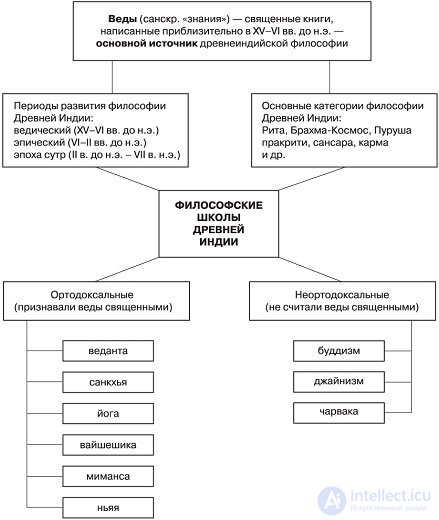
Fig. Periods and main categories of the philosophy of Ancient India
The Vedas contain the most significant ideas and categories of the philosophy of Ancient India.
The foundation of the world is Rita — the law of the universal interconnection and sequence of all processes; the cosmic law of evolution and order, as well as the ethical law of all living beings. Rita is substantial in relation to the world.
The impersonal spiritual principle of the world, Purusha — the «primal man», arising out of chaos; Purusha is an intermediate stage between chaos and the material world; his eyes became the Sun and the Moon, his breath gave rise to the wind, and from his body arose the world. Purusha is also primal energy, pure consciousness, as opposed to Prakriti — material consciousness.
Brahma-Cosmos — the God who creates the world, whose exhalation and inhalation are associated with being and non-being, and whose alternating life and death, lasting 100 years of Brahma each (billions of earthly years), are associated with absolute being and absolute non-being.
Samsara (Skt. samsara — rebirth, cycle, wandering, passing through something) — the suffering-bringing process of the countless rebirths of the personality and the immortal soul, its movement into various bodies — of plants, animals, people. This concept signifies worldly existence, the interconnection of all living things. The goal of man is to exit this chain of rebirths, putting an end to suffering.
Karma — the law of fate, predetermining a person's life. Karma leads a person through trials, perfecting the soul to the level of moksha (the highest moral level of the soul's development; such a soul is called a mahatma). But karma can be influenced by one's own deeds, the character of which «improves» or «worsens» it. Bad deeds bring misfortune in the future, good ones — form favorable conditions for a person and, on the whole, have a positive effect even on the Cosmos. This is because everything in the world is interconnected, and every event has consequences.
Atman — a particle of Brahma the Creator, the divine, unchanging component of the human soul. The other component of the soul is manas, this part arising in the course of life; it is subject to changes (both positive and negative) as a result of the acquisition of one or another experience.
The Vedas represent a universal body of knowledge, characteristic of most of the teachings of the Ancient World that have come down to us. The Vedas contain no small number of ideas of a social-ethical and normative character.
The Vedas influenced the whole of Indian philosophy, whose first schools appeared in the period approximately from the 7th to the 1st century B.C. Some of these schools recognized the Vedas as sacred books; these schools are called orthodox: Samkhya, Yoga, Vedanta, Vaisheshika, Mimamsa, Nyaya. Other schools did not consider the Vedas sacred (although they could not entirely escape their cultural influence), relying on other sources; the best-known heterodox schools are Buddhism, Jainism, Charvaka. In the views of representatives of some philosophical schools of Ancient India there was much in common, but much also distinguished their positions.
Vedanta (Skt. — the end or goal of the Vedas) denotes the totality of religious-philosophical schools and teachings of Indian philosophy, the basis of which is the conception of «Brahman-Atman».
In the concept of «Vedanta» all the traditional orthodox schools of the philosophy of Ancient India are sometimes combined. However, later, already in the second half of the first millennium A.D., an independent school of «Vedanta» was formed. In this teaching, in particular, the question is resolved of the identity of the primary absolute, Brahman (the cosmic soul), and the individual soul of the subject who knows it — Atman. Different currents of Vedanta resolve this question in different ways. In one case Brahman is identical with the «I»; in another — the «I» is a part of Brahman; in a third — the «I» is only determined by Brahman.
According to some researchers, Vedanta is considered the most significant and influential philosophical teaching of Ancient India; this teaching — the philosophical foundation of Hinduism — one of the most widespread religions in the world.
Sankhya (Skt. — number, enumeration, calculation) — one of the most ancient philosophical schools; its founder — the sage Kapila, who lived in the 7th century BC.
According to this teaching, reality is founded on two principles: the ideal — purusha, and the material — prakriti. Both principles are uncreated and indestructible. Prakriti consists of three gunas (sattva, rajas, tamas), which a person does not perceive directly, but is subject to their influence through the objective material world. Sankhya denies belief in God, on the grounds that his existence is unprovable and that the emergence of the world can be explained without recourse to the concept of God.
One of the main problems of the teaching is the comprehension of cause-and-effect dependence; adherents of the ideas of Sankhya are convinced that the effect is contained in the cause even before it arises.
Owing to his ignorance, a person binds his soul, his «self», to the body; he mistakenly perceives the sufferings of the body as his own. Therefore a person must strive for liberation through the comprehension of truth.
Yoga (Skt. — participation, union, concentration, order, deep reflection) is known above all for its deeply developed system of exercises, by means of which a person attains a special state in which he is freed from the material world, his soul becomes able to merge with purusha, and the person's «self» with the higher «Self».
This system of exercises was used by many other Indian teachings, forming an element of their systems.
In its philosophical views yoga largely repeats Sankhya, but, unlike the latter, affirms the existence of God as the higher «Self». Yoga proceeds from the premise that the microcosm — the human soul — largely mirrors the cosmic body of the Universe. A person's conscious striving for self-perfection can find a certain correspondence among cosmic processes; one must strive to master the ability to change oneself.
The basic concepts and practices of yoga: subjugation of the body — yama (control of breathing, temperature, cardiovascular activity, etc.); a fixed bodily position in a defined posture — asana; contemplation of a specific real or imagined object — dharana; a state of trance (a sharp change of mental and emotional state) — dhyana; a special concentrated state of the psyche, in which it acquires the irreversibility of psychic processes — samadhi.
Lokayata (Skt. — directed only at this world, current among the people) — an ancient Indian materialist system that arose in the middle of the 1st millennium BC and does not recognize the sanctity of the Vedas.
Charvaka (translated as «materialist», a plain-spoken word) — one of the later varieties of Lokayata.
Charvaka explains the world by the interaction of four elements: earth, water, fire and air. As a result of their combination in various proportions, all things of the material world arise, including souls. This position is justified by the fact that a person perceives nothing through his senses but matter. That is, consciousness is a property of matter; there is nothing else in the world besides it. Therefore the performance of religious rites has no meaning.
The teaching was founded by Siddhartha Gautama Shakyamuni (563–483 BC), who was called Buddha, meaning «the one who has grasped the truth», «the enlightened one».
Gautama was a prince of the Shakya clan, the son of the raja (monarch, king) Shuddhodana of Kapilavastu (a city in the north of Ancient India); he grew up a happy man, married for love, and had a son born to him. But one day, encountering outside the palace a sick man, an old man, and a funeral procession, he thereby came face to face with illness, old age and death, and realized the imperfection of a world full of suffering. After this, upon meeting a hermit, he decided that he too would become a hermit, in order to change his fate and find a path to overcoming suffering.
After seven years of wandering, Gautama (having become a Bodhisattva — «one destined for enlightenment») understood that the path of the ascetic does not lead to the elimination of suffering, but after long reflection he «saw the light», grasped the truth and became the Buddha (this is believed to have occurred in 527 BC). After this he wandered widely, preaching his teaching; he acquired many disciples and followers of his cause, who after the Buddha's death discussed and systematized the teacher's legacy.
The basic idea of the teaching lies in the liberation of a person from suffering, for which he needs to attain nirvana — a state of supreme bliss.
In the course of his reflections the Buddha formulated the four noble truths:
Enlightenment is reached by the «middle way» — a life that excludes extremes: the «path of pleasure» — entertainment, idleness, indolence, physical and moral dissipation, and the «path of asceticism» — mortification of the flesh, deprivation, suffering, physical and moral exhaustion. The «middle way» presupposes knowledge, reasonable self-restraint, self-perfection, contemplation, wisdom and, finally, enlightenment.
For this it is necessary to observe five precepts — do not kill; do not steal; be chaste; do not lie; do not consume intoxicating and mind-altering substances; as well as eight principles (the eightfold path):
The ontological idea of dharmas appears to be important. Dharmas are groups of elements giving rise to: 1) bodily forms, 2) sensations, 3) concepts, 4) imprints of karma, 5) consciousness.
They do not exist separately from one another, but in various combinations with one another they make up a person's entire conception of himself and the world around him. A person's whole life is nothing other than a continuous stream of dharmas. The constant change of their combinations forms a person's constantly changing sensations, impressions and thoughts. Every thing arises as a result of the functioning or interaction of other things, and having arisen, itself exerts an influence on them and participates in the emergence of new things; that is, we are speaking of the fundamental changeability of being (nothing is permanent or stable), of universal relativity, and also of the fact that the material world is nothing but an illusion.
In the 1st century BC Buddhism split into two currents — Hinayana («the narrow path of salvation», «the small vehicle» — presupposing personal salvation, a monastic way of life) and Mahayana («the broad path of salvation», «the great vehicle» — accessible to many people). Later several other currents appeared within Buddhism. The teaching became widespread in India and especially (after the 3rd century AD) in China, Southeast Asia, and other regions as well.
Of all the cultures of the ancient world, Chinese culture is one of the most ancient and self-sufficient. Already in the era of Yin–Shang (16th–11th centuries BC) and in the initial period of the Zhou era, the first natural-scientific conceptions arose, and astronomy and agriculture developed.
Chinese literature spans a period of 4000 years and, before the penetration of Buddhist ideas into it, remained free of external influences. It is characteristic that the Chinese have no national epic. A special place in this literature is occupied by the classic books of Chinese learning, which arose in the first half of the first millennium BC and in the period of the hundred schools (6th–11th centuries BC). A whole series of these books contains the most ancient poetry, history, legislation and philosophy. These are for the most part works by unknown authors, written at various times. Confucian thinkers paid particular attention to them, and beginning in the 2nd century BC these books became fundamental to the humanistic education of the Chinese intelligentsia: knowledge of them was a sufficient prerequisite for passing the state examinations for the post of official. All philosophical schools, right up to the 20th century, referred to these books in their reasoning, and constant references to them were characteristic of the whole of cultural life. These include: the «Book of Songs» ( Shi Jing, 11th– 6th centuries BC), which is a collection of the most ancient folk poetry and also contains cultic hymns. It became a model for Chinese poetry in its further development. The «Book of History» (Shu Jing, early 1st millennium BC) is a collection of official documents and descriptions of historical events. It had a great influence on the formation of later official writing. The «Book of Rites» ( Li Shu, 4th–1st centuries BC), which includes three parts: the Rites of the Zhou era, the Rites of ceremonies, and Notes on ritual. It contains a description of the proper organization of political and religious ceremonies and the norms of social and political activity. It idealizes the most ancient period of Chinese history, which it regards as the model and measure of further development. The «Spring and Autumn Annals» (Chunqiu, together with the commentary of Zuo Zhuan, 4th century BC) is a chronicle of the state of Lu (5th century BC) and later served as a model and measure for resolving ethical and formal-literary questions. Finally, the «Book of Changes» ( I Ching, 12th– 6th centuries BC) is the most important of all. It contains the earliest conceptions of the world and the human being in Chinese philosophy. In its texts, written at various times, one can trace the beginning of the transition from a mythological depiction of the world to its philosophical comprehension.
It reflects the most ancient solutions to ontological questions, and it developed the conceptual apparatus used by subsequent Chinese philosophy. The world, however, is not understood in it as a world of rational manipulations.
Around the «Book of Changes» there arose, and still exist, a whole series of historico-philosophical and philosophical disputes, spanning the entire history of Chinese thought and Chinese philosophy. The «Book of Changes» lays down the foundations and principles for the development of philosophical thinking in China.
Like literature, Chinese religion is likewise devoid of mythology. The gods of ancient Chinese religion are bloodless schemata, personal but inaccessible to contemplation forces, which influence but do not act. In the whole of classical ancient Chinese literature one can point to only two places containing a hint of an anthropomorphic conception of a supreme being — Shangdi, or Heaven (all the rest are of later origin). Belief in the continuation of life after death (of the most ancient origin), which found direct expression in the cult of ancestors, gave no answer as to the «place and condition» of this further life.
It is natural that the soil in which religion and poetry found insufficient nourishment could not favor the flourishing of philosophy.
All that has been said is confirmed by the nature of the Chinese language. Above all, the abstract character of the Chinese language is striking. The Chinese construction of sentences is distinguished by logical consistency and precision. And yet the logical perfection of the Chinese language does not make it a perfect instrument of philosophical thought: for it is one thing to have a logical concept as such, and another to have its verbal expression. It is moreover known that the extent and content of a concept stand in inverse relation to one another. Thus, for example, if the word De, which in itself denotes only the concept of greatness, acquires grammatical significance as a part of speech depending on its position in the construction of a phrase, i.e. without changing its phonetic composition, it can mean magnitude, great, to be great, to make great. It is evident that here a single logical concept corresponds to various grammatical concepts, none of which has an exact equivalent in phonetic composition. It often happens that one and the same Chinese sentence, from a grammatical point of view, admits of various interpretations, so that where grammatical analysis does not lead to a definitive conclusion, one must be guided by logical connection. And if this is insufficient, then – by ordinary usage.
Corresponding to this grammatical ambiguity is, further, an equally great indeterminacy of meaning, and, unfortunately, it is precisely those concepts most readily used by Chinese philosophers that suffer from this defect. Thus, for example, the basic meaning of the word xin – heart, just as with us, is used in both a literal and a figurative sense, but to this are added further secondary meanings: spirit, cast of mind, intention. The word ming originally means command, and as a verb – to command, and in addition, in the sense of a heavenly command, it means: destiny, predetermination, fate, and further, in the sense of the duty imposed by Heaven upon the ruler, it means dominion and, finally, in the sense of the destiny of all living creatures, – life.
No less varied is the meaning the Chinese associate with the word li. Originally it denoted religious rites, but quite early it came to be associated with the meaning of etiquette, as well as conventional forms of conduct, and finally it was extended to the corresponding cast of mind behind these external forms, so that li also means courtesy, a sense of courtesy.
These examples are sufficient to show that a phrase whose grammatical analysis raises no doubts can nevertheless present very great, sometimes insurmountable, difficulties when it comes to logical analysis, i.e. to the precise and adequate conveyance of thought. A third source of misunderstanding is the peculiar phonetics of the language. The fact is that the Chinese language is extremely poor phonetically and consists exclusively of monosyllabic words, and as a result is very rich in identically pronounced words of different meaning — a deficiency that not even Chinese script, with its thousands of written signs or characters, is able to fully remedy. Closely connected with this is the Chinese love of wordplay, as well as a tendency to resort to wordplay where a definition of a concept would be appropriate, i.e. to explain a philosophical term by a similarly sounding word of more or less similar meaning. Thus, precisely on account of its abstract logical character, the Chinese language proved to be a poorly suited instrument for philosophical thought.
The mythological form of thought persisted until the 1st millennium BC, and some myths became constituent parts of ancient Chinese cosmological conceptions. This applies above all to the myths of the spirits yin and yang. Yin and yang are transformed into forces by means of which the formation and development of the Universe takes place. Many mythological images pass into later philosophical treatises, rationalized myths become part of philosophical ideas, and mythical characters become historical figures used in preaching, for example, the Confucian teaching. In particular, the mythical sovereigns Yao, Shun and Yu were transformed into ideal rulers of antiquity, whom one ought to emulate. The period of their rule was declared the «golden age» in the history of China. An analogous transformation occurred with the images of the cruel rulers Jie and Zhou. They were turned into tyrants – the antipodes of Yao, Shun and Yu.
Like the philosophy of other peoples, Chinese philosophy is closely connected with mythology, but this connection had certain peculiarities: Chinese myths are above all historical legends about past dynasties, about the «golden age», and references to ancient myths are the most authoritative arguments in favor of those propositions in the books of Chinese learning that are supported by such references. Alongside the emergence of the cosmological conceptions of yin and yang, conceptions of the «five primary elements» (water, fire, metal, earth, wood) also arose.
In the ancient monument of philosophical theorizing «Shu Jing», in the chapter «Hong Fan» («The Great Plan»), it is said of the five primary elements: water, fire, wood, metal, earth – in particular, that water moistens and flows downward, that fire blazes and rises upward, that wood may be straight or bent, that metal is malleable and changeable, that earth serves for sowing and harvest. It further states that what is moist and flows downward becomes salty, what blazes and rises upward becomes bitter, what is straight and bent becomes sour, what is malleable and changeable becomes corrosive, and finally, what receives the seed and gives the harvest becomes sweet.
In this parallelism of elements and taste sensations one can already discern the beginnings of the later natural philosophy, which in the most fantastical way transfers the parallelism of phenomena onto a whole series of other domains.
In the «I Ching», or the «canonical Book of Changes», which is usually considered the oldest text of philosophical literature in China, the original text consists of only 64 hexagrams, each of which in turn consists of 6 lines, partly whole and partly broken, and is supplied with brief explanations. In this original form the text of the «I Ching» was a collection of oracle sayings and served as a guide to the art of divination. The first attempt at its philosophical interpretation contains the following basic ideas: the beginning of all being is formed by the cosmic forces Yin and Yang. Yang is the bright, masculine, creative principle, opposed by Yin – the dark, feminine, receptive principle. That which is unknowable in Yin and Yang (i.e. their essence) is called spirit. From the exchange between Yin and Yang arises the norm (Dao). Yang is embodied in heaven, Yin – in earth. With heaven and earth is given the distinction of high from low, noble from base, hard from soft; motion and rest achieve their continuity, activities fall into categories, beings are divided into classes: happiness and misfortune appear. Heaven engenders the celestial constellations, earth – the earthly forms, and the process of transformation becomes evident. It finds its expression in the driving force of thunder and lightning, in the fertilizing activity of wind and rain, and in the cycle of the sun and moon, which results in the alternation of heat and cold.
Heaven produces all that is masculine, earth – all that is feminine. Heaven presides over the beginning of all things, while earth brings beings to completion. The sage, capable of investigating the phenomena of heaven and earth, resembles heaven and earth; his knowledge encompasses all things, and therefore he is free from error; he rejoices in heaven and knows what is predetermined, and therefore he is carefree; he is firm in his love for people, and therefore he is capable of love.
The authority of the «I Ching» is attested by the extensive literature associated with it. The study of it reached the height of its flourishing in the natural philosophy of the 11th and 12th centuries
In the 6th–3rd centuries B.C. new phenomena appeared in the spiritual life of China. The Zhou state disintegrated, and the struggle among the kingdoms of Qin, Chu, Qi, Wei, Jin, Zhao, and Han led, in the second half of the 3rd century B.C., to the destruction of the «Warring States» and to the unification of China into a centralized state under the aegis of the Qin dynasty. This period is characterized by the flourishing of culture and of political and ethical philosophy. New social groups, in opposition to the hereditary aristocracy, rose up against belief in «heaven», or invested the concept of heavenly destiny with an entirely different meaning. Attempts were made to find the «ideal law» of governing the country, to create new rules of social relations, to determine the place of the individual person within the surrounding world, and to define man's relations with nature (heaven), with the state, and with other people.
The true flourishing of Chinese philosophy falls precisely in the period of the 6th–3rd centuries B.C., which is rightly called the golden age of Chinese philosophy. It is in this period that such philosophical-sociological works as «Dao De Jing», «Lun Yu», «Mozi», «Mencius», «Zhuangzi», «Guanzi», «Liezi», and others appear. It is in this period that the great thinkers Laozi, Confucius, Mozi, Zhuangzi, Mencius, Xunzi, Shang Yang, and Han Feizi come forward with their conceptions and ideas. It is in this period that the schools of Chinese philosophy are formed – the natural philosophers, Daoism, Confucianism, Mohism, Legalism, and the School of Names, which exerted an enormous influence on all subsequent development of Chinese philosophy, as well as on the problems, concepts, and categories which then become traditional for the entire subsequent history of Chinese thought, right up to the most recent times.
Natural philosophy. In the Warring States period (5th–3rd centuries B.C.) the so-called school of natural philosophers took shape. Its main representative is considered to be Zou Yan (305–240 B.C.), who attended the Jixia Academy, founded in Linzi, the capital of the state of Qi.
According to the representatives of this school, the world is formed from the material principle qi or yuanqi («prime matter»), the light and pure part of which rises upward and forms heaven, while the heavy and turbid part sinks and creates earth. The first is called yang-qi, the second – yin-qi. In addition, there also exist 5 qi, or 5 primary elements (the so-called 5 phases) – water, fire, wood, metal, earth. The flourishing and passing of yin-yang and the 5 primary elements occurs in the alternation of the four seasons.
Zou Yan developed the principle of the cyclical mutual generation and mutual destruction of the five moving principles (wu xing). Extending its action to human society, Zou Yan advanced a theory of the «cycle of moral qualities of the five moving principles» (the title of one of his treatises): just as metal overcomes wood, and fire overcomes metal, so the Xia dynasty (23rd–18th centuries B.C.) was overthrown by the Shang dynasty (17th–11th centuries B.C.) – metal, which in turn was overthrown by the Zhou dynasty (11th–3rd centuries B.C.) – fire. This doctrine formed the basis of the theory of the cyclical development of history (e.g. in Dong Zhongshu and others).
On the whole this natural-philosophical theory, in which yin-yang and the 5 primary elements function simultaneously as semi-physical and semi-metaphysical categories, exerted an exceptional influence on the development of Chinese philosophical thought. It was widely used by Daoism, Confucianism, and Buddhism. The teaching of yin-yang and the 5 elements found varied application in the development of the theoretical foundations of Chinese medicine, chemistry, music, and so on.
Confucianism. The year 551 B.C. marks a decisive turning point in the general culture of China. This is the year of the birth of Confucius, who became, more than any other man, the educator of his people and even more, its «uncrowned king», as grateful posterity called him.
Confucius's activity coincides with the era of the beginning disintegration of the state and moral life of the Zhou during the Chunqiu period. He saw his task as preventing this disintegration. He saw the path to a solution in a return to the patriarchal forms of life of the ancient world, and in order to draw the attention of his contemporaries to this goal more convincingly and reliably, he selected from all the poetic and prose traditions those which seemed to him most suitable for the moral and political revival of his people. On this basis arose the classical texts which, by the conviction of the Chinese, are the most valuable possession of their literature. «I am a transmitter, not a creator; I believe in and love antiquity» – such is Confucius's credo.
Confucius was not a philosopher in the true sense of the word, and the thoughts he expresses are distinguished neither by bold originality nor by striking novelty. The modest form in which he clothes them is devoid of rhetorical embellishment. The «Analects» («Lun Yu») is the only reliable source of information about his teaching, and they are characteristic of his manner of teaching. These are not extended sermons and discourses, but brief answers to his disciples' questions, and it is precisely this that lends them their particular force. Sayings such as «Virtue does not remain solitary; it will surely find neighbors», or «Make loyalty and truthfulness your chief concern», «Do not befriend one who is not your equal», «If you have made a mistake, do not be ashamed to correct it», or «The wise man knows no doubt, he who loves people knows no sorrow, the brave man knows no fear», and the like, have the advantage that practical worldly wisdom is here clothed in a form that is easily imprinted in the memory.
Thus a characteristic feature of Confucius's teaching is anthropocentrism. He is almost uninterested in problems of cosmogony, and pays little attention to spirits and the otherworldly («Not knowing what life is, how can one know what death is?», «Not knowing how to serve people, how can one serve spirits?»), although he considers heaven not only a part of nature but also the highest spiritual, determining force in the world, and sacrifices to ancestors the most important expression of reverence for them. However, at the center of his attention is the problem of man, of his intellectual and moral character. Confucius was the first to develop the concept of the ideal man (junzi), the noble man – not by origin, but through cultivating in himself high moral qualities and culture – who must above all possess ren – humaneness, humanity, love for people, the manifestations of ren being justice, loyalty, sincerity, and so on. A special place is occupied by the concept of xiao – filial piety, respect for parents and for elders in general. Confucius considered xiao the basis of ren and of the other virtues, and the most effective method of governing the country (for the country is a large family). Confucius considered yue – music – the best means of changing bad customs and habits, and assigned the leading role to li – ritual propriety, i.e. the rules of decorum regulating human conduct in various life situations. The starting point of Confucius's teaching on the clear division of duties in society was the concept of zheng ming – the rectification of names, i.e. bringing things into correspondence with their designation: «let the prince be a prince, the subject a subject, the father a father, the son a son».
Confucius's ideas played an enormous role in the subsequent history of China, when their conservative character contributed to the transformation of Confucianism into a state doctrine. They left their imprint on every aspect of the country's life, and Confucius himself became an object of veneration, as the embodiment and lofty model of what he taught.
Daoism. In a sphere of ideas distinct from Confucianism, Daoism developed, standing in the sharpest contradiction to Confucianism, both in its tendency to negate the world and in the intuitive-mystical character of its teaching. The founder of Daoism is considered to be Laozi (b. 604 B.C.), and to him is attributed the composition of the «Dao De Jing» – the canonical book of the Dao and virtue, considered the grandest and profoundest expression of the Chinese spirit. In his philosophical constructions Laozi developed three basic concepts: Dao, De, and wu wei.
In Laozi's philosophy, Dao is the invisible, omnipresent, natural law of nature, of human society, of behavior and thought of the individual, inseparable from the material world and governing it (which is why Dao is sometimes compared to Heraclitus's Logos). Dao gives birth to the myriad of things, is inactive, and thereby does everything. Dao is eternal and nameless, empty and inexhaustible, and the investigation of Dao leads to ruin.
De, which in Confucianism means an ethical norm, morality, a moral quality, appears in Laozi merely as a constant property, quality, attribute of things, that through which the invisible and inaudible Dao is revealed, thanks to which it manifests itself in the world of things as «energy».
According to Laozi, that all things come out of Dao we can know only by means of Dao itself. Thus Dao is not only the basis of being, but also of knowledge. The thinking subject, just like external things, traces its origin to Dao and has its purpose in it. Therefore the greatest task of the holy man is to assimilate himself to Dao, to embody it in himself. Thanks to this it is also a moral norm: Dao is eternally without activity and yet not inactive, that is, it influences without acting. The same applies to one who is guided by it: «the holy man abides in active non-action and teaches without words.» Such is the original concept of wu wei (literally, non-action, inaction), which means submission to the natural process, harmony with Dao, the absence of any action that runs counter to it. Laozi's teaching exerted a strong influence on other schools of Chinese philosophy. On the whole his views show an unmistakable resemblance to Buddhist and Christian ethics, although Laozi lived 600 years before our era.
Mohism. The founder of Mohism is the ancient Chinese thinker and political figure Mozi (480–420 B.C.), who became famous for opposing the absolutist despotism of Confucius's socio-political teaching, although he himself valued and respected Confucius. He advanced the «principle of the veneration of wisdom», i.e. the origin of the state and of power on the basis of a social contract among people, according to which power was entrusted to «the wisest of men» regardless of his origin.
The basic idea of Mozi's philosophy is «universal love» of all for all. It stands opposed to the Confucian principle of humaneness (ren), of relations within the family, and of the hierarchical nature of ethics. A number of Mozi's positions have a «negative» character: he is against music – because it distracts a person from productive and administrative activity; «against fate» – because a person's life is determined by his actions and not by inescapable fate; «against aggressive wars» – since they are the greatest and most brutal of crimes. Recognizing the existence of «spirits and ghosts», who can punish evil and reward good, and of «the will of heaven» as a guide for human conduct, Mozi introduced a religious strand into his teaching.
Legalism. Legalism (from the Latin for law) is the teaching of the school of legists, fajia, a doctrine of governing man, society, and the state. It arose and took shape in the 6th–3rd centuries B.C. and developed in intense struggle with early Confucianism, together with which it strove for the creation of a powerful, well-governed state, while differing, however, in philosophical justification and in the methods of constructing it. Whereas Confucianism placed the moral qualities of people in the foreground, Legalism proceeded from laws and argued that politics is incompatible with morality. A ruler must understand people's psychology well in order to govern them successfully. The main method of influence is rewards and punishments, with the latter meant to prevail over the former. The central place in the Legalist program was occupied by the striving to strengthen the state through the development of agriculture, the building of a strong army capable of expanding the country's borders, and the keeping of the people ignorant.
The Legalists created the conception of a despotic state founded on the equality of all before the law. The sole exception was the ruler himself – the only creator of laws. Legalism played a decisive role in shaping the imperial-bureaucratic system of administration, which existed in China without fundamental change until the beginning of the 20th century. The basic ideas of Legalism are: state regulation of economic processes in the country, systematic renewal of the state apparatus through the appointment of officials (instead of the traditional principle of hereditary office), the introduction of a unified principle for the conferral of ranks of nobility, offices, privileges, and stipends for army service and military merit, equal opportunities in advancement to administrative posts, a clear gradation within the ruling estate, unification of the thinking of officialdom, the personal responsibility of officials, and censorial oversight of the activity of state officials.
Beginning in the 3rd century B.C., a process of fusion of Legalism and early Confucianism into a single teaching took place, which was developed by Xunzi. Beginning with the Han era, when Confucianism, having assimilated the ideas of Legalism, became the official ideology, Legalism ceased to exist as an independent teaching.
The School of Names (mingjia). The School of Names, also called the school of logicians, sophists, or dialecticians («disputers»), dealt with the problems of the connection between «names» (ming) and «reality» (shi), the relations between concepts (names of objects) and the objects themselves, and the conventionality of names-concepts. Unlike other schools, these problems were, for the mingjia, central, if not the sole subject of their activity. Representatives of the mingjia were famous for their skill in argument, resorting for this purpose to paradoxical assertions («a chicken has three legs», «fire is not hot», «only having set out for Yue today, I arrived there long ago», and the like),
The most prominent representatives of the School of Names (Mingjia) were Hui Shi (370 – 310 BCE) and Gongsun Long (320 – 250 BCE). Hui Shi represented that one of the two currents of the Mingjia which emphasized the commonality, the unity («the great unity» and «the small unity») of the myriad things, considered the differences between them conditional and relative, and pointed to the continuous mobility and changeability of phenomena and things: «heaven and earth are (equally) low, mountains and marshes are (equally) level», «the sun, having just reached its zenith, is already setting; a thing, having just been born, is already dying», «universal love should be extended to the whole myriad of things, for heaven and earth (constitute) one body».
The representative of the second current of the Mingjia, Gongsun Long, emphasized above all the difference of the myriad things, dividing their commonality into separate elements. In doing so he separated the particular from the general, the name – the concept – from the real object, holding that the former exists independently in relation to the latter, and he absolutized the role of the qualities and features of things and phenomena. Among his famous sayings are: «a white horse is not a horse», «two does not contain one», «only division is truly indivisible and genuine under Heaven», «the shadow of a flying bird does not move», and others. Along with the Later Mohists, the philosophers of the Mingjia made a significant contribution to the development of the problems of logic.
Thus, ancient Indian and ancient Chinese philosophy consider the human being in unity with nature, i.e. the object of philosophical reflection is the relation «human being – world», as a result of which the entire history of the development of philosophy may be represented as the process of the human being's coming to awareness of the essence of being and of his own essence.
In general, however, the philosophy of the Ancient East developed within the channel of religious quests and bore a predominantly moral character. Greco-Roman philosophy, by contrast, strove for a scientific, rationalistic explanation of the world.
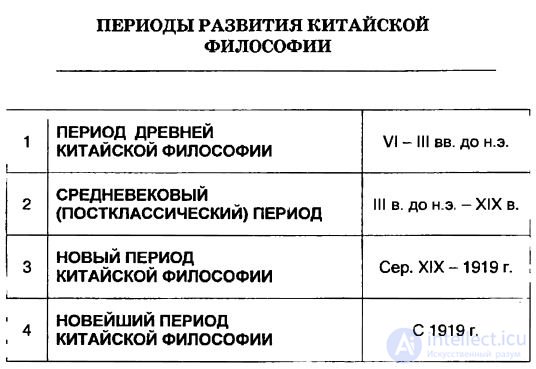
1. THE PERIOD OF ANCIENT CHINESE PHILOSOPHY — 6th–3rd centuries BCE
2. THE MEDIEVAL (POST-CLASSICAL) PERIOD — 3rd century BCE – 19th century CE
3. THE NEW PERIOD OF CHINESE PHILOSOPHY — mid-19th century – 1919
4. THE NEWEST PERIOD OF CHINESE PHILOSOPHY — from 1919
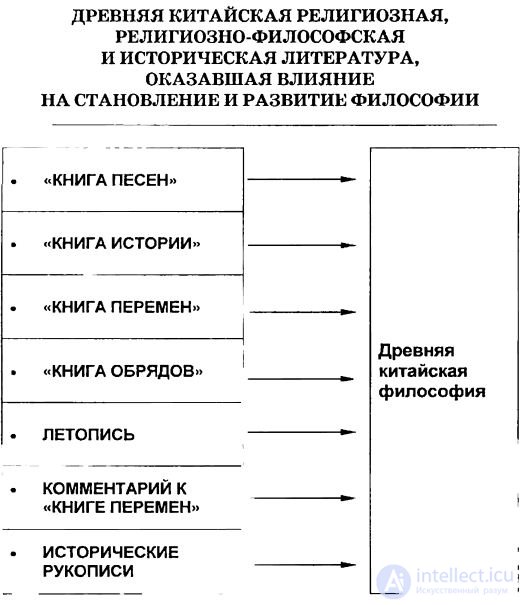
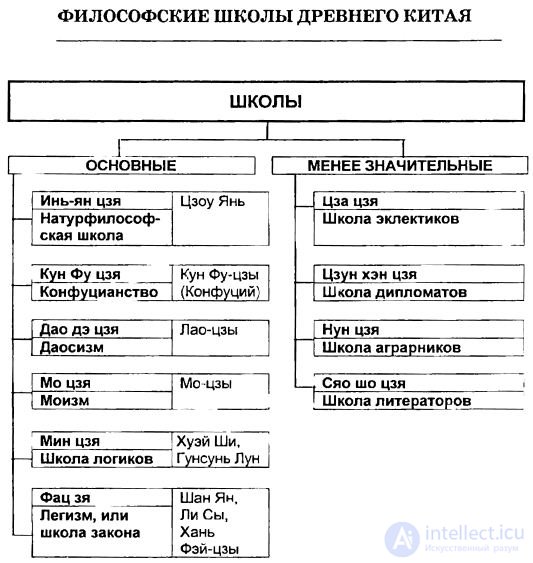
MAIN SCHOOLS:
LESS SIGNIFICANT:
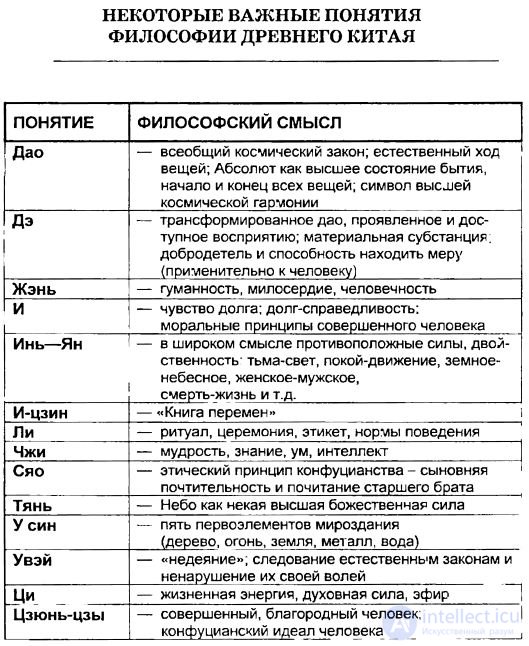
Dao — the universal cosmic law; the natural course of things; the Absolute as the highest state of being, the beginning and end of all things; a symbol of the highest cosmic harmony.
De — transformed dao, manifested and accessible to perception; material substance; virtue and the capacity to find measure (as applied to the human being).
Ren — humaneness, benevolence, humanity.
Yi — the sense of duty; duty-justice; the moral principles of the perfected person.
Yin-Yang — in the broad sense, opposing forces, duality: darkness-light, rest-motion, masculine-feminine, earthly-heavenly, death-life, and so on.
I Ching — the «Book of Changes».
Li — ritual, ceremony, etiquette, norms of behavior.
Zhi — wisdom, knowledge, mind, intellect.
Xiao — the ethical principle of Confucianism — filial piety and reverence for one's elder brother.
Tian — Heaven as a certain highest divine force.
Wu xing — the five primordial elements of the universe (wood, fire, earth, metal, water).
Wuwei — «non-action»; following the natural laws and not disturbing them by one's own will.
Qi — vital energy, spiritual force, ether.
Junzi — the perfected, noble person; the Confucian ideal of the human being.
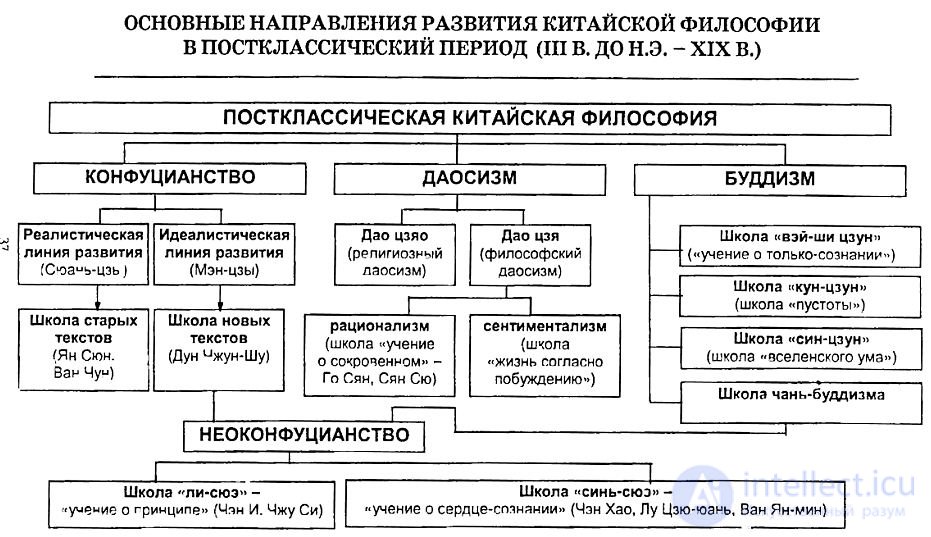
CONFUCIANISM:
DAOISM:
Daojiao (religious Daoism);
Daojia (philosophical Daoism):
BUDDHISM:
NEO-CONFUCIANISM (derived from CONFUCIANISM and BUDDHISM):

Comments