
Lecture
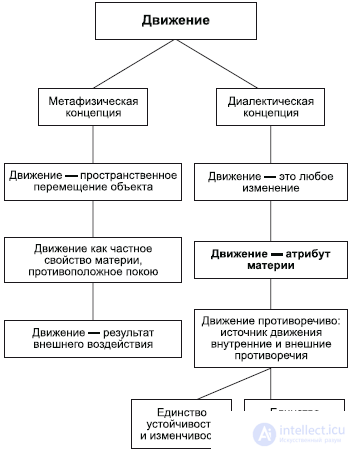
In metaphysical materialism, motion is understood, as a rule, in the narrow sense, as the spatial displacement of an object, with the object undergoing no qualitative change in the process; in dialectical materialism, motion is understood in the broad sense, as any change of an object at all. Mechanical motion is one of the forms of motion, and besides it there exist physical (optical, electrical, and other), chemical, biological, and social changes. In metaphysical materialism, certain special-scientific conceptions were absolutized, chiefly mechanics. The predominant development of mechanics in the 17th-18th centuries gave rise to exaggerated hopes for the possibility of explaining all natural phenomena from the standpoint of mechanics. These hopes proved unfounded, and this in turn exposed the incorrectness of understanding motion solely in terms of mechanical processes.
In contrast to the mechanical conception, in which motion was counterposed to rest (an object can either move or be at rest), and motion was thereby understood as a particular property of matter, dialectical materialism regards motion (change) as a mode of existence of matter, an attribute. Matter neither loses nor acquires the capacity for change.
Whereas in metaphysical materialism motion was understood mainly as "forced," as the result of external influence, in dialectical materialism it is held that motion has a twofold conditioning: by external influences as well as by the internal activity of material objects.
Understanding motion as change in general guards against reducing the diversity of kinds of motion to some single one, as was the case in metaphysical, mechanical materialism. The assertion that motion is an attribute of matter does not mean that there exists some motion "in pure form"; motion as an attribute of matter is that which is universal and present in all concrete kinds of motion.
Motion is contradictory above all as a unity of the relative and the absolute. Motion is relative in the sense that a change of place or state of an object always occurs relative to another object. Motion is absolute in the sense that motion is universal, uncreatable, and indestructible; nothing is absolutely at rest.
The contradictory nature of motion also consists in the unity of the moments of stability and changeability. In metaphysical materialism, motion and rest (stability) were counterposed to one another. In fact, stability and changeability are both aspects of motion itself.

Comments