
Lecture
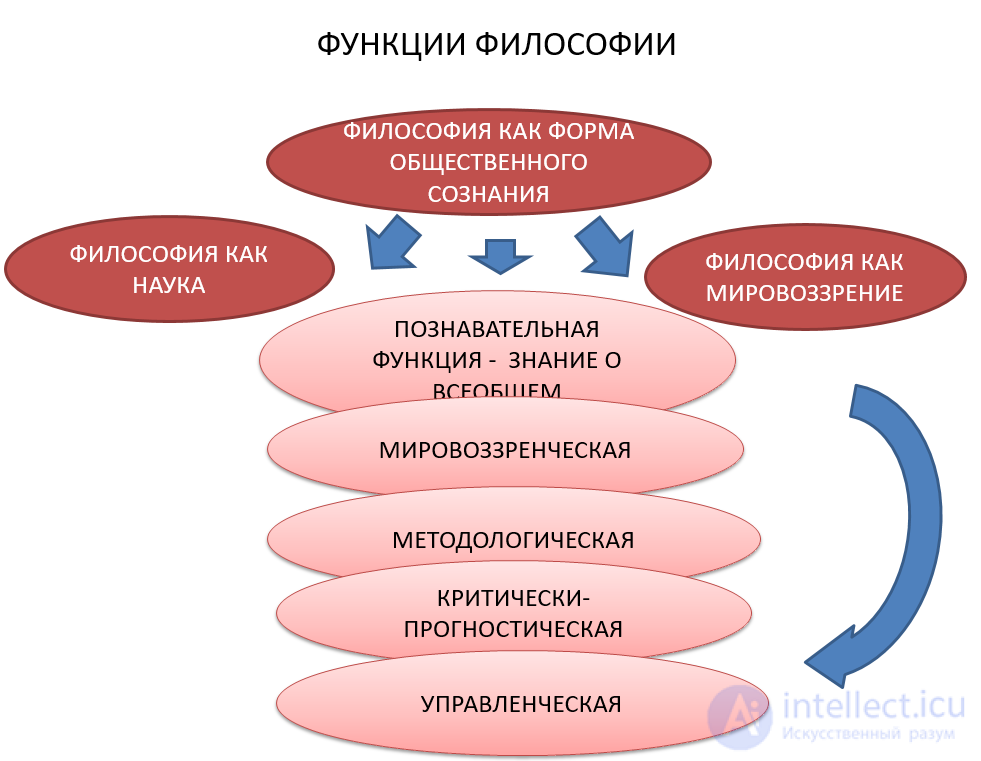
All the functions of philosophy are closely interconnected, and depending on the goals, tasks, attitudes, and situations, the degree to which they are manifested can vary.
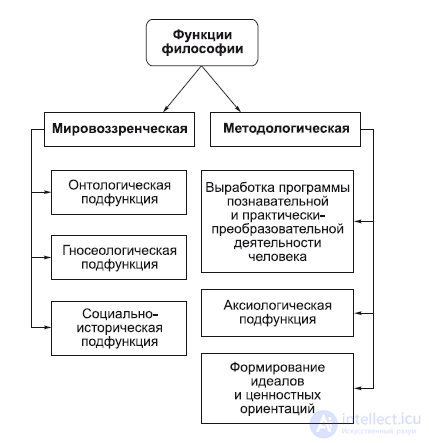
Philosophy performs two main functions: the worldview function and the methodological function. In its worldview function, philosophy acts as a theory that grounds the resolution of worldview questions, as the basis for the conscious formation of a worldview. In the course of realizing the worldview function of philosophy, a person forms a conception of being, of the human being, and of society.
The worldview function itself includes a complex of subfunctions: the ontological, the epistemological, and the socio-historical. The last of these, strictly speaking, could be subsumed under the first two, but it is expedient to single it out as a separate subfunction. This is connected with the specificity of social reality and its cognition as a particular case of being and cognition in general; but this particular case is of exceptional significance for the human being. It is precisely this subfunction that directs attention toward reflecting on the problems of social life and the prospects for the development of society.
The methodological function of philosophy demonstrates its capacity for obtaining new knowledge or achieving practical goals. In every sphere of human activity - economic, political, scientific, pedagogical, and so on - there are its own specific methodological attitudes. But besides the specific ones there are also general ones. Philosophy works out general methodological ideas, which are then made concrete in various spheres of activity.
Whereas in its worldview function philosophy is oriented toward reflecting the universal properties and regularities of being and cognition, in its methodological function philosophy is oriented toward working out a program for cognitive and practically transformative activity.
Sometimes what is called the axiological function is included within the methodological function of philosophy, as a subfunction (sometimes it is singled out as a special function alongside the worldview and methodological ones). The axiological subfunction (from the Greek axia – value) is connected with the formation, in a person, of value orientations, ideals, convictions, and the corresponding methodological attitudes toward realizing them.
From what has been said, it is clear that the study of philosophy, especially by a young person, is of great significance in the process of personality formation and the formation of one's worldview. And one must not only study the problems of philosophy but also reflect on them, analyzing the proposed solutions, working out one's own point of view on the resolution of these problems, putting forward one's own problematic conjectures, and so on. Philosophy (in addition to its other important functions) develops the intellect and the capacity for theoretical thinking.
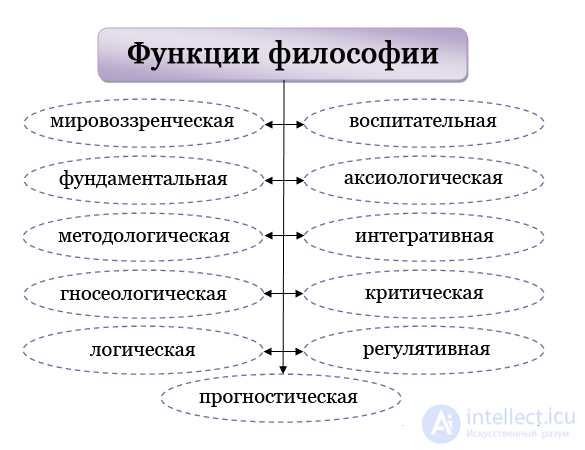
One of the main and most significant functions of philosophy is the worldview function. Philosophy forms people's conceptions of the world and its structure, of the human being and society, of the principles governing relations with the surrounding world and the place of the human being within it, thereby shaping his worldview. Philosophy clarifies a person's views, goals, interests, and needs and their connection with surrounding reality; it works out a universal philosophical picture of the world and reveals human nature as a result of the comprehension and systematization of scientific knowledge, as well as the content of the other forms of social knowledge.
Within the categories of philosophy, reflection on worldview problems takes place, and a conceptual apparatus is worked out for the analysis and comparison of various types of worldviews. Thus, this function contributes to the construction of a unified and generalized system of human knowledge and to the development of worldview ideals.
The essence of the fundamental function of philosophy lies in the disclosure and formation of general concepts, laws, and principles of real actuality, applied both in science and in the practical activity of people. Philosophy studies not objects, not empirical reality, but how this reality "lives" in social consciousness; it studies the meanings of reality for society and the human being.
Philosophy seeks the ontological, methodological, moral, and aesthetic foundations of the world. A philosopher always constructs a system of values for the world, and thereby reveals the initial foundations of human activity. Philosophy, unlike any other science, begins with the human being.
The methodological function of philosophy is characterized by the formation of general principles and norms of cognitive activity, and it also contributes to the growth of scientific knowledge and the creation of preconditions for scientific discoveries.
Method and the methodology of cognition are that "Ariadne's thread" which helps the researcher successfully find his way out of the labyrinth of the problems of cognition - and there are always plenty of these. However, the methodological function is not reducible to the methodology of cognition: it concerns the strategic level of the methodology of human activity as a whole. Philosophy compares and evaluates the various means of this activity, pointing to the most optimal among them. Philosophical methodology determines the direction of scientific research and makes it possible to find one's bearings amid the infinite diversity of facts and processes occurring in the objective world.
The epistemological function of philosophy propels human thought toward the cognition of the surrounding world and the search for truth.
Thanks to the theory of philosophical cognition, the regularities of natural and social phenomena are disclosed, the forms by which human thought advances toward truth are investigated, along with the paths and means of attaining it, and the results of the other sciences are generalized. The mastery of philosophical knowledge is of great importance for the development of a person's culture of thinking and for solving a wide range of theoretical and practical problems.
The logical function of philosophy is manifested in the formation of a person's definite position in interpersonal and socio-cultural relations, and it also determines the culture of human thinking. It also consists in the development of the philosophical method itself, its normative principles, and in the logical grounding of various conceptual and theoretical structures of scientific knowledge.
If general epistemology persuades us of the possibility and necessity of adequate scientific cognition of an object, then logic is called upon to ensure that this adequacy is achieved. It works out the means for the fullest, most precise reflection of the developing, continuously changing essence of the object.
The educative function of philosophy is directed toward forming, in a person, moral, ethical, and cultural values, and a striving for self-improvement, creation, and the search for life priorities.
Knowledge of philosophy contributes to the formation, in a person, of important qualities of a cultured individual: an orientation toward truth, honesty, and goodness. Philosophy is able to shield a person from the superficial and narrow bounds of everyday thinking; it invigorates the theoretical and empirical concepts of the particular sciences with a view to the most adequate possible reflection of the contradictory, changing essence of phenomena.
The formation of philosophical thinking is at the same time the formation of such valuable qualities of a cultured individual as self-criticism, criticality, and doubt. The cultivation of doubt, however, is not the development of skepticism (and, in this sense, of skepticism as such). Doubt is one of the active means of scientific inquiry. Philosophy provides a solid general methodological and epistemological foundation for the consistent self-development of doubt into scientific confidence, for its harmonious combination with faith in overcoming errors and delusions, and in attaining fuller, deeper, and more objective truths.
Philosophy gives people a common language, working out for them unified, generally significant conceptions of the main values of life. It acts as one of the important factors contributing to the removal of the "barriers to communication" generated by narrow specialization.
The axiological function of philosophy consists in reflecting the phenomena of surrounding reality from the standpoint of the various values that determine people's choices, actions, ideals, and norms of behavior.
Philosophy cannot rid society of the negative phenomena generated by the socioeconomic system. But it can shield the system of values from the penetration of the false and the critically unverified, the vicious and the politically reckless, the primitive and the radicalist.
An undoubted merit of contemporary philosophical thought is the advancement, by its representatives, of new values. These include general humanistic values, environmental values, and the values of quality of life. The value of quality of life is contrasted with standard of living, with mass production and consumption. For a person, for his health and happiness, it is not so much the standard of living that matters as its quality. This is determined not so much by comfort as by kind and humane relations in society, social equality, and closeness to nature. To be in harmony with oneself, with others, and with nature has become, for many people, a priority guideline and motive of behavior.
The essence of the integrative function of philosophy consists in uniting into a single whole the practical, cognitive, and value-based life experience of people. Philosophy strives to generalize, evaluate, and comprehend both the intellectual, spiritual, and practical achievements of all humanity, and its negative historical experience.
The knowledge supplied by individual disciplines is so diverse that it needs to be reduced to a single, integral scientific picture of the world. But the development of the theoretical foundations of scientific cognition is not reducible to a mechanical combination of the data of various disciplines. The very synthesis of scientific discoveries is possible only on a higher theoretical foundation than the discoveries themselves. If philosophy is not the foundation of the individual sciences, but is instead based entirely on these disciplines, then, on such an approach, philosophy turns into a side appendage to natural science, a kind of optional add-on for science. This approach is refuted by science itself. The greatest scientists of various eras, working in the field of fundamental research, from Lomonosov to Einstein, persistently and fruitfully worked on methodological and worldview problems, without having, in the philosophy available to them, any corresponding grounding for their natural-scientific research. Thus, philosophy forms the methodological foundation for every scientific discipline that has attained the heights of self-awareness. And a science that has not risen to self-awareness and has no methodological foundation remains undeveloped.
Philosophy also performs a critical function, striving to destroy old ideals and views and to form a new worldview, which is accompanied by doubts about, and criticism of, accepted dogmas and stereotypes.
The philosopher constantly encounters the discrepancy between social reality and ideals. Reflection on social reality, comparing it with the social ideal, leads to a critique of this reality. In criticism, the subject's dissatisfaction with the object, and the desire to change it, are expressed. Philosophy is critical by its very nature. The foundation and essence of a philosopher's critical work is the discovery and disclosure of contradictions, of discrepancies between the accepted system of concepts and values and the content that is introduced into them by a new stage in the development of world history.
By means of the regulative function, philosophy influences the mutual coordination of a person's concrete actions and directions of life activity, on the basis of an understanding of general principles and goals defined with the help of a philosophical worldview.
The prognostic function of philosophy is based on forecasting the forms and directions of the development of future objects, processes, phenomena, matter, consciousness, humanity, and society, on the basis of the existing system of knowledge about surrounding reality.

Comments