
Lecture
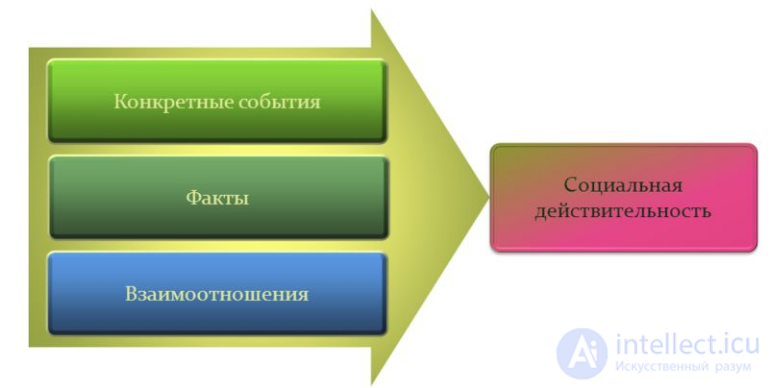
Social actuality (or social reality) is the totality of social phenomena and processes that exist in reality. At present the term "social reality" is used in two senses: an ontological one, reflecting all objectively existing social processes and phenomena, and an epistemological one, which is the subject matter of specific social and humanities sciences and theories
The study of society is the subject matter of social philosophy. The concept of «society» is polysemous. In the broadest sense this concept is applied both to the animal world (for example, when one speaks of a «community» of insects, a herd of monkeys) and to human beings. If the concept is applied only to human beings, it likewise has different meanings. In the broad sense one speaks of humankind, the world community. In a narrower sense, society is understood as an ethnic or national-state association, groups of people bound by a common origin and situation, common occupations, interests and goals. But under all interpretations, society is not simply some sum, a conglomerate of people. In this connection Marx noted: «Society does not consist of individuals, but expresses the sum of the connections and relations in which these individuals stand to one another»
What unites people into a society is joint life activity. A certain multitude of people becomes a social group, a society, when it is capable, through its activity, of creating all the necessary conditions for coexistence. Social life is a process of the joint activity of people.
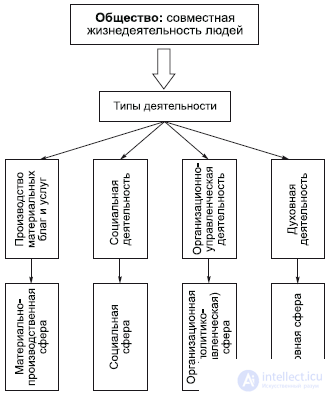
Human activity is manifold. For society to exist as a certain stable social formation, the following types of activity are necessary.
1. The production of material goods and services. This form of activity is called by different names, for example, material production (K. Marx), economic activity (E. Durkheim), the economy/household (S. N. Bulgakov), and so on.
2. Social activity. It is expressed in the production and reproduction of people themselves and of human life directly. This activity is carried out by the family, ethnic groups, professional groups, and so on—what is often called «civil society». In this activity, programs of education and upbringing, health care, social welfare, and so on are created and implemented.
3. Organizational-administrative activity. Its purpose is the creation and optimization of social ties and interaction through social management and political activity (the subjects of the latter being mainly the state and political parties).
4. Spiritual activity—the production and consumption of the diverse information necessary for life, ranging from the everyday to the scientific, including knowledge in the fields of economics, politics, morality, art, and so on.
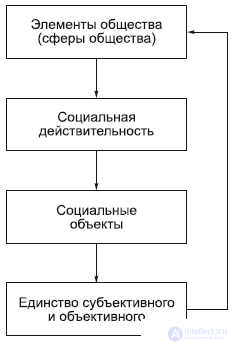
Four types of joint activity are necessary for the existence of society. These types determine the elements of society (or the so-called spheres of social life): the material-productive, the social, the organizational (political-administrative), and the spiritual. The concept of a «sphere of social life» denotes a stable domain of human activity and its results, satisfying certain needs of a social or personal character. Special social institutions exist within these spheres.
In addition to the concept of society, the concept of social actuality is also used. By social actuality we shall understand social life in the full diversity of its manifestations—the life of humankind, of social groups, collectives, and individual persons. Social actuality is composed of a multitude of diverse acts of human activity and the results of that activity.
Social activity is qualitatively different from natural activity. This difference is determined by the specific features of the human being and of human activity. Characterizing the fundamental differences between society and nature, Engels wrote: «In nature (insofar as we leave out of account the reaction of man upon nature), only blind, unconscious forces act on one another, and it is in their interplay that the general laws manifest themselves… Nowhere here is there any conscious, desired aim. On the other hand, in the history of society people endowed with consciousness act, acting deliberately or under the influence of passion, striving toward definite goals. Here nothing happens without a conscious intention, without a desired aim»[16].
Social actuality consists of social objects (recall that matter and the material world exist in the form of material objects). Social objects are manifold: they include people themselves, social groups, social institutions, technology created by people, everyday objects, and so on.
The fundamental difference between social objects and material objects lies in the fact that social objects represent a unity of the objective and the subjective. Social objects contain something absent from natural objects—consciousness, the spiritual life of people. Social objects possess specific features that no natural objects possess when taken in their independent existence apart from humanity. Let us elaborate on this specificity.
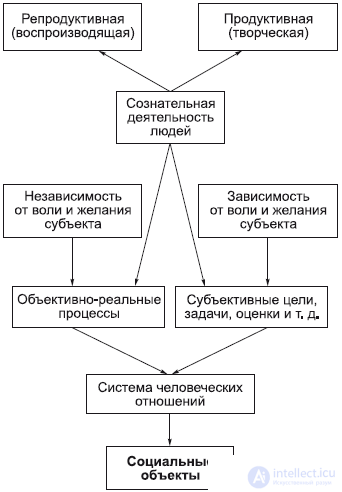
Analysis of social objects shows that they possess a twofold determinacy.
1. They exist as objectively real processes which, having arisen through the conscious activity of people, exist independently of the will and desire of the subject. Thus the material elements of social life (instruments of production, everyday objects, and so on), as well as its «non-material» elements, such as political relations, morality, and others, upon coming into being, acquire, as it were, an independent existence not dependent on their creators. This applies also to people themselves as social objects. True, one can speak of their independence only in a relative sense. Even material elements, if a person does not use them, lose their character as social objects. (Abandoned equipment ceases to function as equipment, decomposing into chemical compounds and elements.)
2. At the same time, social objects have an objective side—embodied in them is some subjective intent, purpose, and so forth. If, in considering social objects, one abstracts from the goals and meaning of human activity with which they are connected, then their specificity as social objects disappears. (One can imagine such a situation: some rational extraterrestrial being observing people at a stadium or sitting in front of a television.) It is characteristic that one can study the physical or biological properties of soccer balls, televisions, or people for as long as one likes, but if one does not understand the purpose, the meaning that sport or television has for people, then this study will not help explain why people at the stadium or in front of the television rejoice or grieve, yawn from boredom, and so on. The secret of the ability of social objects to affect people in a particular way lies not in these objects themselves, but in the people who created them and deal with them.
Thus the properties of social objects at first glance appear paradoxical: they belong to the object and at the same time are determined, as it were, by circumstances external to it. They are, as it were, «ascribed» to it by people (an «objectification» of the content of consciousness occurs). And here an interesting variant is possible, when one and the same material object can act in the role of various social objects (thus, for example, a wooden spoon can be a piece of tableware and a musical instrument, depending on the situation in which a person places it). And the human personality itself can possess different properties depending on the social role it performs.
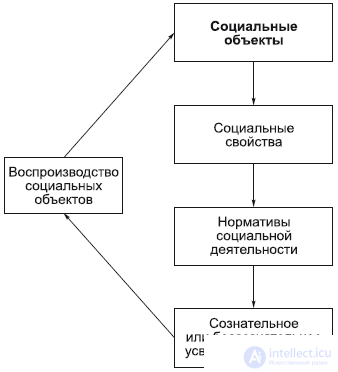
Social properties are «systemic» properties, that is, properties inherent to an object by virtue of its inclusion in a certain system and its functioning within it. Therefore it is impossible to understand social properties if one abstracts from the system of human relations into which the social object enters. Take, for example, a person. Such characteristics of theirs as «father», «head of a collective», and so on, belong to them not because they are that way in themselves, but because they are an element of a definite system. The presence in social objects of systemic properties leads to paradoxical consequences: these objects can change even when nothing seems to be happening to them. Thus, a son is born to a man, he becomes a father, but he himself does not change in this and may not even know of the birth of his son. This means that in social systems, in addition to the usual force-based determinants, there act non-force determinants, whereby changes in some parts of the system cause changes in others without any energetic interaction between them.
Social properties exist only insofar as there are people in whose activity they are formed. Social properties are, so to speak, peculiar «traces» left in social objects by the consciousness of their creators, and one must be able to «decode» these traces in order to discover the properties of social objects. In the course of their lives, people constantly «decode» them and structure their activity accordingly.
The world of social objects with their social properties is reproduced on the basis of certain rules and standards. The activity of people is itself always ordered in one way or another. Sometimes standards of activity are expressed in clearly formulated prescriptions (legal statutes, production standards, the rules of chess, and so on). Sometimes they lack clear formalization and are applied semi-consciously.
In the process of socialization, people consciously or unconsciously assimilate norms, ways of handling the objects that surround them.
In the history of society, in all its spheres, certain patterns of activity, behavior, and thought are transmitted from generation to generation. A peculiar «social heredity» is formed. Of course, these standards are not given once and for all. Over time, society moves away from old patterns of activity and new ones arise. In human activity there is a unity of reproductive (replicating) and productive (creative) moments. The first moment accounts for the stability of society's existence, and the second for its variability, its development.
Traditionally, the cognition of nature (natural science) and social cognition are regarded as relatively independent domains of cognitive activity.
In fact, however, things are not so simple. There are domains of knowledge that cannot be assigned solely to the competence of natural science or of social cognition (thus philosophy and mathematics are used in the study of both natural and social phenomena). There are disciplines that study the human being but, strictly speaking, do not belong to social cognition (human anatomy, physiology). Technical knowledge occupies a special place. There exist complex research programs that unite various branches of the natural, social, and technical sciences around themselves. The peculiar «blurring» of the boundaries between natural science and the social sciences testifies to the fact that there is much in common between them. But at the same time social cognition has its own specificity, arising from the specificity of social activity.
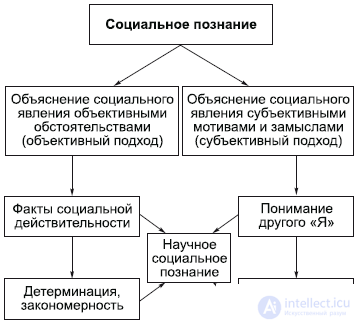
The explanation of social phenomena is twofold:
a) explanation by objective circumstances that lawfully condition the possibility of their occurrence, and
b) subjective motives and intentions of those who reproduce these phenomena. It is necessary to take into account the motives of the activity of individual persons and social groups.
Social actuality, in its complexity, in the diversity of the objects it comprises, and in its rate of change, surpasses natural actuality. The boundaries between the various sides and processes of human activity and social life are quite fluid. All this complicates the cognition of social actuality, its representation in precise concepts. Many concepts of sociology are difficult to quantify (for example, how does one quantitatively assess kindness, nobility, or the significance of a reform or a work of art?). And this most likely testifies not to the insufficient precision of the concept, but to the objective «indeterminacy» of those aspects of social activity that these concepts reflect.
Social cognition is not reducible to the sum of the social sciences; it includes diverse forms of extra-scientific cognition. Extra-scientific cognition occurs in everyday life, in art, in play, and so on. Cognitive processes here are, as it were, woven into other kinds of human activity. People live in social actuality and come to know it. Social problems are often posed and reflected upon by people on the basis of their own experience, their communication with others, before these problems come to be addressed by social science.
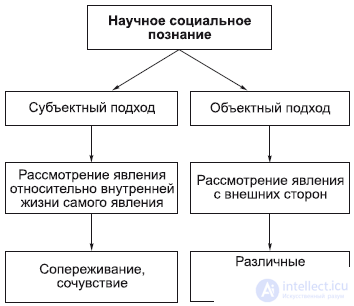
Scientific social cognition is carried out on the basis of a combination of two approaches.
• The «object approach». The general methodology of scientific research is used. Here the human being and the products of their activity are regarded as an object upon which the researcher performs cognitive operations (placing it under special conditions, subjecting it to tests, measuring it, and so on), thereby obtaining the sought information.
• The «subject approach». Here the other person is perceived not as an object separated from the researcher, but as an equal partner, a subject of communication. Research then becomes a dialogue of subjects.
In some social sciences (economics, management theory, and others) the object approach predominates. Research here is directed at representing the actual state of social phenomena. In a number of disciplines (pedagogy, psychiatry, conflictology, and others) the subject approach plays a significant role, in which the person under study is an active subject of communication. A poor teacher is one who treats the student merely as an object of instruction and upbringing and does not seek ways toward sincere, personal communication with them. The subject is known by the researcher as another «I», possessing an independent inner spiritual life. The researcher's task is to understand this other «I». And understanding a person as a kind of penetration into their inner subjective world is not mere knowledge, but empathy, compassion.
The object approach makes it possible to construct objective knowledge about the facts of social actuality, to reveal their determination, to give them a theoretical explanation. On the basis of the object approach, ways are developed of applying social theories to the practice of managing people, collectives, of creating concrete programs of social development, methods of organizational work, and so on. But the object approach makes it difficult to grasp human individuality, the world of inner spiritual life.
The subject approach is a specifically humanistic form of constructing social knowledge. Recourse to it presupposes the researcher's involvement in communication with another person (a «text»). But there are problems here too. Understanding another's «I» inevitably bears the imprint of the researcher's own «I» and, consequently, cannot be entirely free of the researcher's own subjectivity. This approach suffers from a certain ineliminable «intuitiveness», an incomplete reliability of its conclusions. And here it needs to be supplemented by the object approach.
Both the object approach and the subject approach are necessary for the cognition of social actuality.
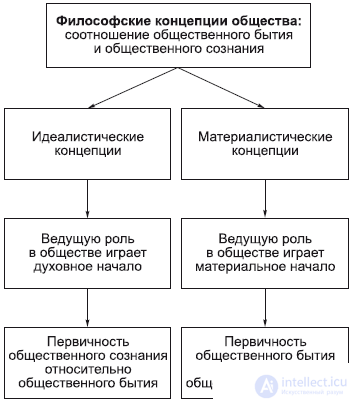
Philosophical conceptions of society, of the character of its existence and development, rest, in worldview terms, on one or another resolution of the fundamental question of philosophy as applied to social actuality. In this connection two main conceptions are usually distinguished: the idealist and the materialist.
In views on social life and the history of society, the idealist conception long predominated, and continues to do so today. The idealist conception proceeds from the assertion that the determining role in society is played by a spiritual principle. Such a principle was held to be either God, the World Mind, and so on, or the consciousness of people. Thus the objective idealist Hegel held that all of history is merely an external manifestation of the absolute idea; the highest form of manifestation of the absolute idea in society is the Prussian monarchy. In another case we encounter the thesis that «opinions rule the world». The figures of the French Enlightenment movement, proceeding from the view that the main basis and cause of changes in society lies in ideas, in the struggle of opinions, maintained that in order to change society in a progressive direction, people must be enlightened, and the ideas of good, truth, and justice, and so on, instilled in their consciousness. The nineteenth-century positivists said that ideas govern the world.
The idealist understanding of society has certain grounds. It is an indisputable fact that all human actions and deeds take place with the participation of consciousness. At the dawn of humanity's existence, consciousness was "interwoven" into practical life. Later an important historical fact was the separation of mental labor from physical labor. The emergence of mental labor as a relatively independent sphere of activity makes possible the generation of a peculiar illusion that consciousness and ideas are independent of the material life of society and develop entirely on their own. With the separation of mental from physical labor, the ruling strata of society monopolized mental labor, while physical labor was left to the masses of the people. And the ruling classes direct production and exchange, take control of the state into their own hands, and determine policy, law, ideology, and so on.
The first variant of the materialist understanding of society may be considered the geographical school in sociology ("geographical determinism"), which holds that geographical environment exerts a determining influence on the specific character and history of social life. This will be discussed in more detail in the following section.
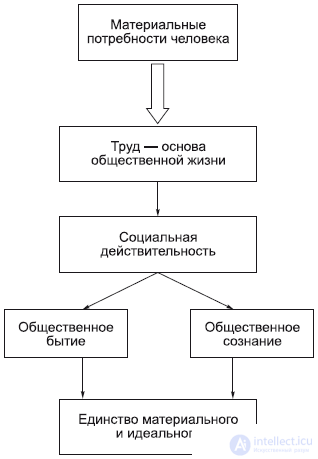
The second, principal variant of the materialist understanding of history was put forward in Marxism. Marx and Engels proceeded from a simple fact: before engaging in science, art, philosophy, and so on, people must eat, drink, clothe themselves, have a roof over their heads, and so forth, and for this they must labor. Labor is the foundation of social life.
If we consider the structure of society, which includes the relationship among four spheres of social life, a hierarchy is formed: the economic, the social, the political, and the spiritual spheres.
In the philosophical understanding of society the categories of social being and social consciousness are used. Social being is characterized as the material life of society, its production and reproduction. It includes: the mode of production of material goods, the economic relations that form among people in the process of production, distribution, and exchange, and the material aspects of the life of the family, classes, nations, and other forms of human community. Social consciousness is characterized as the spiritual life of society. It includes the various views, ideas, moods, and theories of social groups.
The idealist understanding of history asserts the primacy of social consciousness with respect to social being, while the materialist understanding asserts the primacy of social being with respect to social consciousness.
When the relationship between consciousness and being is examined at the general philosophical level, materialism understands the primacy of being above all in the genetic sense. This means that there was a time when material being, the natural environment (in particular, on Earth), existed while consciousness did not yet exist, and consciousness arose on the basis of the evolution of the natural environment. But in society there cannot be a situation in which the material side of social life already exists while social consciousness does not yet exist. Social reality is a unity of the material and the ideal. And then the question is not what exists earlier or later, but whether the material side of the life of society, material conditions, plays the determining role with respect to spiritual life, or whether the spiritual side of the life of society determines the material side.
The material and spiritual sides of the life of society exist in interaction. But within this interaction there are active and reactive connections. Then, from the standpoint of the materialist understanding of society, the active connection will be oriented from the material toward the ideal, while the reactive connection runs the other way. From the standpoint of the idealist understanding of society the situation is reversed.
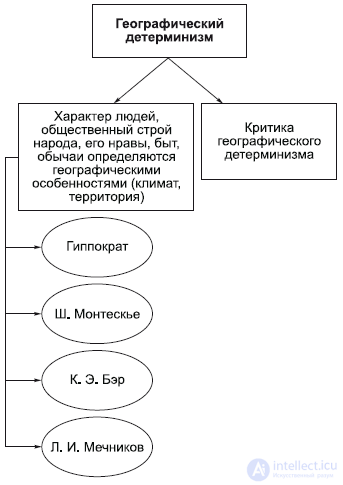
The natural, necessary preconditions for the existence of society are natural conditions (the geographical environment) and people, the population.
Since ancient times, views on society have put forward conceptions that ascribe a determining role in history to these natural preconditions. Even in antiquity the foundations were laid for a doctrine that later came to be called the geographical school in sociology (also known as geographical determinism). Thus Hippocrates (460–377 BCE) held that the character of peoples is determined by the peculiarities of climate.
The geographical school in sociology became especially widespread from the beginning of the sixteenth century. The age of great geographical discoveries, the development of capitalism, and the need for extensive use of natural resources for economic development — all of this stimulated interest in the geographical environment.
One of the major representatives of geographical determinism in the modern era was Montesquieu. In his book "The Spirit of the Laws" he argues that geographical factors — climate, soil, terrain, and so on — influence the customs and inclinations of peoples, and that a people's social order, way of life, and laws depend on them. The peoples of hot countries are timid, like old men, while the peoples of cold climates are bold, like youths. Where the climate is hot, the people give themselves over to laziness and indulgence. Fertile soil breeds indulgence and an unwillingness to risk one's life, and paralyzes energy. To make a people work, fear of punishment is necessary, which is why despotisms tend to arise more readily in the south than in the north. Barren soil, by contrast, favors freedom, since people living on it must obtain for themselves everything the soil denies them. The conditions of barren soil make people hardy, brave, and warlike, inclined to defend their freedom. The faintheartedness of the peoples of hot climates has almost always led them into slavery, whereas the courage of the peoples of cold climates has kept them in a state of freedom.
The geographical school was represented in our country as well. K. E. von Baer (1792–1876) maintained that the destiny of peoples is determined "in advance and inevitably by the nature of the locality they occupy." L. I. Mechnikov (1838–1888) sought to demonstrate that the geographical environment is the decisive force of historical progress, emphasizing in particular the special role of waterways. It should be noted that our scholars did not draw extreme conclusions from geographical determinism. Mechnikov, in particular, held that all people, regardless of where they live, are capable of creating cultural values.
The geographical school in sociology harbored within itself the possibility of concluding that races and peoples are unequal in worth, and that the subjugation of the peoples of hot countries is a natural consequence of climatic and natural conditions. This possibility was already noted by the French materialists of the eighteenth century. Helvétius therefore rejected geographical determinism.
The geographical school in sociology became one of the sources of the ideology of imperialism. Already in the works of F. Ratzel (1844–1904) it was maintained that a state can exist and develop independently only given a sufficiently large territory. The goal of politics is orientation toward the acquisition of territory. The conception of the geographical conditioning of politics later, under the name "geopolitics," became a doctrine of German imperialism, a claim to "living space," under the slogan "Drang nach Osten!" Drang nach Osten, pronounced: drang nach osten — literally means "Drive to the East".
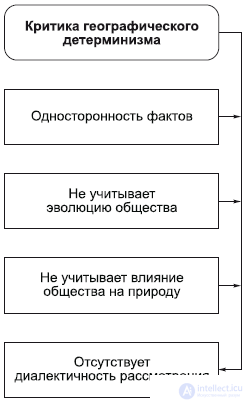
Geographical determinism as a whole has come under criticism. Its main shortcomings are seen as follows.
From what has been said above it follows that the problem of the role of the geographical environment for society requires deeper reflection than is offered by geographical determinism.
The geographical environment is and always will be one of the necessary conditions for the life of society as a whole, and for material production in particular. Society exists in unity with nature.
When representatives of the geographical school in sociology say that the main features of human life, the social order, and the development of culture depend on the geographical environment, there are certain grounds for such views. Indeed, the further back into the past we look, the more we see that people lived mainly in countries with a rich flora and fauna, a warm climate, and so on, while regions with a harsher climate and infertile soils were sparsely inhabited. But it is not enough to explain the development of humanity by the influence of the geographical environment alone. The point is that the relationship of humans to their environment has changed as society has developed.
At the early stages of society's development, people were highly dependent on natural sources of the means of life. In primitive society people assimilated the substances of nature, themselves creating practically nothing that did not already exist in nature. Later, as tools were improved, dependence on nature decreased. A process of transforming nature gets under way. The influence of the geographical environment is mediated by social conditions, above all by the level of development of production. The character of the influence of the natural environment on humans depends not so much on the specific features of that environment as on the level of development of material production. The same environment acts differently on society depending on the particular productive forces and relations of production that have formed within that society.
The components of the geographical environment change slowly under natural conditions. Their changes occur at a considerably faster rate as a result of human impact on them. History shows that these changes can be so great as to have a negative effect on people themselves. In changing their environment, people may at the same time change the conditions of their own existence.
The changes in nature that result from human activity are great and are constantly growing. Humanity keeps discovering new and ever more numerous possibilities for using the geographical environment for its own purposes. What has all this led to? The ecological balance has been disrupted. And it was no accident that, back in the nineteenth century, Marx wrote: "The conclusion is that culture, if it develops spontaneously and is not consciously directed... leaves a desert behind it"[17].
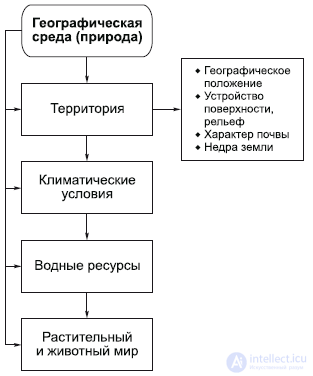
The geographical environment includes the following.
A. The territory inhabited by a given ethnic or sociopolitical entity. The concept of territory includes the following components:
1. Geographical position, that is, the distance of a locality from the poles and the equator, its location on one continent or another, on an island, and so on. A number of features of a given country (climate, flora, fauna, soil, and so on) depend in large part on its geographical position.
2. The configuration of the surface, the terrain. The degree of ruggedness of the terrain, the presence of mountain elevations and ranges, their direction and height, the presence of plains and lowlands, the type and character of the coastline (if the locality is on a sea coast) — all this characterizes the features of the terrain.
3. The character of the soil — marshy soils, podzolic soils, chernozems, sands, weathering crust, and so on.
4. The subsoil — the features of its geological structure, as well as its mineral wealth.
B. Climatic conditions. The quantity and quality of radiant energy received by a given territory from the sun, air temperature and its daily and seasonal course, air humidity, the quantity and character of atmospheric precipitation and its distribution across the seasons, the snow line and its height, the presence of permafrost in the soil, the degree of cloudiness and the number of cloudy days, the direction and strength of the winds, the typicality and recurrence of weather patterns, and so on — these are the basic elements of climate.
C. Water resources — seas, rivers, lakes, marshes, mineral and other springs, groundwater. For many aspects of human life the hydrographic regime of seas, rivers, and lakes is important: temperature, salinity, current, depths, freezing, the character of the bottom of seas and lakes, the direction and speed of river currents, the volume of water in them, the presence of rapids, the presence of waterfalls, water balance, depths, the quantity and quality of mineral springs, the depth at which they occur, the type of marshes, and so on.
D. Flora and fauna. This includes both the living organisms that permanently inhabit a given territory (all plants, most animals, many birds, most microorganisms) — in the soil, in the waters, on the land — and those that migrate periodically (some birds, fish, animals).
Sometimes the concept of the geographical environment also includes natural routes of communication.
Thus, by the geographical environment is meant the totality of geographical position, surface configuration, soil cover, mineral wealth, climate, water resources, and flora and fauna within a certain territory of the Earth on which a given human society lives and develops.
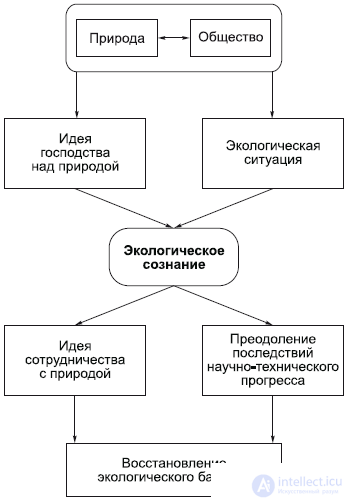
The problem of the interaction between society and nature is the subject matter of the ecological form of social consciousness. For a long time people gave little thought to the results of their impact on nature. Interest in studying nature intensified with the development of natural science during the Renaissance and at the beginning of the modern era. Francis Bacon held that knowledge of nature was necessary for the well-being of society. The conviction took shape that the goal of science was to know nature and to secure dominion over it. To be sure, Bacon made the important qualification that we can dominate nature only by obeying it. But this was somehow forgotten.
The idea of dominion over nature is one of the important ideas in the history of ecological consciousness. But it turned out that this idea essentially justified a predatory attitude toward nature. People sought to take as much as possible from nature, and no one heeded the calls to preserve it. The pursuit of profit at any price eventually led to the present ecological situation.
As a reaction to the situation that had developed, a new ecological way of thinking began to form in the second half of the twentieth century. It reflects the reality of the contemporary world, the results of the interaction between society and nature. In this new ecological thinking, themes are increasingly heard concerning the destructive consequences of scientific and technological progress, the disruption of ecological balance, the pollution of the environment, the growth of irreversible processes in nature, and the prospects for the degradation of humanity. There is a growing awareness of the need for the rational use of nature on a planetary scale. A conviction is taking shape that the preservation of nature and the restoration of ecological balance are values shared by all humanity. The creation of the noosphere (this very concept is today one of the basic concepts of the new ecological thinking) requires a global approach.
The contradiction between society and nature must be resolved not on the basis of human dominion over nature (if by dominion is meant the exploitation of natural riches for the sake of profit). Instead of "dominion" there should be "cooperation," in which favorable conditions exist both for the development of society and for the preservation and evolution of nature. Do the objective conditions for this exist today? Are people today ready for it?
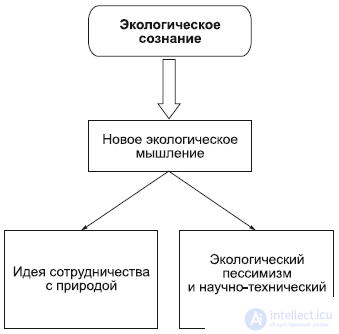
Today various options for assessing and resolving the ecological problem are proposed. Among them, ecological pessimism and scientific-technical optimism stand out. Proponents of the first (J. Forrester, D. Meadows, R. Heilbroner – in the USA) maintain that the development of society is becoming incompatible with the preservation of nature; a scenario is possible in which the surrounding natural environment is completely destroyed, resulting in the demise of humanity itself. What is to be done to avoid this scenario? Here are some proposals:
All these proposals proceed from the assumption that the complete restoration of ecological balance is already unattainable, and that one can speak only of a certain reduction in society's impact on nature.
Proponents of scientific-technical optimism (D. Bell, A. Toffler in the USA, B. de Jouvenel, J. Fourastié – in France, C. Freeman, D. Gabor – in Great Britain, and others) believe that all global problems, including ecological ones, are solvable with the help of scientific and technical progress. Among the ways of solving the ecological problem, the following are proposed.
The second natural, necessary precondition of society is people, the population.
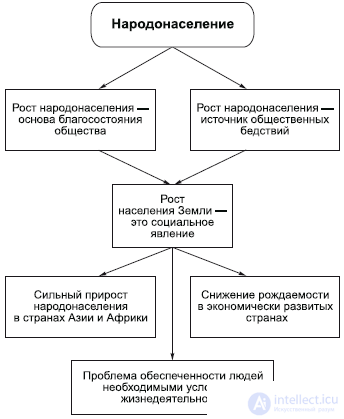
There exists a conception asserting that population growth is a factor determining the development of society. Within the framework of this conception, two variants have taken shape.
1. It is held that population growth is the basis of society's well-being. It is precisely population growth that forces people to seek new sources of subsistence, which stimulates the development of production. (This point of view was maintained, for example, by the English economist W. Petty in the seventeenth century, and in our country, in the nineteenth century, by M. M. Kovalevsky.)
2. Another conception asserts that population growth is a source of social calamities. In 1798, T. R. Malthus (1766–1834) published the book "An Essay on the Principle of Population." He believed that there supposedly exists a «great law of nature» – a constant tendency of all living creatures to multiply faster than is allowed by the supplies of food at their disposal. According to this «law,» the means of subsistence grow no faster than in arithmetic progression, whereas population, if it meets no obstacles, grows in geometric progression, doubling every generation – every 25 years.
Whereas Malthus in his own time spoke fairly cautiously about the possibility of overpopulation, the neo-Malthusians of the twentieth century regard overpopulation as an accomplished fact. The planet is «packed to the brim with people.» Asserting that there exists an absolute overpopulation on Earth, the Malthusians see in wars, epidemics, famine, and the like a means of improving people's lives. The neo-Malthusians say that the «population explosion» now occurring is dangerous, and that new extensive centers of famine will soon arise.
So there is a problem: how is population growth proceeding, and how does this growth affect society? Demographic studies that have been conducted show that the population is growing, but at different rates at different times, and clearly not in the progression that Malthus spoke of. On the whole, the rate of growth is accelerating.
The facts prove that population growth is not a «law of nature» but a social phenomenon, regulated by social factors. The facts are inconsistent with naturalistic views that suppose population growth to be determined by the biological laws of reproduction. Population growth cannot be regarded as an independent biological process proceeding independently of social conditions.
There exists an interrelationship between the size and growth of population and the development of society. The size and rate of population growth influence social life as a whole, but they are not the determining factor. A stronger influence on the structure and rate of population growth is exerted by social factors: material production, the culture of a given society, traditions, wars, revolutions, the state of public health, and measures aimed at encouraging or limiting the birth rate, and so on.
For a long time, population growth was, in essence, a spontaneous, unmanaged process. At present, however, attention to the population problem is intensifying; one can speak of the formation of a special form of social consciousness – demographic consciousness.
At the center of attention of demographic consciousness is the demographic problem: the prospects for providing people with the conditions necessary for their life activity, above all with food products. How do matters stand here?
Given the current state of agricultural technology and agronomic science, it is entirely possible, even on the agricultural land currently in use, to produce enough food not only for those living today but for approximately the same number of people again. And yet even now millions of people on Earth live on the brink of starvation and go hungry. The matter lies not in the objective possibilities of agriculture, but in social factors.
On the whole, there exist objective possibilities for fully providing the population with clothing, food, housing, and other vitally necessary factors. The demographic problem is solvable. But it must be emphasized that its solution must be combined with the solution of the ecological problem.

Comments